Matthew 2:2
Matthew 2:3
Matthew 2:4
Matthew 2:5
Matthew 2:6
Matthew 2:7
Matthew 2:8
Matthew 2:9
Matthew 2:10
Matthew 2:11
Matthew 2:12
Matthew 2:13
Matthew 2:14
Matthew 2:15
Matthew 2:16
Matthew 2:17
Matthew 2:18
Matthew 2:19
Matthew 2:20
Matthew 2:21
Matthew 2:22
Matthew 2:23
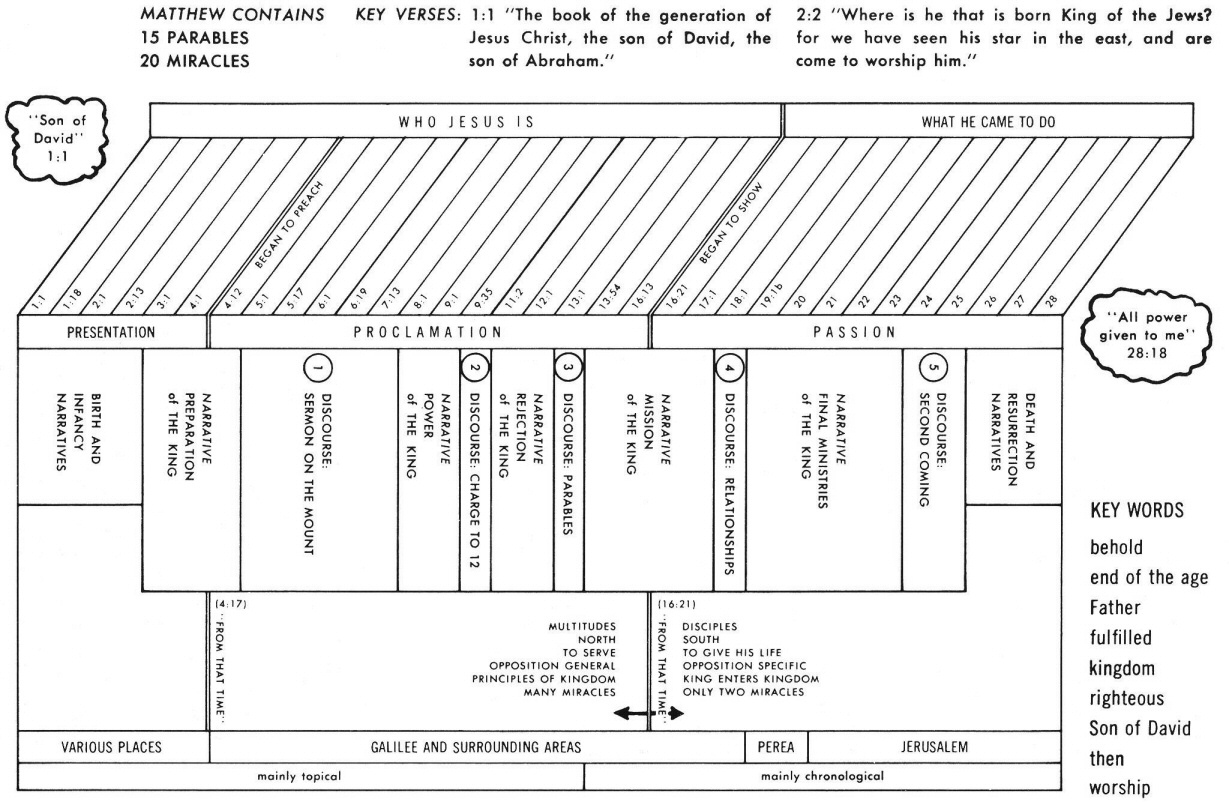
Click chart to enlarge
Charts from Jensen's Survey of the NT - used by permission
Another Chart from Charles Swindoll
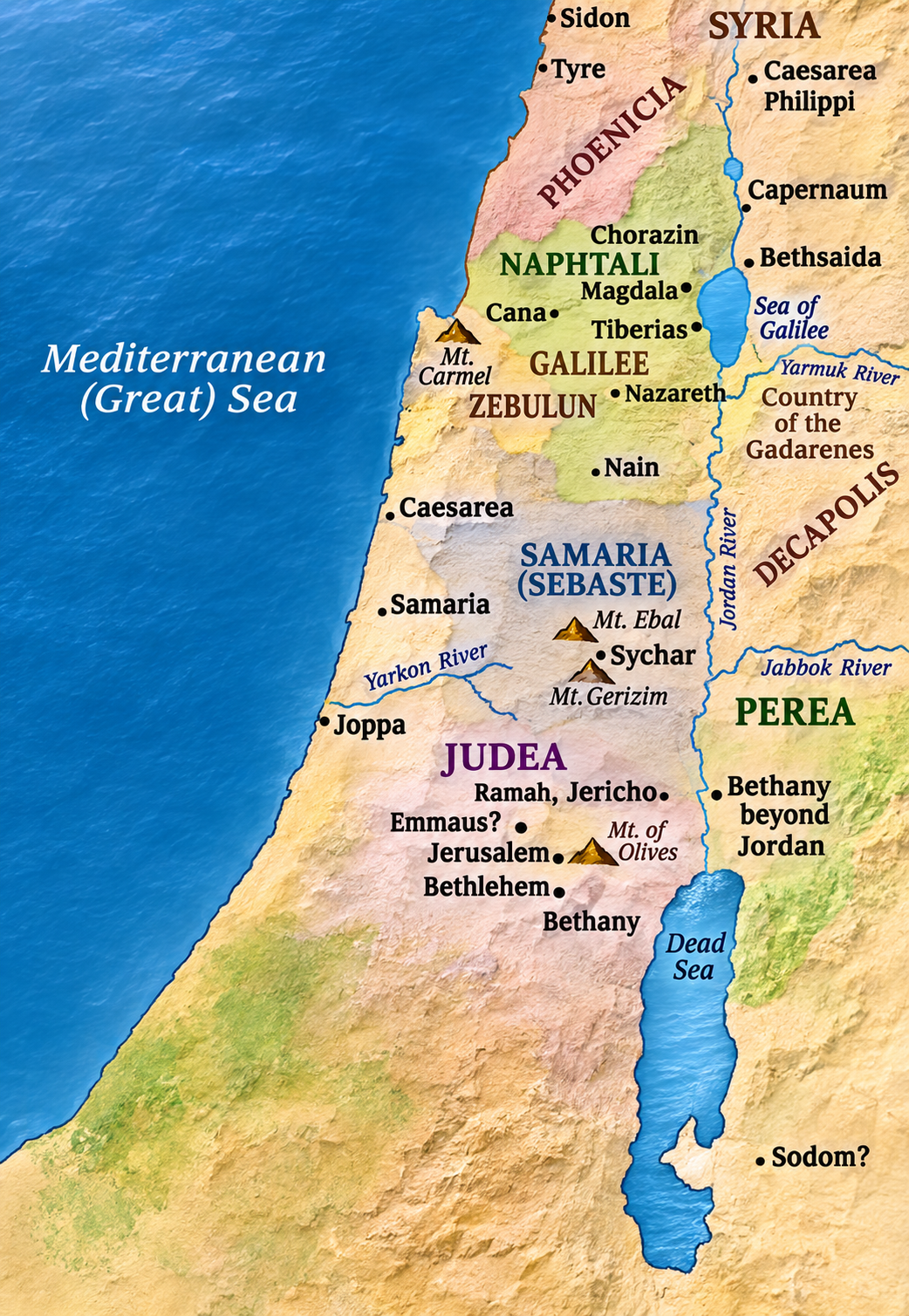
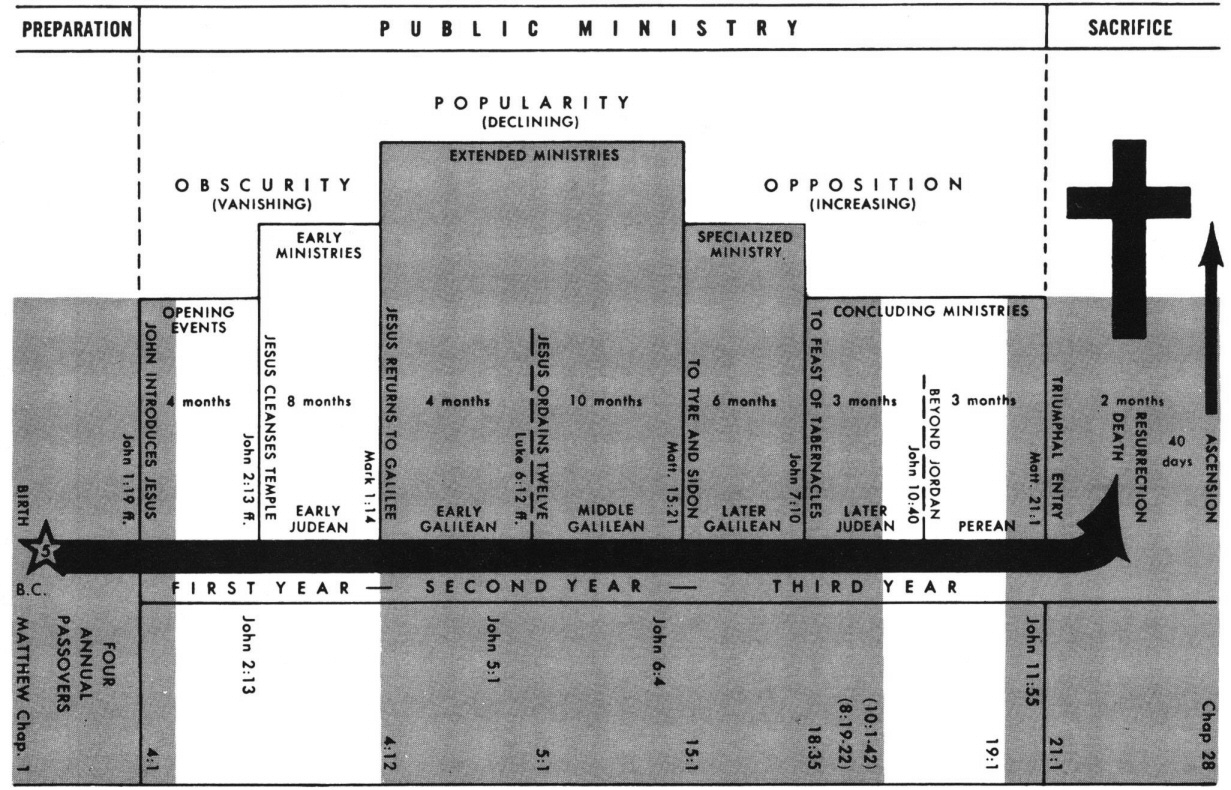
Click chart to enlarge
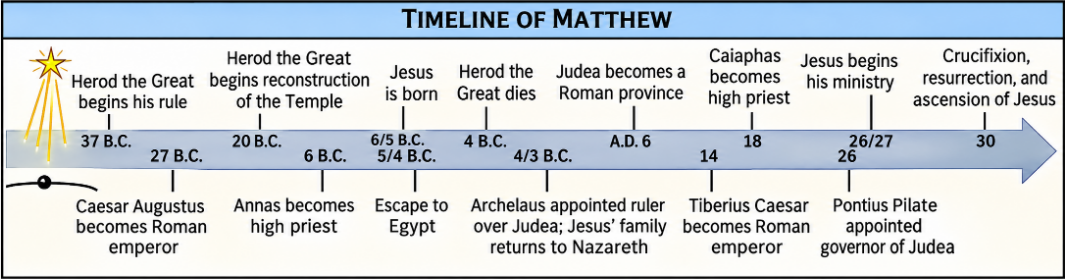
Source: Ryrie Study Bible
Matthew 2:1 Now after Jesus was born in Bethlehem of Judea in the days of Herod the king, magi from the east arrived in Jerusalem, saying,
NET After Jesus was born in Bethlehem in Judea, in the time of King Herod, wise men from the East came to Jerusalem
GNT Τοῦ δὲ Ἰησοῦ γεννηθέντος ἐν Βηθλέεμ τῆς Ἰουδαίας ἐν ἡμέραις Ἡρῴδου τοῦ βασιλέως, ἰδοὺ μάγοι ἀπὸ ἀνατολῶν παρεγένοντο εἰς Ἱεροσόλυμα
NLT Jesus was born in Bethlehem in Judea, during the reign of King Herod. About that time some wise men from eastern lands arrived in Jerusalem, asking,
KJV Now when Jesus was born in Bethlehem of Judaea in the days of Herod the king, behold, there came wise men from the east to Jerusalem,
ESV Now after Jesus was born in Bethlehem of Judea in the days of Herod the king, behold, wise men from the east came to Jerusalem,
NIV After Jesus was born in Bethlehem in Judea, during the time of King Herod, Magi from the east came to Jerusalem
- "Fourth year before the account called Anno Domini."
- Jesus - Mt 1:25 Lu 2:4-7
- Bethlehem of Judea - Mt 2:5 Mic 5:2 Lu 2:11,15 Joh 7:42
- Herod - Herod the Great. Mt 2:3,19 Ge 49:10 Da 9:24-25 Hag 2:6-9
- from - Ge 10:30 Ge 25:6 1Ki 4:30 Job 1:3 Ps 72:9-12 Isa 11:10 Isa 60:1-22
Related Passages:
Matthew 1:25 but kept her a virgin until (EXPRESION OF TIME) she gave birth to a Son; and he called His name Jesus.
Luke 2:4-7 Joseph also went up from Galilee, from the city of Nazareth, to Judea, to the city of David which is called Bethlehem, because he was of the house and family of David, 5in order to register along with Mary, who was engaged to him, and was with child. 6 While they were there, the days were completed for her to give birth. 7 And she gave birth to her firstborn son; and she wrapped Him in cloths, and laid Him in a manger, because there was no room for them in the inn.
Numbers 24:17 (BALAALM'S MESSIANIC PROPHECY OF A STAR) “I see Him, but not now; I behold Him, but not near; A star shall come forth from Jacob (FROM NATION OF ISRAEL), A scepter (SPEAKS OF A KING) shall rise from Israel, And shall crush through the forehead of Moab, And tear down all the sons of Sheth.
Micah 5:2 (THE PLACE OF HIS BIRTH PREDICTED) “But as for you, Bethlehem Ephrathah, Too little to be among the clans of Judah, From you One will go forth for Me to be ruler in Israel. His goings forth are from long ago, From the days of eternity.”
Luke 2:11; 15 for today in the city of David there has been born for you a Savior, who is Christ the Lord. (2:15) When the angels had gone away from them into heaven, the shepherds began saying to one another, “Let us go straight to Bethlehem then, and see this thing that has happened which the Lord has made known to us.”
John 7:42 “Has not the Scripture said that the Christ comes from the descendants of David, and from Bethlehem, the village where David was?”
Genesis 49:10 “The scepter shall not depart from Judah, Nor the ruler’s staff from between his feet, Until Shiloh comes, And to him shall be the obedience of the peoples.
Daniel 9:24-25 (THE TIME OF HIS BIRTH PREDICTED) “Seventy weeks have been decreed for your people and your holy city, to finish the transgression, to make an end of sin, to make atonement for iniquity, to bring in everlasting righteousness, to seal up vision and prophecy and to anoint the most holy place. 25“So you are to know and discern that from the issuing of a decree to restore and rebuild Jerusalem until Messiah the Prince there will be seven weeks and sixty-two weeks; it will be built again, with plaza and moat, even in times of distress.
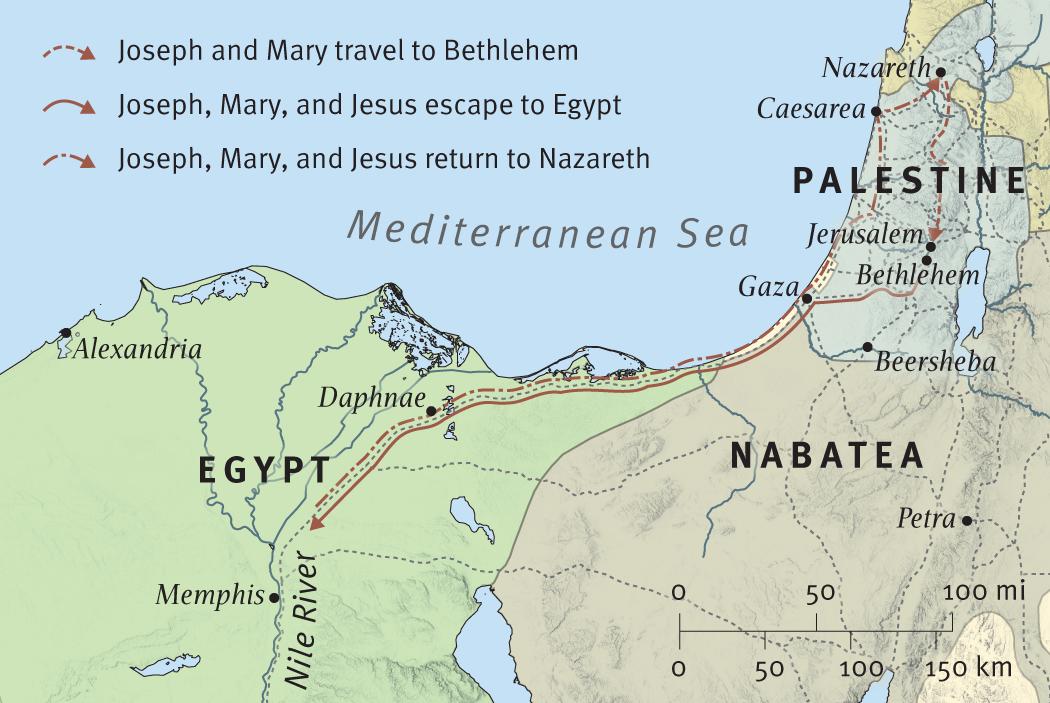
Jesus' Birth & Flight to Egypt
(ESV Global Study Bible)
WISE MEN STILL
SEEK MESSIAH
Then and now the truly wise man or woman seeks for Jesus of Nazareth, the Savior of the World.
D A Carson notes that "Few passages have received more diverse interpretations than this one (Mt 2:1-12)...During the last hundred years or so, such diversity has sometimes sprung from a reluctance to accept either the supernatural details or the entire story as historically true."
Now after Jesus was born in Bethlehem of Judea - Note the expression of time after. The question is how long after Jesus was born? If we compare Matthew 2:1 with Matthew 2:7 and Matthew 2:16 this suggests that that the wise men evidently arrived sometime within the first two years after the birth of Jesus. Why else would Herod kill all the male infants two years or younger? See additional support for this interpretation in notes on Matthew 2:11 where the wise men came to "the house" versus Lk 2:16 "the baby...lay in the manger." Two distinct locations support a definite time gap. If this approximation of the birth of Jesus is accurate, it means the familiar nativity scene with the Magi at the manger, alongside the shepherds, does not match the biblical account.
Luke gives us more details of the birth of Jesus (keeping in mind that this account in Matthew may be up to 2 years after the actual birth event - see below)
Joseph also went up from Galilee, from the city of Nazareth, to Judea, to the city of David which is called Bethlehem, because he was of the house and family of David, 5 in order to register along with Mary, who was engaged to him, and was with child. 6 While they were there, the days were completed for her to give birth. 7 And she gave birth to her firstborn son; and she wrapped Him in cloths, and laid Him in a manger, because there was no room for them in the inn. (Lu 2:4-7)
A T Robertson - Matthew does not propose to give biographic details of the supernatural birth of Jesus, wonderful as it was and disbelieved as it is by some today who actually deny that Jesus was born at all or ever lived, men who talk of the Jesus Myth, the Christ Myth, etc. “The main purpose is to show the reception given by the world to the new-born Messianic King. Homage from afar, hostility at home; foreshadowing the fortunes of the new faith: reception by the Gentiles, rejection by the Jews” (Bruce). (Word Pictures in the New Testament)
Robertson on Bethlehem - There was a Bethlehem in Galilee seven miles northwest of Nazareth (Josephus, Antiquities XIX. 15). This Bethlehem (house of bread, the name means) of Judah was the scene of Ruth’s life with Boaz (Ruth 1:1f.; Matt. 1:5) and the home of David, descendant of Ruth and ancestor of Jesus (Matt. 1:5). David was born here and anointed king by Samuel (1 Sam. 17:12). The town came to be called the city of David (Luke 2:11). Jesus, who was born in this House of Bread called himself the Bread of Life (John 6:35), the true Manna from heaven. Matthew assumes the knowledge of the details of the birth of Jesus in Bethlehem which are given in Luke 2:1–7 or did not consider them germane to his purpose. Joseph and Mary went to Bethlehem from Nazareth because it was the original family home for both of them. The first enrollment by the Emperor Augustus as the papyri show was by families (κατʼ οἰκιαν [kat’ oikian]). Possibly Joseph had delayed the journey for some reason till now it approached the time for the birth of the child.
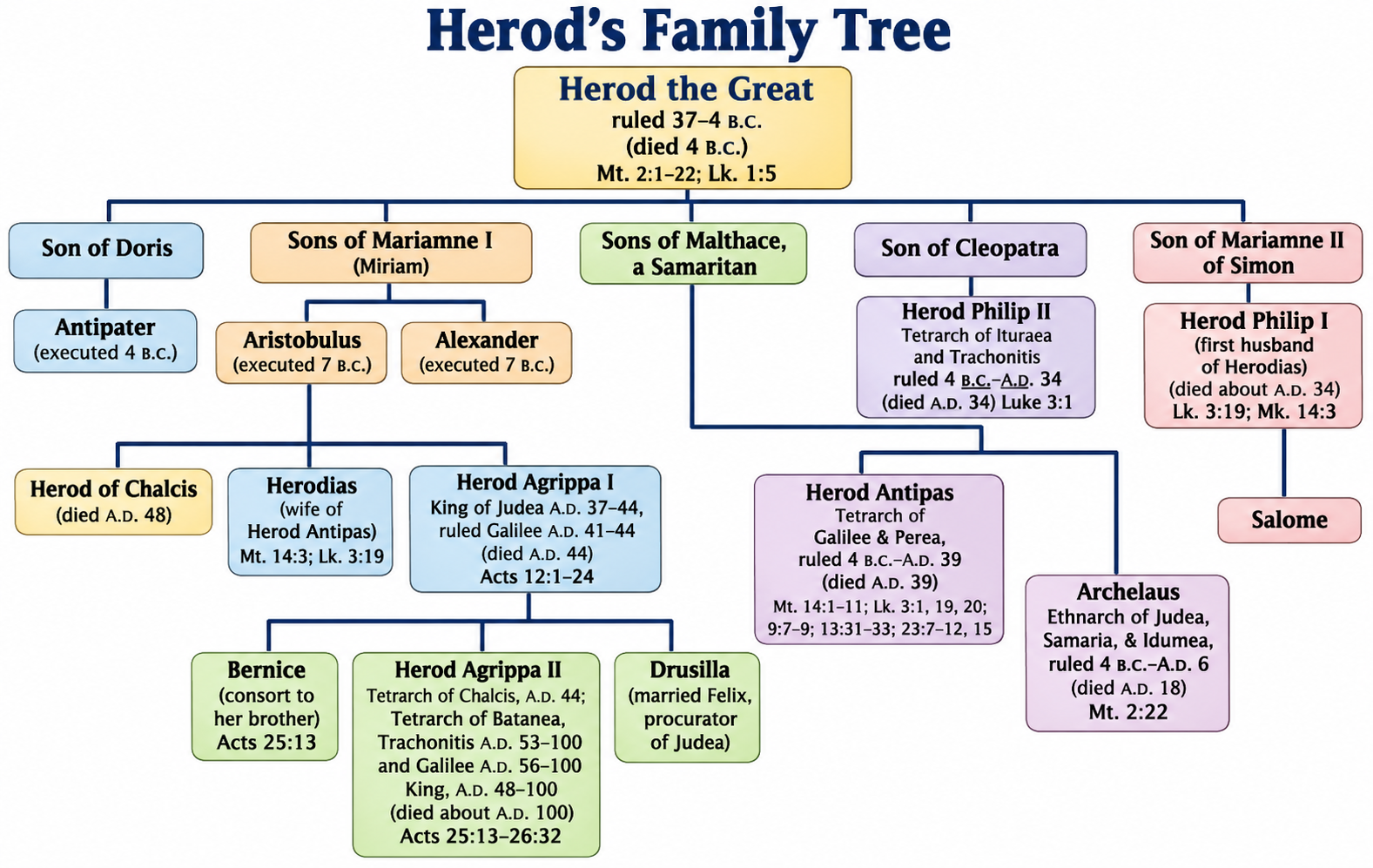
In the days of Herod the king (basileus) - Note Matthew calls him "king" to immediately set up the conflict with Jesus Who the Magi called "King of the Jews." The Herod mentioned here (Mt 2:1, 3, 7, 12, 13, 16, 19, 22) and Lk 1:5 is known to history as Herod the Great, (see diagram above) because of all the great works of building he accomplished, but in reality he was "Herod the Paranoid!" He ruled Palestine from 37 B.C. until he died in 4 B.C. His family was nominally Jewish but actually Idumaean (Edomite, Ge 36:1). He was known for his extensive building projects (including the temple in Jerusalem) and for his cruelty. (See Herod’s Temple in the Time of Jesus and Temple Complex in the Time of Jesus). The Romans had appointed his grandfather, Antipas (died 78 B.C.) governor of Idumaea, and Julius Caesar had made his father, Antipater, procurator of Judea (47 - 43 B.C.). The Roman triumvir, Mark Antony, appointed Herod the Great tetrarch of Galilee in 37 B.C. He greatly increased the splendor of Jerusalem, erecting the Temple, which was the center of Jewish worship in the time of our Lord.
Robertson on in the days of Herod - This is the only date for the birth of Christ given by Matthew. Luke gives a more precise date in his Gospel (2:1–3), the time of the first enrollment by Augustus and while Cyrenius was ruler of Syria. More will be said of Luke’s date when we come to his Gospel. We know from Matthew that Jesus was born while Herod was king, the Herod sometimes called Herod the Great. Josephus makes it plain that Herod died B.C. 4. He was first Governor of Galilee, but had been king of Judaea since B.C. 40 (by Antony and Octavius). I call him “Herod the Great Pervert” in Some Minor Characters in the New Testament. He was great in sin and in cruelty and had won the favour of the Emperor. The story in Josephus is a tragedy. It is not made plain by Matthew how long before the death of Herod Jesus was born. Our traditional date A.D. 1, is certainly wrong as Matthew shows. It seems plain that the birth of Jesus cannot be put later than B.C. 5. The data supplied by Luke probably call for B.C. 6 or 7. (Word Pictures in the New Testament)
D A Carson - Traditionally some have argued that Herod died in 4 B.C.; so Jesus must have been born before that. Josephus (Antiq. XVII, 167[vi.4]) mentions an eclipse of the moon shortly before Herod's death, and this has normally been identified as having occurred on 12-13 March 4 B.C. After Herod's death there was a Passover celebration (Jos. Wars II, 10[i.3]; Antiq. XVII, 213[ix.3]), presumably 11 April4 B.C.; so the date of his death at first glance seems secure. (Expositor's Bible Commentary page 104) (SEE also Chronological Aspects of the Life of Christ : Harold W. Hoehner)
Arnold Fruchtenbaum on Herod the Great - He was a very clever, ruthless ruler who was constantly on the watch for insurrection and intrigue. His life reads like the worst kind of soap opera of villainy and murder. He became so evil that he killed three or possibly four of his sons, and his favorite wife Miriamne. He had ten wives, and offspring who were constantly conspiring against each other. He was so paranoid that he built incredibly elaborate fortresses in a planned escape route in a line towards Egypt, which included Masada (which he fortified in the 30’s B.C.). He was an Idumean, a race forcibly converted to Judaism earlier in history, and while he practiced Judaism (not eating pork) he was not ethnically Jewish. This is one reason the Jewish people hated him.
Bruce Barton on Herod the Great (what a sad misuse of the word "great"!) - Herod had expanded and beautified the Jerusalem temple, but he had placed a Roman eagle (picture) over the entrance and also had built pagan temples. When he helped the Jews, it was for political purposes and not because he cared about them or their God. Evil and ruthless, Herod the Great later ordered a massacre of infants (Mt 1:16-18) in a futile attempt to kill the infant Jesus, whom some were calling the new "king of the Jews" (Mt 2:1-2). Herod the Great ruled from 37 to 4 b.c. (See Life Application New Testament Commentary - Page 241)
(KJV - Behold) Magi (magos) from the east (anatole) arrived in Jerusalem - Thinking that the King of the Jews would be born in the royal palace, they went to Herod. From the east is the picture "from the rising of the sun" in this case to the east of Israel, the "orient", the direction east; the part of the horizon where the sun first appears. I see a slight play on words here for men coming from the rising sun were coming to see the newborn Son! Fruchtenbaum adds that " In the Bible the east is always the area of Mesopotamia, so there are at least two astrologers from Babylonia." Luke makes no mention of the magi. Notice first that they are magi or wise men, not kings.
D A Carson points out that "Matthew does not say that the rising star the Magi had seen led them to Jerusalem. They went first to the capital city because they thought it the natural place for the King of the Jews to be born."
The magi had in some way (NOT SPECIFIED) been made aware of this divine birth and had come seeking the KING OF THE JEWS. Notice also that in Mt 2:2 they asked "Where is He who has been born King of the Jews?" but Herod did not know as we see in Mt 2:4 for he himself gathered "together all the chief priests and scribes of the people, he inquired of them where the Messiah was to be born." Apparently, the magi were ignorant of the prophecy in Micah 5:2 as was Herod. Fruchtenbaum agrees noting that "The Magi come to Jerusalem, since they did not have the book of Micah which predicts where Messiah was to be born (Micah 5:2). They would have assumed that the Messiah would be born in the capital of Israel, Jerusalem." So how did the magi find their way to the King of the Jews? Mt 2:10-11 tell us "they saw the star (HIS STAR)...and they came into the house and saw the Child."
Magi (magos) from the east (anatole) - These sages probably originated in Media. Herodotus identified the Magi as one of the tribes of the Medes, who served as their priestly class (Herodotus I, 101). They came to be known throughout Mesopotamia as a group of wise men, counselors, and astrologers, and were sometimes called “Chaldeans” in Babylonian literature (cf. Dan 2:2-13). The ones in this text were possibly Zoroastrians from Persia, who may have learned of the coming King of the Jews through the Jewish community that remained in the East, perhaps from the influence of Daniel, who had been appointed chief over the wise men of Babylon (Dan 2:48). We do not know how many came; the tradition of “three wise men” comes from the three gifts they brought to the toddler Jesus. It is striking that Matthew, writing to Jews, included the story of the Gentile wise men from the East, while Luke, writing to Gentiles, included the story of the humble Jewish shepherds. From the beginning, Jesus came for both Jew and Gentile (Mt 8:11; 28:19).
J Vernon McGee - These wise men who came from the East evidently came from different areas. They had been studying the stars, and when this new star appeared, they joined forces and came to Jerusalem. I don't know how many there were, but I'm almost sure it wasn't three, and I believe three hundred would be more nearly true. But, please, don't say that I said there were three hundred!....If they had seen His star in the east and it had been an eastern star, the wise men would have ended up in India or China. The star was in the west! The wise men were in the east. The star was in the west, and they followed it. They came west, not east. My question is this: How in the world did they associate a star with a king, and how did they identify it with Israel? All I know is that in that section of the East, the people had a prophecy given by Balaam, which is recorded in Numbers 24:17. (Remember that old Balaam gave this prophecy concerning the nation Israel.) (SEE Thru the Bible: The Gospels Matthew 1-13)
Warren Wiersbe seems to agree with McGee - We do not know how many magi there were. From the three gifts listed in Matthew 2:11, some people have assumed there were three kings from the Orient, though this is not certain. But when their caravan arrived in Jerusalem, there were enough of them to trouble the whole city. (Bible Exposition Commentary)
J C Ryle speaks of the cost of the magi to seek Jesus - The conduct of the wise men described in this chapter is a splendid example of spiritual diligence. What trouble it must have cost them to travel from their homes to the house where Jesus was born! How many weary miles they must have journeyed! The fatigues of an Eastern traveller are far greater than we in England can at all understand. The time that such a journey would occupy must necessarily have been very great. The dangers to be encountered were neither few nor small. But none of these things moved them. They had set their hearts on seeing Him “that was born King of the Jews;” and they never rested till they saw Him. They prove to us the truth of the old saying, “Where there is a will there is a way.” It would be well for all professing Christians if they were more ready to follow the wise men’s example. Where is our self-denial? What pains do we take about our souls? What diligence do we show about following Christ? What does our religion cost us? These are serious questions. They deserve serious consideration. (Matthew 2 Commentary)
Many writers seek to locate where the magi were from and how many there were, but the Bible is silent on both accounts. The beautiful worshipful hymn We Three Kings of Orient has led many to believe there were 3 magi, but that is not absolutely certain. They probably base this presumption on the fact that Matthew mentions 3 gifts. Here is what we can say with certainty -- There were at least two because the word magi is in the plural, but this may have been two or two thousand for the Bible does not say. They were men. The were directed. They came. They acknowledged. They worshipped. And this is what every "wise" man (and woman) should do while today is still called today (cf Jn 9:4, 2Co 6:2, Acts 16:30,31).
John MacArthur adds that the magi "were well-versed in astronomy and astrology, agriculture, mathematics, and history. They were involved in various occult practices and were famous for their ability to interpret dreams (cf. Da. 2:1ff.). Such was their political power and influence that no Persian ruler came to power without their approval....(and in his note on the use in Matthew adds) The magi from the east (the word literally means “from the rising” of the sun, and refers to the orient) who came to see Jesus were of a completely different sort. Not only were they true magi, but they surely had been strongly influenced by Judaism, quite possibly even by some of the prophetic writings, especially that of Daniel. They appear to be among the many God-fearing Gentiles who lived at the time of Christ, a number of whom—such as Cornelius and Lydia (Acts 10:1–2; Acts 16:14)—are mentioned in the New Testament. (For more on magi sermon Matthew 2:1: Who Were the Wise Men?)
Louis A. Barbieri has an interesting note - Though not all scholars agree on the timing of the arrival of the Magi from the East, they apparently came some time after the birth of Jesus. Jesus and Mary and Joseph, though still in Bethlehem, were now in a house (Mt 2:11), and Jesus was called a Child (paidion, Mt 2:9, 11) rather than a newborn Infant (brephos, Luke 2:12). The exact identity of the Magi is impossible to determine, though several ideas have been suggested. They have been given traditional names and identified as representatives of the three groups of peoples that descended from Noah's sons, Shem, Ham, and Japheth. More likely they were Gentiles of high position from a country, perhaps Parthia, northeast of Babylon, who were given a special revelation by God of the birth of the King of the Jews. This special revelation may simply have been in the sky, as might be indicated by their title "Magi" (specialists in astronomy) and by the fact they referred to a star which they saw. Or this revelation could have come through some contact with Jewish scholars who had migrated to the East with copies of Old Testament manuscripts. Many feel the Magi's comments reflected a knowledge of Balaam's prophecy concerning the "star" that would "come out of Jacob" (Num. 24:17). (See Bible Knowledge Commentary - Page 20)
It is easy to be confused about the chronology
of the events surrounding Christ's birth.
William MacDonald adds "It is easy to be confused about the chronology of the events surrounding Christ's birth. While verse 1 may appear to indicate that Herod tried to kill Jesus during Mary and Joseph's stay in the stable at Bethlehem, the combined evidence points to a time one or two years later. Matthew says in verse 11 that the wise men saw Jesus in a house. The order by Herod to execute all male children under two years old (Mt 2:16) also is an indication of the passage of an unspecified period of time since the royal birth. (See Believer's Bible Commentary: Second Edition - Page 1115)
Dionysius Exiguus introduced the Anno Domini dating system in AD 525 but his calculation placed Christ's birth several years too late, although precisely how he arrived at his date remains uncertain. Jesus was likely born several years before the calendar date we call AD 1!
J C Ryle on the magi - Whether they were Chaldeans or Arabians we cannot say. Whether they learned to expect Christ from the ten tribes who went into captivity, or from the prophecies of Daniel, we do not know. These verses show us, that there may be true servants of God in places where we should not expect to find them. The Lord Jesus has many “hidden ones” like these wise men. Their history on earth may be as little known as that of Melchizedek, and Jethro, and Job. But their names are in the book of life, and they will be found with Christ in the day of His appearing. (Matthew 2 Commentary)
🙏 THOUGHT - The wise men (Magi) were scientists, yet they saw no conflict between science and Scripture or between searching for truth and worshiping the Savior. Devout Christians can worship the Lord with the mind as well as the heart (Matt. 22:37). “Science without religion is lame,” said Albert Einstein. “Religion without science is blind.” (Wiersbe)
Guzik - There was a general expectation of a Messiah or great man from Judea. Not very long after Jesus was born, the Roman historian Seutonius wrote: “There had spread over all the Orient an old and established belief, that it was fated at that time for men coming from Judea to rule the world.” Tacitus, another Roman historian of the general period, wrote: “There was a firm persuasion … that at this very time the East was to grow powerful, and rulers coming from Judea were to acquire universal empire.” (Cited in Barclay) (Matthew 2 Commentary)
BEHOLD - The NASB and NET both omit the important demonstrative particle (idou) which means “Lo and behold!”, serving to call attention to something external or exterior to oneself. Behold (2400) is the second person singular aorist middle imperative of eidon which means to see, perceive, look at. In the NT idou is used as a demonstrative particle that draws attention to what follows. Idou in the middle voice means "you yourself look, see, perceive!" The aorist imperative is a command emphasizing "Do it now! Don't delay!" In 2Cor 5:17 Paul uses idou, to get his reader's attention as he introduces the truth that the one who in now in Christ is a qualitatively new person. (see also notes above on "behold")
Spurgeon reminds us that "Behold is a word of wonder; it is intended to excite admiration. Wherever you see it hung out in Scripture, it is like an ancient sign-board, signifying that there are rich wares within, or like the hands which solid readers have observed in the margin of the older Puritanic books, drawing attention to something particularly worthy of observation." I would add, behold is like a divine highlighter, a divine underlining of an especially striking or important text. It says in effect "Listen up, all ye who would be wise in the ways of Jehovah!" Behold is used by Matthew 62 times.
Magi (wise men)(3097)(magos) is derived from the Persian word magus meaning "great" (thus "great, powerful men") and in the plural ("magi") as in Mt 2:1, 7, 16, magi referred to the high priestly caste Persians (also Medes and Babylonians) who are affectionately called the "wise men." The other sense of magos is that of a magician or sorcerer, one who used magic crafts or "witchcraft." We know that the magi were not kings because this specific title means “wisemen” or more specifically, “astrologers.” BDAG adds that magos referred to "a Persian and then also Babylonian wise man and priest, who was expert in astrology, interpretation of dreams and various other occult arts (Herodutus, Josephus 20.142). The Septuagint uses magos in Daniel 2:2 when King Nebuchadnezzar desired to know the meaning of his dream and called "the magicians (epaoidos - one that uses charms or incantations), the conjurers (magos), the sorcerers (pharmakos)." Matt. 2:1; Matt. 2:7; Matt. 2:16; Acts 13:6; Acts 13:8
The Greek word magos (Mt 2:1, 7, 16) appears in the Greek translations (Septuagint Theodotion's version) of Daniel to describe the court wise men of Babylon. It translates the Hebrew and Aramaic word ʾaššāp (0825, 0826), usually rendered “conjurer” or “enchanter” in English Bibles. For example, when Nebuchadnezzar demanded that his wise men tell him his dream, magoi were among them (Da 2:2). The word recurs in the same setting in Daniel 2:10. Outside Daniel, the Septuagint does not use the word. Pharaoh’s “magicians” in Exodus are called epaoidoi, “enchanters” (Ex 7:11), not magoi. The Hebrew title “Rab-mag,” borne by a Babylonian official at the fall of Jerusalem (Jer 39:3, 13), was once thought to mean “chief of the magi,” but most scholars now derive it from an Akkadian title for a high court official.
The use of magos in Daniel is significant for Matthew 2. Daniel himself was placed over this very group (Da 2:48 = "chief prefect over all the wise men of Babylon." Da 5:11 confirms Daniel had been appointed by Nebuchadnezzar "chief of the magicians, conjurers, Chaldeans and diviners."). Daniel, then, a Jewish prophet, was head over the magoi of Babylon and his position over the wise men could have provided an opportunity to communicate the prophetic revelation God had given him, including the coming of Messiah (especially Da 7:13,14 = "to Him [Son of Man] was given dominion, Glory and a kingdom"; Da 9:24-26 states "until Messiah the Prince there will be seven weeks and sixty-two weeks" which gives the timing of Jesus' first coming). Some commentators suggest that this may help explain why Eastern magi centuries later were looking for the King of the Jews (Matthew 2:1, 2). It is also notable that they did not know the place of birth because they would not have had access to Micah's prophecy and Daniel never told were Messiah would be born.
These prophecies from Daniel explain why many interpreters suggest that the magi of Matthew 2 learned of the coming King of the Jews through Daniel’s writings and specifically called Him "the King of the Jews!"
East (395)(anatole from anatello = to rise - ana = up, again + tello = to make to rise) means rising (as of a star or the sun). In some context anatole refers to the rising of the sun or "breaking of the dawn" which means East or Orient (used with this meaning especially in the Lxx - Ge 2:8, Ge 10:30, Ge 11:2, Ge 12:8; used of the Magi from the east who saw the star in the east - Mt 2:1, 2, 9, those who come into God's kingdom will be from "east and west" = Mt 8:11, Lk 13:29, "lightning comes from the east" = Mt 24:27). Here Luke is using anatole to refer to the coming of Christ. John uses anatole to describe the "angel ascending from the rising of the sun." (Rev 7:2), to describe "kings from the east" as they assemble at Armageddon (Rev 16:12), and lastly to describe the "three gates on the east" of the holy city of Jerusalem that will come down out of heaven from God (Rev 21:13). Anatole - east(7), east*(1), rising(1), Sunrise(1). 10v - Matt. 2:1; Matt. 2:2; Matt. 2:9; Matt. 8:11; Matt. 24:27; Lk. 1:78; Lk. 13:29; Rev. 7:2; Rev. 16:12; Rev. 21:13
Related Resources:
QUESTION - What year was Jesus Christ born? - GotQuestions.org
ANSWER - The Bible does not provide the exact day or even the exact year in which Jesus was born in Bethlehem. But a close examination of the chronological details of history narrows the possibilities to a reasonable window of time.
The biblical details of Jesus’ birth are found in the Gospels. Matthew 2:1 states that Jesus was born during the days of Herod the king. Since Herod died in 4 B.C., we have a parameter to work with. Further, after Joseph and Mary fled Bethlehem with Jesus, Herod ordered all the boys 2 years old and younger in that vicinity killed. This indicates that Jesus could have been as old as 2 before Herod’s death. This places the date of His birth between 6 and 4 B.C.
Luke 2:1-2 notes several other facts to ponder: “In those days a decree went out from Caesar Augustus that all the world should be registered. This was the first registration when Quirinius was governor of Syria.” We know that Caesar Augustus reigned from 27 B.C. to A.D. 14.
Quirinius governed Syria during this same time period, with records of a census that included Judea in approximately 6 B.C. Some scholars debate whether this is the census mentioned by Luke, but it does appear to be the same event. Based on these historical details, the most likely time of Christ’s birth in Bethlehem is 6-5 B.C.
Luke mentions another detail concerning our timeline: “Jesus, when he began his ministry, was about thirty years of age” (Luke 3:23). Jesus began His ministry during the time John the Baptist ministered in the wilderness, and John’s ministry started “in the fifteenth year of the reign of Tiberius Caesar, Pontius Pilate being governor of Judea, and Herod being tetrarch of Galilee, and his brother Philip tetrarch of the region of Ituraea and Trachonitis, and Lysanias tetrarch of Abilene, during the high priesthood of Annas and Caiaphas” (Luke 3:1-2).
The only time period that fits all of these facts is A.D. 27-29. If Jesus was “about thirty years of age” by A.D. 27, a birth sometime between 6 and 4 B.C. would fit the chronology. More specifically, Jesus would have been approximately 32 years old at the time He began His ministry (still “about thirty years of age”).
What about the day of Christ’s birth? The tradition of December 25 was developed long after the New Testament period. It’s the day Christians have agreed to celebrate the birth of Jesus, but the exact day of His birth is unknown.
Jesus was born in Bethlehem of Judea
approximately 6-4 B.C.
What is known is that biblical and historical details point to an approximate year of birth. Jesus was born in Bethlehem of Judea approximately 6-4 B.C. to Mary, His mother. His birth changed history forever, along with the lives of countless people around the world.
QUESTION - Where was Jesus born? - GotQuestions.org
ANSWER - The Bible chronicles Jesus Christ’s birth in Matthew 1:18–25; 2:1–12; Luke 1:26–38; and Luke 2:1–20. At the time of Mary’s pregnancy, a decree by Caesar Augustus went out that “all the world should be registered” (Luke 2:1). This meant that every person in the Roman Territory was required to return to the city of their ancestors to be counted in a census.
Joseph lived in Nazareth at the time but needed to travel south to the region of Judea, “to the city of David, which is called Bethlehem, because he was of the house and lineage of David” (Luke 2:4). Naturally, Joseph took his betrothed, Mary, to go with him to be counted as a member of his family. Thus, the young couple ended up in the small town of Bethlehem at the time of Jesus’ birth.
This location aligns with the prophecy foretold by Micah, proclaiming that the Christ would be born in Bethlehem: “But you, Bethlehem Ephrathah, though you are small among the clans of Judah, out of you will come for me one who will be ruler over Israel, whose origins are from of old, from ancient times” (Micah 5:2).
Because so many had returned to Bethlehem for the census, the small city was overflowing with people. There was no room for Mary and Joseph in the inn, which forced them to take refuge in the only place available—a shelter for animals. (Although the Bible never mentions animals being present at the birth of Christ, Luke does say that the baby Jesus was laid in a manger—and the presence of a manger strongly implies the presence of animals.)
Traditionally, the “inn” referred to in Luke 2:7 is thought to be a kind of commercial hotel. And the place where Mary and Joseph took shelter was a stable somewhere in the vicinity. However, we don’t know for sure if that was the case, because the Greek word translated as “inn” (kataluma) can also be translated as “guest room.” This translation would lead us to envision more of a private home filled with guests, plus a separate area used to house the family’s animals.
Sometimes the place for animals was located on the lower level of a house, away from where the people lived. So, when Luke refers to “no room in the kataluma,” he could have meant there was no room on the upper level, which was already full of sleeping visitors or family. Archaeological findings have also revealed homes that merely had a wall separating the front of the house from the back, where animals were kept safe. Both of these floor plans imply an indoor animal shelter connected to the house in some way. Regardless, there was a manger or feeding trough in the place where Christ was born, and that was used as a resting place for the newborn Jesus, as stated in Luke 2:7.
There is also a theory that the shelter in which Jesus was born was a place near Bethlehem called Migdol Eder ("Tower of the Flock"). This was a watchtower used by shepherds. According to some theories, the tower would have had a place underneath used during the lambing season to shelter the newborn lambs. Other theories speculate that those lambs were designated to be sacrifices in the Jerusalem temple. The prophet Micah, who foretold Bethlehem as the place of the Messiah’s birth, mentions Migdol Eder: “As for you, watchtower of the flock [Hebrew, Migdol Eder], stronghold of Daughter Zion, the former dominion will be restored to you; kingship will come to Daughter Jerusalem” (Micah 4:8). The Tower of the Flock theory is used to explain why, when the heralding angels gave the sign that the baby would be “wrapped in cloths and lying in a manger,” the shepherds seemed to know exactly where to look. And it would be apropos for the Messiah to be born in the same place where the sacrificial lambs were born. There is no consensus among commentators, however, that Micah's reference to Migdol Eder is meant to identify an actual tower near Bethlehem.
Whether the actual location of Jesus’ birth was an indoor animal shelter, a separate barn, or a tower used for lambing, the Bible is clear that Jesus Christ, the Son of God, was born in a humble setting in the town of Bethlehem.
QUESTION - Why was Jesus born in a manger? - GotQuestions.org - WATCH VIDEO
ANSWER - It is a common saying at Christmastime that Jesus Christ was “born in a manger.” Of course, it wasn’t possible for Him to actually be born in the manger, but that’s where Mary laid Him after His birth (Luke 2:7). Although we are not sure of the exact location of where Jesus was born, we do know that it was near Bethlehem and that there was a manger, or feeding trough, there.
God promised the Savior’s virgin birth immediately after mankind’s first sin in the Garden of Eden (Genesis 3:15). Hundreds of years later, the prophet Micah foretold the birth of Christ in the small town of Bethlehem: “But you, Bethlehem Ephrathah, though you are small among the clans of Judah, out of you will come for me one who will be ruler over Israel, whose origins are from of old, from ancient times” (Micah 5:2). This prophecy was fulfilled when Jesus’ earthly parents, Mary and Joseph, were called to Bethlehem for a census of the entire Roman territory (Luke 2:1–5). While they were in Bethlehem, the time came for Jesus to be born (Luke 2:6).
Because of the crowds that had come to Bethlehem, there was no room at the inn for Mary and Joseph (Luke 2:7). While tradition says that the inn was a sort of hotel, we don’t know that for sure. In fact, the Greek word translated “inn” (kataluma) could be translated “guest room.” This fact has led some to believe that Jesus may not have been born in a stable or barn, but in a house with a lower floor serving as a nighttime shelter for the families’ animals. If that were the case, it wouldn’t be surprising to find a manger located in that area of the house. When Luke states that there was no room in the kataluma, he could mean there was no room on the upper level, which would have been full of other people sleeping.
In any case, Jesus was born at night, in some sort of keeping-place for animals. After Jesus was delivered, Mary His mother wrapped Him in cloths and laid Him in a manger (Luke 2:7). Later that same night, shepherds from nearby fields found Him just as the angels told them they would (Luke 2:10–12).
So, why was the Savior and King born in a place where animals were kept? And why was He then laid in the animals’ food trough? Surely, God’s Son deserved a high-profile birth in the most elegant of surroundings. But, instead, God’s own Son made His appearance on earth in the lowliest of circumstances. This humble birth conveys an amazing message to creation: the transcendent God condescended to come to us. Instead of coming to earth as a pampered, privileged ruler, Jesus was born in meekness, as one of us. He is approachable, accessible, available—no palace gates bar the way to Him; no ring of guards prevents our approach. The King of kings came humbly, and His first bed was a manger.
Mark Moore in his interesting book The Chronological Life of Christ - Page 24 asks "If we are going to accept the incarnation, is it not fair to expect some evidence to back up such a wild claim? Is it not fair to ask, "Did Jesus act like God? Did he do the things God alone is able to do?" The answer to these questions is a resounding "YES!"
- He was prophesied (Isa 9:6-7)
- He performed miracles (Jn 10:25)
- He taught with authority (Mt 7:28-29)
- He had supernatural knowledge (Mt 21:1-3; 24:1-2; 26:17-35; Mk 2:6-8; Jn 1:47-49; 2:23-25; 4:16-19, 28-30; 11:4, 11-15; 14:29; 16:4; 18:4; 21:5-6, 18-19)
- He was sinless (Jn 8:46; 2 Cor 5:21; Heb 4:15; 1 Pet 2:22)
- He was one with the Father (Jn 1:1-5, 18; 3:35-36; 10:25-30; 14:1-11)
- He accepted worship (Mt 16:16-17; 26:6-13; Lk 5:8-9; 7:36-50; 19:35-40; Jn 20:27-29)
QUESTION - Who was Herod the Great? - GotQuestions.org
ANSWER - The name Herod comes up again and again in the New Testament from Matthew 2 to Acts 26. (40V - Matt. 2:1; Matt. 2:3; Matt. 2:7; Matt. 2:12; Matt. 2:13; Matt. 2:15; Matt. 2:16; Matt. 2:19; Matt. 2:22; Matt. 14:1; Matt. 14:3; Matt. 14:6; Mk. 6:14; Mk. 6:16; Mk. 6:17; Mk. 6:18; Mk. 6:20; Mk. 6:21; Mk. 6:22; Mk. 8:15; Lk. 1:5; Lk. 3:1; Lk. 3:19; Lk. 8:3; Lk. 9:7; Lk. 9:9; Lk. 13:31; Lk. 23:7; Lk. 23:8; Lk. 23:11; Lk. 23:12; Lk. 23:15; Acts 4:27; Acts 12:1; Acts 12:6; Acts 12:11; Acts 12:19; Acts 12:21; Acts 13:1; Acts 23:35) A casual reader might think that Herod had tremendous longevity as a ruler. However, Herod is the family name of a ruling dynasty in Judea and the surrounding region (SEE CHART OF HEROD'S LINE). There are four different Herods in the New Testament as well as Herod Philip II, who is referred to as Philip the tetrarch in the New Testament.
Herod I came to be known as Herod the Great and was also called King of the Jews. He ruled from 37 or 36 BC to 4 BC. He is mentioned in the New Testament in Matthew 2. Magi from the East came to Jerusalem looking for the one who had been born King of the Jews. Of course, this would arrest Herod’s attention, as this was his title. Herod called the scribes and determined that, according to prophecy, the Messiah would be born in Bethlehem. As the magi left for Bethlehem to find the Messiah, Herod asked them to report back to him with the location of the newborn King “so that I too may go and worship him” (Matthew 2:8).
f course, Herod had no such intentions. The magi find Jesus and worship Him, presenting their gifts to Him, but they are then warned by God in a dream not to return to Herod. When Herod realizes that the magi have not reported back to him, he is furious and calls for the slaughter of all the boys up to two years old in Bethlehem and the surrounding area, hoping to end the life of any potential rival. God warns Joseph that he needs to flee to Egypt with Jesus and Mary. Jesus is not harmed; however, there is a great slaughter of the innocents in and around Bethlehem (Matthew 2:16–18). Such is Herod the Great’s biblical legacy.
Herod the Great was the son of a high-ranking official in the Hasmonean dynasty, which was ruling Judea and the surrounding region as an independent kingdom. He was an Idumean or Edomite (a descendant of Esau), but there had been intermarriage between Jews and Edomites, and Herod publicly identified himself as a Jew, although he was not faithful to observe Jewish Law. In 41 BC Herod the Great was named governor of Galilee. However, the Jewish Hasmonean dynasty was in conflict with Rome, and Herod supported Rome in the conflict. He was given the title King of the Jews by the Roman Senate and then charged with the responsibility of conquering Judea so that he could rule as a client king. After about three years of fighting, Herod was victorious in 37 or 36 BC.
As king of Judea, Herod the Great’s primary directive was to carry out the wishes of Rome. As always, Rome wanted to maintain peace and foster good will among the local inhabitants who had been conquered. (If that didn’t work, Rome would eventually respond with overwhelming force.) Herod tried to foster good will by reducing taxes, enacting policies that helped bring about economic prosperity, and building public works including the incredible artificial port city of Caesarea, the fortress of Masada, and fortifications around Jerusalem. Herod also built a magnificent palace for himself atop a man-made mountain. The palace was called the Herodium.
In order to gain favor with the Jews, Herod the Great greatly enlarged and updated the temple in Jerusalem to a size and magnificence it had never enjoyed before, not even under Solomon. This renovated structure became known as Herod’s temple. He also married Mariamne, a Hasmonean princess, and appointed her brother as high priest.
Despite his brilliant and ambitious building projects, Herod the Great had a dark side that showed itself in the events of Matthew 2 and in other historical events. He always feared potential rivals. He had his wife’s brother Aristobulus, the high priest, drowned in the swimming pool in his palace. He put to death 46 members of the Sanhedrin. He killed his mother-in-law. He also had his wife Mariamne murdered along with two of their sons, as he considered them potential rivals with legitimate claim to the throne because of their Hasmonean lineage. (Herod had ten wives in all and many other children who did not have Hasmonean blood.) Augustus Caesar is reported to have said, “It is better to be Herod’s dog than one of his children.” When placed in this context, the incident in Matthew 2 does not seem out of character.
In BC 4, after a long and excruciating illness, Herod the Great died. This news was reported to Joseph by an angel of the Lord in a dream in Matthew 2:19, so Joseph knew it was safe to return to Israel with Jesus.
Of course, our dating system will cause some consternation. We know that Herod died in 4 BC, which means that Jesus must have been born before 4 BC. It is normally assumed that Jesus was born in 1 BC (or perhaps 0 BC or AD 1), but these dates were assigned at least nine centuries later, and there were some errors in the calculations. So Jesus was born some time before 4 BC, and we do not know how much time passed between Joseph’s taking his family to safety in Egypt and Herod’s death.
Upon Herod the Great’s death, his sons were appointed rulers in his place. Archelaus was appointed ethnarch (ruler of an ethnic group, but not a king) of Samaria, Judea, and Idumea. He is mentioned once in Scripture: when Joseph heard that Archelaus was ruling in Judea in place of his father Herod, Joseph took his family to Nazareth in Galilee (Matthew 2:22–23). Philip (Herod Philip II) was appointed tetrarch of Iturea and Traconitus. Philip is mentioned later in the New Testament as the one who lost his wife to his half-brother, Herod Antipas, the Herod who was then rebuked by John the Baptist for taking his brother Philip’s wife (Matthew 14:3–4).
Herod the Great was an ambitious and ruthless ruler who set himself in opposition to the King of kings and Lord of lords. Throughout history and the scriptural record, we see the Herod family following in the footsteps of their father in opposing Christ.
ED: HEROD THE "GREAT" WILL STAND AT THE GREAT WHITE THRONE JUDGMENT OF JESUS CHRIST - JOHN "saw the dead, the GREAT and the small, standing before the throne, and books were opened; and another book was opened, which is the book of life; and the dead were judged from the things which were written in the books, according to their deeds." (Rev 20:12) Herod the GREAT will suffer GREAT torment forever and ever in the Lake of fire!
Stewart Perowne - BORROW his book The life and times of Herod the great
Herod the Great (reigned 37–4 BC) was among the most ruthless rulers of the ancient world, especially toward his own family. Almost everything we know comes from the Jewish historian Josephus (Antiquities books 14–17 and Jewish War book 1). Here are his best-known victims, roughly in order:
Early rivals and opponents
- Hezekiah, a Galilean rebel leader, along with many of his men (c. 47 BC), executed without trial while Herod was a young governor of Galilee. The Sanhedrin summoned Herod to answer for it.
- Antigonus II, the last Hasmonean king, whom Herod had Mark Antony behead in 37 BC after capturing Jerusalem.
- Forty-five leading men of Antigonus’s party, executed when Herod took the throne. Josephus also says Herod killed members of the Sanhedrin who had opposed him.
His wife’s family (the Hasmoneans)
- Aristobulus III, his 17-year-old brother-in-law, whom Herod had made high priest. When the crowds cheered the popular young priest, Herod had him “accidentally” drowned in a pool at Jericho (35 BC).
- Joseph, his uncle and brother-in-law (husband of his sister Salome), executed on suspicion of an affair with Mariamne (c. 34 BC).
- Hyrcanus II, Mariamne’s grandfather and a former high priest, executed at about 80 years of age (30 BC).
- Mariamne I, his wife, whom he deeply loved, executed on charges of adultery and plotting (29 BC). Josephus says Herod was haunted by grief for her afterward.
- Alexandra, Mariamne’s mother, executed for plotting (28 BC).
- Costobarus, his sister Salome’s second husband, executed along with the “sons of Baba,” Hasmonean sympathizers he had hidden (c. 27 BC).
His own sons
- Alexander and Aristobulus IV, his sons by Mariamne, strangled at Sebaste (7 BC). An old soldier named Tero who protested the injustice was stoned, along with some 300 officers accused of supporting the princes.
- Antipater, his eldest son, executed only five days before Herod’s own death (4 BC).
Religious opponents
- Pharisees who opposed him and were implicated in a palace intrigue (c. 7–5 BC).
- Two teachers, Judas and Matthias, and about forty of their students, who tore down the golden eagle Herod had placed over the temple gate. Herod had them burned alive (4 BC).
His final order
- As he lay dying at Jericho, Herod had the leading men of Judea locked in the hippodrome and ordered that they be killed when he died, so there would be mourning in the land, even if not for him. His sister Salome released them instead.
The infants of Bethlehem. Josephus does not mention the slaughter in Matthew 2:16-18, which is not surprising. Bethlehem was a small village, and scholars estimate the number of boys two and under at perhaps a dozen or two. In the long list of Herod’s murders, it would have seemed minor to a historian. But it fits Herod’s character perfectly: any threat to his throne, real or imagined, had to be eliminated.
Bethlehem (composite from multiple dictionaries) (Hebrew bêt leḥem, 01035; Greek Bethleem, G965) means “house of bread,” from bayit (01004), “house,” and leḥem (03899), “bread” or “food.” The modern Arabic name, Beit Lahm, means “house of meat.” A minority view (ISBE) suggests the name may originally have meant “house of Lakhmu,” an ancient deity, but “house of bread” is the meaning reflected in the biblical tradition. Bethlehem is a village in the hill country of Judah about 5 to 6 miles south of Jerusalem, at an elevation of roughly 2,350 to 2,550 feet, slightly higher than Jerusalem. It sits on a limestone ridge about a mile long, with deep valleys to the north and south, just east of the main road from Jerusalem to Hebron. The position is naturally strong, and the surrounding countryside is fertile, with grain fields, fig and olive groves, and vineyards, fitting its name. The town has no spring of its own, so its people relied on cisterns and, for centuries, on an aqueduct from Solomon’s Pools.
Bethlehem is one of the oldest towns in the land. Its earliest name was Ephrath or Ephrathah (Gen 35:16, 19; 48:7; Ruth 4:11; Ps 132:6), and it was also called Bethlehem Ephrathah (Mic 5:2) and Bethlehem-judah, to distinguish it from a Bethlehem in Zebulun (Judg 17:7-9; 19:1, 18; Ruth 1:1; 1 Sam 17:12). Chronicles names Salma, a descendant of Caleb, as the “father” or founder of Bethlehem (1 Chr 2:51). Scripture first mentions it as the place near which Rachel died giving birth to Benjamin and was buried by the roadside (Gen 35:16-19; 48:7). Tradition still marks Rachel’s tomb near the town’s entrance. The Levites in the dark accounts of Judges 17-19 came from Bethlehem.
The town is best known as the home of Ruth and Boaz (Ruth 1:19; 2:4; 4:11), whose story unfolds in the fields east of town, from which Ruth could see the mountains of her native Moab. Above all, Bethlehem was the birthplace and home of David, the son of Jesse the Ephrathite (1 Sam 17:12, 15), and so it became known as “the city of David” (Lk 2:4). Here Samuel anointed David king in Saul’s place (1 Sam 16:4-13). During David’s wars with the Philistines, who held Bethlehem with a garrison, three of his mighty men broke through enemy lines to bring him water from the well by Bethlehem’s gate (2 Sam 23:13-17; 1 Chr 11:16-19). David’s fierce nephews, the sons of Zeruiah, also came from Bethlehem, and Asahel was buried there in his father’s tomb (2 Sam 2:32). Rehoboam later fortified the town (2 Chr 11:6), and men of Bethlehem returned to it after the Babylonian exile (Ezra 2:21; Neh 7:26).
After David’s time Bethlehem faded into relative insignificance, but Micah foretold that this small town would be the birthplace of the eternal Ruler of Israel (Mic 5:2). That prophecy was fulfilled when Jesus was born there (Mt 2:1, 5-6; Lk 2:4-7, 15). The shepherds came to Him there (Lk 2:15-17), and later the Magi (Mt 2:1-11). Herod’s massacre of Bethlehem’s young boys followed (Mt 2:16-18), fulfilling Jeremiah’s words about Rachel weeping for her children (Jer 31:15), a poignant echo of Rachel’s burial nearby.
Christians venerated Bethlehem as the site of the nativity from very early times. Around AD 132 the emperor Hadrian desecrated the site by planting a grove to the pagan god Adonis, which shows that the location was already honored before then. About AD 330, Constantine and his mother Helena built the Church of the Nativity over a cave traditionally identified as the stable where Jesus was born. Though enlarged by Justinian and often damaged and repaired, the church remains one of the oldest Christian churches in existence. Nearby is the grotto where Jerome is said to have spent some thirty years translating the Scriptures into Latin (the Vulgate). Bethlehem prospered during the Crusades and remained an important Christian center into modern times.
Bethlehem of Zebulun. A second, much less known Bethlehem belonged to the tribe of Zebulun (Josh 19:15). It was probably the home and burial place of the judge Ibzan (Judg 12:8-10). It is identified with the village of Beit Lahm, about 6 to 7 miles northwest of Nazareth.
THOUGHT: It is fitting that the One who said, “I am the bread of life; he who comes to Me will not hunger, and he who believes in Me will never thirst” (Jn 6:35), was born in the “house of bread” and laid in a manger, a feeding trough.
John Piper summarizes Mt 2:1-12 noting that "There are at least five truths that Matthew wants us to see in this story about Christ and worship
- Jesus is the Messiah, the King of the Jews, and should be honored as such.
- Jesus is to be worshiped not just by Jews, but by all the nations of the world, as represented by the wise men from the east.
- God wields the universe to make his Son known and worshiped. This is his great goal in all things—that his Son be known and worshiped.
- Jesus is troubling to people who do not want to worship him and brings out opposition for those who do.
- Worshiping Jesus means joyfully ascribing authority and dignity to Christ with sacrificial gifts. (We Have Come to Worship Him)
POSB has a list of the "Unusual Events" Surrounding the Birth of Jesus (Humanly speaking unusual yes, but divinely sovereign for sure!):
Jesus Christ, Birth: Jesus’ birth was one of the most convulsive and disturbing events in all history (see Lu. 2:1–24).
- There was Mary’s pregnancy—the idea of her being an unwed mother (Mt. 1:18; Lu. 1:26f). Who of that day would ever believe her story? Required was a willingness to be available to God regardless of embarrassment and the opinions of family, friends, and neighbors.
- There was Joseph’s discovery of Mary’s pregnancy (Mt. 1:19). The shock of Mary’s apparent broken trust and of personal embarrassment were more than Joseph could bear (Mt. 1:20). Required was a willingness to forget self completely.
- There was the child, the Son of God Himself, being born in a smelly manger (Mt. 1:25; Lu. 2:1f). Required was a willingness to be humble.
- There was the family’s having to be uprooted and moved to a foreign nation, Egypt (Mt. 2:13f). Required was a willingness to obey at any cost.
- There was the slaughter of all children under two years of age (Mt. 2:16f). The heavy weight of feeling some responsibility was bound to attack Joseph and Mary. Required was a willingness on their part to bear anything.
- There was the visit of the wise men showing that the foreign relationships of nations were affected (Mt. 2:1f). Required was a willingness to bear the pressure of responsibility and the demands of being in the limelight.
- There was the uproar of Herod’s household traumatically affecting the lives of both Joseph and Mary (Mt. 2:7–8, 15–16, 22). Required was a willingness to stand against all odds. (BORROW The Preacher's outline & sermon Bible)
John Butler - Sermon Starters - Volume 7 - The Birth of Christ
- Matthew 2:1 "Now when Jesus was born in Bethlehem of Judea in the days of Herod the king, behold there came wise men from the east to Jerusalem" (Matthew 2:1).
The birth of Christ was a momentous event, yet the world by and large was unaware of the fact. Today the world is more aware of the event, but it does not seem interested in honoring the event. We note three important things about the birth of Christ.
FIRST—THE PLACE OF HIS BIRTH
"Jesus was born in Bethlehem of Judea." The birth of Christ came about just as it was predicted in Micah 5:2. It did not look like that would happen, for Mary was in Nazareth and that was not Bethlehem. But God moved the greatest power on the earth, the Roman government, to prescribe action (Luke 2) that would get Mary to Bethlehem for the birth of Christ. When God predicts, He will move heaven and earth if necessary to fulfill the prediction. Micah predicted the birth of Christ some 700 years before it happened. This would give the critics plenty of time to scoff at the prediction. The Bible also predicts the second coming of Christ. It has been many years since the prediction was first made, but you can count on it being fulfilled. Scoffers abound about the second coming, as they did about the first coming, but as Vance Havner said, when you see a scoffer you have just seen another sign of His coming (I Peter 3:3).
SECOND—THE PRINCE AT HIS BIRTH
"In the days of Herod the king." God could have picked any other time for the birth of Christ, and it would have been a better time. Herod was a vile, bloody king and did not hesitate to try and kill Christ by his decree to kill all the babies two years old and younger in the Bethlehem area (Matthew 2). God seems to delight to do His greatest works when the opposition is the greatest. This should encourage all of us, for sometimes it seems like all is against us and that God cannot help us as things are just too bad. Don't give up when in those situations, remember that Christ was born in the days of Herod. If Christ could be born during Herod's days and survive, God can deliver us regardless of how dire our situation is.
THIRD—THE PIETY BECAUSE OF HIS BIRTH
"Behold there came wise men from the east to Jerusalem." When Christ was born, some special people came to worship Him. We note two important things about this piety.
• The wisdom of worship. "Wise men." The word translated "wise men" could also be translated "magician" or even "scientist." But the meaning involves wisdom, hence "wise men." People who worship Christ are wise indeed.
• The way of worship. "From the east to Jerusalem." A great effort was put out to worship Christ. Worship is not necessarily convenient. It can cost much effort and expense. However it is worth i
Wiersbe asks "What were the responses to His birth?
- Creation responded by putting a miraculous star in the heavens to tell the world a King had been born (Nu 24:17).
- The Gentiles responded by worshiping Him and bringing Him gifts. Matthew shows early in his book that Jesus came to save Gentiles as well as Jews. The wise men were astrologer-scientists who studied the heavens. The star led them to the Scriptures, and the Scriptures led them to the Savior. (See Ps. 19.) God speaks to us in ways we can understand. (ED: But as noted below, they may have had access to the "Daniel Papers!")
- Herod responded with fear and deception. He wanted no new King to threaten his reign.
- The chief priests and scribes gave the right information but the wrong response. They were only five miles away from the Messiah, yet they refused to go to see Him! What good is it to understand Bible prophecy if it doesn’t make a difference in your life? (BORROW With the Word)
Matthew 2:2 "Where is He who has been born King of the Jews? For we saw His star in the east and have come to worship Him."
NET saying, "Where is the one who is born king of the Jews? For we saw his star when it rose and have come to worship him."
GNT λέγοντες, Ποῦ ἐστιν ὁ τεχθεὶς βασιλεὺς τῶν Ἰουδαίων; εἴδομεν γὰρ αὐτοῦ τὸν ἀστέρα ἐν τῇ ἀνατολῇ καὶ ἤλθομεν προσκυνῆσαι αὐτῷ.
NLT Jesus was born in Bethlehem in Judea, during the reign of King Herod. About that time some wise men from eastern lands arrived in Jerusalem, asking, 2 "Where is the newborn king of the Jews? We saw his star as it rose, and we have come to worship him."
KJV Saying, Where is he that is born King of the Jews? for we have seen his star in the east, and are come to worship him.
ESV saying, "Where is he who has been born king of the Jews? For we saw his star when it rose and have come to worship him."
NIV and asked, "Where is the one who has been born king of the Jews? We saw his star in the east and have come to worship him."
- born - Mt 21:5 Ps 2:6 Isa 9:6,7 Isa 32:1,2 Jer 23:5 Zec 9:9 Lu 2:11 Lu 19:38 Lu 23:3,38 Joh 1:49 Joh 12:13 Joh 18:37 Joh 19:12-15,19
- His - Nu 24:17 Isa 60:3 Lu 1:78,79 Rev 22:16
- worship - Mt 2:10-11 Ps 45:11 Joh 5:23 Joh 9:38 Joh 20:28 Heb 1:6
Related Passages:
Numbers 24:17 “I see him, but not now; I behold him, but not near; A star shall come forth from Jacob, A scepter shall rise from Israel, And shall crush through the forehead of Moab, And tear down all the sons of Sheth.
Matthew 2:10-11 When they saw the star, they rejoiced exceedingly with great joy. 11 After coming into the house they saw the Child with Mary His mother; and they fell to the ground and worshiped Him. Then, opening their treasures, they presented to Him gifts of gold, frankincense, and myrrh.
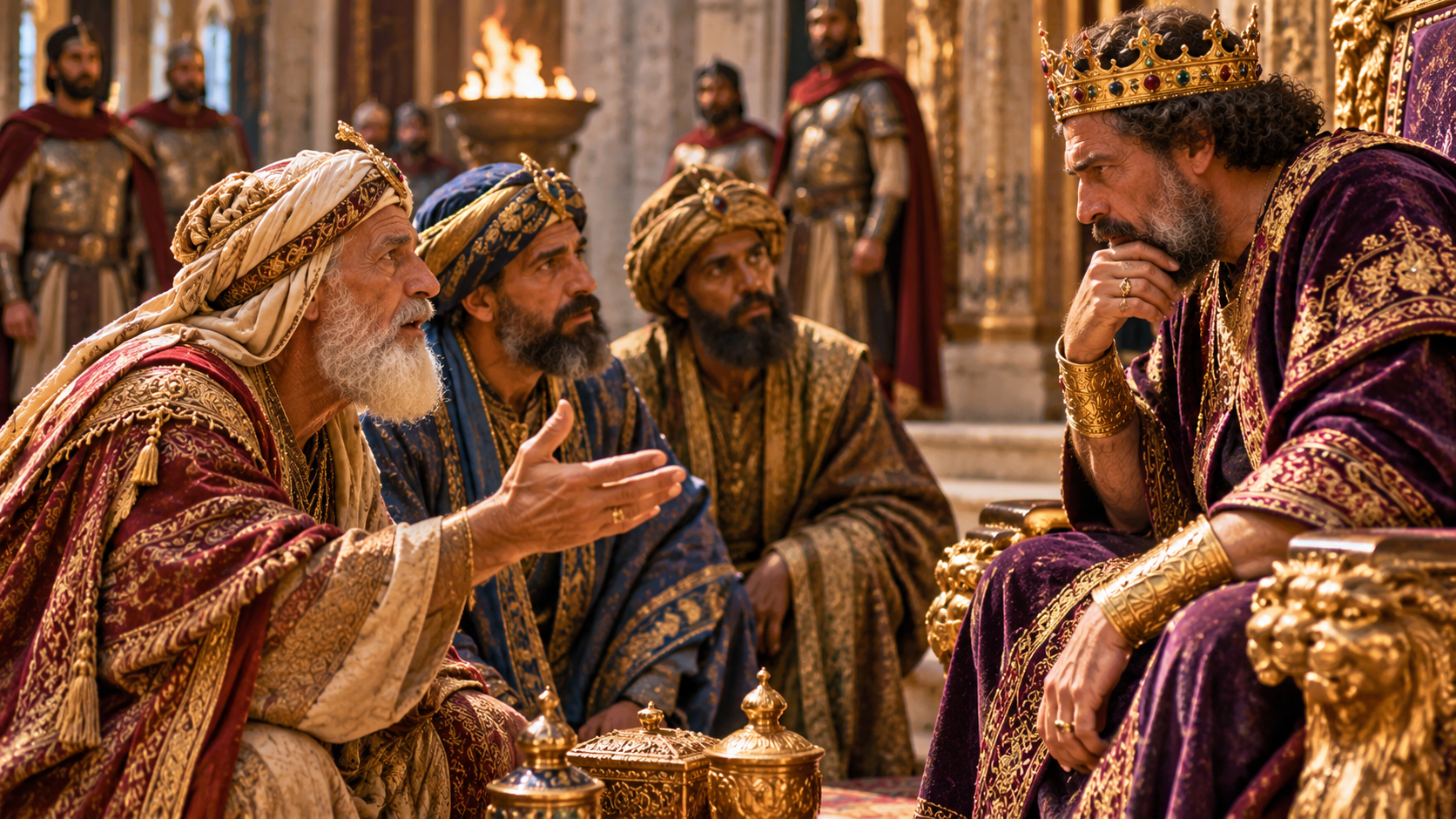
THE PURPOSE OF
THE MAGI - WORSHIP!
Where is He who has been born (tikto) King (basileus) of the Jews (Ioudaios)? - This is the essence of the story - Jesus is to be the King of the Jews. In Mt 2:4 the King of the Jews is equated with the Messiah! Jesus did not assume His throne in His first advent, but rest assured He will be the King of the Jews in His Second Coming for He will return as King of kings (Rev 19:16), set up His Messianic Kingdom and reign from His throne in Jerusalem. Imagine the threat that such a question posed to Herod the Great, for he considered himself "King of the Jews." (cf "Herod the king" in Mt 2:3) No wonder Herod was "troubled" (Matthew 2:3). While we do know that nature was a witness to the Creator (Ps. 19:1-6) and that He had set eternity in their hearts (Eccl. 3:11), that is only natural revelation which will not accomplish salvation (contrary to some having taught the Gospel is in the stars). The wise men would have needed wise, special revelation. (See also How did people know about God before the Bible?)
Gotquestions has a sad observation regarding Jesus' title King of the Jews - It is interesting that only non-Jews used this specific title to describe Jesus, underscoring the truth of John 1:11, which says, “He came to his own, and his own people did not receive him.”
King of my life I crown Thee now—
Thine shall the glory be;
Lest I forget Thy thorn-crowned brow,
Lead me to Calvary.
—Hussey
Jesus is King of our lives,
so we must serve Him all of our lives.
Notice that for the magi to even ask this question about the King of the Jews clearly indicates that they had divine revelation from some source. They simply could not have known this of their own accord. What was the source? We cannot be certain. There are a number of prophecies that allude to Messiah as King and considering that Daniel was captive in Babylon (in the east), and wrote his prophecies while in Babylon, and Da 2:4-7:28 were in Aramaic, the common language of the land (cf Da 12:4), it is certainly possible that the magi had access to his prophecies which would have included predictions of a great King such as the ones below:
I kept looking in the night visions, And behold, with the clouds of heaven One like a Son of Man (THE MESSIAH) was coming, And He came up to the Ancient of Days (GOD THE FATHER) And was presented before Him. “And to Him (THE MESSIAH) was given dominion, Glory and a kingdom (CLEARLY INDICATING HE WOULD BE THE KING OVER THIS KINGDOM), That all the peoples, nations and men of every language Might serve Him. His dominion is an everlasting dominion Which will not pass away; And His kingdom is one Which will not be destroyed. (Da 7:13-14)
‘Then the sovereignty, the dominion and the greatness of all the kingdoms under the whole heaven will be given to the people of the saints of the Highest One; His kingdom will be an everlasting kingdom, and all the dominions will serve and obey Him.’ (Da 7:27)
Arnold Fruchtenbaum makes an interesting comment - Daniel saved the lives of all the astrologers by correctly interpreting the king’s dream, and many must have become believers in Daniel’s God through this. No doubt many of these men turned from worshipping the stars to worshipping the Creator of the stars. So this body of “wise men” most likely had Daniel’s writings from which to determine the time of Messiah’s coming. As to the knowledge of the star being the herald, they also may have had the book of Numbers. Read Numbers 24:17. Why may they have had this book? There is another Babylonian connection here. Balaam was a Babylonian astrologer (Deuteronomy 23:4 “Balaam son of Beor from Pethor of Mesopotamia- that is on the banks of the Euphrates river in Babylonia). He was probably from the Babylonian School of Astrology.
One other point that is worth noting is that the magi could have known about when the Messiah would have been born from studying (and having the Spirit open their eyes) Daniel's great prophecy in Daniel 9:24-27. However even Daniel's prophecies say nothing about HIS STAR, which must remain a mystery until Heaven (cf Dt 29:29 = “The secret things belong to the LORD our God, but the things revealed belong to us and to our sons forever, that we may observe all the words of this law.")
Da 9:24 Seventy weeks have been decreed for your people and your holy city, to finish the transgression, to make an end of sin, to make atonement for iniquity, to bring in everlasting righteousness, to seal up vision and prophecy and to anoint the most holy place. Da 9:25 “So you are to know and discern that from the issuing of a decree to restore and rebuild Jerusalem until Messiah the Prince there will be seven weeks and sixty-two weeks; it will be built again, with plaza and moat, even in times of distress. Da 9:26 “Then after the sixty-two weeks the Messiah will be cut off and have nothing, and the people of the prince who is to come will destroy the city and the sanctuary. And its end will come with a flood; even to the end there will be war; desolations are determined. Da 9:27 “And he will make a firm covenant with the many for one week, but in the middle of the week he will put a stop to sacrifice and grain offering; and on the wing of abominations will come one who makes desolate, even until a complete destruction, one that is decreed, is poured out on the one who makes desolate.”
Compare Jesus fateful words of warning in Luke 19:41-44
When He approached Jerusalem, He saw the city and wept over it, 42 saying, “If you had known in this day (JESUS' POINT IS THAT THEY COULD HAVE AND SHOULD HAVE KNOWN ABOUT THIS DAY - HOW? FROM DANIEL'S PROPHECY ABOVE!), even you, the things which make for peace! But now they have been hidden from your eyes. 43 “For the days will come upon you when your enemies will throw up a barricade against you, and surround you and hem you in on every side, (ROMAN DESTRUCTION OF TEMPLE BY TITUS IN 70 AD) 44 and they will level you to the ground and your children within you, and they will not leave in you one stone upon another, because you did not recognize the time of your visitation.”
In addition there are other OT prophecies which speak of Messiah as King:
Psalm 2:6 “But as for Me (GOD THE FATHER), I have installed My KING (GOD THE SON, MESSIAH) Upon Zion, My holy mountain.”
Psalm 48:1-2 Great is the LORD, and greatly to be praised, In the city of our God, His holy mountain. 2 Beautiful in elevation, the joy of the whole earth, Is Mount Zion in the far north, The city of the great KING .
Psalm 110:1-2 A Psalm of David. The LORD (GOD THE FATHER) says to my Lord (GOD THE SON, MESSIAH): “Sit at My right hand Until I make Your (MESSIAH'S) enemies a footstool for Your feet.” 2 The LORD will stretch forth Your strong scepter from Zion (A KING POSSESSES A SCEPTER), saying, “Rule in the midst of Your enemies.”
Isaiah 9:6; 7 For a child will be born to us, a son will be given to us; And the government will rest on His shoulders; And His name will be called Wonderful Counselor, Mighty God, Eternal Father, Prince of Peace. 7 There will be no end to the increase of His government or of peace, On the throne of David and over his kingdom (JESUS THE KING), To establish it and to uphold it with justice and righteousness From then on and forevermore. The zeal of the LORD of hosts will accomplish this.
Isaiah 32:1; 2 Behold, a KING (MESSIAH) will reign righteously And princes will rule justly. 2 Each will be like a refuge from the wind And a shelter from the storm, Like streams of water in a dry country, Like the shade of a huge rock in a parched land.
Jeremiah 23:5 “Behold, the days are coming,” declares the LORD, “When I will raise up for David a righteous Branch; And He will reign as KING and act wisely And do justice and righteousness in the land.
Zechariah 9:9 Rejoice greatly, O daughter of Zion! Shout in triumph, O daughter of Jerusalem! Behold, your KING is coming to you; He is just and endowed with salvation, Humble, and mounted on a donkey, Even on a colt, the foal of a donkey.
Comment - Note that Matthew quotes this passage in Mt 21:4-5 (This took place to fulfill what was spoken through the prophet: 5 “SAY TO THE DAUGHTER OF ZION, ‘BEHOLD YOUR KING IS COMING TO YOU, GENTLE, AND MOUNTED ON A DONKEY, EVEN ON A COLT, THE FOAL OF A BEAST OF BURDEN.’”) as fulfilled by Jesus as He entered Jerusalem riding a colt down the Mount of Olives (Lk 19:37) to begin His "Passion Week" - "The crowds going ahead of Him, and those who followed, were shouting (Ps 118:26), “Hosanna to the Son of David; BLESSED IS HE WHO COMES IN THE NAME OF THE LORD; Hosanna in the highest!” " (Mt 21:9). Luke has the crowd "shouting: “BLESSED IS THE KING WHO COMES IN THE NAME OF THE LORD; Peace in heaven and glory in the highest!” (Lk 19:38)
Notice...
(1) Matthew omits part of the prophecy in Zechariah 9:9 = "He is just and endowed with salvation." (Mt 21:5)
(2) Matthew quotes Psalm 118:26 "BLESSED IS HE..." while Luke quotes it "BLESSED IS THE KING...."
But only a few days later the Jews denied Jesus was their KING and "cried out, “Away with Him, away with Him, crucify Him!” Pilate said to them, “Shall I crucify your KING?” The chief priests answered, “We have no KING, but Caesar.” " (Jn 19:15)
Can you see the tragic irony - At the beginning of His life on earth, the Gentiles (magi) acclaimed Jesus as KING of the Jews, whereas at the end of His life, the Jews denied He was their KING!
Spurgeon observes that "A stir begins as soon as Christ is born. He has not spoken a word; he has not wrought a miracle; he has not proclaimed a single doctrine; but ‘when Jesus was born,’ at the very first, while as yet you hear nothing but infant cries, and can see nothing but infant weakness, still his influence upon the world is manifest. ‘When Jesus was born (PROBABLY NOT IMMEDIATELY AFTER HIS BIRTH AS EXPLAINED ABOVE), there came wise men from the east,’ and so on. There is infinite power even in an infant Savior.”
For (gar) - Term of explanation. The magi explain to Herod why they have come to see the King of the Jews. Can't you just imagine Herod's jaw drop when they tell him how they were led to come! A star! And not just any star, but they refer to it as "HIS star." Now if their mention of a King did not get Herod's attention, imagine Herod's reaction when he finds out this King has His Own STAR! In a sense, the magi actually have good theology, for we know it was the preincarnate Jesus Who created that STAR (Heb 1:2, Col 1:16, Neh 9:6)! So in that sense it is "His star." (Dt 10:14) Oh, how mysterious is this truth.
John Piper writing on God's power in all the events surrounding His Son's incarnation points out that "Luke shows God influencing the entire Roman Empire so that the census comes at the exact time to get a virgin to Bethlehem to fulfil prophecy with her delivery. Matthew shows God influencing the stars in the sky to get foreign magi to Bethlehem so that they can worship him."
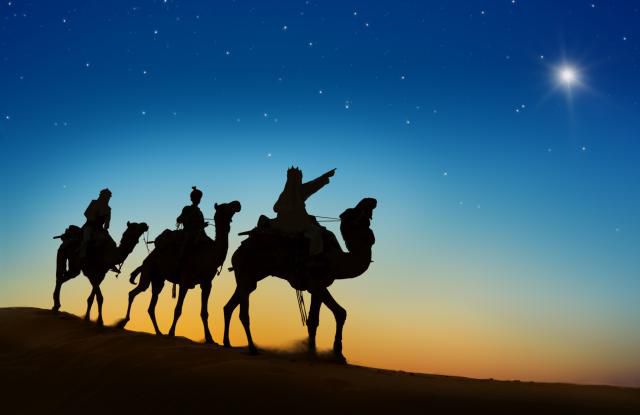
We saw His star in the east - The identity of HIS STAR is subject of much speculation as discussed below. The point of the STAR guiding the magi is that God is in some way exerting supernatural power to bring about the result that He desires, in this case the worship of His Son by these Gentile magi. Don't miss this because you are "star gazing" so to speak. Focus on the real "Star" of the story, Jesus Christ! East is anatole which is used in Mt 2:1 (magi from the east) and is also used Luke's account of Jesus' birth when John the Baptist's "father Zacharias was filled with the Holy Spirit, and prophesied" (Lk. 1:67) a prophecy which included the following description of Jesus "Because of the tender mercy of our God, with which the Sunrise (anatole) from on high will visit us (REFERRING TO THE BIRTH OF JESUS)." (Lk. 1:78) As alluded to the Bible does not definitively tell us about HIS STAR but there is one passage that is worth noting and it comes from one of the four messianic prophecies from Balaam in the book of Numbers. Could the magi have had a copy of the Pentateuch? We cannot know for certain.
Numbers 24:17 “I see HIM, but not now; I behold HIM, but not near; A STAR shall come forth from Jacob, a SCEPTER shall rise from Israel, and shall crush through the forehead of Moab, and tear down all the sons of Sheth.
COMMENT - Balaam reluctantly was forced by God to prophesy of the coming of the Jewish Messiah and he related that to a STAR and a SCEPTER. Obviously this was not a literal star because it is described as coming forth from Jacob. He goes on to state that the STAR and the SCEPTER are essentially one and the same. Remember, that the term scepter is a symbol of royalty, of kingship. This STAR which would rise out of Jacob, is himself a KING. The Septuagint translates scepter with the Greek word for man (anthropos) and reads "a man shall rise out of Israel." It is fascinating to note that Balaam’s occupation was that of astrology. Even more significant, he came from the city of Pethor, a city on the banks of the Euphrates River in Babylonia (Nu 22:5; Deut 23:4). It is therefore possible that the magi were exposed to the prophecies of Balaam. As intriguing as these possible associations are, they would still not explain the appearance of the star to the magi. And so we will have to wait until Heaven for the full revelation! Be patient, beloved. There will be many joys in store for us in Heaven!
NET Note on His star - Some have argued that it was a comet, but these are frequent and would hardly be associated with Israel or the Messiah. Most modern evangelicals probably take it as a special supernatural light that guided the wise men from Persia to Jerusalem. This theory, however, does not explain why they followed it at all; there was little reason to connect a sudden, slow-moving light in the sky with the promised Jewish king. The magi, expert astronomers as they were, would hardly call such a light a star. The magi may have been familiar with Scriptures such as Ge 3:15, Nu 24:17 (promised "Star out of Jacob"), Isa 7:14 (promised "God with us").
ED: BUT NONE OF THESE PASSAGES PROPHESY OF A STAR THAT WOULD GUIDE ONE TO THE KING OF THE JEWS. EVEN IF IT WERE A "SUPERNATURAL PHENOMENON," WHICH IS VERY POSSIBLE, HOW WOULD THE MAGI HAVE KNOWN TO FOLLOW IT UNLESS THEY HAD SPECIFICALLY BEEN GIVEN SUPERNATURAL INSTRUCTION? I PERSONALLY THINK WE MUST WAIT UNTIL HEAVEN TO LEARN ABOUT "HIS STAR.")
What was the star of Bethlehem? - (ED: NOTE THAT THE BIBLE NEVER CALLS IT THE STAR OF BETHLEHEM, BUT DOES CALL IT "HIS STAR") (Excerpt) - The star of Bethlehem is associated with the birth of Christ and the visit of the magi (wise men) as recorded in Matthew 2:1–12. The text implies the star of Bethlehem appeared only to the magi in the East (most likely the area of Persia, or modern-day Iran). There is no biblical record of anyone else observing the star of Bethlehem. The magi in the East saw something in the heavens—the star of Bethlehem—that alerted them to the fact that the Jewish Messiah was born. The magi do not call the star of Bethlehem by that name; in Matthew 2:2 they refer to it as being “HIS STAR” since it was a sign to them that a king was born. The star prompted the magi to travel to Jerusalem, the capital of Israel. This would be the logical place to start looking for the birth of the King of the Jews for someone who did not know of Micah’s prophecy about Bethlehem. (click full article - What was the star of Bethlehem?)
Spurgeon - We believe it to have been a luminous appearance in mid-air; probably akin to that which led the children of Israel through the wilderness, which was a cloud by day and a pillar of fire by night. Whether it was seen in the daylight or not we cannot tell.
Fruchtenbaum - This passage contains the record of the visit of the Magi from the east who were led there by the visibility of a star. Because of this, even some Christians have stated that there is some validity to astrology, and some have even attempted to develop a doctrine of biblical astrology.
John Piper has a good exhortation regarding the natural human tendency to want to try to explain the nature of the STAR - The answer is: We do not know. There are numerous efforts to explain it in terms of conjunctions of planets or comets or supernovas or miraculous lights. We just don’t know. And I want to exhort you not to become preoccupied with developing theories that are only tentative in the end and have very little spiritual significance. I risk a generalization to warn you: people who are exercised and preoccupied with such things as how the star worked and how the Red Sea split and how the manna fell and how Jonah survived the fish and how the moon turns to blood are generally people who have what I call a mentality for the marginal. You do not see in them a deep cherishing of the great central things of the gospel—the holiness of God, the ugliness of sin, the helplessness of man, the death of Christ, justification by faith alone, the sanctifying work of the Spirit, the glory of Christ’s return and the final judgment. They always seem to be taking you down a sidetrack with a new article or new tape or book.(We Have Come to Worship Him)
Related Resource:
And have come to worship (proskuneo) Him - Worship was the purpose of their long journey. They had come to bow down in adoration and reverence before the King of kings. Notice that proskuneo occurs three times in this chapter, contrasting the genuine worship of the Magi (Mt 2:2, 11) with the feigned “worship” of Herod (Mt 2:8). Note also that worship that proves His deity. Jesus declared that worship belongs to God alone (Mt 4:10) Peter refused worship (Acts 10:25, 26) as did an angel (Rev 22:8,9). Yet Jesus repeatedly accepted worship (Mt 14:33; Mt 28:9). The Magi’s worship at the beginning of Matthew and the disciples’ worship at the end (Mt 28:17) are like "bookends" of the Gospel giving the testimony to Christ’s deity. Is it not sad that these Gentiles recognized what most of Jesus' own people refused to accept (Jn 1:11)? Indeed it is striking that the title “King of the Jews” first appears in Matthew on the lips of Gentile Magi who came to worship Him, and it last appears on a Roman placard above His cross calling Him "King of the Jews" (Mt 27:37). Thus Gentiles announced Jesus' as King at His birth and at His death.
Worship (bow down) (4352)(proskuneo from pros = before + kuneo = kiss or adore) means to prostrate one’s self, to kiss the hand to (towards) one in token of reverence, to fall upon the knees and touch the ground with the forehead as an expression of profound reverence (to make a salam), by kneeling or prostration to do homage to one or make obeisance, either in order to express respect or make supplication. When Jesus Christ was born into this world, He was attended and worshipped by angels. (Lu 2:13f). Proskuneo represents the most common Near Eastern act of adoration and reverence and also carries the idea of profound awe and respect. Some believe that the root word kuneo may be related to kuon which is the Greek word for dog and which then could be picturing a dog licking his master's hand.
Proskuneo literally means to kiss toward someone, to throw a kiss in token of respect or homage, to prostrate oneself in homage, to do reverence to, to adore and so to worship and show respect. In the ancient Oriental (especially Persia) the mode of salutation between persons of equal rank was to kiss each other on the lips. When the difference of rank was slight, they kissed each other on the cheek. When one was much inferior, he fell upon his knees touched his forehead to the ground or prostrated himself, and as he was bowing down he would be throwing kisses toward the superior. It is this latter mode of salutation that is intended by the Greek writers in the use of the verb proskuneo . Matthew's uses of proskuneo - Matt. 2:2; Matt. 2:8; Matt. 2:11; Matt. 4:9; Matt. 4:10; Matt. 8:2; Matt. 9:18; Matt. 14:33; Matt. 15:25; Matt. 18:26; Matt. 20:20; Matt. 28:9; Matt. 28:17
🙏 THOUGHT - Beloved, worship should be the supreme purpose of our lives, permeating even our service to the Lord, so that everything we do is offered as an act of worship (Ro 12:1; Col 3:17, 23). And don't miss the striking irony in Matthew's account: Gentile magi traveled a great distance to worship the King of the Jews, while Herod, the reigning king of the Jews, sought to murder Him! The magi sought Him to bow before Him; Herod sought Him to destroy Him (Mt 2:2, 8, 11, 13). Interestingly, Matthew provides relatively few details about Jesus' actual birth, devoting far more attention to the contrasting responses to His arrival. The issue was not merely where the King was born, but how people responded to Him! That same question confronts every heart today: Will we bow before Christ as King, or resist His rightful rule over our lives? (Lk 6:46; Php 2:10,11).
QUESTION - What does it mean that the magi saw His star in the east (Matthew 2:2)? GOTQUESTIONS.ORG
ANSWER - Part of the Christmas story is the visit of the magi. Some time after Jesus was born, wise men from the east arrived in Jerusalem asking, “Where is He who has been born King of the Jews? For we have seen His star in the East and have come to worship Him” (Matthew 2:2, NKJV). In order to understand the significance of that event, one has to go back in time more than a thousand years prior to the birth of Jesus.
During the time of exodus, there was a ruler of Moab named Balak (Numbers 22:4). He saw how the Israelites had defeated the Amorites, and he was afraid. Balak and the Moabites began to feel the threat of the people of Israel moving closer. Balak sent word to a prophet named Balaam and asked him to curse the people of Israel on Moab’s behalf (Numbers 22:6). God instructed Balaam to refuse the invitation (Numbers 22:12). But, after several exchanges between Balak’s messengers and Balaam, Balaam finally went to meet with Balak (Numbers 22:21). Despite God’s displeasure with Balaam and after God’s miraculous deliverance of Balaam’s life by the voice of his donkey (Numbers 22:22–35), God allowed Balaam to present a message to Balak.
God’s message to Balak was not what the king wanted. There was no curse of Israel, only blessing. Included in the oracle was a prediction that a star shall come forth from Jacob and a scepter would rise from Israel (Numbers 24:17). While the message spoke in part of the coming judgment on Moab, it also reminded the world that there would one day be a King in Israel who would lead the people to victory and judgment on Israel’s enemies.
Sometime after Jesus was born (Matthew 2:1a), magi (Gr. magos) from the east came to Jerusalem to find that King (Matthew 2:2a). Tradition tells us that the wise men may have been three in number, that they were from three different nations, and other interesting embellishments, but the biblical text simply records that these wise men were from the east (Matthew 2:1), and they all seemingly came from one country (Matthew 2:12). The magi journeyed west to find the prophesied King because they saw His star in the east (Matthew 2:2).
The magi recognized that the star they saw signified that the King of prophecy had arrived. They followed the star to Bethlehem until it was directly overhead the Christ Child’s location (Matthew 2:9). They “rejoiced exceedingly with great joy” when they saw the star above (Matthew 2:10, ESV), and they came to the house where Mary and Jesus were.
Upon entering the house the star had led them to, the magi presented their gifts to Jesus and began to worship Him. They had met the One they recognized as the King of the Jews and the fulfillment of prophecy (Matthew 2:2, 11).
In contrast to the magi’s reaction to the birth of Christ is that of King Herod (the Roman-appointed ruler in Jerusalem). Herod heard that the magi had come to Jerusalem looking for the King of the Jews. He reached out to them secretly to inquire when they had first seen the star in the east (Matthew 2:7). He then tried to deceive them into thinking that he also wanted to worship this newborn King, but God warned the magi of Herod’s deception. Rather than report Jesus’ location back to Herod, the magi went home another route (Matthew 2:12).
Matthew does not make it clear whether the star the magi saw in the east is the same star predicted through Balaam, but there was a star predicted to rise in Israel, and that star would be associated with the King (Numbers 24:17). The magi rightly calculated that the particular star they saw from the east would lead them to the King of the Jews. Perhaps God communicated something directly to them (as He did in Matthew 2:12). Perhaps they also knew of Daniel’s prophecy concerning the timing of the King’s birth (Daniel 9:25). Perhaps they just recognized a connection to Balaam’s prophecy. In any case, the magi got it right: they were guided by “His star in the east,” and they arrived at the exact place where the newborn King of the Jews was staying.
QUESTION - What was the star of Bethlehem? - GotQuestions.org WATCH VIDEO
ANSWER - The star of Bethlehem is associated with the birth of Christ and the visit of the magi (wise men) as recorded in Matthew 2:1–12. The text implies the star of Bethlehem appeared only to the magi in the East (most likely the area of Persia, or modern-day Iran). There is no biblical record of anyone else observing the star of Bethlehem.
The magi in the East saw something in the heavens—the star of Bethlehem—that alerted them to the fact that the Jewish Messiah was born. The magi do not call the star of Bethlehem by that name; in Matthew 2:2 they refer to it as being “his star,” since it was a sign to them that a king was born. The star prompted the magi to travel to Jerusalem, the capital of Israel. This would be the logical place to start looking for the birth of the King of the Jews for someone who did not know of Micah’s prophecy about Bethlehem.
In Jerusalem, the magi visited King Herod and were told that the new king they were looking for would be born in Bethlehem, not in Jerusalem (Matthew 2:5). The wise men left Herod’s palace, and the star of Bethlehem appeared to them once again. In fact, the star “went ahead of them until it stopped over the place where the child was. When they saw the star, they were overjoyed” (verses 9–10). The star of Bethlehem, apparently mobile, led the magi to the precise place where they could find Jesus.
Modern portrayals of the Christmas nativity scene usually show the wise men visiting Jesus on the night of His birth. That is likely not what truly occurred. King Herod discovered from the magi the “exact time” the star of Bethlehem had first appeared to them (Matthew 2:7), and he later ordered all male children two years old and under in Bethlehem to be killed (verse 16). Herod obviously thought the star of Bethlehem had first appeared when Christ was born; if he was right, then Jesus could have been up to two years old when the star of Bethlehem later guided the magi through the streets of Bethlehem. The Greek word translated “young child” in Matthew 2:9 can mean anything from a newborn infant to a toddler.
So, the magi may have first observed the star of Bethlehem the night of Jesus’ birth, or they may have first seen it up to two years beforehand. Either way, they found Jesus still in Bethlehem when they arrived. Joseph and Mary almost surely stayed in Bethlehem until Mary could travel again. In fact, they probably stayed there for the 40 days necessary to complete Mary’s purification. From Bethlehem, they could easily make the five-mile trip to Jerusalem for the sacrifice for Mary’s purification (Luke 2:22). The fact that the magi came to a “house” (Matthew 2:11) rather than the stable makes sense because Joseph naturally would have moved his family to a more protected place as soon as possible—the morning after Jesus was born, in all probability.
After seeing the star of Bethlehem, the magi traveled to Jerusalem to look for the Messiah. The question arises, how would Persian magi know about the Jewish Messiah? Undoubtedly, they would have been exposed to the writings of the Jewish prophet Daniel, who had been the chief of the court seers in Persia. Daniel 9:24–27 is a prophecy that gives a timeline for the birth of the Messiah. Also, they may have been aware of the words of the pagan prophet Balaam (who was from the town of Pethor on the Euphrates River near Persia) in Numbers 24:17. Balaam’s prophecy specifically mentions “a star” and “a scepter” rising out of Jacob.
What exactly was the star of Bethlehem? The Greek word translated “star” in the text is the word aster, which is the normal word for a star or celestial body. The word is used 24 times in the New Testament, and most of the time it refers to a celestial body. It can be used to denote angels, as in Revelation 12:4, where aster seems to refer to the fallen angels who followed Satan’s rebellion. Basic rules of biblical interpretation state that we should take the normal sense of a word unless there is compelling evidence to suggest otherwise. In that case, the star of Bethlehem should be considered an actual heavenly body. Many Bible scholars suggest a natural explanation for the star of Bethlehem, their theories ranging from a supernova to a comet to an alignment of planets. Something in the heavens provided a brighter-than-normal light in the sky.
However, there is evidence to suggest that the star of Bethlehem was not a natural stellar phenomenon, but something unexplained by science. First, the fact that the star of Bethlehem seemed to appear only to the magi indicates that this was no ordinary star. Also, celestial bodies normally move from east to west due to the earth’s rotation, yet the star of Bethlehem led the magi from Jerusalem south to Bethlehem. Not only that, but it led them directly to the place where Joseph and Mary were staying, stopping overhead. There is no natural stellar phenomenon that can do that.
So, if the normal usage of the word star doesn’t fit the context, what does? The star of Bethlehem in Matthew 2:1–12 was likely an angel or a manifestation of the Shekinah Glory. The Shekinah, which literally means “dwelling of God,” was the visible presence of the Lord. Prior to this, the most notable appearance of the Shekinah was the pillar of cloud that led the Israelites by day and the pillar of fire that led them by night (Exodus 13:21). The Shekinah can obviously lead people to specific locations, and it was seen later in connection with Christ’s ministry (e.g., Matthew 17:5; Acts 1:9). Either an angel or the Shekinah would fit the evidence. It shouldn’t surprise us that God would use a miraculous sign to signal the advent of His Son into the world. Those with eyes to see joyfully beheld His glory.
QUESTION - What does it mean that Jesus is the King of the Jews? GOTQUESTIONS.ORG
ANSWER - Jesus is referred to as the King of the Jews two times in His earthly life: at His birth by the wise men (Matthew 2:2) and at His trial and subsequent crucifixion (Mark 15:2). All four gospels record the words “King of the Jews” as part of Pilate’s instructions to the angry mob (Matthew 27:37; Mark 15:9; Luke 23:38; John 19:3) and Pilate’s direct address to Jesus (Matthew 27:11; Mark 15:2; Luke 23:3; John 18:33). It is interesting that only non-Jews used this specific title to describe Jesus, underscoring the truth of John 1:11, which says, “He came to his own, and his own people did not receive him.”
The title King of the Jews had both messianic and political implications. Kings in Israel were anointed with oil as a sign of God’s choosing (see 1 Kings 1:39), and the meaning of Messiah is “Anointed One.” As the Son of David, the Messiah was chosen by God to fulfill the Davidic Covenant and rule on the throne in Jerusalem. When the magi came to Jerusalem seeking the King of the Jews, they most likely had in mind a future political leader, much to King Herod’s chagrin. But the Jews in Jerusalem, hearing the magi’s question, would have thought of the long-awaited Messiah.
In Mark 15:32 some mockingly call Jesus the “King of Israel” and associate the title with “Christ” (“Messiah”). What they meant as jeering scorn—what kind of king would be hanging on a cross?—was, ironically, the exact truth. Jesus was the King of Israel, and He was on the cross to save them from their sins.
The sign that Pilate posted over Jesus on the cross identified the “criminal” in three languages: “Jesus of Nazareth, the King of the Jews” (John 19:19). The Jewish leaders objected to the application of a Messianic title to Jesus: “Do not write ‘The King of the Jews,’ but that this man claimed to be King of the Jews” (John 19:21). For reasons he kept to himself, Pilate refused to alter the sign (verse 22), which was another ironic statement of truth.
During the trial of Jesus, Pilate had asked Him, “Are you the King of the Jews?” (Mark 15:2). Jesus answered, “It is as you say” (NASB). Later, Jesus expanded on the idea of His being a king: “My kingdom is not of this world. If it were, my servants would fight to prevent my arrest by the Jewish leaders. But now my kingdom is from another place” (John 18:36). The King of the Jews was rejected by Israel, but there is a broader spiritual kingdom that He still ruled.
After the conversation about Jesus’ kingship, Pilate turns to the crowd and asks, “Do you want me to release ‘the King of the Jews’?” (John 18:39). In no uncertain terms, the crowd shouts their answer: “No, not him! Give us Barabbas!” (John 18:40). Pilate then allows the soldiers to give Jesus a beating, during which they clothe Jesus as a king, mock Him with cries of “Hail, King of the Jews!” and repeatedly slap Him in the face (John 19:3). After the mockery, Pilate again presents Jesus to the crowd as the King of the Jews: “Here is your king,” he says (John 18:14). In response they shout, “‘Take him away! Take him away! Crucify him!’ ‘Shall I crucify your king?’ Pilate asked. ‘We have no king but Caesar,’ the chief priests answered” (John 18:15). Their choice had been made, and Jesus, their true king, was led away to be crucified (verse 16).
Some people during Jesus’ ministry recognized Jesus as the King of the Jews. As Jesus neared Jerusalem the final time, the crowd with Him “thought that the kingdom of God was going to appear at once” (Luke 19:11). In other words, they believed Jesus was the King of the Jews, and they were ready to help Him set up the earthly kingdom. Jesus told a parable indicating that the kingdom would be delayed (verses 12–27), but the crowd’s enthusiasm did not wane. As He entered Jerusalem, Jesus was greeted with shouts of welcome for the King of the Jews: “Blessed is the king who comes in the name of the Lord! Peace in heaven and glory in the highest!” (verse 38).
God’s people had been expecting a deliverer since God first promised one in Genesis 3:15. God Himself unified the Hebrews under Moses and told them that, as long as they followed and obeyed Him, He would bless and guide them (Deuteronomy 11:8–9; 27:9–10). But the children of Israel rejected the Lord as their leader and demanded an earthly king (1 Samuel 8:7, 19). God gave them what they wanted and appointed Saul as the first king over Israel (1 Samuel 9:17). When Saul disobeyed the Lord, he was then rejected by God, and his sons were not allowed to succeed him on the throne (1 Samuel 15:9–11, 23, 28). Instead, God chose David to be the next King of the Jews (1 Samuel 16:1). God promised David that his name would be forever associated with the throne of Israel (2 Samuel 7:12–16). Through the inspiration of the Holy Spirit, David penned the prophetic Psalm 22, which gave Israel hints about what their future Messiah and Deliverer would endure. But, in their desperation for an earthly king and an earthly kingdom, most of the Jews disregarded those prophetic words as well as the ones in Isaiah 53. When Jesus came, He fulfilled those prophecies. Importantly, He was from the royal line of David (Matthew 1:1; John 7:42) and could rightly take the title King of the Jews, but because Jesus was not what they wanted, “his own people did not receive him” (John 1:11, ESV).
A king is a supreme ruler. When the Jews clamored for a king in Samuel’s day, they were rejecting God as their Supreme Ruler (1 Samuel 8:7). Because of their hard hearts, He allowed them temporary kings. But this led to bondage and their destruction as a nation, highlighting the reality that what they wanted was not what they needed. The kingdom was divided after King Solomon’s rule, and both parts of the divided kingdom eventually fell to foreign enemies. Jerusalem was destroyed at least twice, once by the Babylonians under Nebuchadnezzar (2 Kings 25:8–10) and again by the Romans under Titus in AD 70. The Jews who rejected their true King were scattered among the nations for centuries until 1948.
Isaiah 11:1 announced that one day a “shoot from the stem of Jesse” (verse 1) would come and set the world to rights. The Jews have long interpreted such prophecies as foretelling an earthly king for Israel. We understand Jesus to be that King; however, God had bigger plans than just an earthly kingdom. He never resigned Himself to Israel’s rejection of His kingship, but rather used their rejection of Him as an opportunity to demonstrate His love for the whole world (John 3:16). The Son of God took on human flesh, came in the form of a servant, and showed His people what a real Deliverer was like (Philippians 2:5–11; Mark 10:44).
Because this King of the Jews did not fit the ideas they had cherished for thousands of years, the Jews again rejected the One they needed. Many Jews are still waiting for the wrong kind of king. Revelation 19:16 describes the day when Jesus will return to rule over the earth. At that time, the ancient prophecies of an earthly kingdom of God will be fulfilled, and no one will doubt that Jesus is the King of kings and the Lord of lords. Every nation, tribe, and tongue will bow to the King of the Jews (1 Timothy 6:14–16; Romans 14:11; Philippians 2:10; Revelation 5:9).
THIS BEGS THE QUESTION DEAR READER:
IS JESUS KING OF YOUR LIFE?
Messianic Hope: The King of the Jews
The concept of the King Messiah who would one day come to deliver His people from oppression has been the sustaining hope of the Jewish people for generations. King Messiah is the instrument by whom God's king is to be established in Israel and the world. This hope runs throughout the Tanakh. This Messiah would be anointed by God to...
- Restore the Kingdom of David (Jer 23:5, Jer 30:9, Ezek 34:33)
- Restore the Temple (Isa 2:2, Micah 4:1, Zech 6:13, Ezekiel 37:26-28)
- Regather the exiles (Isa 11:12, Isa 43:5-6)
- Usher in world peace (Isa 2:4)
- Spread Torah knowledge of the God of Israel, which will unite humanity as one. Zech 14:9 And the LORD will be king over all the earth; in that day the LORD will be the only one, and His name the only one.
In the Tanakh, the key passage on which the idea of the Messianic King would rule is 2 Sa 7:11ff. This covenant could not have been fulfilled by Solomon and therefore refers to another anointed King.
Rambam's View of Mashiach
The Medieval rabbi Maimonides ("Ramban") is considered to be the voice of traditional Judaism. His "12th Principle" of the Jewish faith is his affirmation that the Messiah is coming to restore Israel to greatness beyond even King Solomon. "I believe with complete faith in the coming of the Messiah, and though He may dely, nevertheless I wait for His coming every day." He went on to say "If a King will arise from the House of David who is learned in the Torah and observant of the mitzvot, as prescribed by the written law and the oral law, as David his ancestor was, and will compel all of Israel to walk in the way of the Torah and reinforce the breaches; and fight the wars of G-d, we may, with assurance, consider Him the Messiah. If he succeeds in the above, builds the Temple in its place, and gathers the dispersed for Israel, he is definitely the Messiah." (Mishneh Torah).
According to rabbinical Judaism (following Maimonides), this Messiah figure is not divine, though he certainly has divine powers and attributes.
Matthew 2:1-10 Wishing On Stars
A Star shall come out of Jacob; a Scepter shall rise out of Israel. —Numbers 24:17
On the night Jesus was born, the bright light of a single star announced His birth. It was an announcement that many had hoped and prayed for, yet many missed.
Perhaps they were like me. Perhaps their hopes were more like dreams and their prayers were more like wishes. Maybe they were looking for a star that would grant every whim, not a light that would reveal their sin.
Every Christmas when I sing in our church’s annual Festival of Lights program, I wish for several things. I wish for those few magic moments when the choir is so perfectly in tune that I can’t hear anyone, yet I can hear everyone. I think that’s what the music of heaven will be like.
Every night when people are laughing at the drama, I wish that I could see what’s so funny. But I always get stuck in a part of the choir loft that’s behind the set.
Yes, I wish for these things, but I know that instead of wishing to hear the pure strains of a few songs, I ought to pray that I will hear God when He speaks.
Instead of wishing I could see the drama, I should pray that my eyes would see Jesus and not be distracted by the world.
Wishing is hoping I’ll get what I want from God. A prayer is a plea that God will get what He wants from me. By Julie Ackerman Link (Our Daily Bread, Copyright RBC Ministries, Grand Rapids, MI. — Reprinted by permission. All rights reserved)
What Does God Want From Me?
- Trust (Psalm 37:3; Proverbs 3:5-6)
- Praise (Psalm 67:3; Psalm 100:3-4)
- Obedience (John 15:8-14; James 1:22-25)
Christmas is a time to think of what God gave to us and what we can give to Him.
Arnold Fruchtenbaum on the Gospel of Matthew - Theme: Jesus the Messiah, the King of the Jews
- Prime Audience: the first believers who had need of a Gospel, Jewish believers.
- Emphasis: Matthew’s emphasis was on Jesus’ fulfillment of the role of Messianic King.
- The early days of the Church were spent primarily in Jerusalem, and the believers there had direct access to the apostles for information about Jesus. However, upon the stoning of Stephen in Acts 7, many of these Jewish believers were dispersed to places such as Syria and Lebanon.
- They then had need of an authoritative life of the Messiah, which Matthew gave them in his Gospel.
- Matthew’s account supports the theme of Jesus the Messiah, King of the Jews in several ways.
- Matthew quotes the Old Testament, or the Tanakh (the 5 books of Moses, the Prophets, and the writings) over 60 times and makes extensive use of Messianic prophecies to show that Jesus was really the Messianic Davidic King.
- Many Jewish people were asking, and still ask today, if Jesus was the Messiah, where is the Messianic Kingdom promised?
- Matthew explains the Kingdom program and the delay of an earthly Messianic Kingdom.
- He also relayed Jesus’ words which warned of the impending judgment of 70 A.D. (Matthew 22:7, Matthew 23:36-38), which uniquely concerned the Jewish nation.
THE OFFICE OF KING
The third office of the Messiah is still future, the office of King. His first office was fulfilled in history by His First Coming; He presently holds His second office; His third office is future, and He will begin to function as King only with His Second Coming.
A. Description of the Office
The office of King, as far as its relationship to Jesus is concerned, is His right to rule over Israel and the world.
Just as His prophetic and priestly offices were predicted by the Old Testament, His kingly office was also predicted by the Old Testament and much more frequently than the other two. That the Messiah would be King was predicted in Genesis 49:10; Numbers 24:17; 1 Chronicles 17:10–14; Psalm 2:7; Psalm 45; Psalm 72; Psalm 119; Isaiah 9:6–7; Isaiah 11:1–10; Isaiah 33:17; Jeremiah 23:5–6; Daniel 7:13–14; Micah 5:2; and Zechariah 9:9.
B. Future Fulfillment of the Office
The New Testament clearly teaches the future fulfillment of this office by Yeshua when He returns. Even within the scope of the Gospels during the time of His First Coming, He was declared to be King of the Jews (Mt. 2:1–2). The wise men came looking for Him, asking the question: Where is he that is born King of the Jews? He is also referred to as King in Matthew 21:4–5; Luke 1:30–33; John 1:49; and John 18:37.
Jesus offered Himself as King at His First Coming, but He could not rule as King until He was accepted by His own nation. Unfortunately, at His First Coming when He offered Himself as King, He was rejected (Mat. 27:37; Mk. 15:16–20; Lk. 19:11–14; Lk 23:38; Jn. 19:19–22). All of these specific passages emphasize, not just the rejection of Yeshua as Messiah, but in particular, the rejection of Him as King of the Jews. Since Yeshua could not fulfill that function until He was accepted by His own nation, He did not become King during His First Coming nor is He functioning in that office today. Instead, at His First Coming He remained within the scope of Prophet and, today, He remains within the scope of Priest. Some day, He will function in that third office, the office of King of the Jews and King of the world. Indeed, when Jesus comes back, He is returning for the purpose of setting up His Kingdom.
The prerequisite to the Second Coming is the Jewish request for Him to return. Some day, all Israel will be saved; all Israel will accept Yeshua as their King (ED: cf Ro 11:26-27, Zechariah 12:10-14, Zechariah 13:1, Zechariah 13:8-9, et al). Once they do, then Yeshua will come again to set up His Kingdom and rule over it as King. This particular aspect of His Second Coming—for the purpose of setting up a Kingdom to rule over as King—is brought out in Revelation 19:15–16 and Matthew 25:34, 40.
IV. CONCLUSION
In summary, Jesus holds three offices: Prophet, Priest, and King. He does not function in all three offices simultaneously, but chronologically. At His First Coming, He functioned as Prophet. Between the First and Second Comings, He is functioning as Priest. At the Second Coming, He will function as King, and He will function in that capacity for 1,000 years.
Normally, the Triumphal Entry is interpreted to represent the time when Yeshua (Jesus) came and officially offered Himself as the King of the Jews and as Israel’s Messiah. But that is not the best interpretation of the actual significance of the Triumphal Entry, because Yeshua had already been offering Himself as the Messiah and the King of the Jews for the previous three and one-half years. Israel had already rejected the Messiahship of Jesus about a year and one-half earlier (Mt. 12:22–45). At that point, Yeshua said that the generation of His day was guilty of committing the “unpardonable sin”; therefore, they were under the judgment that would come in the year A.D. 70. Furthermore, the Kingdom offer was then rescinded, to be re-offered to a later Jewish generation: the generation of the Great Tribulation. The Triumphal Entry into Jerusalem was not for the purpose of officially offering Himself as the King; there was a different purpose. The Triumphal Entry took place in the context of the Passover. The significance of this particular Passover was that this was the Passover when Yeshua knew that the final atonement for sin would be made, by virtue of His death (Lk. 22:14). (See another interpretation - What is the significance of the triumphal/triumphant entry?)
The Star
First of all, we will discuss the issue of the star. The basic rule of interpretation is this:
When the plain sense of Scripture makes common sense, seek no other sense. Therefore take every word at its primary, ordinary, usual, literal meaning unless the facts of the immediate context studied in the light of related passages and axiomatic and fundamental truths indicate clearly otherwise. (Dr. David L. Cooper)
We should take the Bible exactly as it says unless there is some indication in the text and in the context that tells us we cannot take it literally. Five things indicate that this is not a literal star.
To begin with, that this was no ordinary star is evident by the actions that this star took. The star is referred to as “His” star, the King of the Jews’ star, in a way that the other stars simply cannot be. This star appears and disappears. This star moves from east to west. This star moves from north to south. This star hovers over one single house in Bethlehem and points to where the Messiah is. Any literal star, as we know it, that will hover over just one house in Bethlehem will destroy this entire planet. It is very evident that this cannot be a literal star. Again, there are five things about this star which make it clear that it cannot be a physical star:
1. It is the personal star of the King of the Jews.
2. It appears and disappears.
3. It moves from east to west.
4. It moves from north to south.
5. It literally hovers over one single house in Bethlehem.
Obviously it must be something different—but what is it?
The root meaning of the Greek word for “star” simply means “radiance” or “brilliance.” By this star coming in the form of a light, what we actually have is the appearance of the Shechinah Glory rather than an astrologer’s star. (WHILE THIS IS A POSSIBILITY NOTE THIS IS CONJECTURE AND NOT DEFINITELY STATED BY THE BIBLICAL TEXT) What is the Shechinah Glory? The Shechinah Glory is the visible manifestation of God’s presence. Whenever God became visible in the Old Testament, this is referred to as the Shechinah Glory. In most cases, the Shechinah Glory came in the form of a light, fire, cloud or some combination of these three things. Over in Babylonia a light appeared, a brilliance, a radiance, that may have looked like a star from a distance and yet had actions and did things which no star can do or does do. What these Wise Men actually saw was the Shechinah Glory. When they saw this Shechinah Glory, when they saw this unusual brilliance, they deduced from it that it was a signal that the King of the Jews, the Messiah, had finally been born. (A study of the Shechinah Glory can be found in Appendix 4 of the author’s The Footsteps Of The Messiah.) Keeping in mind that in ancient times the two disciplines of astronomy and astrology were not separate sciences, if anyone would recognize a new light in the heavens, it would be them. (Arnold Fruchtenbaum - Messianic Christology)
J C Ryle speaks of the amazing faith of the magi - The conduct of the wise men is a striking example of faith (ED: HOWEVER AS ALLUDED TO ABOVE, THE MAGI MUST HAVE HAD SOME SPECIAL REVELATION ON WHICH TO BASE THEIR FAITH FOR AS PAUL TEACHES "faith comes from hearing, and hearing by the word of Christ." Ro 10:17). They believed in Christ when they had never seen Him;—but that was not all. They believed in Him when the Scribes and Pharisees were unbelieving;—but that again was not all. They believed in Him when they saw Him a little infant on Mary’s knee, and worshipped Him as a King. This was the crowning point of their faith.—They saw no miracles to convince them. They heard no teaching to persuade them (ED: HERE I WOULD SLIGHTLY DISAGREE. SOMEHOW THE MAGI HAD RECEIVED SPECIAL REVELATION THAT HE WOULD BE KING OF THE JEWS). They beheld no signs of divinity and greatness to overawe them. They saw nothing but a newborn infant, helpless and weak, and needing a mother’s care like any one of ourselves. And yet when they saw that infant, they believed that they saw the divine Saviour of the world. “They fell down and worshipped Him.” It is a faith that deserves to be placed side by side with that of the penitent thief. The thief saw one dying the death of a malefactor, and yet prayed to Him, and “called Him Lord.” (cf Lk 23:39-43) The wise men saw a new-born babe on the lap of a poor woman (Mt 2:11), and yet worshipped Him and confessed that He was Christ (ED: THE TEXT DOES NOT SAY THEY ACTUALLY CONFESSED HIM AS CHRIST BUT THAT WOULD BE A REASONABLE ASSUMPTION). Blessed indeed are those that can believe in this fashion! (cf Jn 20:28) This is the kind of faith, let us remember, that God delights to honor. Wherever the Bible is read the conduct of these wise men is known, and told as a memorial of them. Let us walk in the steps of their faith. Let us not be ashamed to believe in Jesus and confess Him, though all around us remain careless and unbelieving. Have we not a thousand-fold more evidence than the wise men had, to make us believe that Jesus is the Christ? Beyond doubt we have. Yet where is our faith? (All Ryle's Expository Comments on the Gospels on one page)
Though we aren't Magi being physically guided by a star, we can still look at the stars in the sky to marvel at God's magnificent creation and His creative power. If you have a telescope and weather permits, spend time looking at the night sky. As you gaze at the stars, reflect on how God directed the Magi and protected Joseph, Mary, and Jesus. If there's a planetarium nearby, you could visit a star show with a friend and then discuss the way that God used a star as part of the story of the birth of Jesus.
The Only King
They bowed down and worshiped him. Matthew 2:11
Today's Scripture & Insight: Matthew 2:1–12
As five-year-old Eldon listened to the pastor talk about Jesus leaving heaven and coming to earth, he gasped when the pastor thanked Him in prayer for dying for our sins. “Oh, no! He died?” the boy said in surprise.
From the start of Christ’s life on earth, there were people who wanted Him dead. Wise men came to Jerusalem during the reign of King Herod inquiring, “Where is the one who has been born king of the Jews? We saw his star when it rose and have come to worship him” (Matthew 2:2). When the king heard this, he became fearful of one day losing his position to Jesus. So he sent soldiers to kill all the boys two years old and younger around Bethlehem. But God protected His Son and sent an angel to warn His parents to leave the area. They fled, and He was saved (vv. 13–18).
When Jesus completed His ministry, He was crucified for the sins of the world. The sign placed above His cross, though meant in mockery, read, “This is Jesus, the King of the Jews” (27:37). Yet three days later He rose in victory from the grave. After ascending to heaven, He sat down on the throne as King of kings and Lord of lords (Philippians 2:8–11).
The King died for our sins—yours, mine, and Eldon’s. Let’s allow Him to rule in our hearts. By: Anne Cetas (Our Daily Bread, Copyright RBC Ministries, Grand Rapids, MI. — Reprinted by permission. All rights reserved)
Reflect & Pray
What does it mean for you to have Jesus as your King? Are there areas of your life where He’s not?
Jesus, thank You for willingly dying for our sins and offering forgiveness. Teach us to submit to Your rule.
John Butler - Sermon Starters - Volume 7 - Wise Men See Herod
- Matthew 2:2 "Where is he that is born king of the Jews? for we have seen his star in the east and are come to worship him" (Matthew 2:2).
The wise men had gotten as far as Jerusalem and could go not farther without help. So they went to the logical place for directions, namely, Herod who was the then "king of the Jews." The wise men said three things to Herod, none of which pleased this very wicked man.
FIRST—THE SEEKING
"Where is he that is born king of the Jews?" This question was very revealing. It revealed the dumbness of Herod, and it disclosed the birth of Christ.
• Dumbness of Herod. Herod the Great, as he was known in Israel did not know about the most important birth that ever occurred. He is like the king of England who wrote in his diary on the 4th of July 1776, the day of the declaration of Independence, that nothing important happened that day. Little did he know. Ask famous politicians today about Jesus Christ and all they will say will add darkness to the subject. They seldom, if ever, know anything about Christ.
• Declaration of Christ's birth. Though born in a lowly manger, yet his birth is announced in the palace and by men of high standing. Christ may be despised and ignored but He is the most important being ever to set foot on this earth!!!
SECOND—THE STAR
"We have seen his star in the east." The wise men came from the east. The star had to be west of them if its purpose was to guide them. What a great privilege these wise men had. But privilege brings responsibility which can be very costly, the the wise men were indeed very responsible in that they came (at great cost and inconvenience) many miles to worship Christ. If you have not received divine privileges lately, or ever, maybe it is because you do not treat privilege with responsibility. Our day wants privilege (they call it 'rights') but they do not want the responsibility that comes with privilege.
THIRD—THE SUBSERVIENCE
"Are come to worship him." There are at least three lessons in this statement of devotion to Christ. They all have to do with the worship by the wise men.
• The prudence of worship. "Wise men." The words "wise men" are a translation of the word 'magi' which is applied to various groups, from scientist to magicians and by implication means they were exceptionally wise. And wisdom is found in worshipping Christ. This is not evidenced in football stadiums or other sports arenas which schedule their games at church worship times which keeps many from worship.
• The plebian of worship. "Worship him." Worship requires humility, for it is bowing before some one else regardless of your rank.
• The Person of worship. "Him." This speaks of Christ's Deity. Only God is to be worshipped (Matthew 4:10; Revelation 19:10; Revelation 22:9).
Ian Paisley in his devotional A Text A Day Keeps the Devil Away -
They Saw His Star
"We have seen his star"
I think that it is right to believe that the wise men were kings in their own right. A star appeared to them in the east. It was certainly the far east for it took them two years to make their journey. The star was worth following for it was to lead them to their king. Though foreigners they were to become His subjects.
They saw His star and watched it!
They Saw His Would—Be Slayers
"When Herod the king had heard these things, be was troubled, and all Jerusalem with him."
Herod was vile, wretched, old in crime and crooked in soul. He decided he would soon wipe the new king off the face of the earth. He reckoned without God. He pretended to show interest in the child so that he too could also worship Him. This was but a rouse, for his mind was made up to slay Him.
They saw Herod and worried him!
They Saw Himself
"And when they were come into the house, they saw the young child with Mary his mother, and fell down, and worshipped him: and when they had opened their treasures, they presented unto him gifts; gold, and frankincense, and myrrh."
If they had kept following the star they would not have been sidetracked to Herod. Now having found the King they fell down and worshipped Him alone (Mary rightfully excluded) and presented gifts—gold, for royalty; frankincense, for sacrifice; myrrh, for burial. They saw Himself and worshipped Him.
Matthew 2:2 A Russian Legend
Where is He that is born King of the Jews? for we have seen His star in the east, and are come to worship Him"—Matt. 2:2
The Russian peasantry have a curious tradition. It is that an old woman, the Baboushka, was at work in her house when the wise men from the East passed on their way to find the Christ-child. "Come with us," they said; "we have seen His star in the East, and go to worship Him." "I will come, but not now," she answered; "I have my house to set in order; when this is done I will follow and find Him." But when her work was done the three kings had passed on their way across the desert, and the star shone no more in the darkened heavens. She never saw the Christ-child, but she is living and searching for Him still. For His sake she takes care of all His children. It is she who in Russian and Italian houses is believed to fill the stockings and dress the tree on Christmas morn. The children are awakened by the cry of "Behold the Baboushka!" and spring up hoping to see her before she vanished out of the window. She fancies, the tradition goes, that in each poor little one whom she warms and feeds she may find the Christ-child, whom she neglected ages ago, but is doomed to eternal disappointment.
Norman Geisler - MATTHEW 2:2—Why does the Bible commend the Magi for following the star, when it condemns astrology?
PROBLEM:
The Bible condemns the use of astrology (see Lev. 19:26; Deut. 18:10; Isa. 8:19), yet God blessed the wise men (Magi) for using a star to indicate the birth of Christ.
SOLUTION:
First, we need to ask what astrology is. Astrology is a belief that the study of the arrangement and movement of the stars can enable one to foretell events—whether they will be good or bad.
Second, the star used in the biblical account was to announce the birth of Christ, not to foretell this event. God gave the star to the Magi to proclaim to them that the child had already been born. We know the child was already born, because in Matthew 2:16, Herod gives a command to kill all the boys in Bethlehem and vicinity that are two years old or younger in accordance with “the time which he had ascertained from the Magi” (NASB).
Third, there are other cases in the Bible in which the stars and planets are used by God to reveal His desires. Psalm 19:1–6 affirms that the heavens declare God’s glory, and Romans 1:18–20 teaches that creation reveals God’s existence. Christ refers to what will happen to the sun, moon, and stars in connection with His second coming (Matt 24:29–30), as did the prophet Joel (2:31–32). The star guiding the Magi was not used to predict, but to proclaim the birth of Christ. (When Critics Ask)
Matthew 2:1-12 Be A Star
Those who turn many to righteousness [shall shine] like the stars forever and ever. —Daniel 12:3
Many today seek stardom by trying to get into the media spotlight. But a young Jewish captive achieved “stardom” in a better way.
When Daniel and his friends were taken captive by a ruthless invading nation, it was unlikely that they would be heard from again. But the godly young men soon distinguished themselves as intelligent and trustworthy.
When the king had a dream that his wise men could not repeat nor interpret, he condemned them to death. After a night of prayer with his friends, Daniel received from God the content of the dream and its interpretation. As a result, the king promoted Daniel to be his chief advisor (see Da 2:48).
If the story ended there, it would be remarkable enough. But some scholars believe that Daniel’s influence in Babylon made people aware of messianic prophecies about a Savior who would be born in Bethlehem. Daniel’s teaching may have been the reason that 500 years later wise men from the East followed a star to a remote and unfamiliar part of the world to find an infant King, worship Him, and return to their country with the good news of God’s incredible journey to earth (Matt. 2:1-12).
By turning others to righteousness, we, like Daniel, can become a star that will shine forever.By Julie Ackerman Link
Make me a blessing, make me a blessing!
Out of my life may Jesus shine;
Make me a blessing, O Savior, I pray,
Make me a blessing to someone today. —Wilson
You can attract people to Jesus when you have His light in your life.
Matthew 2:3 When Herod the king heard this, he was troubled, and all Jerusalem with him.
NET When King Herod heard this he was alarmed, and all Jerusalem with him.
GNT ἀκούσας δὲ ὁ βασιλεὺς Ἡρῴδης ἐταράχθη καὶ πᾶσα Ἱεροσόλυμα μετ᾽ αὐτοῦ,
NLT King Herod was deeply disturbed when he heard this, as was everyone in Jerusalem.
KJV When Herod the king had heard these things, he was troubled, and all Jerusalem with him.
ESV When Herod the king heard this, he was troubled, and all Jerusalem with him;
NIV When King Herod heard this he was disturbed, and all Jerusalem with him.
- he - Mt 8:29 Mt 23:37 1Ki 18:17,18 Joh 11:47,48 Ac 4:2,24-27 Ac 5:24-28 Ac 16:20,21 Ac 17:6,7
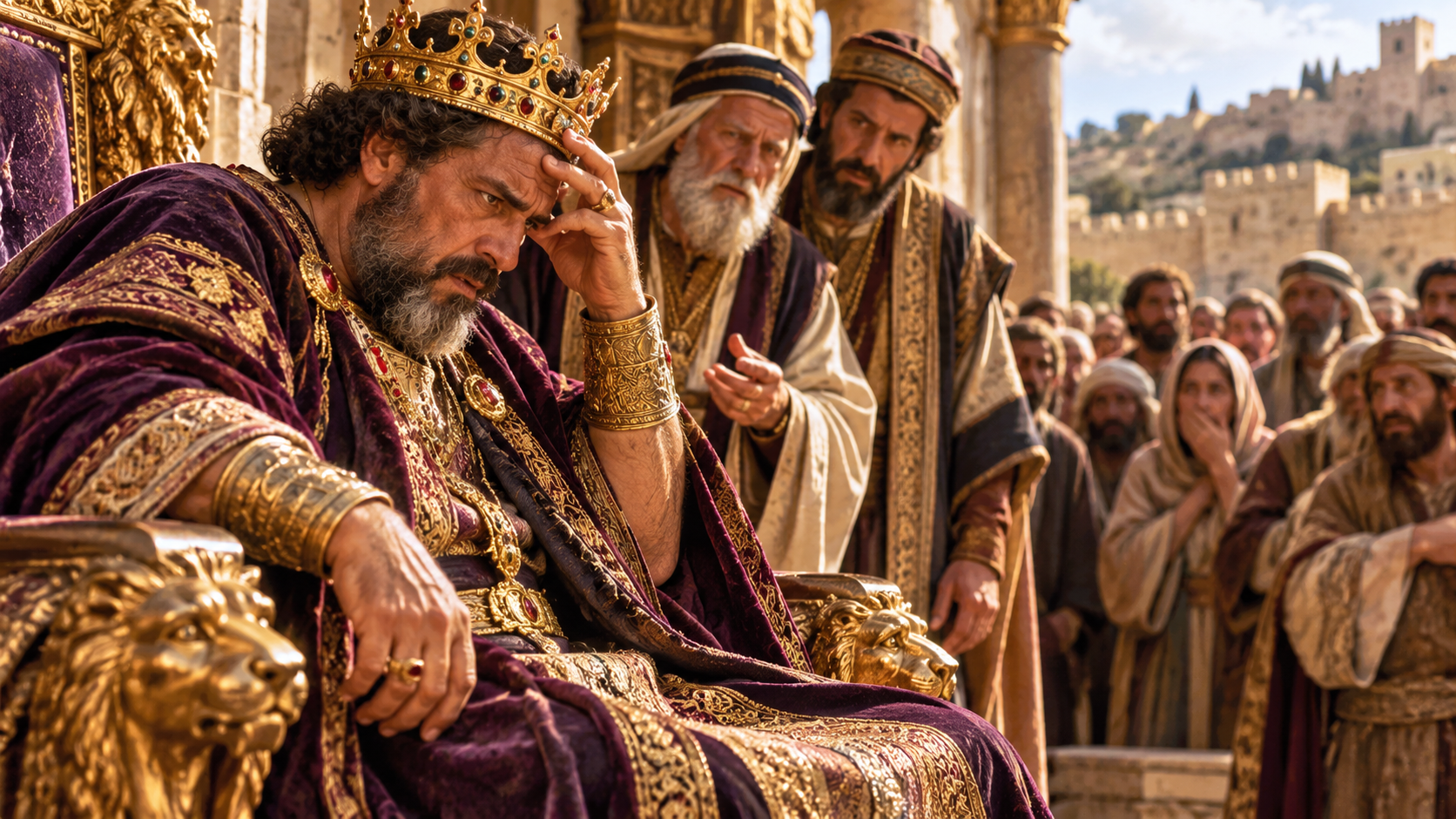
A TROUBLED
TYRANT
When Herod the king heard this - What is this? The question of the magi about another King (Mt 2:2)! Herod the king Herod had been called “king of the Jews” by the Senate in Rome for almost 40 years. Herod the king is also known as "Herod the Great." This designation of "great" is clearly in the eyes of men, but it will carry no weight with God at the Great White Throne judgment for John records "And I saw the dead, the GREAT and the small, standing before the throne, and books were opened; and another book was opened, which is the book of life; and the dead were judged from the things which were written in the books, according to their deeds...And if anyone’s name was not found written in the book of life, he was thrown into the lake of fire." (Rev 20:12,15)
D A Carson says Herod "was wealthy, politically gifted, intensely loyal, an excellent administrator, and clever enough to remain in the good graces of successive Roman emperors. His famine relief was superb and his building projects (including the temple, begun 20 B.C.) were admired even by his foes. But he loved power, inflicted incredibly heavy taxes on the people, and resented the fact that many Jews considered him a usurper. In his last years, suffering an illness that compounded his paranoia, he turned to cruelty and in fits of rage and jealousy killed close associates.” (See Matthew)
Barclay on Herod's evil disposition - “Augustus, the Roman Emperor, had said, bitterly, that it was safer to be Herod’s pig than Herod’s son. (The saying is even more epigrammatic in Greek, for in Greek hus is the word for a pig, and huios is the word for a son).” (See The Gospel of Matthew, Volume One)
Spurgeon - This trouble is again testimony to the greatness of Jesus, even as a young child. “Jesus of Nazareth is so potent a factor in the world of mind that, no sooner is he there in his utmost weakness, a now-born King, than he begins to reign. Before he mounts the throne, friends bring him presents, and his enemies compass his death.....Herod heard a good Bible study about the birthplace of the Messiah, but it did him no good. “When the earth-king dabbles in theology, it bodes no good to truth. Herod among the priests and scribes is Herod still. Some men may be well instructed in their Bibles and yet be all the worse for what they have discovered....Mark that the wise men never promised to return to Herod; they probably guessed that all this eager zeal was not quite so pure as it seemed to be, and their silence did not mean consent.
He was troubled (tarasso) - NLT = "was deeply disturbed" Just the thought of a rival King of the Jews would have been sufficient information to give him quite a fright. One can almost see him shaking which is the literal meaning of the Greek verb tarasso. This picture recalls another king named Belshazzar, who became frightened by the sudden appearance of a hand writing on the wall (Da 5:5) and as a result "the king’s face grew pale and his thoughts alarmed him, and his hip joints went slack and his knees began knocking together." (Da 5:6) Some commentators suggest that the city was disturbed not only by the news itself but by fear of how Herod would react. Herod was notoriously paranoid about rivals. He had executed his wife Mariamne and three of his own sons, Alexander, Aristobulus, and Antipater, the last only days before his own death.
Bob Utley - "he was troubled (tarasso), and all Jerusalem with him" Herod the Great was so cruel and unpredictable that when he was upset, everyone was afraid! A notable example of his cruelty was that when he was near death, he was afraid no one would mourn his passing, so he imprisoned many Pharisees who were to be crucified when he died. This would ensure that the day of his death would be a day of grieving. The order was not carried out, but it illustrates his character.
Spurgeon - “Jesus of Nazareth is so potent a factor in the world of mind that, no sooner is he there in his utmost weakness, a now-born King, than he begins to reign. Before he mounts the throne, friends bring him presents, and his enemies compass his death.”
And all Jerusalem with him - Notice the adjective “ALL.” While probably hyperbole, it clearly speaks of the majority of the unholy populace of the Holy City! Why would the Holy City be so disturbed (tarasso, stirred up, agitated) by the birth of the Holy One? In part, they likely feared how the paranoid Herod would react, since he had already murdered his own wife and sons to protect his throne (and Mt 2:16 shows their fears were justified). But their reaction also suggests that they were not living holy lives, for instead of rejoicing like the Magi (Mt 2:10), they were troubled at the news of their Messiah’s birth! Certainly the religious leaders would have been disturbed, for this true King of the Jews threatened the power base of the chief priests and the false “religion” of the scribes, which was based on rabbinical traditions rather than the Word of Truth, the Bible (Mk 7:13).
How often the very persons who live nearest to
the means of grace are those who neglect them most!
J C Ryle - These verses teach us, that it is not always those who have most religious privileges, who give Christ most honor. We might have thought that the Scribes and Pharisees would have been the first to hasten to Bethlehem, on the slightest rumor that the Saviour was born. But it was not so. A few unknown strangers from a distant land were the first, except the shepherds mentioned by St. Luke, to rejoice at His birth. “He came unto his own, and his own received him not.” (Jn 1:11) What a mournful picture this is of human nature! How often the same kind of thing may be seen among ourselves! How often the very persons who live nearest to the means of grace are those who neglect them most! There is only too much truth in the old proverb, “The nearer the church the further from God.” Familiarity with sacred things has an awful tendency to make men despise them. There are many, who from residence and convenience ought to be first and foremost in the worship of God, and yet are always last. There are many, who might well be expected to be last, who are always first. (Matthew 2 Commentary)
Was troubled (disturbed) (5015)(tarasso) literally means to shake back and forth, be agitated (like water boiling) and stir up (like the pool in John 5:4,7, Lxx = Isa 51:15 = "stirs up the sea"; Ps 46:2, 3, 6 referring to earth, water, nations; 2Sa 22:8 = of earth shaking). Most of the NT uses of tarasso are figurative and describe the state of one's mind as stirred up, agitated or experiencing inward commotion. The passive voice is always used in the NT with a negative meaning, and refers to an unsettled mind, as here when Herod heard of the birth of the King of the Jews
Tarasso is used in two commands (present imperative with a negative - stop this or do not let it begin) from Jesus to disciples (and applicable to all believers) in Jn 14:1 "Do not let your heart be troubled; believe in God, believe also in Me." and Jn 14:27 "“Peace I leave with you; My peace I give to you; not as the world gives do I give to you. Do not let your heart be troubled, nor let it be fearful." Sometimes we need to hear Jesus say this twice to us also, don't we!
TARASSO - 18V - disturbed(1), disturbing(2), stirred(3), stirring(1), terrified(2), troubled(9). Matt. 2:3; Matt. 14:26; Mk. 6:50; Lk. 1:12; Lk. 24:38; Jn. 5:4; Jn. 5:7; Jn. 11:33; Jn. 12:27; Jn. 13:21; Jn. 14:1; Jn. 14:27; Acts 15:24; Acts 17:8; Acts 17:13; Gal. 1:7; Gal. 5:10; 1 Pet. 3:14
John Butler - Sermon Starters - Volume 7 - Agitation Of Christmas Matthew 2:3
- "When Herod the king had heard these things, he was troubled, and all Jerusalem with him" (Matthew 2:3).
The word "troubled" in our text means to be agitated, agitation as water that is boiling. It is a strong word and shows hostility here.
FIRST—THE MESSAGE THAT TROUBLED
"Heard these things." The message that agitated was at least fourfold.
- The coming of Christ. The wise men had said Someone important was born. The birth of Christ was not meant with much joy in the world to which He came.
- The crown for Christ. The wise men had said that Christ was to be the "king of the Jews." (Matthew 2:2). This manifested rank and power for Jesus Christ. Herod especially would not like this.
- The celebration of Christ. The wise men were going to worship Him. Worship means reverence, respect, deference, honor. It makes the person worshipped very honored especially when the worshippers have come a long distance to worship Him. This would upset Herod.
- The communicants for Christ. Because the wise men had come a long distance to worship Him, they were obviously very dedicated and devoted to Christ. The world does not adore such people.
SECOND—THE MONARCH THAT WAS TROUBLED
"Herod." Several things about Herod are in the context of this text. No wonder he was troubled at the news of Christ's birth and worship. All of this was contrary to him.
- His character. He was very deceitful to the wise men, for he pretended to also want to worship Christ, when in fact, he wanted to do away with Christ. History is not kind to Herod. He was jealous, self-serving and proud. While alive he was called 'Herod the Great,' but death changed the 'Great' to 'Guile.' The Bible never calls him 'Great' but it does call John the Baptist and Jesus "Great." (Luke 1). He was ignorant of important spiritual truths, was hypocritical (feigned himself a worshiper of Christ), cruel (as we will note in more detail next), and contemptible.
- His cruelty. Herod lashed out in and effort to kill the Christchild by killing all the children two years and younger in the Bethlehem vicinity. History verifies his cruelty. At his death he wanted a group of people to be slain so there would be sorrow in the land when he died. He was so cruel he knew people would rejoice at his death so made this horrible decree for sorrow (which was not carried out).
THIRD—THE MUNICIPALITY THAT WAS TROUBLED
"And all Jerusalem with him." A world that calls a Herod 'Great' will not rejoice over the coming of Christ. You would expect Jerusalem, of all places, to rejoice, but it was filled with sin. We give ourselves away by what we rejoice in, criticize and compliment. Evil likes evil, not righteousness. The world despises Christianity.
Matthew 2:4 Gathering together all the chief priests and scribes of the people, he inquired of them where the Messiah was to be born.
NET After assembling all the chief priests and experts in the law, he asked them where the Christ was to be born.
GNT καὶ συναγαγὼν πάντας τοὺς ἀρχιερεῖς καὶ γραμματεῖς τοῦ λαοῦ ἐπυνθάνετο παρ᾽ αὐτῶν ποῦ ὁ Χριστὸς γεννᾶται.
NLT He called a meeting of the leading priests and teachers of religious law and asked, "Where is the Messiah supposed to be born?"
KJV And when he had gathered all the chief priests and scribes of the people together, he demanded of them where Christ should be born.
ESV and assembling all the chief priests and scribes of the people, he inquired of them where the Christ was to be born.
NIV When he had called together all the people's chief priests and teachers of the law, he asked them where the Christ was to be born.
- the chief priests- Mt 21:15,23 Mt 26:3,47 Mt 27:1 1Ch 24:4-19 2Ch 36:14 Ezr 10:5 Ne 12:7 Ps 2:2 Joh 7:32 Joh 18:3
- the chief priests- Mt 7:29 Mt 13:52 2Ch 34:13,15 Ezr 7:6,11,12 Jer 8:8 Mk 8:31 Lu 20:19 Lu 23:10 Joh 8:3 Ac 4:5 Ac 6:12 Ac 23:9
- he inquired of them - Mal 2:7 Joh 3:10
Gathering together all the chief priests: These were the temple hierarchy (the high priest and his associates) and were mostly Sadducees (Mt 3:7). At this time the high priest was appointed by the Romans. These men preferred the recognition of the political power than the recognition of the One with Power. Imagine how honored these religious leaders would be to be invited by King Herod to give spiritual advice. However it is notable that Sadducees and Pharisees (most scribes were pharisees) did not get along, but this was an exceptional case which makes me think of the enemy of my enemy is my friend!
John 12:42-43 says "Nevertheless many even of the rulers believed in Him, but because of the Pharisees they were not confessing Him, for fear that they would be put out of the synagogue; 43 for they loved the approval of men rather than the approval of God." (This is a tough one! Were the rulers true believers or were they like those in John 2:23,24? Compare Paul's teaching in Ro 10:9,10, Mk 8:34-37, 38, with other passages like Jn 19:38-39, Mk 15:43, Lk 23:50,51 - Certainly Nicodemus and Joseph of Arimathea did confess, but were there others?)
And scribes of the people - Scribes were primarily Pharisees, authorities who were interpreters of the Jewish law. Sometimes they are referred to as “lawyers” (see Lu 10:25). They were professional scholars, "teachers of the law" so called because it was their office to make copies of the Scriptures, to classify and teach the precepts of the oral law, and to keep careful count of every letter in the O.T. writings.. They knew exactly where the Messiah was to be born (Mt 2:5), but lacked the faith to accompany the magi to actually go to the place where He was. To know about Christ is not enough! One must go to Christ! Many today in America know, but fail to go in repentance and faith and will be sadly shocked in the day of judgment (cf Mt 7:21-23).
He inquired of them where the Messiah was to be born - KJV has demanded (for inquired) which is a poor translation for the word means simply to seek to learn something by asking. Inquired is in the imperfect tense indicating he asked them again and again. Although they obviously eventually did give the right answer, perhaps a number of them did not know the answer. As King he could have demanded but that is not the sense with this verb. Messiah is actually the word usually translated Christ and not the Greek word messias which means Messiah and is used only in John 1:41 and John 4:24. What do we learn from this passage? If we compare it with the question of the magi in Mt 2:2 "Where is He who has been born King of the Jews?" It is clear that the King of the Jews is the Messiah! The phrase was to be born is literally "where the Christ is born" which Robertson calls the "prophetic present" which does imply certainty or states with assurance that which is predicted. The idea is that events which are future are pictured as if present. It is worth noting that Herod actually seems to believe the Scriptures, but still seeks to destroy the King of the Jews. He was Satan’s puppet. And what about the Jewish "wise men" (scribes)? These Jewish "wise men" know and yet don't go! Gentile wise men know and go!
Constable adds that "Some of the Jews—particularly the Essenes whom Herod did not consult, but not the Sadducees and Pharisees—were expecting a Messiah to appear soon because of Daniel 9:24–27 (ED: SEE ESPECIALLY PREDICTION OF MESSIAH'S COMING IN Da 9:25 see note = "So you are to know and discern that from the issuing of a decree to restore and rebuild Jerusalem until Messiah the Prince there will be seven weeks and sixty-two weeks." cf JESUS' WARNING - "“If you had known in this day, even you, the things which make for peace!...." - see note on Lk 19:42). Daniel had been a wise man in the East also."
Gathering together (4863)(sunago from sun = with + ago = to lead, ) means literally to lead together. To gather (in) or gather (up) It is a bit ironic that this verb gives us the word synagogue the place where Jews gathered to worship. Here they gathered for what would prove to the the antithesis of worship of God, as Herod would seek to kill the King of the Jews on finding out His birthplace.
Chief priests (749)(archiereus from arche = first in a series, the leader or ruler, idea of rank or degree + hiereus = priest - hieros is that which is determined, filled or consecrated by divine power) refers to the priest that was chief over all the other priests in Israel. In the plural archiereus refers to all the ruling priests, the members of the high-priestly families as a group, the upper echelons of the priestly class, especially those who served on the Sanhedrin, the Jewish high court (Lk 9:22, Mk 8:31).
Scribes (1122)(grammateus from grapho = to write) was one skilled in Jewish law and theology scribe, expert, scholar (Mt 2.4). Grammateus also referred to a chief executive officer of a governmental entity such as a town official secretary, town clerk (Acts 19.35). Jesus gives a long rebuke including 8 WOES primarily to the Scribes and Pharisees which should be read to help understand how this group of Jewish religious men functioned (See Mt 23:1-39, 13, 14, 15, 16, etc). Most sources consider the lawyers (nomikos - meaning one skilled in the Mosaic law) to be scribes specialized in the jurisprudence of the Law of Moses. Finally the scribes in Lk 5:17 (nomdidaskalos) were teachers of the Jewish law who were equal to the lawyers and scribes MacArthur adds that "Not all Pharisees were scribes, but the scribes were primarily Pharisees, who were interpreters and teachers of the law of Moses and the traditional rabbinic writings. Their teaching provided the theological framework for the Pharisees’ legalistic system of works-righteousness. The scribes were the dominant force in Judaism, not only theologically, but socially. Their views affected every aspect of life, and they also handled all legal matters, including property, estates, and contracts. They were revered, and given the respectful title of Rabbi (Mt. 23:7). That title was sometimes given to Jesus because He was a teacher (cf. John 1:38, 49; John 3:2, 26; John 6:25). It was commonly believed that Moses received the law, then gave it to Joshua, who gave it to the elders, who gave it to the prophets, who gave it to the scribes. (Luke Commentary on Lk 20:46)
Messiah (literally Christ)(5547)(Christos from chrio = to rub or anoint, consecrate to an office) describes one who has been anointed with oil, one who has been consecrated. The majority of the NT uses refer to Jesus. Christos describes Jesus as the "Anointed One" the Greek synonym for "Messiah (Anointed One).
Inquired (ask)(4441)(punthanomai means to inquire, ask, seek to learn usually from someone (Mt 2:4; Lk 15:26; Lk 18:36; Jn 4:52; Acts 4:7; Acts 10:18, 29; Acts 21:33; Acts 23:19f. The word carries the sense of asking by inquiry, rather than asking by making a request to receive
Inquiry Of Ignorance
- Matthew 2:4 "And when he had gathered all the chief priests and scribes of the people together, he demanded of them where Christ should be born"
The wise men had asked where this special person was bom and Herod would find out for them in spite of his spiritual ignorance.
FIRST—HIS SYCOPHANTS
"He . . . gathered all the chief priests and scribes of the people together." Herod had the religious leaders as sycophants. They fawned his person for special favors. Therefore it was no trick for him to gather the religious leaders together to learn where the Christ-child was born. There are always those ministers who are more interested in political clout then they are in spiritual clout. They prefer the recognition of the powers that be to the recognition of the Power that is, namely, God. "They loved the praise of men more than the praise of God" (John 12:43). If they prefer Christ, they will be secret disciples like Joseph of Arimathaea. They equate respect for high office with fawning of high officers (though evil). We could do without this kind. One can easily imagine how honored these religious leaders would be to be invited to give Herod some spiritual advice. In their long and decorative robes they would vie with one another to be the closet to wicked Herod so they could boast about it at the next Sanhedrin meeting.
SECOND—HIS SERIOUSNESS
"Demanded." The translation is a bit strong. It means simply to inquire, to seek information etc. But the tense of the verb gives away the seriousness of Herod. It is in the perfect tense which means Herod continually asked them where Christ would be born. You can see why the translators used "demanded." Herod was a worried man. "King of the Jews" (Matthew 2:2) upset him and he looked at Christ as an usurper. He must know where Christ is to be born so he can take immediate action to stop the Christ-child from taking Herod's prestigious and powerful throne. Herod was very serious in his inquiry. He did not 'demand' as we think of 'demanding' today, but his continual repeating of his request showed his agitation.
THIRD—HIS STUPIDITY
"He demanded of them where Christ should be born." Herod was spiritually a dunce. He did not know the important facts spiritually. He obviously knew how to politic. He curried Rome into making him a very powerful ruler over Israel. But he did not know much spiritually. He would get along well with our politicians today. Be they Republican or Democrat, they all have one thing in common—they know little, if anything about spiritual matters. They know how get elected again and again but they do not know anything much where it really matters. They approve of things the Bible condemns (abortion, homosexualism, gambling, and booze) and do not seem to realize that the solution to the world's problems is being in deference to Christ. (John Butler - Sermon Starters - Volume 7)
Matthew 2:5 They said to him, "In Bethlehem of Judea; for this is what has been written by the prophet:
NET "In Bethlehem of Judea," they said, "for it is written this way by the prophet:
GNT οἱ δὲ εἶπαν αὐτῷ, Ἐν Βηθλέεμ τῆς Ἰουδαίας· οὕτως γὰρ γέγραπται διὰ τοῦ προφήτου·
NLT "In Bethlehem in Judea," they said, "for this is what the prophet wrote:
KJV And they said unto him, In Bethlehem of Judaea: for thus it is written by the prophet,
ESV They told him, "In Bethlehem of Judea, for so it is written by the prophet:
NIV "In Bethlehem in Judea," they replied, "for this is what the prophet has written:
- Ge 35:19 Jos 19:15 Ru 1:1,19 Ru 2:4 Ru 4:11 1Sa 16:1
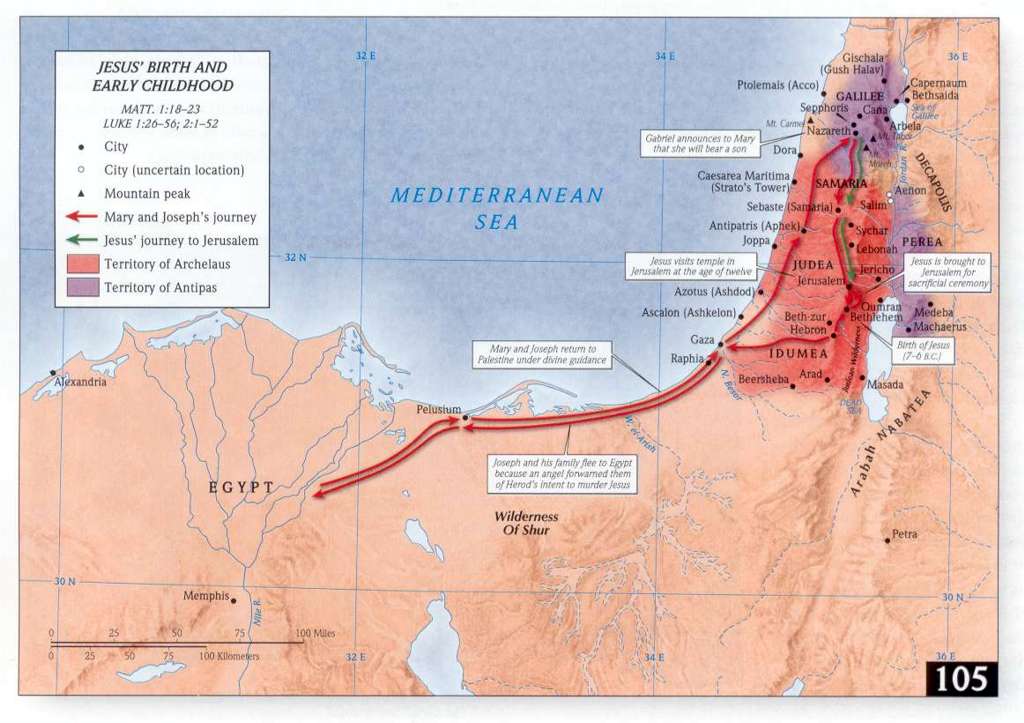
Events of Jesus' birth. See another map without captions.
Holman Bible Atlas (digital; Hardcover) © 1998 B&H Publishing by permission.
Please do not download or copy.
BORN IN THE VERY CITY
GOD PREDICTED
They - The religious experts, "all the chief priests and scribes" Herod had summoned.
Said to him, "In Bethlehem of Judea; for this is what has been written (grapho) by (dia) the prophet (prophetes) - This is interesting. They did not answer, we need to go back to our Scriptural scrolls and check this one out. They seem to know the answer (after Herod had inquired several times - see notes on Mt 2:4). This is sad when religious leaders know the answers but fail to communicate (much less even believe) the truth to those under their tutelage! The priests were to teach the people and they did apparently know the facts but there was a problem (Ezek 44:23) There is no record of them going to Bethlehem! They know but refuse to go! Wow! What a striking contrast - Gentile Magi traveled hundreds of miles with far less light, while the experts in Scripture stayed home. What's wrong with this picture?
Some 30 years later Jesus would again describe the same tragedy of disparity between head knowledge and heart transformation declaring “You search the Scriptures because you think that in them you have eternal life; it is these that testify about Me; and you are unwilling to come to Me so that you may have life” (Jn 5:39,40).
Has been written (grapho) is in the perfect tense, which stresses a past act with lasting results and could be rendered something like “it was written, and it still stands written.” In short, it is the formula of Scripture’s permanent authority. It is in the passive voice, which means the subject (the text) receives the action, and the writer is not named as the subject. The passive voice with “by” (or “through,” dia) “the prophet” implies that the prophet was the intermediate agent (the “instrument”) and God was the ultimate Author, as Matthew states explicitly in Mt 1:22 and Mt 2:15: “what was spoken by the Lord through the prophet.” In this sense, grapho functions as a divine passive. Peter makes clear that the Holy Spirit is the divine Author explaining that “no prophecy was ever made by an act of human will, but men moved by the Holy Spirit spoke from God” (2Pe 1:21; cf. 2Ti 3:16). The prophet Micah was moved by the Spirit, even as Matthew was moved by the Spirit to pen the Gospel we are reading.
John Walvoord - Matthew adroitly answers Jewish unbelief concerning Jesus Christ by quoting their own official body to the effect that the prophecy of His birth in Bethlehem was literal, that the Messiah was to be an individual, not the entire Jewish nation, and that their Messiah was to be a King who would rule over them. (Matthew - Thy Kingdom Come)
There may be knowledge of Scripture in the head, while there is no grace in the heart.
...Let us all beware of resting satisfied with head-knowledge
J C Ryle - These verses teach us, that there may be knowledge of Scripture in the head, while there is no grace in the heart. Mark how king Herod sends to inquire of the priests and elders “where Christ should be born.” Mark what a ready answer they return him, and what an acquaintance with the letter of Scripture they show. But they never went to Bethlehem to seek for the coming Saviour. They would not believe in Him, when He ministered among them. Their heads were better than their hearts.—Let us all beware of resting satisfied with head-knowledge. It is an excellent thing, when rightly used. But a man may have much of it, and yet perish everlastingly. What is the state of our hearts? This is the great question. A little grace is better than many gifts. Gifts alone save no one. But grace leads on to glory. (Matthew 2 Commentary)
Has been written (1125) (grapho) from root graph- = primarily means to scratch on or engrave as on an ornament, reports, letters, etc; English = graph, graphic, etc) means to engrave or inscribe with a pen or stylus characters or letters on a surface which can be wood, wax, metal, leather, stone, parchment, dirt (John ), paper, etc. The similar phrase it is written is frequent in the Gospels - Matt. 4:4; Matt. 4:6; Matt. 4:7; Matt. 4:10; Matt. 11:10; Matt. 21:13; Matt. 26:24; Matt. 26:31; Mk. 1:2; Mk. 7:6; Mk. 9:13; Mk. 14:21; Mk. 14:27; Lk. 2:23; Lk. 3:4; Lk. 4:4; Lk. 4:8; Lk. 4:10; Lk. 7:27; Lk. 19:46; Lk. 24:46; Jn. 6:31; Jn. 6:45; Jn. 12:14
It is written should be in the heart
and on the lips of every Christian
🙏 THOUGHT - It is written ("It stands written") occurs 76 times in the Bible and four uses are in the temptation of Christ, 3x by Jesus and once by the Tempter (Matt. 4:4; Matt 4:6; Matt 4:7; 4:10). When we were children and our parents told us to do something and we questioned "Why?", the answer was usually "Because I said so!". Why are we commanded to be holy? Because God said so! A popular saying is "God said it, I believe it, that settles it." This sounds good but isn't accurate because God's Word is true, irregardless of whether we believe it or not. A more accurate "saying" would be God said it, that settles it! It is written (or "has been written") should put a stop to every complaint or excuse. In essence, Jesus sets Satan's suggestion next to Scripture's statement. There is an important principle here - we should always lay God's Word besides Satan's subtle seductions - The best way to show a stick is crooked is not to argue about it or spend time denouncing it, but to lay a straight stick alongside it. “It is written” should be in the heart and on the lips of every Christian." (F. Whitfield ) “It is written” should decide every controversy, settle every doubt, and overcome every difficulty. (Amen!)
🙏 THOUGHT - Grapho is in the perfect tense which indicates that God's Word was written down at a point in time and stands written! It is still in force, still relevant to your life! Jesus in fact said “Heaven and earth will pass away, but My words will not pass away." (Mt 24:35) This begs the question - why don't we memorize His Word? All of the shiny trinkets and babbles we spend time collecting will vanish (cf 1 Jn 2:17), but God's Word will endure. Eat the Word beloved (1 Pe 2:2, Heb 5:14), so that you may be enabled by the Spirit to meditate on the Word anywhere, anytime and you will also experience the promised blessings of meditation (Ps 1:1, Ps 1:2, Ps 1:3, Joshua 1:8)
Prophet (4396)(prophetes from próphemi = literally to tell beforehand in turn from pró = before, in front of, forth, on behalf of + phemí = speak, tell) is primarily a forth-teller or one who speaks out God’s message, primarily to their own generation, usually always calling the people to God's truth for them at that moment, often using the phrase "Thus saith the Lord." The prophet is one who speaks before in the sense of proclaim, or the one who speaks for, i.e., in the Name of (God). "As distinct from the sacral figures of pagan antiquity the biblical prophet is not a magician. He does not force God. On the contrary, he is under divine constraint. It is God Who invites, summons, and impels him--e.g., Jer 20:7" (Lamorte and Hawthorne) Although we commonly think of the prophet as predicting future events (foretelling) generally this was secondary to his work of forth-telling. When they functioned as predictors or prognosticators, the Biblical prophets foretold the future with 100 percent accuracy. And so if they were correct on the first coming of Messiah, they will be correct on His second coming and on the coming of the antichrist. In sum, forth-telling dealt with current events and fore-telling with future events, but in both the goal is the same -- to call us to trust the Lord and submit to His will for our lives, living in conformity with His Word. Matthew uses this word four times in chapter 2 - Mt 2:5, Mt 2:15, Mt 2:17, Mt 2:23.
Matthew 2:1 with Micah 5:2 Perfect Predictions
At the beginning of a new year and a new millennium, we hear many predictions. But then, making predictions is nothing new. In 1983, US News & World Report magazine had a section titled “What The Next 50 Years Will Bring.” It had the usual suggestions about the growing importance of computers, about new medical breakthroughs, and about the sleeker, faster ways of getting around. The introduction said, “Prediction is at best a risky business.” Then it quoted Sir Francis Bacon, who said, “Dreams and predictions ought to serve but for winter talk by the fireside.”
That may be true of man’s predictions, but not of God’s prophecies. Man may speculate about what will happen next week, but God showed us in the Bible that He knows the future. This truth is one reason we can have absolute confidence in the Book of books. The Old Testament contains hundreds of prophecies about people, events, and nations that have already been fulfilled. The chance of that many predictions coming true is astronomical.
Do you lack confidence in the Bible? Spend some time examining its many fulfilled prophecies. I predict you’ll be convinced that it truly is God’s Word, and that you can rely on it for everything in your future.
For Further Study
Look up the following prophecies and their fulfillment:
Isaiah 7:14 & Luke 1:26-35;
Micah 5:2 & Matthew 2:1;
Isaiah 53:9,12 & Matthew 27:38,57-61.
In a changing world you can trust God's unchanging Word.
It has been estimated that there are 333 prophecies in the Old Testament that are fulfilled in the Messiah. Clearly the fulfillment of all 333 in one Man would be literally impossible based on chance alone. But what about the odds against even a smaller number being fulfilled by chance. Click for an illustration of the statistical unlikelihood that even 8 of OT prophecies could have fulfilled in Jesus merely by chance (See also Stoner in Science Speaks). Jesus Himself taught in one of His post-resurrection appearances that...
"beginning with Moses and with all the prophets, He explained to them the things concerning Himself in all the Scriptures." (Luke 24:27)
The Messiah (Christ) is the Word of God (Jn 1:1) and so it should come as no surprise that He is described in every Old Testament book.
- In Genesis He is the Seed of the woman (Ge 3:15).
- In Exodus He is the Lamb of God for sinners slain (Ex 12:5, 6, 7, 11).
- In Leviticus He is our High Priest (the whole book).
- In Numbers He is the Star out of Jacob (Nu 24:17).
- In Deuteronomy He is the Prophet like unto Moses (Dt 18:15).
- In Joshua He is the Captain of the Lord’s armies (Josh 5:13, 14, 15).
- In Judges He is the Angel of the LORD or the messenger of Jehovah (Jdg 13:18, 19, 20, 21, 22, 23).
- In Ruth He is our Kinsman-Redeemer (Chapter 3).
- In Samuel, Kings and Chronicles He is the King of Kings and Lord of Lords (1Sa 8:1, 2, 3, 4, 5, 6, 7, 8, 9).
- In Ezra, Nehemiah and Esther He is the sovereign Lord over all the kingdoms of the earth (entire books).
- In Job He is our risen and returning Redeemer (Job 19:25).
- In Psalms He is the Blessed Man (Psalm 1:1, 2, 3), the Son of Man (Psalm 2:2, 3, 4, 5, 6, 7, 8, 9, 10, 11, 12), the Crucified One (Psalm 22), the Coming One (Psalm 24), the Reigning One (Psalm 72).
- In Proverbs He is our Wisdom (Pr 14).
- In Ecclesiastes He is the forgotten Wise Man (Eccl 9:14, 15).
- In Song of Solomon He is my Beloved (Song 2:16).
- In Isaiah He is our suffering Substitute (Isa 53).
- In Jeremiah He is the LORD OUR RIGHTEOUSNESS (Jer 23:6).
- In Lamentations He is the Man of sorrows who weeps for His people (Lam 1:12, 13, 14, 15, 16, 17, 18).
- In Ezekiel He is the glory of God (Ezek 1:28).
- In Daniel He is the Smiting Stone (Da 2:34) and the Companion in the furnace of fire and the den of lions (Da 3:24, 25; Da 6:22).
- In Hosea He is David’s Greater King (Hos 3:5).
- In Joel He is the Hope of His people (Joel 3:16).
- In Amos He is the Rescuer of Israel (Amos 3:12).
- In Obadiah He is the Deliverer upon Mount Zion (Oba 1:17).
- In Jonah He is the buried and risen Saviour (compare Mt 12:40).
- In Micah He is the Everlasting God born in Bethlehem (Mic 5:2).
- In Nahum He is our Stronghold in the day of wrath (Nah 1:7).
- In Habakkuk He is the Anchor of our faith (Hab 2:4).
- In Zephaniah He is in the midst for judgment and cleansing (Zeph 3:5,15).
- In Haggai He is Lord of presence and power (Hag 1:13).
- In Zechariah He is the coming king riding on a donkey (Zech 9:9).
- In Malachi He is the Sun of Righteousness (Mal 4:2).
Related Resources:
- Messianic Prophecy
- Josh McDowell's classic "More than a Carpenter" - good book to suggest to your skeptical friends!
- How a Jewish man Michael Goldstone met Messiah - site has multiple similar video testimonies
- Messianic Prophecies • WebBible Encyclopedia • ChristianAnswers.Net
- AccordingtotheScriptures.org -- 353 Prophecies Fulfilled in Jesus Christ - nice simple chart
- Jesus and messianic prophecy - Wikipedia
- Messianic Prophecy
- Messianic Prophecies - Bible.org - J. Hampton Keathley, III
- Prophecies Concerning Christ - Michael Finlay
- Prophecies of the Birth of Christ - J. Hampton Keathley, III
- The Story of the "Seed" - The Coming of the Promised Messiah - Bob Deffinbaugh
- Prophecies of Jesus Christ as Messiah
- Chris Tomlin's song Jesus Messiah
- Messianic Prophecies in Isaiah - 20 part Series by S Lewis Johnson
- The Messianic Hope of Israel - Series - Max Reich
- Messianic Prophecy in the Old Testament - Wil Pounds
- Messianic Prophecies, Types & Applications in the Old Testament - Wil Pounds
- Numbers 24:15-19 A Star Will Come out of Jacob - Greg Herrick
- Numbers 24:17-19 Messianic Prophecies - Allen Ross
- The Amazing Prophecy Of Names - A study of Isaiah's names for the Savior
- Commentary on Messianic Predictions (V1-Gen, Ps, Minor Prophets) - E W Hengstenberg (Pdf)
- Commentary on Messianic Predictions (V2-Isa, Zeph, Jer) - E W Hengstenberg
- The Jewish Tradition Of Two Messiahs - RBC
- 2 Timothy 3:16-17: Study on Authority of God's Word
- The Power of God's Word - a simple study
- The Necessity of Scripture (Pdf) - William D. Barrick
- The Sufficiency of Scripture (Pdf) - John MacArthur (also here)
- Rationality, Meaningfulness & Precision of Scripture - Robert L. Thomas
- The Authority of Scripture (Pdf) - Richard L. Mayhue
- The Testimony of Prophecy by Charles Simeon (Or Here - scroll down to 2 Peter 1:19)
Matthew 2:6 'AND YOU, BETHLEHEM, LAND OF JUDAH, ARE BY NO MEANS LEAST AMONG THE LEADERS OF JUDAH; FOR OUT OF YOU SHALL COME FORTH A RULER WHO WILL SHEPHERD MY PEOPLE ISRAEL.'"
NET 'And you, Bethlehem, in the land of Judah, are in no way least among the rulers of Judah, for out of you will come a ruler who will shepherd my people Israel.'"
GNT Καὶ σὺ Βηθλέεμ, γῆ Ἰούδα, οὐδαμῶς ἐλαχίστη εἶ ἐν τοῖς ἡγεμόσιν Ἰούδα· ἐκ σοῦ γὰρ ἐξελεύσεται ἡγούμενος, ὅστις ποιμανεῖ τὸν λαόν μου τὸν Ἰσραήλ.
NLT 'And you, O Bethlehem in the land of Judah, are not least among the ruling cities of Judah, for a ruler will come from you who will be the shepherd for my people Israel.' "
KJV And thou Bethlehem, in the land of Juda, art not the least among the princes of Juda: for out of thee shall come a Governor, that shall rule my people Israel.
ESV "'And you, O Bethlehem, in the land of Judah, are by no means least among the rulers of Judah; for from you shall come a ruler who will shepherd my people Israel.'"
NIV " 'But you, Bethlehem, in the land of Judah, are by no means least among the rulers of Judah; for out of you will come a ruler who will be the shepherd of my people Israel.' "
- YOU, BETHLEHEM - Mt 2:1 Mic 5:2 Joh 7:42
- A RULER- Mt 28:18 Ge 49:10 Nu 24:19 1 Chr 5:2 Ps 2:1-6 Isa 9:6-7 Eph 1:22 Col 1:18 Rev 2:27 Rev 11:15
- WHO WILL SHEPHERD MY PEOPLE ISRAEL - Ps 78:71,72 Isa 40:11 Jer 23:4-6 Eze 34:23-25 Eze 37:24-26
Related Passages:
Micah 5:2 “But as for you, Bethlehem Ephrathah, Too little to be among the clans of Judah, From you One will go forth for Me to be ruler in Israel. His goings forth are from long ago, From the days of eternity.”
NET Micah 5:2 As for you, Bethlehem Ephrathah, seemingly insignificant among the clans of Judah– from you a king will emerge who will rule over Israel on my behalf, one whose origins are in the distant past. (Mic 5:2NET)
2 Samuel 5:2 “Previously, when Saul was king over us, you were the one who led Israel out and in. And the LORD said to you, ‘You will shepherd My people Israel, and you will be a ruler over Israel.’”
1 Chronicles 11:2 “In times past, even when Saul was king, you were the one who led out and brought in Israel; and the LORD your God said to you, ‘You shall shepherd My people Israel, and you shall be prince over My people Israel.’”
Luke 2:4 Joseph also went up from Galilee, from the city of Nazareth, to Judea, to the city of David which is called Bethlehem, because he was of the house and family of David,
John 7:42 “Has not the Scripture said that the Christ comes from the descendants of David, and from Bethlehem, the village where David was?”
Genesis 49:10 “The scepter shall not depart from Judah, Nor the ruler’s staff from between his feet, Until Shiloh comes, And to him shall be the obedience of the peoples.
Numbers 24:19 “One from Jacob shall have dominion, And will destroy the remnant from the city.”
Isaiah 9:6-7 For a child will be born to us, a son will be given to us (INCARNATION); And the government will rest on His shoulders (RULING AS KING IN MESSIANIC KINGDOM); And His name will be called Wonderful Counselor, Mighty God, Eternal Father, Prince of Peace. 7 There will be no end to the increase of His government or of peace (cf Da 7:14 "His dominion is an everlasting dominion"; Da 7:27 "His kingdom will be an everlasting kingdom, and all the dominions will serve and obey Him."), On the throne of David and over his kingdom, To establish it and to uphold it with justice and righteousness From then on and forevermore. The zeal of the LORD of hosts will accomplish this.
Psalms 2:1-6 Why are the nations in an uproar And the peoples devising a vain thing? 2 The kings of the earth take their stand And the rulers take counsel together Against the LORD and against His Anointed, saying, 3 “Let us tear their fetters apart And cast away their cords from us!” 4 He who sits in the heavens laughs, The Lord scoffs at them. 5 Then He will speak to them in His anger And terrify them in His fury, saying, 6 “But as for Me, I have installed My King Upon Zion, My holy mountain.”
Matthew 25:31-32 (WHY ISRAEL NEEDED MESSIAH TO BE THEIR SHEPHERD) “But when the Son of Man comes in His glory, and all the angels with Him, then He will sit on His glorious throne. 32 “All the nations will be gathered before Him; and He will separate them from one another, as the shepherd separates the sheep from the goats;
Zechariah 10:2 (WHY ISRAEL NEEDED MESSIAH TO BE THEIR SHEPHERD) For the teraphim speak iniquity, And the diviners see lying visions And tell false dreams; They comfort in vain. Therefore the people wander like sheep, They are afflicted, because there is no shepherd.
Mark 6:34 (WHY ISRAEL NEEDED MESSIAH TO BE THEIR SHEPHERD) When Jesus went ashore, He saw a large crowd, and He felt compassion for them because they were like sheep without a shepherd; and He began to teach them many things.
1 Kings 22:17 (2Ch 18:16) (WHY ISRAEL NEEDED MESSIAH TO BE THEIR SHEPHERD) So he said, “I saw all Israel Scattered on the mountains, Like sheep which have no shepherd. And the LORD said, ‘These have no master. Let each of them return to his house in peace.’”
BETHLEHEM HOUSE OF BREAD
BIRTHPLACE OF BREAD OF LIFE
AND YOU, BETHLEHEM, LAND OF JUDAH, ARE BY NO MEANS LEAST AMONG THE LEADERS OF JUDAH - Remember all CAPS in the NASB identifies a direct Old Testament quotation. Here Matthew records the chief priests and scribes citing (presumably from memory) Micah 5:2 to identify Bethlehem as the birthplace of the Messiah. Although Bethlehem was a small and seemingly insignificant town, it would receive extraordinary distinction as the birthplace of Israel's promised King.
FOR (term of explanation) OUT OF YOU SHALL COME FORTH A RULER (hegemon - one who rules in a preeminent position) - This is the first of four fulfilled prophecies in chapter 2 of Matthew - (1) Mt 2:6 fulfilled Micah 5:2 (2) Mt 2:15 fulfilled Hosea 11:1 (3) Mt 2:18 fulfilled Jeremiah 31:15 and (4) Mt 2:23 is said to "fulfill what was spoken through the prophets." There is however no specific prophecy or prophecies that can be definitely linked to Matthew 2:23. See discussion below on OT quotes in the NT.
WHO WILL SHEPHERD (poimaino) MY PEOPLE ISRAEL - This prophecy combines Mic. 5:2 and 2Sa 5:2 where the LORD declares that David will shepherd His people Israel and become their ruler. Thus Matthew emphasizes that Jesus is not merely Israel's promised King but also her Shepherd-King, the greater Son of David Who will rule with both royal authority and shepherd-like care (Ezek 34:23–24; Mt 25:31–32; Jn 10:11).
The reference to “My people Israel” preserves the distinctly Jewish flavor of the prophecy. Matthew identifies Jesus as the promised Davidic Messiah whose coming fulfills God's ancient promises to Israel.
🙏 THOUGHT – Beloved, how remarkable that the promised Ruler of Israel was born not in the splendor of Jerusalem but in humble Bethlehem! God's ways often overturn human expectations (1Co 1:27–29). Yet the greater wonder is the character of this King. Jesus declared, “I am the good shepherd; the good shepherd lays down His life for the sheep” (Jn 10:11). The One destined to rule the nations first came to give His life for sinners (Mk 10:45). We can entrust ourselves to Him because His authority is matched by His sacrificial love. The hands that will one day hold the scepter are the very hands that were pierced for His sheep!
Shepherd (4165) poimaino from poimen = shepherd) was one who tended flocks like a shepherd and who carried out oversight, protecting, leading, encouraging, discipling, guarding, guiding and feeding ("feed and lead"). The verb describes the full work of a shepherd, which involves far more than feeding. A shepherd leads the flock to pasture and water, protects it from predators, guides it along safe paths, gathers the strays, tends the sick and injured, and exercises oversight over the whole flock. The verb could be summarized as “feed and lead.” In classical Greek poimainō means primarily “to herd” or “to tend,” and it was often used figuratively of one who cherishes, guides, rules, or governs. The idea of the ruler as the “shepherd of the people” goes back at least to Homer, who called kings “shepherds of the peoples,” and it was common throughout the ancient Near East.
POIMAINO - 11V - caring(1), rule(3), shepherd(5), tending sheep(1), tends(1). Matt. 2:6; Lk. 17:7; Jn. 21:16; Acts 20:28; 1 Co. 9:7; 1 Pet. 5:2; Jude 1:12; Rev. 2:27; Rev. 7:17; Rev. 12:5; Rev. 19:15
QUESTION - Is Micah 5:2 a Messianic prophecy? GOTQUESTIONS.ORG
ANSWER - Micah 5:2 predicts, “But you, O Bethlehem Ephrathah, who are too little to be among the clans of Judah, from you shall come forth for me one who is to be ruler in Israel, whose coming forth is from of old, from ancient days.” The verse clearly speaks of a coming king in Israel, but does it predict the coming of the Messiah?
Micah 5:2 makes a couple of predictions.
First, the birthplace of this future “ruler of Israel” would be Bethlehem Ephrathah. Since there were two locations known as Bethlehem at the time of Micah’s writing, the addition of Ephrathah is significant. It specifies the Bethlehem in Judah, the portion of Israel in which the capital, Jerusalem, was located. Bethlehem was considered “little,” or insignificant, among the cities of Judah, yet would serve as the birthplace of this future ruler.
Second, the coming ruler of Jewish background was one “whose coming forth is from old, from ancient days.” What else could this refer to other than the Messiah? Only the Messiah fits the description of a ruler in Israel whose origin was from times past. In fact, “from ancient days” is sometimes synonymous with “eternal” (as in Habakkuk 1:12). Only the Jewish Messiah could be a ruler in Israel from eternity past.
This interpretation is strengthened by the fact that the Jewish religious leaders in the first century identified Micah 5:2 as a Messianic prophecy. In Matthew 2, wise men from the East visited King Herod in Jerusalem and asked where the king of the Jews had been born. Herod assembled all the chief priests and scribes, and “he inquired of them where the Christ was to be born. They told him, ‘In Bethlehem of Judea,’” basing their answer on Micah 5:2.
Only Jesus Christ fits the Messianic claims of Micah 5:2. He was born in Bethlehem Ephrathah (Matthew 2; Luke 2:1-20). Jesus claimed to be the Messiah, the ruler of Israel (John 4:25, 26). He also fits the description as being “from ancient times” or eternal (John 1:1; Colossians 1:16,17). No other ruler in Israel fits these requirements. Dozens of other direct prophecies in the Old Testament (some scholars cite hundreds) fit Jesus’ birth, ministry, and death.
Jesus told the Jews that the Law and the Prophets provided a clear witness that He was who He claimed to be. “These are the Scriptures that testify about me,” He said (John 5:39). Still today, those who investigate the prophecy of Micah 5:2 and other Messianic passages find compelling evidence that Jesus is the Messiah, the Son of God.
John Butler - Sermon Starters - Volume 7 Knowing But Not Going
- Matthew 2:6 "And thou Bethlehem, in the land of Juda, art not the least among the princes of Juda; for out of thee shall come a Governor, that shall rule my people Israel."
Herod was not disappointed. His religious sycophants had the answer for Him as to where Christ would be born.
FIRST—THE PLACE IN THE ANSWER
"And thou Bethlehem, in the land of Juda, art not the least among the princes of Juda." The religious leaders that toadied up to Herod knew but did not practice Scripture. They told Herod Christ would be born in Bethlehem, and they quoted Micah 5:2 to confirm their claim.
- The size. "Least among the princes of Juda." The size of Bethlehem was so small that sometimes it was left off the list of towns of that area (namely Judah). But God does not reject small. Size is not the criteria for service but character is. Bethlehem may be small, but during World War II President Roosevelt and Prime Minister Winston Churchill sat side by side sing on board a ship at a Christmas service singing, "O Little Town of Bethlehem." Take care of your character, God will take care of your calling. Regardless of how obscure you may be. He can make a small Bethlehem into a significant place. The site. "In the land of Juda." This information would identity what Bethlehem was spoken of in Scripture. It would also tell Herod that it was close by his location so he could quickly and cruelly end this opposition to his rule. There was another Bethlehem in the north in Zebulon so Herod needed to know which Bethlehem.
SECOND—THE PRODUCT IN THE ANSWER
"A governor, that shall rule my people Israel." The passage quoted by the religious leaders also said some important truths about the Person who was born in Bethlehem.
- The position. "Governor." This person born in Bethlehem was called "Governor." This word means the principle ruler, Christ will be "King of kings and Lord of lords." (Revelation 19:16).
- The purpose. "Shall rule my people Israel." He, not Herod, will be "king of he Jews. (Matthew 2:2). "Rule" could be translated 'shepherd.' It will be a much better rule then Herod's oppressive rule. Yet people vote for Herod because he does not disturb their sinning.
THIRD—THE PASSIVENESS IN THE ANSWER
"There shall come." The religious leaders knew but did not go.
- Their disinterest. The religious leaders did not want Christ and here evidence absolutely no interest in him. Religion had degenerated into political and cultural correctness.
- Their detachment. The religious leaders made no application to their information. This is the habit of many today. I had an adult Sunday School teacher in my Chicago church who could wax eloquent with information, but had no application. He was a very popular teacher because no application means no conviction and no rebuking. ()
MATTHEW 2:6—How can we explain Matthew’s apparent misquotation of Micah 5:2? Norman Geisler - When Critics Ask
PROBLEM:
Matthew 2:6 quotes Micah 5:2. However, the words Matthew uses are different than those used by Micah.
SOLUTION:
Although Matthew seems to have changed some of the words from the passage in Micah, there is no real deviation in the meaning of the text. Matthew, in some instances, seems to have paraphrased.
First, Matthew inserts the phrase “land of Judah” for the word “Ephrathah.” This does not really change the meaning of the verse. There is no difference between the land of Judah and Ephrathah, except one is more specific than the other. In fact, Ephrathah refers to Bethlehem in the Micah passage, and Bethlehem is located in the land of Judah. However, this does not change the basic meaning of this verse. He is speaking of the same area of land. Interestingly, when Herod asked the chief priests and the scribes where the child was to be born, they said, “in Bethlehem of Judea” (Matt. 2:5, NASB).
Second, Matthew describes the land of Judah as “not the least” but Micah states that it is “little.” Here, Matthew may be saying that since the Messiah is to come from this region, it is by no means least among the other areas of land in Judah. The phrase in Micah only says that Bethlehem is too little or small, as compared to the other areas of land in Judah. The verse does not say it is the least among them, only very little. Matthew is saying the same thing in different words, namely, that Bethlehem is little in size, but by no means the least in significance, since the Messiah was born there.
Finally, Matthew uses the phrase “who will shepherd My people Israel” and Micah does not. Micah 5:2 recognizes that there will be a ruler in Israel, and Matthew recognizes this as well. However, the phrase that is not mentioned in Micah is actually taken from 2 Samuel 5:2. The combining of verses does not take away what is being said, but it strengthens the point that the author is making. There are other instances where an author combines one Scripture with another. For example, Matthew 27:9–10 combines some of Zechariah 11:12–13 with Jeremiah 19:2, 11 and 32:6–9. Also, Mark 1:2–3 combines some of Isaiah 40:3 with Malachi 3:1. Only the first passage is mentioned, since it is the main passage being cited.
In brief, Matthew is not misrepresenting any information in his quotation of Micah 5:2 and 2 Samuel 5:2. Matthew’s quote is still accurate even though he paraphrases part of it and combines another portion of Scripture with it.
Matthew 2:7 Then Herod secretly called the magi and determined from them the exact time the star appeared.
KJV Then Herod, when he had privily called the wise men, enquired of them diligently what time the star appeared.
NET Then Herod privately summoned the wise men and determined from them when the star had appeared.
NLT Then Herod called for a private meeting with the wise men, and he learned from them the time when the star first appeared.
ESV Then Herod summoned the wise men secretly and ascertained from them what time the star had appeared.
NIV Then Herod called the Magi secretly and found out from them the exact time the star had appeared.
BGT Τότε Ἡρῴδης λάθρᾳ καλέσας τοὺς μάγους ἠκρίβωσεν παρ᾽ αὐτῶν τὸν χρόνον τοῦ φαινομένου ἀστέρος,
CSB Then Herod secretly summoned the wise men and asked them the exact time the star appeared.
- Mt 26:3-5 Ex 1:10 1Sa 18:21 Ps 10:9,10 Ps 55:21 Ps 64:4-6 Ps 83:3,4 Isa 7:5-7 Eze 38:10,11 Rev 12:1-5,15
THE STAR THAT STIRRED
WORSHIP AND WICKEDNESS
Then (tote) is an expression of time marks progression or sequence in a narrative. Then is one of Matthew’s favorite connecting ("hinge") words, which he uses about ninety times to move from one event to the next. When used as an adverb THEN (see note) is always worth pausing to ponder and query asking questions like "What time is it? What happens next? Why does this happen now?, etc".
Herod - This Herod is Herod the Great (see family tree), who ruled Judea under Rome beginning in 37 BC. In 4 BC he died soon after the flight of Joseph, Mary, and the infant Jesus into Egypt (Mt 2:19). This indicates that Christ was born between 6-4 B.C. Herod was an Idumean, a descendant of Esau’s Edomite people (see Ge 27:40). He was a capable builder, the one who rebuilt the temple, but also a ruthlessly suspicious ruler who executed one of his wives and several of his own sons when he suspected them of plotting against him. A saying later attributed to Caesar Augustus captured his reputation: it was better to be Herod’s pig than his son. Herod the Jew would not eat pork, but he would kill his sons. A man who would murder his own children to protect his throne would not hesitate to kill all the infants of a small village.
Secretly (lathra) called the magi (magos) - Secretly speaks of his sinister deception. In other words, Herod hid his intentions both from the religious leaders he had just consulted and from the city, which was already “troubled” (Mt 2:3) The secrecy itself shows that his motives were evil.
and determined (akriboo) from them the exact time the star (note) appeared (phaino) - Determined (akriboo) means to Herod sought to find out exactly and accurately the timing of the star. Determined (akriboo) is in the aorist tense, describing a single, deliberate act of interrogation. Herod was not curious about the star. He was gathering intelligence. Exact time is one word chronos which means "time" but translators have added "exactly" presumably based on the meaning of the associated verb akriboo.
The star (aster)(see note) appeared (phaino) - The Greek reads literally “the time of the appearing star.” Herod wanted to know when the Magi had first observed the star associated with the birth of the King of the Jews (Mt 2:2). Why was the timing important? By knowing when the star appeared, Herod could calculate the approximate age of the child “born King of the Jews” (assuming the star appeared to the Magi when Jesus was born). His decree to slay all the male children “from two years old and under, according to the time which he had determined from the magi” (Mt 2:16), suggests that the star had appeared some time earlier, though not necessarily a full two years. For example (and this is speculation), the Magi might have told Herod the star had appeared about a year earlier. Given Herod’s ruthless, calculating nature, he may well have allowed a margin of safety in his murderous calculation.
D A Carson has an interesting comment on Herod's confidence regarding his plan to kill the males less than 2 years old (Mt 2:16) - The reason Herod wanted to learn, at his secret meeting with the Magi (Mt 2:7), the exact time the star appeared was that he had already schemed to kill the small boys of Bethlehem (cf. Mt 2:16). The entire story hangs together (see Mt 2:16). Herod's hypocritical humility-"so that I may go and worship him" (Mt 2:8)-deceived the Magi. Conscious of his success, Herod sent no escort with them. This was not "absurdly trusting" (Schweizer, Matthew), since the deception depended on winning the Magi's confidence. Herod could scarcely have been expected to foresee God's intervention (Mt 2:12). (Expositor's Bible Commentary page 108)
Herod could calculate when the star appeared, but he could not thwart
the God Who made it appear, nor the angel God sent to protect His Son!
Then (5119) tote is an expression of time which means "At that time." When is Then? After the celestial signs just mentioned in Mt 24:39, then they see the sign of all signs! This sign cannot be missed or mistaken by anyone on planet earth! Note the second use of then marks the time of mourning. First the sign and then the mourning. (Click here for more in depth discussion of THEN)
When used as an adverb THEN is always worth pausing to ponder and query asking questions like "What time is it? What happens next? Why does this happen now?, etc". When then is used (as determined by the context) to be an expression of time or "time phrase", it usually indicates sequence and thus marks that which is next in order of time, soon after that, following next after in order of position, narration or enumeration, being next in a series (See English definitions or here). Observing then can be very useful in following the course of events in a chapter or paragraph, especially in eschatological (prophetic) passages - e.g., in Nebuchadnezzar's dream there are several occurrences of "then" (in the NAS) - Da 2:35, Da 2:39, Da 2:40, Da 2:46, Da 2:48. Compare the uses of then in the Olivet Discourse - Mt 24:9, Mt 24:14, 16, 21, 23, 30 (2 uses!), etc-see commentary.
Secretly (2977)(lathra from lanthano = to be hidden) is an adverb that means in a secretive way, doing so without others noticing. Four uses in NT - Matt. 1:19; Matt. 2:7; Jn. 11:28; Acts 16:37 - Of Herod who "secretly called the magi." (Mt 2:7). Of Martha when she "called Mary her sister, saying secretly, “The Teacher is here and is calling for you.” (Jn 11:28) Of Paul after being falsely beaten and jailed asked and "now are they sending us away secretly?"
Determined (198) akriboo (from akribea - accurate) to ascertain exactly, to learn with precision, to inquire carefully, and so to determine accurately. It comes from the adjective akribēs (G196), “exact, precise, strict,” whose origin is uncertain, though some connect it with akros, “highest point” or “extremity,” suggesting accuracy down to the finest point. In classical Greek, akriboō meant to make exact or to investigate accurately, and it was used of understanding a matter thoroughly or getting to the bottom of it. The idea is not casual inquiry but careful, pointed investigation that leaves no detail uncertain. The verb occurs only twice in the New Testament - Mt 2:7 and Mt 2:16.
Star (792)(aster) is literally a single star or luminous (heavenly) body (Mt 2:2, 7, 9, 10 - see note; 1 Cor. 15:41; Rev. 6:13; Rev 8:12). Figuratively aster was used of spiritual leaders and even of Christ (Rev 22.16 = "I am the root and the descendant of David, the bright morning star.”), Aster describes those in charge of churches as Christ's messengers (? pastors or angels - see commentary on Rev 1.20), and of false teachers as "wandering stars"(Jude 1:13).
Gilbrant = For the Septuagint translators astēr almost invariably rendered the Hebrew kôkhāv (cf. the Bar Kochba rebellion of A.D. 132 which derived its name from its leader “Son of a Star”). First and foremost, together with the sun and moon (a frequent refrain), the stars are God’s creation (Genesis 1:16; Psalm 8:3); hence they must not be worshiped (Deuteronomy 4:19). Metaphorically the stars represent an unfathomably large number (Genesis 15:5; Genesis 22:17; 1 Chronicles 27:23; Nehemiah 9:23). (Complete Biblical Library Greek-English Dictionary)
Zodhiates has an interesting comment on aster in 1 Cor 15:41 - What Paul is saying that as we look at the sun, the moon, and the stars, and know them, so believers in their resurrection bodies will be recognized for the glory that they have won through their life of sacrifice and compliance with Christ. Not all believers will enjoy heaven equally, nor will they shine with equal splendor.(Complete Word Study Dictionary)
Aster - 24x in 21v in the NT - Matt. 2:2; Matt. 2:7; Matt. 2:9; Matt. 2:10; Matt. 24:29; Mk. 13:25; 1 Co. 15:41; Jude 1:13; Rev. 1:16; Rev. 1:20; Rev. 2:1; Rev. 2:28; Rev. 3:1; Rev. 6:13; Rev. 8:10 Rev. 8:11; Rev. 8:12; Rev. 9:1; Rev. 12:1; Rev. 12:4; Rev. 22:16
Aster in Septuagint (Lxx) - Ge 1:16; Ge 15:5 (count the stars, if you are able to count them.” And He said to him, “So shall your descendants be.”); Ge 22:17; Ge 26:4; Ge 37:9; Dt. 4:19 (Do not worship stars - "And beware not to lift up your eyes to heaven and see the sun and the moon and the stars, all the host of heaven, and be drawn away and worship them and serve them, those which the LORD your God has allotted to all the peoples under the whole heaven.); Jdg. 5:20; 1 Chr. 27:23; Neh. 9:23; Ps. 8:3 (When I consider Your heavens, the work of Your fingers, The moon and the stars, which You have ordained; ); Eccl 12:2; Isa. 13:10 (Day of the Lord = "For the stars of heaven and their constellations Will not flash forth their light; The sun will be dark when it rises And the moon will not shed its light."); Isa. 47:13; Jer. 8:2; Jer. 31:35; Dan. 8:10; Dan. 12:3 (“Those who have insight will shine brightly like the brightness of the expanse of heaven, and those who lead the many to righteousness, like the stars forever and ever.); Joel 3:15 (Day of the Lord = "The sun and moon grow dark And the stars lose their brightness.");
Dictionary Articles:
- Bridgeway Bible Dictionary Stars
- Easton's Bible Dictionary Stars
- Holman Bible Dictionary Stars
- Hastings' Dictionary of the Bible Stars
John Butler - Sermon Starters - Volume 7 Herod's Deceptive Seeking
Matthew 2:7 Then Herod, when he had privily called the wise men, enquired of them diligently what time the star appeared" (Genesis 7:23).
Herod was upset about the news of a "king of the Jews." Matthew 2:2 being born and did some inquiring to protect himself from this threat.
FIRST—THE PRIVACY OF THE INQUIRY
"Then Herod when he had privily called the wise men." We think we can conceal our actions but God sees all.
- The purpose of privacy. Herod liked to deal secretly so others would not see the evil he was doing or see his deficiencies. Herod thought he was acting clandestinely here but little did he know that his actions would be recorded for all to see in the Gospel of Matthew.
- The practice of privacy. The lesson here is that no matter how we conceal matters God sees everything and knows everything about us. He even knows our thoughts.
SECOND—THE PASSION OF THE INQUIRY
"Diligently Herod's evil plans really needed to know how long it had been since Christ was born.
- The pretense in the diligence. This diligence looked good for Herod. But his passion here was passion for the preservation of his throne and not a passion for praise for Christ.
- The problem for the diligence. He shows ignorance in his pretense. He does not seem to allow for the fact that the appearance of the star to the wise men could have come before Christ was born. But than Herod is a wicked politician, not an honest seeker of the truth. Spiritual ignorance is often accompanied by practical ignorance (e.g. the case of evolution). Herod was a first-class fool (Romans 1:22).
- The place of diligence. Of course there are some who are honest and noble in their diligence quest for spiritual knowledge. In fact, if you want to know spiritual knowledge, you have to be diligent in the pursuit of it, or you will not learn much.
THIRD—THE THE PERVERSION IN THE INQUIRY
"When the star appeared." Herod wanted to know the time of Christ's birth to help him slay the right age group. While we have already pointed out the perverting of his inquiry, we emphasize it here.
- The perverting of the star. The star was a guide to the Christchild, it was not intended to be used to kill the Christ-child as Herod planned. Satan loves to pervert that which God gives us, for our good and help, into something that he can pervert to lead people to doing evil. That explains why some texts are perverted to justify evil.
- The perverting of the motivation. God is interested in your motivation—it can justify or rebuke your actions. Herod's inquiry is another illustration of the spiritual ignorance of those who are in powers of authority politically. They may be skilled in politics but when he comes to spiritual matters, they are all thumbs. But they use pretended spiritual interest and knowledge to get votes.
QUESTION - What was the star of Bethlehem? GOTQUESTIONS.ORG
ANSWER: The star of Bethlehem is associated with the birth of Christ and the visit of the magi (wise men) as recorded in Matthew 2:1–12. The text implies the star of Bethlehem appeared only to the magi in the East (most likely the area of Persia, or modern-day Iran). There is no biblical record of anyone else observing the star of Bethlehem.
The magi in the East saw something in the heavens—the star of Bethlehem—that alerted them to the fact that the Jewish Messiah was born. The magi do not call the star of Bethlehem by that name; in Matthew 2:2 they refer to it as being “his star,” since it was a sign to them that a king was born. The star prompted the magi to travel to Jerusalem, the capital of Israel. This would be the logical place to start looking for the birth of the King of the Jews for someone who did not know of Micah’s prophecy about Bethlehem.
In Jerusalem, the magi visited King Herod and were told that the new king they were looking for would be born in Bethlehem, not in Jerusalem (Matthew 2:5). The wise men left Herod’s palace, and the star of Bethlehem appeared to them once again. In fact, the star “went ahead of them until it stopped over the place where the child was. When they saw the star, they were overjoyed” (verses 9–10). The star of Bethlehem, apparently mobile, led the magi to the precise place where they could find Jesus.
Modern portrayals of the Christmas nativity scene usually show the wise men visiting Jesus on the night of His birth. That is likely not what truly occurred. King Herod discovered from the magi the “exact time” the star of Bethlehem had first appeared to them (Matthew 2:7), and he later ordered all male children two years old and under in Bethlehem to be killed (verse 16). Herod obviously thought the star of Bethlehem had first appeared when Christ was born; if he was right, then Jesus could have been up to two years old when the star of Bethlehem later guided the magi through the streets of Bethlehem. The Greek word translated “young child” in Matthew 2:9 can mean anything from a newborn infant to a toddler.
So, the magi may have first observed the star of Bethlehem the night of Jesus’ birth, or they may have first seen it up to two years beforehand. Either way, they found Jesus still in Bethlehem when they arrived. Joseph and Mary almost surely stayed in Bethlehem until Mary could travel again. In fact, they probably stayed there for the 40 days necessary to complete Mary’s purification. From Bethlehem, they could easily make the five-mile trip to Jerusalem for the sacrifice for Mary’s purification (Luke 2:22). The fact that the magi came to a “house” (Matthew 2:11) rather than the stable makes sense because Joseph naturally would have moved his family to a more protected place as soon as possible—the morning after Jesus was born, in all probability.
After seeing the star of Bethlehem, the magi traveled to Jerusalem to look for the Messiah. The question arises, how would Persian magi know about the Jewish Messiah? Undoubtedly, they would have been exposed to the writings of the Jewish prophet Daniel, who had been the chief of the court seers in Persia. Daniel 9:24–27 is a prophecy that gives a timeline for the birth of the Messiah. Also, they may have been aware of the words of the pagan prophet Balaam (who was from the town of Pethor on the Euphrates River near Persia) in Numbers 24:17. Balaam’s prophecy specifically mentions “a star” and “a scepter” rising out of Jacob.
What exactly was the star of Bethlehem? The Greek word translated “star” in the text is the word aster, which is the normal word for a star or celestial body. The word is used 24 times in the New Testament, and most of the time it refers to a celestial body. It can be used to denote angels, as in Revelation 12:4, where aster seems to refer to the fallen angels who followed Satan’s rebellion. Basic rules of biblical interpretation state that we should take the normal sense of a word unless there is compelling evidence to suggest otherwise. In that case, the star of Bethlehem should be considered an actual heavenly body. Many Bible scholars suggest a natural explanation for the star of Bethlehem, their theories ranging from a supernova to a comet to an alignment of planets. Something in the heavens provided a brighter-than-normal light in the sky.
However, there is evidence to suggest that the star of Bethlehem was not a natural stellar phenomenon, but something unexplained by science. First, the fact that the star of Bethlehem seemed to appear only to the magi indicates that this was no ordinary star. Also, celestial bodies normally move from east to west due to the earth’s rotation, yet the star of Bethlehem led the magi from Jerusalem south to Bethlehem. Not only that, but it led them directly to the place where Joseph and Mary were staying, stopping overhead. There is no natural stellar phenomenon that can do that.
So, if the normal usage of the word star doesn’t fit the context, what does? The star of Bethlehem in Matthew 2:1–12 was likely an angel or a manifestation of the Shekinah Glory. The Shekinah, which literally means “dwelling of God,” was the visible presence of the Lord. Prior to this, the most notable appearance of the Shekinah was the pillar of cloud that led the Israelites by day and the pillar of fire that led them by night (Exodus 13:21). The Shekinah can obviously lead people to specific locations, and it was seen later in connection with Christ’s ministry (e.g., Matthew 17:5; Acts 1:9). Either an angel or the Shekinah would fit the evidence. It shouldn’t surprise us that God would use a miraculous sign to signal the advent of His Son into the world. Those with eyes to see joyfully beheld His glory.
Matthew 2:8 And he sent them to Bethlehem and said, “Go and search carefully for the Child; and when you have found Him, report to me, so that I too may come and worship Him.”
NET He sent them to Bethlehem and said, "Go and look carefully for the child. When you find him, inform me so that I can go and worship him as well."
GNT καὶ πέμψας αὐτοὺς εἰς Βηθλέεμ εἶπεν, Πορευθέντες ἐξετάσατε ἀκριβῶς περὶ τοῦ παιδίου· ἐπὰν δὲ εὕρητε, ἀπαγγείλατέ μοι, ὅπως κἀγὼ ἐλθὼν προσκυνήσω αὐτῷ.
NLT Then he told them, "Go to Bethlehem and search carefully for the child. And when you find him, come back and tell me so that I can go and worship him, too!"
KJV And he sent them to Bethlehem, and said, Go and search diligently for the young child; and when ye have found him, bring me word again, that I may come and worship him also.
ESV And he sent them to Bethlehem, saying, "Go and search diligently for the child, and when you have found him, bring me word, that I too may come and worship him."
NIV He sent them to Bethlehem and said, "Go and make a careful search for the child. As soon as you find him, report to me, so that I too may go and worship him."
- go - 1Sa 23:22,23 2Sa 17:14 1Ki 19:2 Job 5:12,13 Ps 33:10,11 Pr 21:30 La 3:37 1Co 3:19,20
- that - Mt 26:48,49 2Sa 15:7-12 2Ki 10:18,19 Ezr 4:1,2 Ps 12:2,3 Ps 55:11-15 Pr 26:24,25 Jer 41:5-7 Lu 20:20,21
HEROD THE
DECEIVER
And he sent them to Bethlehem - Herod sends the magi, thinking they will serve as his "stool pigeons" (so to speak) and act as his informants as to whereabouts of the infant Jesus. Powerful men think they can use people at will, but God would supernaturally supervene and disrupt Herod's evil ruse.
And said, "Go (poreuo) and search (exetazo) carefully (akribos) for the Child (paidion) - Herod’s instructions sound earnest and responsible: search thoroughly and get it exactly right. But his motives are sinister.
And when you have found (heurisko) Him, report (apaggello - carry back word from a happening, inform) to me, so that (term of purpose) I too may come and worship Him - When my children were little and I knew they were lying I would say "Liar, liar, pants on fire," and then I would set their pants "ablaze" so to speak. Herod is of his father the devil about whom Jesus declared " He was a murderer from the beginning, and does not stand in the truth because there is no truth in him. Whenever he speaks a lie, he speaks from his own nature, for he is a liar and the father of lies." (Jn 8:44). Herod would soon show, "like father, like son," by murdering innocent children in an attempt to murder Christ, exactly what Satan wanted to do!
Wiersbe adds that "Just as Satan had tried to keep Christ from being born, now he tried to destroy Him after He was born (see Rev. 12:1–4). The flesh wars against the Spirit (Gal 5:17), and Herod (an Edomite) warred against Christ (a Jew)." (BORROW Wiersbe's Expository Outlines)
Search (1833) exetazo is verb meaning to examine closely, to inquire carefully, to search out, to investigate thoroughly, with the aim of determining the truth of a matter or locating someone. It is formed from ek “out,” which here intensifies the meaning, and etazō, “to test, examine, inquire,” a verb not found in the New Testament. The compound pictures an inquiry that goes all the way through a matter until the truth is brought out. A related compound, anetazō, “to examine thoroughly,” also comes from etazō.
EXETAZO - 3V - inquire(1), question(1), search(1). Matt. 2:8; Matt. 10:11; Jn. 21:12
SEPTUAGINT - Deut. 19:18; Est. 1:1; Ps. 11:4; Ps. 11:5;
In secular Greek, exetazō often meant to question someone in a judicial setting, and it was especially used of interrogation under torture to extract testimony. That background appears in the New Testament use of anetazō, when the Roman commander ordered Paul “to be examined by scourging so that he might find out the reason why they were shouting against him that way” (Acts 22:24), until he learned that Paul was a Roman citizen (Acts 22:29: “Therefore those who were about to examine him immediately let go of him; and the commander also was afraid when he found out that he was a Roman, and because he had put him in chains.”).
The Septuagint gives a clearer sense of the word’s biblical meaning. In Deuteronomy it describes a careful judicial investigation. If a town was reported to have turned to idolatry, the people were to investigate the matter thoroughly before acting (Deut 13:14: “then you shall investigate and search out and inquire thoroughly. If it is true and the matter established that this abomination has been done among you,”). If the investigation confirmed the wickedness, the town was destroyed. Judges were likewise required to investigate a suspected false witness thoroughly (Deut 19:18: “The judges shall investigate thoroughly, and if the witness is a false witness and he has accused his brother falsely,”). Most significantly, David used the word of God’s searching of human hearts when he charged Solomon (1 Chr 28:9: “As for you, my son Solomon, know the God of your father, and serve Him with a whole heart and a willing mind; for the LORD searches all hearts, and understands every intent of the thoughts. If you seek Him, He will let you find Him; but if you forsake Him, He will reject you forever.”). Because the LORD examines every heart, Solomon was to serve Him wholeheartedly (cf. Jer 17:10: “I, the LORD, search the heart, I test the mind, Even to give to each man according to his ways, According to the results of his deeds.”).
Although the verb is common in Greek, it appears only three times in the New Testament, with two different shades of meaning. The first is a careful search for someone, using every means available to find him. Herod sent the Magi to Bethlehem with these instructions (Mt 2:8: “And he sent them to Bethlehem and said, ‘Go and search carefully for the Child; and when you have found Him, report to me, so that I too may come and worship Him.’”). The command combines exetazō with the adverb akribōs, “accurately, carefully,” so it means “search out thoroughly and precisely.” Herod’s choice of words matches his earlier act of determining exactly (akriboō) when the star appeared (Mt 2:7). Having pinned down the time, he now wanted the Magi to pin down the place. The verb is in the aorist imperative, a direct command from a king who expected to be obeyed. The Magi did search and did find the Child, but God warned them not to report back (Mt 2:12).
The second shade of meaning is examining a person’s character. Jesus instructed the Twelve, when entering a town on their mission, to find a host of good character (Mt 10:11: “And whatever city or village you enter, inquire who is worthy in it, and stay at his house until you leave that city.”). “Inquire” is exetazō: they were to investigate carefully to find a person who was “worthy” (axios), that is, receptive to the message of the kingdom.
The final use is in a negative sense, describing what the disciples did not do. When the risen Jesus served breakfast on the shore of Galilee, “None of the disciples ventured to question Him, ‘Who are You?’ knowing that it was the Lord” (Jn 21:12). They felt a certain awe in His presence, yet there was no need to investigate His identity, because they knew it was Him.
There is a striking irony in the use of this word in Matthew 2. Herod commanded the Magi to search out the Child so that he could destroy Him, while pretending he wanted to worship. But the God who “searches all hearts” (1 Chr 28:9) had already searched Herod’s heart and exposed his true intent. Herod’s investigation came to nothing, because the King he sought to examine was the One who examines kings.
Child (3813)(paidion diminutive of pais = child) is a little child of either sex, ranging from an infant (Mt 19:13, 14; Mk 10:13-15; Lk 18:16, 17, etc) to children who are older (Mt 11:16; Mt 14:21; Mt 15:38; Mt 18:2-5, etc) Paidion is used repeatedly of the infant Jesus in Matthew Matt. 2:8; Matt. 2:9; Matt. 2:11; Matt. 2:13; Matt. 2:14; Matt. 2:20; Matt. 2:21. Paidion is used as a term of comparison, Jesus making the point that we are to become like a little child (Mk 10:15 Lk 18:17), the implication of course being that this is not an infant but a child old enough to express saving faith in the Messiah!. Paidion stresses the need for moral training and guidance. As a term of address, paidion occurs in the NT only in 1John 2:14, 18 and John 21:5.
William Barclay says that "teknion indicates a child young in age and paidion a child young in experience, and, therefore, in need of training and discipline. (1 John 2 - Daily Study Bible)
Another has said that teknion emphasizes more the relationship, the dependence or weakness of the infant, the community of nature and kinsmanship between parent and child, while paidion stresses the immaturity of the child, the need to be under instruction or direction.
Herod, The Actor
Matthew 2:8 "And he sent them to Bethlehem, and said, Go and search diligently for the young child; and when ye have found him, bring me word again, that I may come and worship him also" (Matthew 2:8).
Herod was acting very deceptive here in speaking with the wise men. He spoke some truth but not all truth. It was obvious that he did not belong in the 'truthful' category but in the 'lying' category.
FIRST—THE WAY PROCLAIMED
"He sent them to Bethlehem." Bethlehem was just five miles south. The wise men had asked where Christ was born. Herod called the religious leaders to him to tell him this fact. He obviously did it clandestinely, he wanted to look good in telling the wise men where to go. Then he called the wise men privately to ask about the star. Herod would use this inquiry of the wise men to advance his own evil plans (Matthew 2:13). He was like many evil people who will use tragedy, floods, sports, and whatever to promote themselves, to get their picture on the front page, to be interviewed by radio and TV, to get votes for himself or herself. It is the Jesse Jackson syndrome (QCT newspaper).
SECOND—THE WORK PRECEPT
"Go and search diligently for the young child." This was both guileful advice and good advice.
- Guileful advice. You will note Herod did not volunteer to help them search. He was like a lot of people, they can give good advice but they do not follow it themselves. Jesus said of the religious leaders of his day, who were like that, "All therefore whatsoever they bid you observe, that observe and do; but do not ye after their works; for they say and do not:" (Matthew 23:3).
- Good advice. We ought to search diligently in spiritual matters. "Seek ye the Lord while he may be found." (Isaiah 55:6). Lack of diligence in spiritual matters will curse a person with many missed blessings. Often folk are diligent where it doe not matter, but not where it matters. Folk will get up early to get their kid to soccer practice, but not for church. If church attendance requires any diligence they complain, for they reserve their diligence for carnal efforts.
THIRD—THE WORSHIP PROMISED
"When ye have found him, bring me word again, that I may come and worship him also." Herod promised that he too wanted to worship the Christ-child. It must have been a very convincing bit of subterfuge, for the wise men required a special revelation from God not to inform Herod of their finding the Christ-child (Matthew 2:12). Herod was so deceptive here. He feigned interest in Christ so he could destroy Him. Satan puts many in church like that. They feign an interest in spiritual matters to get their foot in the door, to get elected to office, and to be appointed as a teacher of some prestigious class, but then they become such problems to deal with at board meetings and business meetings that they actually are a liability and not an asset in the church. (John Butler - Sermon Starters - Volume 7)
Matthew 2:9 After hearing the king, they went their way; and the star, which they had seen in the east, went on before them until it came and stood over the place where the Child was.
NET After listening to the king they left, and once again the star they saw when it rose led them until it stopped above the place where the child was.
GNT οἱ δὲ ἀκούσαντες τοῦ βασιλέως ἐπορεύθησαν καὶ ἰδοὺ ὁ ἀστήρ, ὃν εἶδον ἐν τῇ ἀνατολῇ, προῆγεν αὐτούς, ἕως ἐλθὼν ἐστάθη ἐπάνω οὗ ἦν τὸ παιδίον.
NLT After this interview the wise men went their way. And the star they had seen in the east guided them to Bethlehem. It went ahead of them and stopped over the place where the child was.
KJV When they had heard the king, they departed; and, lo, the star, which they saw in the east, went before them, till it came and stood over where the young child was.
ESV After listening to the king, they went on their way. And behold, the star that they had seen when it rose went before them until it came to rest over the place where the child was.
NIV After they had heard the king, they went on their way, and the star they had seen in the east went ahead of them until it stopped over the place where the child was.
- the star - Mt 2:2 Ps 25:12 Pr 2:1-6 Pr 8:17 2Pe 1:19
Related Passages:
Numbers 23:17 (DID THE MAGI KNOW THIS PROPHECY? WE DO NOT KNOW.) “I see him, but not now; I behold him, but not near; A star shall come forth from Jacob, A scepter shall rise from Israel, And shall crush through the forehead of Moab, And tear down all the sons of Sheth.
Revelation 22:16 (THE STAR LED TO THE BRIGHT MORNING STAR) “I, Jesus, have sent My angel to testify to you these things for the churches. I am the root and the descendant of David, the bright morning star.”
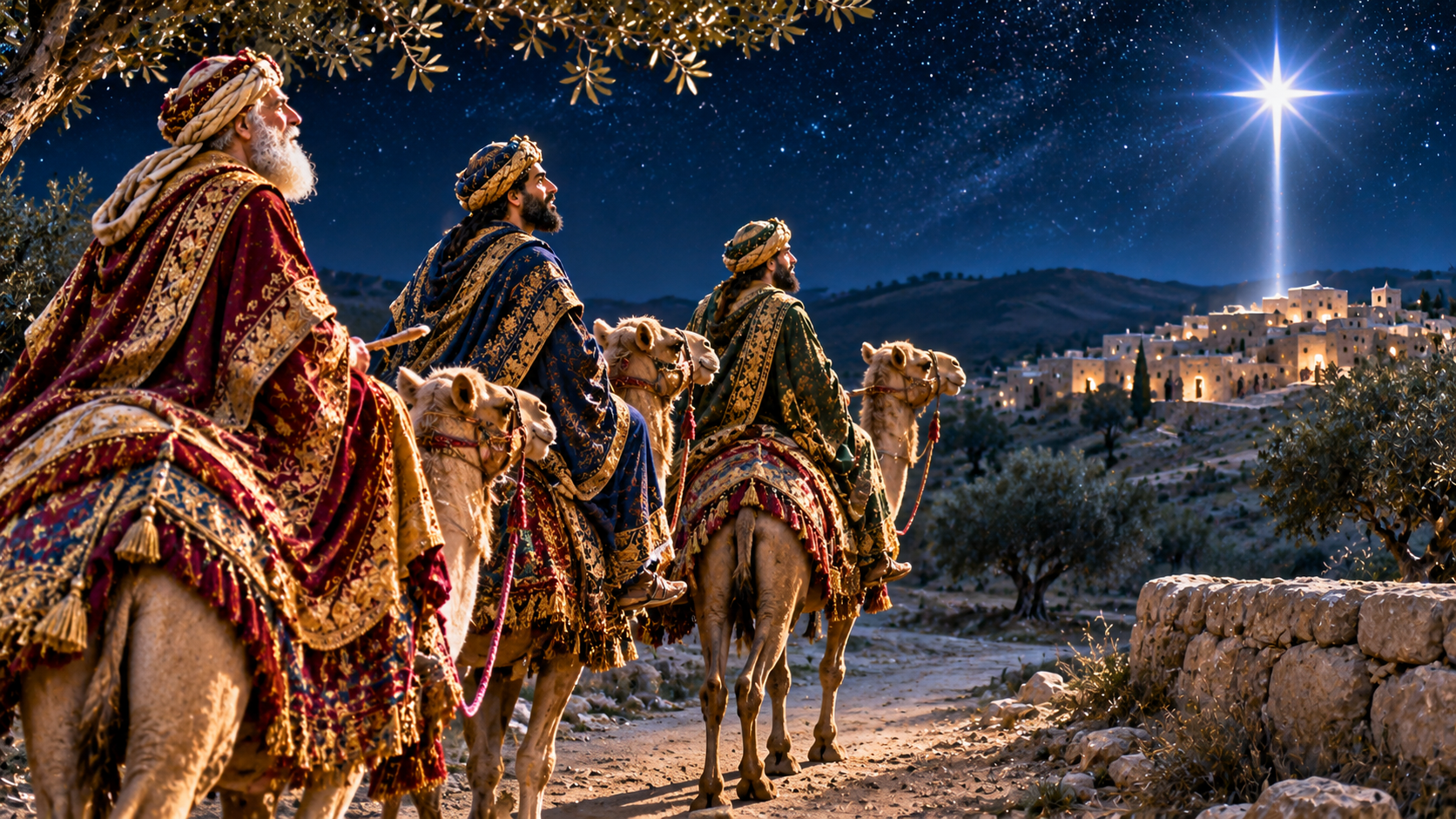
MAGI FOLLOW THE
STAR TO BETHLEHEM
After hearing (akouo) the king (basileuo), they went their way - At this time they were doubtless duped by the deceiver Herod and had all intentions of returning as indicated by the fact that God had to give them a specific warning not to return. As the story unfolds they “heard the king,” but in the end they obeyed a higher King.
And the star (aster), which they had seen in the east (see anatole), went on before them - ESV = "the star that they had seen when it rose" Matthew identifies this as the same star previously observed by the Magi (Mt 2:2). It appears that the star reappeared! This is not just "a" star, not just "any" star, but was "the star," identified as a specific star by use of the definitive article "the" (in Greek). The recognized something about the star that identified it as "His star." (Mt 2:2) and so off they went on the short journey to Bethlehem. They knew beyond a shadow of a doubt that this was His star. How did they know? We simply do not know but won't Heaven be fun to talk with them about their journey of a lifetime! Went on before is proago in the imperfect tense picturing the star as going on an on in front of them toward it's target. Ordinary stars do not do this. They rise and set and move east to west across the sky. This surely points to something supernatural. All efforts to give a "natural" explanation for this star are inadequate (conjunction of Jupiter, Saturn, and Mars; a supernova; a comet; etc.) The star did not stop over a general area but over the very house (Mt 2:11) One thinks of the "pillar of cloud by day to lead them on the way, and in a pillar of fire by night to give them light" that led Israel in the wilderness.
The same word (anatole) is used of Christ Himself in Zechariah’s song: “Because of the tender mercy of our God, with which the Sunrise (anatole) from on high will visit us” (Lk 1:78). The star rose to announce the One who is Himself the Sunrise from on high!
🙏 THOUGHT- The supernatural light of God gave direction to the wise men in their search for Jesus. Today that same supernatural light comes from His Word and gives light for those seeking Jesus.
Proverbs 6:23 For the commandment is a lamp and the teaching is light; And reproofs for discipline are the way of life
Psalm 119:105 Nun. Your word is a lamp to my feet And a light to my path.
John 5:39 “You search the Scriptures because you think that in them you have eternal life; it is these that testify about Me;
Until (until) it came and stood over the place where the Child (paidion) was - NET - "until it stopped above the place where the child was." Passages like this should simply cause us to pause and worship Him Who created the stars, the One "Who makes the Bear, Orion and the Pleiades, and the chambers of the south; Who does great things, unfathomable, and wondrous works without number." (Job 9:9-10) When we get glimpses into God's mysterious omnipotent workings as in this passage, I am always reminded of the words of Job "Behold, these are the fringes of His ways; and how faint a word we hear of Him!" (Job 26:14) That the star stood over the place where the Child was is the idea is that it "hovered" over where Jesus was! Will God show us these wonderful workings some day in Heaven? I pray so!
Child (3813)(paidion diminutive of pais = child) is a little child of either sex, ranging from an infant (Mt 19:13, 14; Mk 10:13-15; Lk 18:16, 17, etc) to children who are older (Mt 11:16; Mt 14:21; Mt 15:38; Mt 18:2-5, etc) Paidion is used repeatedly of the infant Jesus in Matthew Matt. 2:8; Matt. 2:9; Matt. 2:11; Matt. 2:13; Matt. 2:14; Matt. 2:20; Matt. 2:21.
Matthew 2:10 When they saw the star, they rejoiced exceedingly with great joy.
NET When they saw the star they shouted joyfully.
GNT ἰδόντες δὲ τὸν ἀστέρα ἐχάρησαν χαρὰν μεγάλην σφόδρα.
NLT When they saw the star, they were filled with joy!
KJV When they saw the star, they rejoiced with exceeding great joy.
ESV When they saw the star, they rejoiced exceedingly with great joy.
NIV When they saw the star, they were overjoyed.
- they rejoiced - De 32:13 Ps 67:4 Ps 105:3 Lu 2:10,20 Ac 13:46-48 Ro 15:9-13
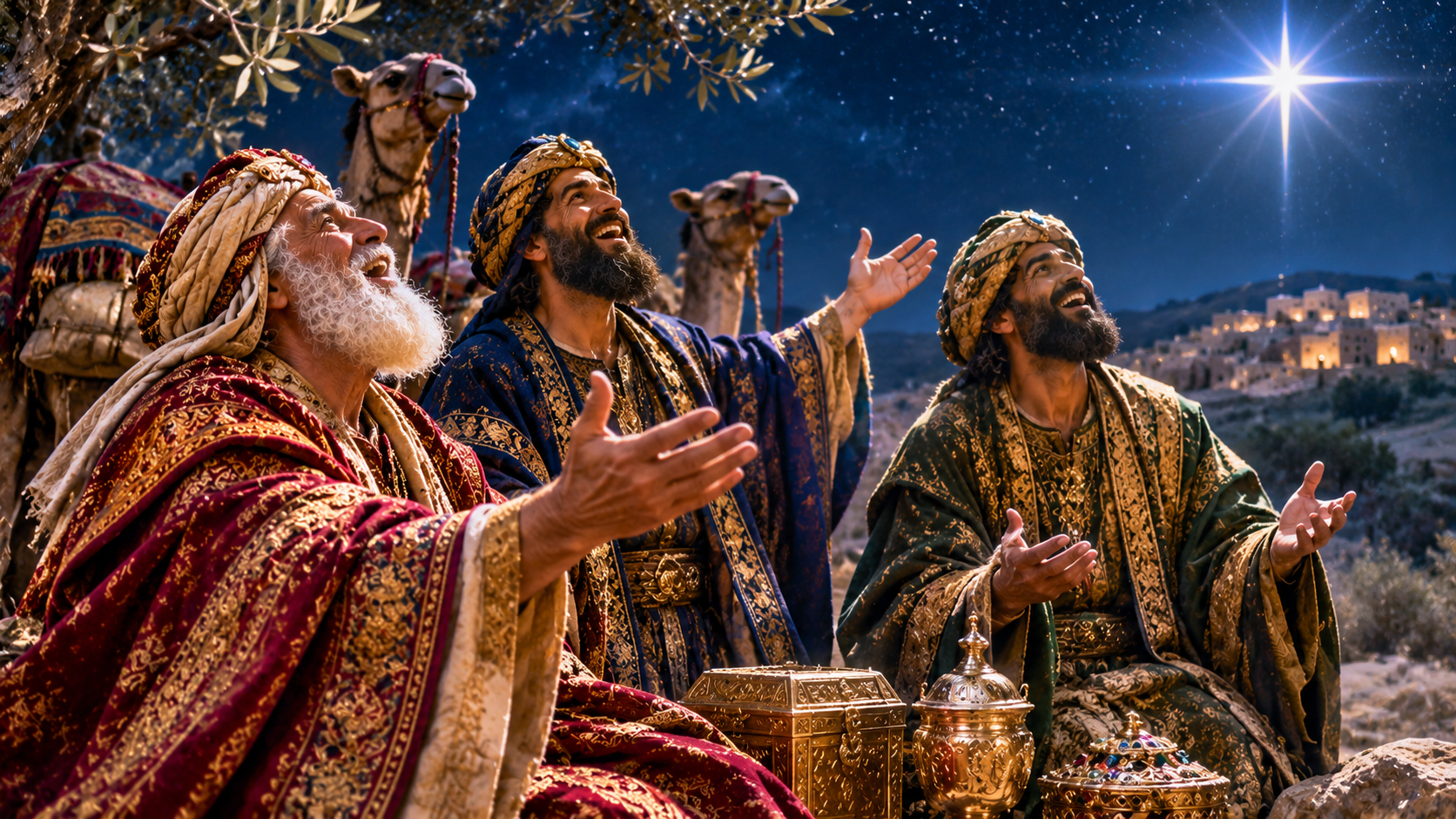
UNSPEAKABLE
INCOMPARABLE JOY
When they saw the star (aster) - It was "the (specific) star," His star (Mt 2:2). And why did they rejoice? Because the star signaled the goal of their long journey (see "Technical Note" below) and the anticipation of seeing Jesus brought them great joy.
TECHNICAL NOTE - How long would the magi have been "on the road" following the star from the east. Assuming they were coming from Babylon (the most common view), where Daniel had once been chief of the wise men, the journey was roughly 500–550 miles in a straight line. But travelers did not cross the Arabian desert directly. They followed the Fertile Crescent, northwest up the Euphrates, then southwest through Syria, a route of about 800–900 miles. The best biblical benchmark is Ezra, who made the same journey with a large company (Ezra 7:9). That is about four months, though Ezra traveled with families, livestock, and temple treasure. A smaller party of men on camels, averaging 20–25 miles a day, could have covered the distance in roughly six weeks to two months of actual travel.
🙏 THOUGHT - The hope (absolute certainty, not "hope so" but "hope sure") that we as believers will one day (SOON) see our Savior face to face (the Goal of our life's journey) ought to stir in our hearts exceedingly great joy today! Are you downcast, despairing? Then preach to your soul to hope in God (Ps 43:5). Ponder your future appointment with Jesus the Lover of your soul. Let that thought invigorate and revive your heart. We need to heed Peter's exhortation to "prepare your minds for action, keep sober in spirit, fix your hope completely on the grace to be brought to you at the revelation of Jesus Christ." (1 Peter 1:13) We need to obey Paul's command to "Set your mind on the things above, not on the things that are on earth. For you have died and your life is hidden with Christ in God. When Christ, who is our life, is revealed, then you also will be revealed with Him in glory." (Col 3:2-4) And we need to heed the exhortation of the writer of Hebrews to fix "our eyes on Jesus, the Author and Perfecter of faith, Who for the joy set before Him endured the cross, despising the shame, and has sat down at the right hand of the throne of God." (Heb 12:2).
D A Carson points out that "The Greek text does not imply that the star pointed out the house where Jesus was; it may simply have hovered over Bethlehem as the Magi approached it. They would then have found the exact house through discreet inquiry since (Luke 2:17-18) the shepherds who came to worship the newborn Jesus did not keep silent about what they saw."
They rejoiced exceedingly (sphodra) with great joy - The Greek reads literally, “they rejoiced a joy great exceedingly” One one might paraphrase, “they rejoiced with an overwhelming, exceedingly great joy.” The NET rendering "they shouted joyfully." Matthew could have simply said "they rejoiced" and we would have understood him. Instead, he piles up words that literally read "they rejoiced with exceeding great joy" Rejoiced is chairo means to enjoy a state of gladness, to be delighted. Exceedingly is sphodra an adverb meaning extremely, greatly, very much. Great is megas which means out of the ordinary in degree, magnitude, or effect. And finally joy is chara is a feeling of great pleasure, of inner gladness, or of delight, an emotion evoked by a sense of well-being and a deep feeling of happiness and contentment. It is almost as if they could not experience a greater degree of joy. So as stated above their "over the top" joy was because of their anticipation at their imminent meeting with the real "Star," the King of the Jews!
🙏 THOUGHT - What a striking contrast between Herod and all Jerusalem being troubled (Matthew 2:3) and the magi rejoicing with exceedingly great joy (Matthew 2:10)! The difference was not in Christ, but in the hearts of those who encountered Him. To Herod, who desperately clung to his earthly throne, Jesus was a threat. To the magi, who humbly bowed before Him, Jesus was the source of overflowing joy. The same King who troubled one heart thrilled another! Beloved, the question is not whether Jesus is King, but whether we are willing to bow before Him. Those determined to rule their own lives find His lordship threatening, but those who gladly surrender to His rule discover the joy of worshiping the true King! (Psalm 2:10–12; John 15:11).
The reaction of these Gentile magi recalls a similar reaction of the Jewish shepherds....
Lk 2:10 But the angel said to them, “Do not be afraid; for behold, I bring you good news of great joy which will be for all the people;
Lk 2:20 The shepherds went back, glorifying and praising God for all that they had heard and seen, just as had been told them.
John Butler observes that "Herod was not rejoicing (HE WAS TROUBLED. HE WAS SCHEMING). Evil people are too busy doing evil to rejoice and to know joy. Their joy is hallow, unreal, superficial, but when God gives joy, it supersedes anything the world has to offer. The wise men knew tremendous joy because Christ was their focus. He is the key to true joy. There is no true joy apart from Jesus. (John Butler - Sermon Starters - Volume 7)
As with gladness men of old
Did the guiding star behold;
As with joy they hailed its light,
Leading onward, beaming bright,
So, now gracious Lord, may we,
Even more be led to Thee.
William C. Dix
Matthew Henry applies the text - What joy these wise men felt upon this sight of the star, none know so well as those who, after a long and melancholy night of temptation and desertion, under the power of a spirit of bondage, at length receive the Spirit of adoption, witnessing with their spirits that they are the children of God. We may well think what a disappointment it was to them, when they found a cottage was his palace, and his own poor mother the only attendant he had. However, these wise men did not think themselves baffled; but having found the King they sought, they presented their gifts to him. The humble inquirer after Christ will not be stumbled at finding him and his disciples in obscure cottages, after having in vain sought them in palaces and populous cities. Is a soul busy, seeking after Christ? Would it worship him, and does it say, Alas! I am a foolish and poor creature, and have nothing to offer? Nothing! Hast thou not a heart, though unworthy of him, dark, hard, and foul? Give it to him as it is, and be willing that he use and dispose of it as it pleases him; he will take it, and will make it better, and thou shalt never repent having given it to him. He shall frame it to his own likeness, and will give thee himself, and be thine for ever. The gifts the wise men presented were gold, frankincense, and myrrh. Providence sent these as a seasonable relief to Joseph and Mary in their present poor condition. Thus our heavenly Father, who knows what his children need, uses some as stewards to supply the wants of others, and can provide for them, even from the ends of the earth.
Thos. Champness - We who look for Jesus ought to be joyful; it is no credit to our Lord when we look as though we were seeking His grave. The dull looks of Christ’s followers have injured Him in the sight of the world. Let us, then, smile as we go, for we have the star if we will look up and put ourselves in the right path.
Exceedingly (4970) sphodra is a Greek adverb meaning exceedingly, greatly, very much, vehemently, extremely. It is technically the neuter plural of the adjective sphodros, “vehement, violent, excessive, eager,” which does not appear in the New Testament but was in widespread use from Homer (eighth century BC) onward, according to Liddell-Scott. The adverb intensifies whatever it modifies, pushing an emotion or quality to its highest degree. The related adverb sphodrōs (G4971), “vehemently, violently,” appears once, describing the storm that battered Paul’s ship (Acts 27:18: “Since we were being violently storm-tossed, on the next day they began to jettison the cargo;”).
Matthew’s uses trace the emotional extremes that surround the life of Jesus: overwhelming joy at His birth, terror at His transfiguration, grief at the announcement of His death, astonishment at His teaching, sorrow at His betrayal, and fear at His crucifixion. Wherever Jesus is, no one remains neutral.
SPHODRA - 10V - deeply(3), exceedingly(1), extremely(3), greatly(1), very(2). Matt. 2:10; Matt. 17:23; Matt. 18:31; Matt. 19:25; Matt. 26:22; Matt. 27:54; Mk. 16:4; Lk. 18:23; Acts 6:7; Rev. 16:21
New Testament usage. Sphodra appears eleven times in the New Testament, nine of them in the Gospels and seven in Matthew alone. It describes a wide range of intense experiences:
Joy: “When they saw the star, they rejoiced exceedingly with great joy” (Mt 2:10).
Fear: At the transfiguration, “When the disciples heard this, they fell face down to the ground and were terrified” (Mt 17:6). At the cross, the centurion and his men “became very frightened and said, ‘Truly this was the Son of God!’” (Mt 27:54).
Grief: When Jesus foretold His death, “they were deeply grieved” (Mt 17:23). The fellow slaves in the parable of the unforgiving servant “were deeply grieved” (Mt 18:31), and the disciples at the Last Supper, “Being deeply grieved, they each one began to say to Him, ‘Surely not I, Lord?’” (Mt 26:22).
Astonishment: “When the disciples heard this, they were very astonished and said, ‘Then who can be saved?’” (Mt 19:25).
Size: The stone at the tomb “had been rolled away, although it was extremely large” (Mk 16:4).
Wealth: The rich young ruler “became very sad, for he was extremely rich” (Lk 18:23).
Growth: “The word of God kept on spreading; and the number of the disciples continued to increase greatly in Jerusalem, and a great many of the priests were becoming obedient to the faith” (Acts 6:7).
Judgment: The plague of hail in the seventh bowl judgment “was extremely severe” (Rev 16:21).
Septuagint usage. In the Greek Old Testament, sphodra frequently translates the Hebrew mᵊʾōd (H3966), “very, exceedingly, greatly.” Several uses tie in with your recent studies in Genesis. God promised Abram, “Do not fear, Abram, I am a shield to you; Your reward shall be very great” (Gen 15:1). As El Shaddai, He promised, “I will establish My covenant between Me and you, And I will multiply you exceedingly” (Gen 17:2), where the Hebrew doubles mᵊʾōd for emphasis. In Genesis 27, the Septuagint uses sphodra to describe the climax of the stolen blessing. Isaac “trembled violently” when he realized what had happened (Gen 27:33), and Esau “cried out with an exceedingly great and bitter cry, and said to his father, ‘Bless me, even me also, O my father!’” (Gen 27:34).
SPHODRA IN SEPTUAGINT - Gen. 7:18; Gen. 7:19; Gen. 12:14; Gen. 13:2; Gen. 13:13; Gen. 15:1; Gen. 17:2; Gen. 17:6; Gen. 17:20; Gen. 18:20; Gen. 19:9; Gen. 20:8; Gen. 21:11; Gen. 24:16; Gen. 24:35; Gen. 26:13; Gen. 26:16; Gen. 27:33; Gen. 27:34; Gen. 30:43; Gen. 32:7; Gen. 34:7; Gen. 34:12; Gen. 39:6; Gen. 41:31; Gen. 41:49; Gen. 47:13; Gen. 47:27; Gen. 50:9; Gen. 50:10; Exod. 1:7; Exod. 1:12; Exod. 1:20; Exod. 9:3; Exod. 9:18; Exod. 9:24; Exod. 10:14; Exod. 11:3; Exod. 12:38; Exod. 14:10; Exod. 19:18; Exod. 19:19; Num. 11:10; Num. 11:33; Num. 12:3; Num. 13:28; Num. 14:7; Num. 14:39; Num. 16:15; Num. 22:3; Num. 32:1; Deut. 2:4; Deut. 3:5; Deut. 4:9; Deut. 4:15; Deut. 6:3; Deut. 9:20; Deut. 9:21; Deut. 13:14; Deut. 17:4; Deut. 17:10; Deut. 17:17; Deut. 20:15; Deut. 24:8; Deut. 27:8; Deut. 28:54; Deut. 28:56; Deut. 29:28; Deut. 30:14; Jos. 3:16; Jos. 6:18; Jos. 9:9; Jos. 9:13; Jos. 9:22; Jos. 9:24; Jos. 10:2; Jos. 10:20; Jos. 11:4; Jos. 22:5; Jos. 22:8; Jos. 23:6; Jos. 23:11; Jdg. 2:15; Jdg. 3:17; Jdg. 6:6; Jdg. 10:9; Jdg. 11:33; Jdg. 12:2; Jdg. 13:6; Jdg. 15:18; Jdg. 18:9; Jdg. 19:11; Ruth 1:20; 1 Sam. 2:17; 1 Sam. 2:22; 1 Sam. 3:21; 1 Sam. 4:10; 1 Sam. 5:9; 1 Sam. 5:11; 1 Sam. 6:19; 1 Sam. 11:6; 1 Sam. 12:18; 1 Sam. 14:20; 1 Sam. 14:31; 1 Sam. 16:21; 1 Sam. 17:11; 1 Sam. 18:15; 1 Sam. 19:1; 1 Sam. 19:4; 1 Sam. 19:8; 1 Sam. 20:30; 1 Sam. 21:12; 1 Sam. 25:2; 1 Sam. 25:3; 1 Sam. 25:15; 1 Sam. 25:36; 1 Sam. 26:21; 1 Sam. 27:12; 1 Sam. 28:5; 1 Sam. 28:15; 1 Sam. 28:20; 1 Sam. 28:21; 1 Sam. 30:6; 1 Sam. 31:4; 2 Sam. 1:26; 2 Sam. 3:8; 2 Sam. 8:8; 2 Sam. 10:5; 2 Sam. 11:2; 2 Sam. 12:2; 2 Sam. 12:5; 2 Sam. 12:30; 2 Sam. 13:1; 2 Sam. 13:3; 2 Sam. 13:15; 2 Sam. 13:21; 2 Sam. 13:36; 2 Sam. 14:25; 2 Sam. 14:27; 2 Sam. 17:8; 2 Sam. 18:17; 2 Sam. 19:32; 2 Sam. 24:10; 2 Sam. 24:14; 1 Ki. 1:4; 1 Ki. 1:6; 1 Ki. 1:15; 1 Ki. 2:12; 1 Ki. 2:35; 1 Ki. 4:20; 1 Ki. 4:29; 1 Ki. 4:30; 1 Ki. 5:7; 1 Ki. 7:47; 1 Ki. 10:2; 1 Ki. 10:10; 1 Ki. 10:11; 1 Ki. 11:19; 1 Ki. 12:24; 1 Ki. 17:17; 1 Ki. 18:3; 1 Ki. 21:26; 2 Ki. 10:4; 2 Ki. 14:26; 2 Ki. 17:18; 2 Ki. 21:16; 1 Chr. 10:4; 1 Chr. 16:25; 1 Chr. 18:8; 1 Chr. 19:5; 1 Chr. 20:2; 1 Chr. 21:8; 1 Chr. 21:13; 2 Chr. 4:18; 2 Chr. 7:8; 2 Chr. 9:1; 2 Chr. 11:12; 2 Chr. 16:8; 2 Chr. 16:12; 2 Chr. 16:14; 2 Chr. 24:24; 2 Chr. 25:10; 2 Chr. 30:13; 2 Chr. 32:27; 2 Chr. 32:29; 2 Chr. 33:12; 2 Chr. 33:14; 2 Chr. 35:23; Ezr. 10:1; Neh. 2:2; Neh. 4:7; Neh. 5:6; Neh. 6:16; Neh. 13:8; Est. 3:5; Est. 4:17; Est. 5:1; Est. 5:9; Job 1:3; Job 2:13; Job 32:2; Job 32:3; Job 35:15; Ps. 6:3; Ps. 6:10; Ps. 21:1; Ps. 31:11; Ps. 38:8; Ps. 46:1; Ps. 47:9; Ps. 48:1; Ps. 50:3; Ps. 78:29; Ps. 78:59; Ps. 79:8; Ps. 92:5; Ps. 93:5; Ps. 96:4; Ps. 97:9; Ps. 104:1; Ps. 105:24; Ps. 107:38; Ps. 109:30; Ps. 112:1; Ps. 116:10; Ps. 119:4; Ps. 119:8; Ps. 119:43; Ps. 119:47; Ps. 119:51; Ps. 119:96; Ps. 119:107; Ps. 119:138; Ps. 119:140; Ps. 119:167; Ps. 139:14; Ps. 142:6; Ps. 145:3; Isa. 16:6; Isa. 31:1; Isa. 47:6; Isa. 47:9; Isa. 52:13; Isa. 64:9; Isa. 64:12; Jer. 2:10; Jer. 2:12; Jer. 2:36; Jer. 9:19; Jer. 14:17; Jer. 18:13; Jer. 20:11; Jer. 24:2; Jer. 40:12; Jer. 48:16; Jer. 50:12; Lam. 5:22; Ezek. 9:9; Ezek. 16:13; Ezek. 20:13; Ezek. 26:7; Ezek. 27:25; Ezek. 37:2; Ezek. 37:10; Ezek. 40:2; Ezek. 47:7; Ezek. 47:9; Ezek. 47:10; Dan. 2:31; Dan. 4:17; Dan. 6:14; Dan. 7:28; Dan. 8:8; Dan. 11:25; Joel 2:11; Obad. 1:2; Jon. 4:4; Jon. 4:9; Nah. 2:1; Zeph. 1:14; Zeph. 3:14; Zech. 9:2; Zech. 9:5; Zech. 9:9; Zech. 14:4; Zech. 14:14
Matthew 2:10 Ready for the Judgment
"When they saw the star, they rejoiced with exceeding great joy."—Matt. 2:10
When they saw the star, they rejoiced. A cause of terror to one person is a cause of joy to another. The baying of a hound on his track strikes dismay to a hunted robber in the woods. The same sound would give cheer to a lost child, when he knew it was his father's hound in search of him. It makes all the difference in the world at which end of the cannon you stand when it is being fired in battle. Its belching fire is the same in either case; but in one instance it is against your enemies, and in the other against you. There is no more terrible thought possible, to the opposer of God, than that the LORD reigneth, and that He is sure to put down all His enemies. There is no thought more comforting than this to the Christian believer. There was an under-witted but a faith-filled Scotch lad in this country, at the time of the great meteoric shower of November, 1833. When on every side men and women were that night in terror at the thought that the hour of final doom had come, this lad's mother aroused him from his sleep with a cry: "Sandy, Sandy, get up, will you? The Day of Judgment has come." Instantly the boy was alive to that call, and was on his feet, shouting, "Glory to God! I'm ready." When the loving followers of Jesus see signs of His appearance, they rejoice with exceeding great joy.
Wise men today worship not only the Child of Bethlehem, but also the Man of Calvary.
How wonderful that we on Christmas morn,
Though centuries have passed since Christ was born,
May worship still the Living Lord of men,
Our Savior, Jesus, Babe of Bethlehem.
—Hutchings
In his portrayal of the nativity scene, Rembrandt focused attention entirely on the Babe in the manger. He did this by painting a shaft of light so that it falls exclusively on the Christ-child. Although he included other figures, they are shrouded in shadows. Rembrandt wanted nothing to detract from the significance of that baby—who was God in the flesh. He Wanted Christ to be the sole object of adoration.
GOD'S HIGHEST GIFT
AWAKENS MAN'S DEEPEST GRATITUDE.
Matthew 2:11 After coming into the house they saw the Child with Mary His mother; and they fell to the ground and worshiped Him. Then, opening their treasures, they presented to Him gifts of gold, frankincense, and myrrh.
NET As they came into the house and saw the child with Mary his mother, they bowed down and worshiped him. They opened their treasure boxes and gave him gifts of gold, frankincense, and myrrh.
GNT καὶ ἐλθόντες εἰς τὴν οἰκίαν εἶδον τὸ παιδίον μετὰ Μαρίας τῆς μητρὸς αὐτοῦ, καὶ πεσόντες προσεκύνησαν αὐτῷ καὶ ἀνοίξαντες τοὺς θησαυροὺς αὐτῶν προσήνεγκαν αὐτῷ δῶρα, χρυσὸν καὶ λίβανον καὶ σμύρναν.
NLT They entered the house and saw the child with his mother, Mary, and they bowed down and worshiped him. Then they opened their treasure chests and gave him gifts of gold, frankincense, and myrrh.
KJV And when they were come into the house, they saw the young child with Mary his mother, and fell down, and worshipped him: and when they had opened their treasures, they presented unto him gifts; gold, and frankincense, and myrrh.
ESV And going into the house they saw the child with Mary his mother, and they fell down and worshiped him. Then, opening their treasures, they offered him gifts, gold and frankincense and myrrh.
NIV On coming to the house, they saw the child with his mother Mary, and they bowed down and worshiped him. Then they opened their treasures and presented him with gifts of gold and of incense and of myrrh.
- they saw - Lu 2:16,26-32,38
- worshipped - Mt 2:2 Mt 4:9,10 Mt 14:33 Ps 2:12 Ps 95:6 Joh 5:22,23 Ac 10:25,26 Rev 19:10 Rev 22:8-10
- presented - or, offered, Ge 43:11 1Sa 10:27 1Ki 10:2,10 Ps 72:10,15 Isa 60:6
- frankincense - Ex 30:23,34 Lev 2:1,2 Lev 6:15 Nu 7:14,86 Ps 45:8 Mal 1:11 Rev 5:8
Related Passages:
Luke 2:12 “This will be a sign for you: you will find a baby wrapped in cloths and lying in a manger.”
Luke 2:16-19 So they (SHEPHERDS) came in a hurry and found their way to Mary and Joseph, and the baby as He lay in the manger.
Psalm 72:10-11 Let the kings of Tarshish and of the islands bring presents; The kings of Sheba and Seba offer gifts. 11 And let all kings bow down before him, All nations serve him.
Isaiah 60:6 “A multitude of camels will cover you, The young camels of Midian and Ephah; All those from Sheba will come; They will bring gold and frankincense, And will bear good news of the praises of the LORD.
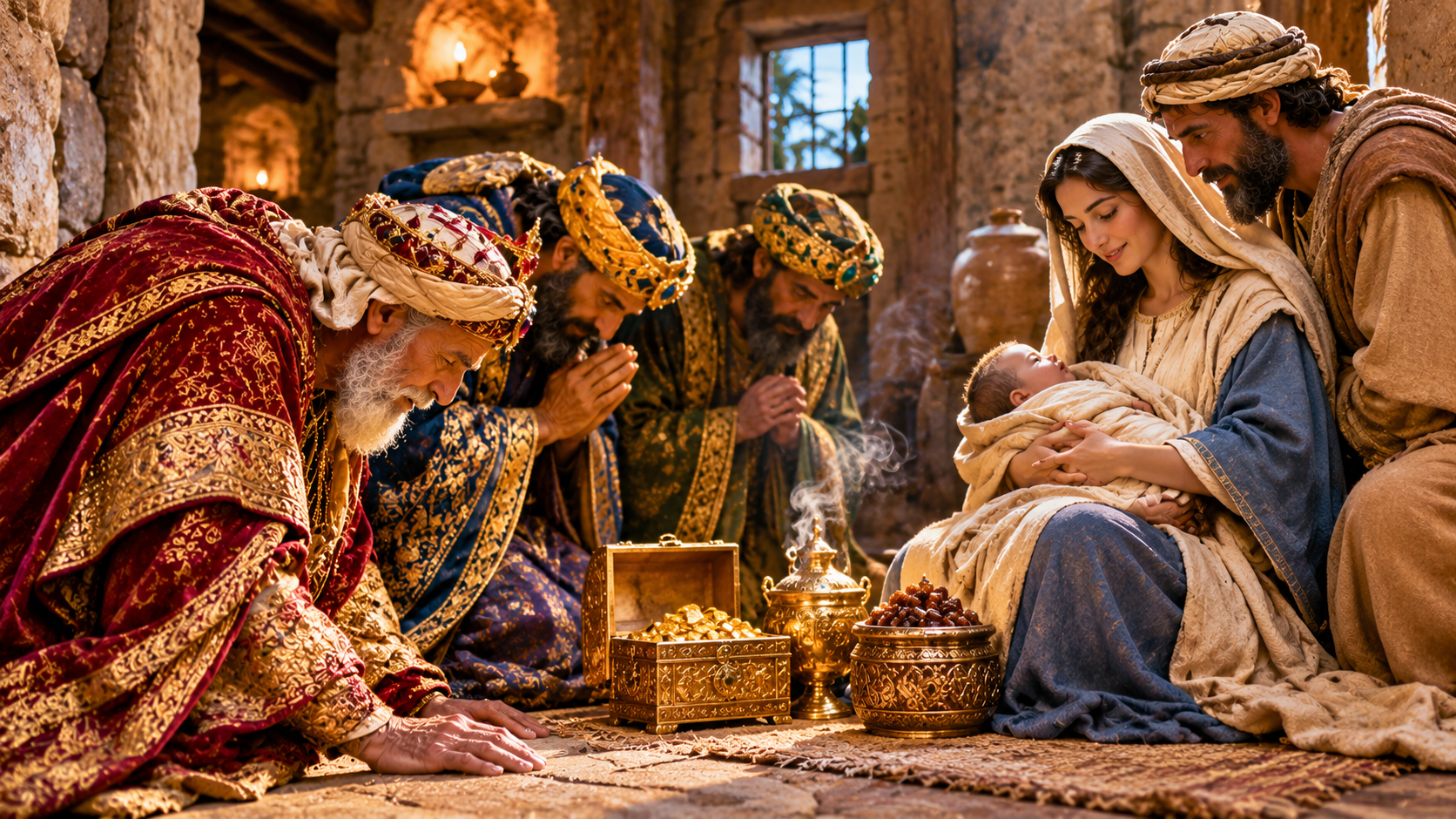
THE FIRST RECORDED
GENTILE WORSHIPPERS
The first recorded worshippers were poor Jewish shepherds and now we see rich Gentile wise men, giving us a foreshadowing of Jesus' life purpose to be the Savior of the world, both Jews and Gentiles, rich and poor!
After coming into the house (oikia) - It would seem that the overcrowded situation which existed in Bethlehem when Mary and Joseph had first arrived arrived was now dissipated. The family had now found a house to live in, instead of their initial accomodations when Mary "gave birth to her firstborn son; and she wrapped Him in cloths, and laid Him in a manger, because there was no room for them in the inn." (Luke 2:7). As discussed below it may have been many weeks or months since His birth, even up to two years. Once again we see one of the errors of Christmas traditions because most Nativity Scenes have Shepherds (who were at His birth in a manger) and Three Kings (who visited the Infant Jesus in a house). The reaction by Herod would also tend to support this premise. Herod, after inquiring "diligently what time the star appeared" to the wise men, ordered all the young children in and around Bethlehem up to two years of age to be slain." (Mt 2:7,16).
D A Carson - This verse plainly alludes to Psalm 72:10-11 and Isaiah 60:6, passages that reinforce the emphasis on the Gentiles (cf. on v.6)....Some time had elapsed since Jesus' birth (vv. 7, 16), and the family was settled in a house. While the Magi saw both the child and his mother, their worship (cf. on v.2) was for Him alone.
They saw the Child (paidion) with Mary His mother: Interesting that there is no mention of Joseph at this visit (cf shepherds in Lk 2:16) We do not know how many magi there were at this viewing of the Messiah. It is notable that Child is the noun paidion and not brephos (most often of a literal baby), the word used to describe the shepherds visit to the "baby (brephos) wrapped in cloths and lying in a manger." (Lk 2:12), Luke adds that the shepherds "came in a hurry and found their way to Mary and Joseph, and the baby (brephos) as He lay in the manger." (Luke 2:16).
So notice the distinctive features of the two visits to Jesus - (1) the magi see the Child (paidion) in the house (oikia) by following a sign (His star) and in contrast (2) the shepherds see a baby (brephos) in the manger by seeing the sign of "a baby wrapped in cloths and lying in a manger.” (Lk 2:12) This contrast between the magi and the shepherds would support the premise that while the shepherds saw the newborn baby Jesus, the magi saw the infant Jesus, some time after His birth. In addition the fact that Herod chose the age of 2 years and younger to be killed supports that the magi did not visit Jesus as a newly born infant but later as a young infant. How much later we cannot say for sure but it could be days, months or even up to 2 years.
Related Resource:
- What does the Bible say about the three wise men (Magi)?
- Watch video on the time of arrival of the magi.
WISE MEN
WORSHIP
And they fell to the ground and worshiped (proskuneo) Him - Fell down is described by BDAG as to "throw oneself to the ground as a sign of devotion, before high-ranking persons or divine beings." Falling to the ground is what you do to acknowledge you (in this case the INFANT JESUS) are high and I am low. One can envision them as they are falling on their faces before Jesus, throwing their kisses toward Him in a gesture of reverence and respect (see proskuneo). Note that they worshipped Him, not Mary who is NOT to be worshipped and Scripture never describes as being worshipped! Respected yes. Revered to a degree, yes. But NEVER worshipped.
INTERESTING NOTE - In the Gospels their are nine prostrations before the Savior. Magi (Matthew 2:11); Jarius (Mark 5:22); Woman healed (Mark 5:33); Syrophoenician woman (Mark 7:25); Peter, (Luke 5:8); The Leper (Luke 5:12); 7, The Gadarene (Luke 8:28); 8, The Samaritan (Luke 17:16); 9, Mary (John 11:32).
Spurgeon - - Those who look for Jesus will see him: those who truly see him will worship him: those who worship him will consecrate their substance to him.
Then, opening their treasures (thesauros), they presented (prosphero) to Him gifts (doron) of gold, frankincense, and myrrh - Their treasures implies they gave their best! In effect they were showing by their gifts the this King of the Jews was their greatest treasure! I am reminded that in Christ "are hidden all the treasures of wisdom and knowledge." (Col 2:3) He is our greatest Treasure in time and eternity! The principle is clear, if we would seek to worship Jesus well, we will unreservedly offer Him our best! The worship of the magi was associated with voluntary giving of gifts. The gifts were expensive gifts and were fit for a king. It is well attested that the Jewish expectation was that both Jews and non-Jews would bring the Messiah gifts While it may be somewhat fanciful, the early church Fathers understood the gold to be symbolic of Christ's deity, the frankincense of His purity, and the myrrh of His death (since it was used for embalming).
Walvoord says "Unquestionably the gifts were chosen appropriately: gold for His deity and majesty, frankincense for the fragrance of His life and His intercession, myrrh for His sacrifice and death."
D A Carson - Bringing gifts was particularly important in the ancient East when approaching a superior (cf. Gen 43:11; 1 Sam 9:7-8; 1 Kings 10:2). Usually such gifts were reciprocated (Derrett, NT Studies, 2:28). That is not mentioned here, but a first-century reader might have assumed it and seen the Great Commission (28:18--20) as leading to its abundant fruition. Frankincense is a glittering, odorous gum obtained by making incisions in the bark of several trees; myrrh exudes from a tree found in Arabia and a few other places and was a much-valued spice and perfume (Ps 45:8; S of Songs 3:6) used in embalming (John 19:39).
Psalm 72:10-11 was written for Solomon but it looks beyond Solomon to One far greater, the future worship of the Messiah
"Let the kings of Tarshish and of the islands bring presents; The kings of Sheba and Seba offer gifts. And let all kings bow down before him, All nations serve him."
While the intent of the gifts was pure worship, there is another possible benefit of the expensive gifts from the magi, for Joseph and Mary would soon have to take the Christ Child to Egypt to escape the murderous designs of Herod. The gifts of the magi would have provided funds needed to make the trip and provide for living expenses. True worship enables the work of God to go forward.
Fruchtenbaum - The Wise Men gave to Jesus three types of gifts: gold, frankincense and myrrh. All of these are full of Old Testament symbolism: gold is the symbol of royalty or kingship, emphasizing that Jesus is a king; frankincense is the symbol of deity because frankincense was part of the special scent burned on the Altar of Incense within the Holy Place and the smoke penetrated into God’s presence in the Holy of Holies itself, thus frankincense emphasizes Jesus is God; myrrh was associated in the Old Testament with death and embalming. While the first line of that famous Christmas song “We three kings of orient are” is not biblically accurate, the last line which says, “God and king and sacrifice” certainly is! (Messianic Christology)
D A Carson disagrees with Walvoord and Fruchtenbaum - Commentators, ancient (Origen, Contra Celsum 1.60) and modern (Hendriksen), have found symbolic value in the three gifts-gold suggesting royalty, incense divinity, and myrrh the Passion and burial. This interpretation demands too much insight from the Magi. The three gifts were simply expensive and not uncommon presents and may have helped finance the trip to Egypt.
House (3614)(oikia from oikos = house) is literally one's residence, home or abode. Oikia is an inhabited edifice, building or dwelling. Oikia is used 94x in 85 verses and is always translated house (or related word like household).
Worshiped (bow down) (4352)(proskuneo from pros = before + kuneo = kiss or adore) means to prostrate one’s self, to kiss the hand to (towards) one in token of reverence, to fall upon the knees and touch the ground with the forehead as an expression of profound reverence (to make a salam), by kneeling or prostration to do homage to one or make obeisance, either in order to express respect or make supplication. When Jesus Christ was born into this world, He was attended and worshipped by angels. (Lu 2:13f). Proskuneo represents the most common Near Eastern act of adoration and reverence and also carries the idea of profound awe and respect. Some believe that the root word kuneo may be related to kuon which is the Greek word for dog and which then could be picturing a dog licking his master's hand. Proskuneo literally means to kiss toward someone, to throw a kiss in token of respect or homage, to prostrate oneself in homage, to do reverence to, to adore and so to worship and show respect. In the ancient Oriental (especially Persia) the mode of salutation between persons of equal rank was to kiss each other on the lips. When the difference of rank was slight, they kissed each other on the cheek. When one was much inferior, he fell upon his knees touched his forehead to the ground or prostrated himself, and as he was bowing down he would be throwing kisses toward the superior. It is this latter mode of salutation that is intended by the Greek writers in the use of the verb proskuneo . Matthew's uses of proskuneo - Matt. 2:2; Matt. 2:8; Matt. 2:11; Matt. 4:9; Matt. 4:10; Matt. 8:2; Matt. 9:18; Matt. 14:33; Matt. 15:25; Matt. 18:26; Matt. 20:20; Matt. 28:9; Matt. 28:17
Treasures (2344)(thesauros from títhemi = put, set) refers to the place where goods and precious things are stored for safekeeping here referring to in essence a "treasure chest."
Presented (4374)(prosphero from prós = to, toward, denotes motion toward a place + phéro = bring) means to carry or bring something into the presence of someone usually implying a transfer of something to that person carry to. Prosphero refers to the presentation of an offering, in this case the magi's (doron). This first use of prophero in the NT in giving an offering to Jesus in the atmosphere of worship and reverence is in striking contrast to the use of prophero as He was being Himself offered up as an offering to God (cf Jn 1:29) and they approached Him and brought (prosphero) sour wine up to His mouth (Jn 19:29)! The first "offering" at His birth to Him in a Cradle, the last offering at His death, to Him on a Cross! Oh my!
Gifts (1435)(doron) is that which is given or granted and stresses the gratuitous character of the gift which is voluntarily transferred by one to another without compensation and here refers to a gift presented as an act of worship and devotion. Almost all 17 uses of doron refer to offerings to God (except Eph 2:8 Rev 11:10).
The Best of All Places "Sitting at the feet of Jesus" Luke 10:39
We learn in the Gospels of nine prostrations before the Saviour.
1, Wise men (Matthew 2:11);
2, Jarius (Mark 5:22);
3, Women healed (Mark 5:33);
4, Syrophenician women (Mark 7:25);
5, Peter, (Luke 5:8);
6, The Leper (Luke 5:12);
7, The Gadarene (Luke 8:28);
8, The Samaritan (Luke 17:16);
9, Mary (John 11:32).
I. Mary Learned the Secret of His Person at Jesus Feet (Luke 10:42)
Only at His feet can we be taught by Him. Cumbered and worried with much service we will never have time to be at His feet. If we have not time to sit there we will not have time to learn.
II. Mary Learned the Secret of His Purpose at Jesus Feet (John 11:32)
Only there could she understand why Lazarus died and why Martha and herself must be plunged into the deepest sorrow. To the grave she led him and there at the very place of deepest sorrow, came the highest joy.
III. Mary Learned the Secret of His Passion at Jesus Feet
This was revealed when she anointed Him for His burial. The secret was out and everywhere her testimony has been told. See Matthew 26:12-13. As I write this I help to fulfil the Lord's prophecy.
Do you sit at Jesus feet? Have you learned these three secrets? - Ian Paisley
QUESTION - What is a Christmas nativity? GOTQUESTIONS.ORG
ANSWER - Displaying a Christmas nativity scene is a long-standing tradition, but it can also present a bit of a skewed view of the actual events of Jesus’ birth. While each person depicted in a traditional nativity scene is a part of the Christmas story, not all the characters were present in one place on the night Jesus was born. Mary, Joseph, and Jesus were in a stable that night due to the overcrowding in Bethlehem’s inn (Luke 2:7), but the Bible never mentions whether or not animals were present—in fact, it never even mentions a stable. The shepherds, once told of Jesus’ arrival, left their flocks to worship the newborn King (Luke 2:16). However, the angels, which are often part of nativity scenes, bore the good news to the shepherds in the fields (Luke 2:8–14). As far as we know, there were no angels flying visibly over the place where Jesus was when the shepherds arrived. In addition, the wise men (the Bible never says how many there were) were also probably not present that first night. The magi visited Jesus some time later, when He was in a house (Matthew 2:1–11). Despite these small details, a Christmas nativity scene is a wonderful reminder of what happened the night Jesus was born. Ever since Adam and Eve’s sin, our relationship with God has been marred and broken (Genesis 3; Romans 5:12). Out of love, God sent His Son in human form “to seek and to save the lost” (Luke 19:10). To that end, Jesus Christ was born in the town of Bethlehem. Modern Christmas nativity scenes help to proclaim Christ’s birth and the true “reason for the season.”
QUESTION - Why did the Magi bring gold, frankincense, and myrrh to Jesus? WATCH VIDEO
ANSWER - Matthew 2 tells us that the magi, or wise men, travelled from the East in search of the Christ child. They inquired of King Herod where they might find Him, saying, "Where is he who has been born king of the Jews? For we saw his star when it rose and have come to worship him" (Matthew 2:2, ESV). Upon finding Jesus, “they bowed down and worshiped him. Then they opened their treasures and presented him with gifts of gold, frankincense and myrrh” (Matthew 2:11).
Gold is a precious metal and as such was a very valuable commodity. Its value could very well have financed Joseph and Mary’s trip to Egypt. The Bible does not tell us any other significance to these three gifts; however, tradition has it that there is a deeper meaning for each of the three. Gold is a symbol of divinity and is mentioned throughout the Bible. Pagan idols were often made from gold and the Ark of the Covenant was overlaid with gold (Exodus 25:10-17). The gift of gold to the Christ child was symbolic of His divinity—God in flesh.
Frankincense is a white resin or gum. It is obtained from a tree by making incisions in the bark and allowing the gum to flow out. It is highly fragrant when burned and was therefore used in worship, where it was burned as a pleasant offering to God (Exodus 30:34). Frankincense is a symbol of holiness and righteousness. The gift of frankincense to the Christ child was symbolic of His willingness to become a sacrifice, wholly giving Himself up, analogous to a burnt offering.
Myrrh, a product of Arabia, was obtained from a tree in the same manner as frankincense. It was a spice and was used in embalming. It was also sometimes mingled with wine to form an article of drink. Such a drink was given to our Savior when He was about to be crucified, as a stupefying potion (Mark 15:23). Matthew 27:34 refers to it as “gall.” Myrrh symbolizes bitterness, suffering, and affliction. The baby Jesus would grow to suffer greatly as a man and would pay the ultimate price when He gave His life on the cross for all who would believe in Him.
QUESTION - What does the Bible say about the three wise men (Magi)? WATCH VIDEO
ANSWER - We assume that there were three wise men because of the three gifts that were given: gold, incense, and myrrh (Matthew 2:11). However, the Bible does not say there were only three wise men. There could have been many more. Tradition says that there were three and that their names were Gaspar/Caspar, Melchior, and Balthasar/Balthazar, but since the Bible does not say, we have no way of knowing whether the tradition is accurate.
It is a common misconception that the wise men visited Jesus at the stable on the night of His birth. In fact, the wise men came days, months, or possibly even years later. That is why Matthew 2:11 says the wise men visited and worshiped Jesus in a house, not at the stable.
We know that the magi were wise men from "the East," most likely Persia, or modern-day Iran. This means the wise men traveled 800 to 900 miles to see the Christ child. Most likely, the magi knew of the writings of the prophet Daniel, who in time past had been the chief of the court seers in Persia. Daniel 9:24-27 includes a prophecy which gives a timeline for the birth of the Messiah. Also, the magi may have been aware of the prophecy of Balaam (who was from the town of Pethor on the Euphrates River near Persia) in Numbers 24:17. Balaam’s prophecy specifically mentions a “star coming out of Jacob.”
The wise men were guided to look for the King of the Jews by a miraculous stellar event, the “Star of Bethlehem,” which they called “His star” (Matthew 2:2). They came to Jerusalem and asked concerning the birth of Christ, and they were directed to Bethlehem (Matthew 2:4–8). They followed God’s guidance joyfully (Matthew 2:10). When they arrived in Bethlehem, they gave costly gifts to Jesus and worshiped Him. God warned them in a dream against returning to Herod, so, in defiance of the king, they left Judea by another route (Matthew 2:12).
So, the magi were men who 1) read and believed God’s Word, 2) sought Jesus, 3) recognized the worth of Christ, 4) humbled themselves to worship Jesus, and 5) obeyed God rather than man. They were truly wise men!
F B Meyer - They offered unto Him gifts, Gold…. (marg.). Our Daily Homily
Gold is for the king. It is meet that Matthew should tell this story: for his is pre-eminently the royal Gospel. Long before the Lord was born, these Eastern sages must have been started on their way, whither and to worship whom they knew not: but an ancient prophecy had foretold that to this babe should be offered of the gold of Sheba, and that kings should bring Him the riches of the Gentiles.
How useful this gold was to Joseph in the following months! It helped him to defray the cost of the journey into Egypt and back, and to maintain his precious charges there. The Heavenly Father knew what those needs would be, and met them by anticipation. If you concern yourself in the affairs of his kingdom, and will obey the warnings and directions He gives; if you dare to step out on the path of literal obedience — you will find that God will become responsible and defray all costs. Gold is naught to Him. He can make it out of common dust by a word.
It is sweet to think of all the gold presented to Jesus in after ages. The wealth of the rich, the golden ornaments taken from the person, the tiny pieces of gold which represent the patient savings of the poor — all these have made up the flowing river of which those golden gifts of the Magi were the first trickling drops. Have you given gold to Him, you who know Him, not as the babe only, but as the Man of the Cross; not as man merely, but as the Son of the Highest! You may have given Him copper in abundance, and silver in handfuls; but let your future gifts to Him be of the best. Or, if poverty restrains you, let the philosopher’s stone of Love turn the meaner metals to gold.
A FITTING PRESENT
Present your bodies a living sacrifice, holy, acceptable to God. —Romans 12:1
Read Mt 2:11-15
A little boy was somewhat perplexed by all the exchanging of presents on Christmas morning, for he had been taught in Sunday school that it was the birthday of the Saviour. Finally, after a long period of silence, he asked,
“Mummy, when are we going to give Jesus His present? I thought it was His birthday!”
Strange isn’t it that most of us give gifts to everyone but the One whose birthday we celebrate? A good question we might ask ourselves is this: What am I going to give to the Lord Jesus this Christmas? If you have never trusted in Him as your Saviour, the thing He desires most from you is a believing heart. Why not put your faith in Jesus’ sacrificial death on the cross so you can be saved from your sins?
If by faith you already know Christ as your Saviour, then the most wonderful thing you can do this Christmas is to present to God the one gift He most desires to receive from you—your body (Ro 12:1).
Our bodies are to be used for God’s purposes. Because we have accepted the gift of salvation from Him, it’s only reasonable that we should present ourselves to the Father. When we give ourselves, we give the one Christmas present that truly fits the occasion! Richard DeHaan
GIVE YOUR ALL TO CHRIST;
HE GAVE HIS ALL FOR YOU.
Someone to Celebrate
Come, let us bow down in worship, let us kneel before the Lord our Maker. Psalm 95:6
Today's Scripture & Insight: Matthew 2:1–12
Many manger scenes depict the wise men, or magi, visiting Jesus in Bethlehem at the same time as the shepherds. But according to the gospel of Matthew, the only place in Scripture where their story is found, the magi showed up later. Jesus was no longer in the manger in a stable at the inn, but in a house. Matthew 2:11 tells us, “On coming to the house, they saw the child with his mother Mary, and they bowed down and worshiped him. Then they opened their treasures and presented him with gifts of gold, frankincense and myrrh.”
Realizing that the magi’s visit happened later than we may think provides a helpful reminder as we begin a new year. Jesus is always worthy of worship. When the holidays are past and we head back to life’s everyday routines, we still have Someone to celebrate.
Jesus Christ is Immanuel, “God with us” (Matt. 1:23), in every season. He has promised to be with us “always” (28:20). Because He is always with us, we can worship Him in our hearts every day and trust that He will show Himself faithful in the years to come. Just as the magi sought Him, may we seek Him too and worship Him wherever we are. By: James Banks (Our Daily Bread, Copyright RBC Ministries, Grand Rapids, MI. — Reprinted by permission. All rights reserved)
Reflect & Pray
Lord Jesus, just as the magi sought You and bowed before You as the coming King, help me to yield my will to You and to follow where You lead.
When we find Christ we offer our worship.
Matthew 2:1-12 Wrapped Up In Greed
When they had come into the house, they saw the young Child . . . and fell down and worshiped Him. —Matthew 2:11
As followers of Jesus, we must be careful to guard our hearts from greed during this holiday season. In a society that has secularized Christmas, that’s not easy.
USA Today reported the results of three polls signaling the erosion of the meaning of Christmas. In a survey of Americans, only one-third said the birth of Jesus is what makes the holiday important.
What is important, then? The presents, of course! According to the poll, 97 percent of us purchase gifts.
While there’s nothing wrong with commemorating the gift of God’s Son by giving gifts to those we love, this pleasant tradition can easily become greed-infected. Remember the toy-of-choice in 1996, the Tickle Me Elmo doll? Some people bought one for a child or grandchild but gave up that loving idea after learning they could turn the toy into a big profit. Newspapers were soon carrying columns of ads offering the fad-of-the-season doll for many times its purchase price.
If you find yourself caught up in the greed of Christmas, take a moment to sit quietly. In your mind’s eye, walk with the wisemen to the Christ-child. Bow before Him and offer Him the gift of your love and worship. Instead of a greedy Christmas this year, let’s make it a worshipful one. By David Egner (Our Daily Bread, Copyright RBC Ministries, Grand Rapids, MI. — Reprinted by permission. All rights reserved)
Take time this Christmastide to go
A little way apart,
And with the hands of prayer prepare
The house that is your heart.
—Anon.
Selfishness makes Christmas a burden; love makes it a delight.
Matthew 2:12 And having been warned by God in a dream not to return to Herod, the magi left for their own country by another way.
NET After being warned in a dream not to return to Herod, they went back by another route to their own country.
GNT καὶ χρηματισθέντες κατ᾽ ὄναρ μὴ ἀνακάμψαι πρὸς Ἡρῴδην, δι᾽ ἄλλης ὁδοῦ ἀνεχώρησαν εἰς τὴν χώραν αὐτῶν.
NLT When it was time to leave, they returned to their own country by another route, for God had warned them in a dream not to return to Herod.
KJV And being warned of God in a dream that they should not return to Herod, they departed into their own country another way.
ESV And being warned in a dream not to return to Herod, they departed to their own country by another way.
NIV And having been warned in a dream not to go back to Herod, they returned to their country by another route.
- warned - Mt 2:22 Mt 1:20 Mt 27:19 Ge 20:6,7 Ge 31:24 Job 33:15-17 Da 2:19
- they left - Ex 1:17 Ac 4:19 Ac 5:29 1Co 3:19
Related Passages:
Matthew 2:22 But when he heard that Archelaus was reigning over Judea in place of his father Herod, he was afraid to go there. Then after being warned by God in a dream, he left for the regions of Galilee,
Matthew 1:20 But when he had considered this, behold, an angel of the Lord appeared to him in a dream, saying, “Joseph, son of David, do not be afraid to take Mary as your wife; for the Child who has been conceived in her is of the Holy Spirit.
Matthew 27:19 While he was sitting on the judgment seat, his wife sent him a message, saying, “Have nothing to do with that righteous Man; for last night I suffered greatly in a dream because of Him.”
DIVINE DIRECTIVE
TO DETOUR
And having been warned (chrematizo) by God in a dream (onar) not to return (onar) to Herod - Apparently this warning was by God Himself as no angelic messenger is described. Chrematizo thus speaks of a divine (or angelic) oracle or declaration as was given to Simeon to whom "it had been revealed to him by the Holy Spirit that he would not see death before he had seen the Lord’s Christ" (Lk 2:26). Here and in Mt 2:22 it is a divine warning.
When God warns, the wise obey at once,
like the Magi who went home by another way.
Notice that every time God speaks in Matthew 1-2, His messengers are obeyed at once: Joseph took Mary as his wife (Mt 1:24), the Magi took another route (Mt 2:12), and Joseph fled to Egypt by night (Mt 2:14), returned to Israel (Mt 2:21), and settled in Galilee (Mt 2:22-23). Obedience to God’s warnings preserved the life of the Messiah.
Marvin Vincent has an interesting note on the meaning of chrematizo in the present context writing "The verb means to give a response to one who asks or consults: hence, in the passive, as here, to receive an answer. The word therefore implies that the wise men had sought counsel of God; and so Wycliffe, "And answer taken in sleep.""
The magi left (anachoreo) for their own country by another way - The magi had ears to hear the supernatural warning and took the divinely directed detour! Once again we see God's sovereign hand orchestrating the events in men's life to assure that His will is accomplished.
🙏 THOUGHT - I wonder if we are as wise as these magi? So many times God gives us a clear warning to "steer clear" of some place, some person, some thing, and we like a stubborn mule go headlong to that place, person or thing about which we were warned to take a detour!
Warned (5537)(chrematizo from chrema = an affair, business, sum of money) in the NT means to impart a divine message (an injunction or warning). In the New Testament means to impart a divine message, to give a divine warning, instruction, or direction, and in the passive to be divinely warned or instructed. It also has a second meaning, to bear a name, to be called. The verb comes from chrēma, “a matter, affair, business,” and in the plural “money, wealth.” Its original meaning was to transact business, to negotiate, to deal with public affairs. From there it came to mean giving an official response to someone who brought a matter for consideration, as a ruler answered a petition or an oracle answered an inquirer. So in classical Greek it was used of oracles giving divine answers, and that is the background for its New Testament sense of God’s communicating His will. A separate development from public business conducted under a name produced the sense “to be called” or “to bear a title.”
CHREMATIZO - 9V - called(2), directed(1), revealed(1), warned(5). Matt. 2:12; Matt. 2:22; Lk. 2:26; Acts 10:22; Acts 11:26; Rom. 7:3; Heb. 8:5; Heb. 11:7; Heb. 12:25
Twice chrematizo is used of dream warnings in Matthew 2. The Magi were warned not to return to Herod (Mt 2:12) and Joseph was warned not to settle in Judea (Mt 2:22). Chrematizo also describes the Holy Spirit’s revelation to Simeon (Lk 2:26), the angel’s instruction to Cornelius (Acts 10:22), and God’s instruction to Moses about building the tabernacle (Heb 8:5) The classic example of obedience to a divine warning is Noah (Heb 11:7: “By faith Noah, being warned by God about things not yet seen, in reverence prepared an ark for the salvation of his household, by which he condemned the world, and became an heir of the righteousness which is according to faith.”). The final use, in the active voice (the other uses are all passive voice), applies the word to all who hear the gospel “See to it that you do not refuse Him who is speaking. For if those did not escape when they refused him who warned them on earth, much less will we escape who turn away from Him who warns from heaven.” (Heb 12:25).
Dream (3677)(onar) is usually a divine communication which is distinct from a vision (horama). Onar is used only in the Gospel of Matthew with no uses in the Septuagint. Onar occurs six times, all in Matthew, and always in the phrase kat’ onar, “in a dream”. Five of the six are clearly divine communications to Joseph or the Magi. The sixth is the dream of Pilate’s wife (Mt 27:19) but that dream is not explicitly said to be from God.
Dream versus vision. An onar is received while asleep. A vision (horama) was often received while awake (Acts 10:3, 17), though it could also come at night (Acts 16:9). God told Israel He would use both means to speak to His prophets (Nu 12:6).
Interesting Parallel - The Joseph of the Old Testament was a man of dreams (Gen 37:19: “They said to one another, ‘Here comes this dreamer!’”), and God used his dreams to bring Israel down to Egypt to preserve their lives. The Joseph of the New Testament, also the son of a man named Jacob (Mt 1:16), received dreams from God that took the true Israel, God’s Son, down to Egypt to preserve His life (Mt 2:13-15). Matthew then applies Hosea 11:1 to Jesus: “OUT OF EGYPT I CALLED MY SON.”
ONAR - 6V - ALL IN MATTHEW Matt. 1:20; Matt. 2:12; Matt. 2:13; Matt. 2:19; Matt. 2:22; Matt. 27:19
Return (3677)(anakampto) from aná = back again + kámpto = bend) means literally to bend back or turn back and so to return. To bend back one's course. To bend one's steps back. Used only 4x - Matt. 2:12 = "“If a man of peace is there, your peace will rest on him; but if not, it will return to you." Lk. 10:6; Acts 18:21 = "“I will return to you again if God wills,” he set sail from Ephesus." Heb. 11:15 = "indeed if they had been thinking of that country from which they went out, they would have had opportunity to return." The "bent" of the hearts of the patriarchs was toward heaven not earth!
ANAKAMPTO - 4V - Matt. 2:12; Lk. 10:6; Acts 18:21; Heb. 11:15
Left (402)(anachoreo from ana = back again or emphatic + choreo = depart, make room) means to depart from a location. Anachoreō is used several times in Matthew to describe a strategic withdrawal in the face of danger (Mt 2:12–14, 22; Mt 4:12; Mt 12:15; Mt 14:13; Mt 15:21) here the magi who were warned by God and in Mt 2:14 of Joseph when he was warned and "left for Egypt" Liddell-Scott says anachoreo was used by Homer to retire or withdraw from battle, to retire from a place, to come back or revert to the rightful owner, to withdraw from the world. Gilbrant adds that "In classical Greek literature the word’s semantic range includes “walk backwards,” “revert to,” or even “to strike” (i.e., “refuse to work”). In the Septuagint anachōreō especially depicts flight or withdrawal from a place or area (e.g., Ex 2:15; Nu 16:24; Josh 8:15)."
ANACHOREO -14V - departed(1), gone(1), gone aside(1), leave(1), left(3), stepping aside(1), withdrew(6). Matt. 2:12; Matt. 2:13; Matt. 2:14; Matt. 2:22; Matt. 4:12; Matt. 9:24; Matt. 12:15; Matt. 14:13; Matt. 15:21; Matt. 27:5; Mk. 3:7; Jn. 6:15; Acts 23:19; Acts 26:31
Matthew 2:13 Now when they had gone, behold, an angel of the Lord appeared to Joseph in a dream and said, "Get up! Take the Child and His mother and flee to Egypt, and remain there until I tell you; for Herod is going to search for the Child to destroy Him."
NET After they had gone, an angel of the Lord appeared to Joseph in a dream and said, "Get up, take the child and his mother and flee to Egypt, and stay there until I tell you, for Herod is going to look for the child to kill him."
GNT Ἀναχωρησάντων δὲ αὐτῶν ἰδοὺ ἄγγελος κυρίου φαίνεται κατ᾽ ὄναρ τῷ Ἰωσὴφ λέγων, Ἐγερθεὶς παράλαβε τὸ παιδίον καὶ τὴν μητέρα αὐτοῦ καὶ φεῦγε εἰς Αἴγυπτον καὶ ἴσθι ἐκεῖ ἕως ἂν εἴπω σοι· μέλλει γὰρ Ἡρῴδης ζητεῖν τὸ παιδίον τοῦ ἀπολέσαι αὐτό.
NLT After the wise men were gone, an angel of the Lord appeared to Joseph in a dream. "Get up! Flee to Egypt with the child and his mother," the angel said. "Stay there until I tell you to return, because Herod is going to search for the child to kill him."
KJV And when they were departed, behold, the angel of the Lord appeareth to Joseph in a dream, saying, Arise, and take the young child and his mother, and flee into Egypt, and be thou there until I bring thee word: for Herod will seek the young child to destroy him.
ESV Now when they had departed, behold, an angel of the Lord appeared to Joseph in a dream and said, "Rise, take the child and his mother, and flee to Egypt, and remain there until I tell you, for Herod is about to search for the child, to destroy him."
NIV When they had gone, an angel of the Lord appeared to Joseph in a dream. "Get up," he said, "take the child and his mother and escape to Egypt. Stay there until I tell you, for Herod is going to search for the child to kill him."
- an angel - Mt 2:19 Mt 1:20 Ac 5:19 Ac 10:7,22 Ac 12:11 Heb 1:13,14
- Get up - Mt 10:23 Rev 12:6,14
- Until - Mt 2:19,20 Jos 3:13,17 Jos 4:10,18 Da 3:25,26 Ac 16:36
- For Herod - Mt 2:16 Ex 1:22 Ex 2:2,3 Job 33:15,17 Ac 7:19 Rev 12:4
Related Passages:
Hosea 11:1 When Israel was a youth I loved him, And out of Egypt I called My son.
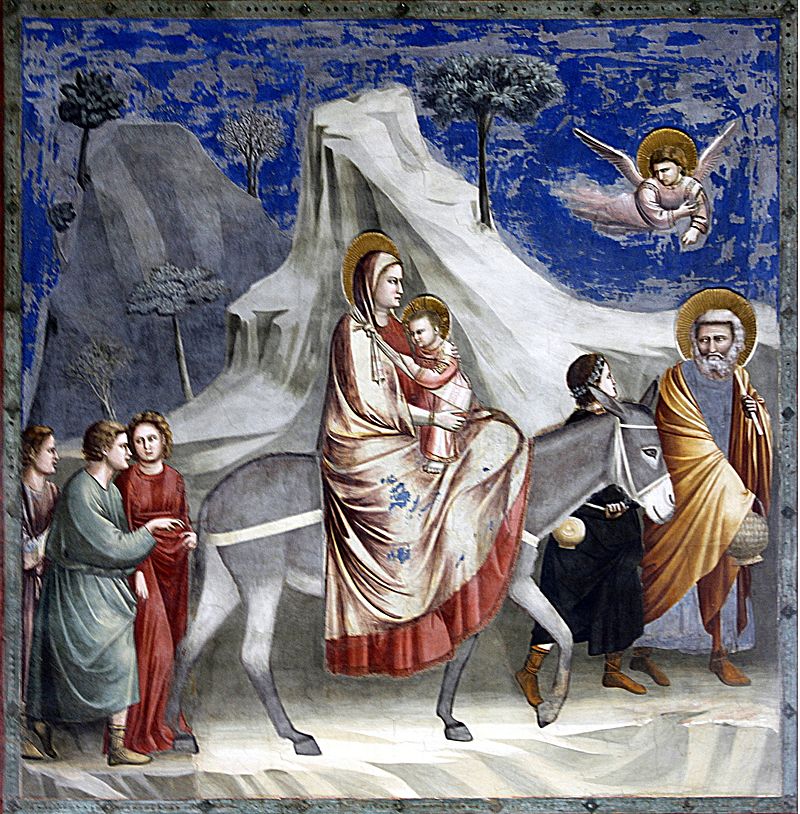
The Flight into Egypt by Giotto di Bondone
GOD SOVEREIGNLY INTERVENES
TO ASSURE SAFETY OF HIS SON
Now when they had gone, behold - Behold (see note above on idou) is to grab our attention. Joseph would seem to have little need to have a behold for an angel in a dream would be enough to grab anyone's full attention!
An angel (aggelos/angelos) of the Lord (kurios) appeared (phaino) to Joseph (kurios) in a dream (onar) - God Himself speaks to the magi in a dream and now speaks via an angel to Joseph in another dream. Notice this is AN angel and not THE Angel of the LORD (Pre-incarnate Christophany) as is seen so often in the OT (cf Ge 16:7).
And said, "Get up! Take the Child (paidion) and His mother and flee (pheugo) to Egypt, and remain there until I tell you - Take is paralambano in the aorist imperative, implying a note of urgency. Do this now! Do not delay! Flee and remain are also commands in present imperative. Keep on fleeing. Keep remaining in Egypt.
God gave directions to the magi via the star and, indirectly, through the Scriptures (the interpretations of the chief priests of Mic 5:2) Matt. 2:1–6: He directed the shepherds to Christ by the angel, Luke 2:9–12, but Joseph received his divine announcements and warnings through dreams, Matt. 1:20; Matt 2:13; Matt 2:19; Matt 2:22, in the same way as his illustrious predecessor of the same name, Gen. 37:5, 9.
So we see fulfillment of OT prophecy involved (1) when Joseph and Mary went to Bethlehem (Micah 5:2) in obedience to the imperial decree (Lu 2:1-5 - sovereignly brought about by God), and (2) when they fled to Egypt (Hosea 11:1), following the command from the Lord's messenger.
For (gar) is a term of explanation. God is giving the reason for the staccato-like commands that convey a sense of urgency. One can imagine the stir in Herod's palace as he realizes the magi have duped him and it did not take him long to realized he had to carry out infanticide!
Herod is going to search (zeteo) for the Child (paidion) to destroy (apollumi) Him - Search speaks of eagerness and diligence and the present tense indicates this search would be continuous. Herod would search until he found the child (or so he thought!)
Flee (escape) (5343)(pheugo) means to flee away in the sense of to take to flight in order to seek safety. To flee in the sense of to escape something, being made safe from danger by eluding or avoiding it. Webster defines flee as to run away often from danger or evil or to hurry toward a place of security. Pheugo is the root of our English word "fugitive" defined as one who escapes from something or someone
Destroy (622)(apollumi from apo = away from or wholly + olethros = state of utter ruin <> ollumi = to destroy) means to destroy utterly but not to cause one to cease to exist.
APOLLUMI IN THE GOSPELS - Matt. 2:13; Matt. 5:29; Matt. 8:25; Matt. 9:17; Matt. 10:6; Matt. 10:28; Matt. 10:39; Matt. 10:42; Matt. 12:14; Matt. 15:24; Matt. 16:25; Matt. 18:11; Matt. 18:14; Matt. 21:41; Matt. 22:7; Matt. 26:52; Matt. 27:20; Mk. 1:24; Mk. 2:22; Mk. 3:6; Mk. 4:38; Mk. 8:35; Mk. 9:22; Mk. 9:41; Mk. 11:18; Mk. 12:9; Lk. 4:34; Lk. 5:37; Lk. 6:9; Lk. 8:24; Lk. 9:24; Lk. 9:25; Lk. 9:56; Lk. 11:51; Lk. 13:3; Lk. 13:5; Lk. 13:33; Lk. 15:4; Lk. 15:6; Lk. 15:8; Lk. 15:9; Lk. 15:17; Lk. 15:24; Lk. 15:32; Lk. 17:27; Lk. 17:29; Lk. 17:33; Lk. 19:10; Lk. 19:47; Lk. 20:16; Lk. 21:18; Jn. 3:16; Jn. 6:12; Jn. 6:27; Jn. 6:39; Jn. 10:10; Jn. 10:28; Jn. 11:50; Jn. 12:25; Jn. 17:12; Jn. 18:9;
Matthew 2:13-21 Out Of Egypt
Take the young Child and His mother, flee to Egypt. —Matthew 2:13
One year when our family was traveling through Ohio on the way to Grandma’s house, we arrived in Columbus just as a tornado warning was issued. Suddenly everything changed as we feared that our children might be in danger.
I mention that story to help us imagine what it was like for Joseph’s family as he, Mary, and their young child traveled to Egypt. Herod, not a tornado, threatened them as he sought to kill their little boy. Imagine how frightening it was for them, knowing that “Herod [sought] the young Child to destroy Him” (Matt. 2:13).
We usually take a more idyllic view of Christmastime—lowing cattle and kneeling shepherds in a peaceful scene. But there was no peace for Jesus’ family as they sought to escape Herod’s horror. Only when an angel told them it was safe did the family go out of Egypt and back home to Nazareth (vv.20-23).
Consider the awe we should feel for the incarnation. Jesus, who enjoyed the majesty of heaven in partnership with the Father, set it all aside to be born in poverty, to face many dangers, and to be crucified for us. Coming out of Egypt is one thing, but leaving heaven for us—that’s the grand and amazing part of this story!
Jesus our Savior left heaven above,
Coming to earth as a Servant with love;
Laying aside all His glory He came,
Bringing salvation through faith in His name.
—Hess
Jesus came to earth for us so we could go to heaven with Him.
INSIGHT: Today’s passage is both a harrowing and a comforting account of early events in Jesus’ life. Verse 15 reminds us that the threat to His life and His family’s hasty escape to Egypt were within God’s plan. By Dave Branon (Our Daily Bread, Copyright RBC Ministries, Grand Rapids, MI. — Reprinted by permission. All rights reserved)
Flee into Egypt Matt. 2:13
Why? Because there is a cruel king who will seek the young child’s life.
Is Christ born in thee? Is thy life like that manger—precious as a casket, because of what it holds? Then have a care; for, craftier and more unscrupulous than Herod, the destroyer of souls will seek to destroy thee.
There is a day coming when they shall say, “They are dead which sought the young child’s life.” Grace shall survive the foe, and we shall yet return to enjoy the comforts of life, with no Herod to threaten us. After all, it is sin which is short-lived, for goodness shall flourish when the evil one is chained up forever. --Thos. Champness
Streams in the Desert “Be thou there till I bring thee word.” (Matt. 2:13)
“I’ll stay where You’ve put me; I will, dear Lord,
Though I wanted so badly to go;
I was eager to march with the ‘rank and file,’
Yes, I wanted to lead them, You know.
I planned to keep step to the music loud,
To cheer when the banner unfurled,
To stand in the midst of the fight straight and proud,
But I’ll stay where You’ve put me.
“I’ll stay where You’ve put me; I’ll work, dear Lord,
Though the field be narrow and small,
And the ground be fallow, and the stones lie thick,
And there seems to be no life at all.
The field is Thine own, only give me the seed,
I’ll sow it with never a fear;
I’ll till the dry soil while I wait for the rain,
And rejoice when the green blades appear;
I’ll work where You’ve put me.
“I’ll stay where You’ve put me; I will, dear Lord;
I’ll bear the day’s burden and heat,
Always trusting Thee fully; when even has come
I’ll lay heavy sheaves at Thy feet.
And then, when my earth work is ended and done,
In the light of eternity’s glow,
Life’s record all closed, I surely shall find
It was better to stay than to go;
I’ll stay where You’ve put me.”
“Oh restless heart, that beat against your prison bars of circumstances, yearning for a wider sphere of usefulness, leave God to order all your days. Patience and trust, in the dullness of the routine of life, will be the best preparation for a courageous bearing of the tug and strain of the larger opportunity which God may some time send you.” (Lettie Cowman)
A Spider's Web - And so was fulfilled what the Lord had said through the prophet: “Out of Egypt I called my son.” -
TODAY IN THE WORD
A children’s story tells that when Mary and Joseph became weary on their way to Egypt, they sought refuge in a cave. A spider, wishing to do something for the Christ child, spun its web across the entrance to block the wind. When Herod’s soldiers passed by, they didn’t bother to check the cave because the spider web was not torn. They didn’t think anyone could possibly be inside. They left the holy family in peace. Some historians attribute the tradition of hanging tinsel on a Christmas tree to represent the safety provided by the spider’s web in that story.
The angel of the Lord once again appeared to Joseph and told him to flee, because Herod would try to murder Jesus. Joseph instantly obeyed (Mt 2:14). Fleeing to Egypt fulfilled the prophecy of Hosea 11:1: “Out of Egypt I called my son.” This passage carries the double meaning of God’s love for Israel, shown by Moses leading the exodus from Egypt, and also God’s love for us by calling His Son from the relative safety of Egypt to return and fulfill His ultimate purpose of suffering and dying on the cross for our sins.
Herod wanted to be sure to eliminate this potential rival to his power, so “he gave orders to kill all the boys in Bethlehem and its vicinity who were two years old and under” (Mt 2:16). Perhaps the soldiers drew a circle around Jerusalem with the radius as far south as Bethlehem and as far north as Ramah. They killed all the young boys within that territory, fulfilling the words of Jeremiah 31:15 that are quoted in Matthew 2:18.
Jacob’s favorite wife, Rachel, was the symbolic mother of the northern tribes of Israel. In Jeremiah 31 she is pictured crying for the exiles at Ramah, a deportation point during the Babylonian captivity. This terrible mourning had its fulfillment in Matthew 2 as the mothers in Bethlehem and the surrounding area wept as their children were brutally slain by Herod’s soldiers.
TODAY ALONG THE WAY
Now we have seen all four prophecies dealing with locations in the birth of Christ fulfilled: born in Bethlehem, called out of Egypt, weeping in Ramah, and called a Nazarene. When originally given by the Old Testament prophets, these prophecies may have seemed strange and unreal. Yet, all were fulfilled and became real during Jesus’ early childhood. Look over the previous days of December, particularly the Old Testament passages. Make a list of the other prophecies regarding Jesus that you can find.
Matthew 2:1-23
He breaks the spirit of rulers; he is feared by the kings of the earth. - Psalm 76:12
TODAY IN THE WORD
Richard von Weizsaecker, former president of Germany, said of the Holocaust, “There were many ways of not burdening one's conscience, of shunning responsibility, looking away, keeping mum. When the unspeakable truth of the Holocaust then became known at the end of the war, all too many of us claimed that they had not known anything about it or even suspected anything.” The guilt of an atrocity rests on the shoulders of leaders, but the many who did nothing to stop it share in the liability.
King Herod the Great is the bad boy of today's passage, but the people he ruled deserve scrutiny as well. The desperate fear of losing power drove Herod to murder, but he wasn't alone in his apprehension.
The Magi don't appear to have come directly to Herod, but to Jerusalem in general—the text doesn't specifically say they came to Herod's palace. The Magi may have asked around Jerusalem looking for the newborn King before word got to Herod about the foreign visitors. We do know for certain that the entire city was troubled by the news of the birth of the Christ (Mt 2:3-4). But the Magi were looking in the wrong city, as the priests and scribes knew from Micah's prophecy (Micah 5:2). Then Herod acted on his own, summoning the Magi privately and covertly sending them in the hope of destroying this threat to his rule (Mt 2:8, 13).
Herod's reaction (and Jerusalem's as well) to the news of Christ's birth is brought into sharp relief by the generous worship of the foreign wise men. The people of Jerusalem doubted the Magi's astronomical claims; those who believed in the fulfillment of prophecy and the birth of Messiah were the Magi (who responded with worship) and the wicked King Herod (who reacted with violence).
Herod ordered the execution of all boys age two and under in the vicinity of Bethlehem, an attempt to hold on to power. But how many people who were “troubled” by the Magi's message must have complied with his atrocious demands?
TODAY ALONG THE WAY
It's unlikely that any of us wield the type of power Herod of Great had, but there are at least two applications we can draw from studying his actions. First, we should never have so tight a grip on our position or our possessions that we aren't willing to surrender to the plan of God. And secondly, a “bad boy” in power will always have accomplices—don't become a partner to their wickedness through quiet cooperation in acts you know to be wrong.
Pray for insight on how to be the best you can be for His sake.
Matthew 2:13-23
TODAY IN THE WORD
It’s interesting to encounter the same two groups of people at Jesus’ birth that were present at His death. That is, Herod represents the worriers while the Magi, Joseph, and Mary represent the worshipers. nervously in Jerusalem, worrying that someone might try to steal Jesus’ body and raise more of an outcry (Matt. 27:62-66). In reality, they were disturbed because they knew that they had shed innocent blood. anoint Jesus’ body with spices, but observed the Sabbath according to God’s commandment (Luke 23:56).a worrier after the Magi came to him with the disturbing news that a new King had been born. Just as Pilate was in a position of authority and could order Jesus’ grave sealed and a guard posted, so Herod had all the authority he needed to try to stamp out this invisible threat. to be killed. Through the Holy Spirit’s inspiration, Luke saw the tragedy in the same light were spiritually sensitive enough to the God of Israel to receive His instruction in a dream and to obey, defying Herod’s order to report back to him (Matt. 2:12).and instantly obeyed each time. We know we have truly worshiped God not just when we have offered up thanksgiving for what He has done, but when we have obeyed what He tells us to do. The worriers at the crucifixion got nowhere, and neither did Herod. Their actions only brought God’s judgment upon them. But the worshipers in each case were blessed as God once again used humanly weak and insignificant vessels to confound the mighty.
TODAY ALONG THE WAY
At Easter time, we usually talk about the worriers and the worshipers and encourage our readers to reaffirm their commitment to be God’s worshipers. This day is made for worship, for leaving off the week’s worries and fastening our minds and hearts on our great God. studies planned for next year, and we want God to use them to bless His people.
Matthew 2:13-23; Luke 2:21-24
TODAY IN THE WORD
Instant Retreat - The story is told of a great military commander who sat by an evening fire with several of his officers to discuss the day's battle. He asked the officers, ""Who did the best today on the field of battle?"" One by one, the men told of soldiers who had fought bravely and risked their lives for their comrades.
The commander heard them out, then said, ""No, I fear you are all mistaken."" He told of a soldier who, just as he raised his arm to strike an enemy, heard the trumpet sound retreat. Instantly, he dropped his arm without striking and retreated, an act the commander called ""perfect and ready obedience to the will of his general.""
Today's reading demonstrates that Joseph and Mary obeyed God in the same spirit of promptness and submission. The story of Jesus' circumcision and Mary's purification in Luke 2 precedes the family's flight into Egypt, possibly by a number of months. But both accounts reveal Jesus' parents' perfect and ready obedience to the will and direction of God.
Apparently, Jesus was circumcised in Bethlehem on the eighth day after His birth, in obedience to the Law (Lev. 12:3). Then, in accordance with the Law, Mary remained ceremonially ""unclean"" for an additional thirty-three days. At the end of that time, she and Joseph traveled to Jerusalem to present the prescribed sacrifice (Lev. 12). Since the couple offered doves or pigeons rather than a lamb, we know that they were poor.
Joseph's obedience to the angelic warnings was much more dramatic than his obedience to the Law. Fleeing to Egypt must have been the last thing on his mind. But he and Mary did exactly that, just because God said to!
We know that more happened here in God's plan than merely the holy family's avoiding danger. Matthew tells us that the flight fulfilled God's prophetic word (Matt. 2:15; Hosea 11:1). By identifying Jesus with Israel, God was validating His Son's identity as Israel's Messiah and calling the nation to identify with Him.
TODAY ALONG THE WAY
Here's a second way you can make good use of these ""in between"" days so as to finish 1996 well.
If you're like most people, you probably didn't have enough time to visit with everyone during the holidays. Why not invite some of those people over for an informal time of fellowship this weekend? You might even enjoy one another's company more without the pressure of the Christmas rush.
Matthew 2:3-8, 13-18
The Son of Man did not come to be served, but to serve, and to give his life as a ransom for many. - Matthew 20:28
TODAY IN THE WORD
Last summer, Israeli archaeologist Ehud Netzer of Hebrew University announced that he had found the tomb of Herod the Great at a dig south of Jerusalem. He had been searching for the tomb at the site, which was Herod's summer palace, since 1972. He and his team knew they had found what they were looking for when they unearthed an enormous staircase, built for Herod's funeral procession, and an elaborately decorated limestone sarcophagus. It had been smashed and no bones were found in it. Netzer explained that the palace had been raided by Jewish rebels in a.d. 66-72. The discovery has been hailed as a milestone in biblical and Near Eastern archaeology.
Herod, of course, played an infamous role in the Christmas story. We've seen various responses to the story thus far, including faith, doubt, amazement, praise, confusion, reflection, and rejoicing. But today we see a different type of response altogether, what might be called “hostile belief.” Herod, who reigned during the years 37-4 b.c., responded to the Magi's news as if it were true and a threat to his political power (Mt 2:3). A “king” had been born? Herod cared nothing for stars and saviors—he saw only the threat of competition. This viewpoint is the Incarnation as seen through the eyes of worldly power.
The king called together Jewish religious scholars and asked where such a king would be born. They knew the Scriptures and gave him the correct answer: Bethlehem (Mt 2:4-6; Micah 5:2). Sadly, it seems they did nothing while Herod acted in “hostile belief.” He lied to the wise men, making sure to meet with them secretly not only so that people wouldn't know he was taking this seriously but also to lessen the risk that someone might enlighten the visitors about his ruthless reputation. As a backup plan, he found out the exact time of the birth, which eventually led to the “slaughter of the innocents” and the flight of Jesus' family to Egypt (Mt 2:13-18).
TODAY ALONG THE WAY
As we see throughout the Christmas story, but especially in the Gospel of Matthew, the birth of Christ fulfilled many Old Testament prophecies. If you have time for deeper or more extensive study, this is a good topic. How many prophecies does the New Testament identify as being fulfilled in the birth of Christ? In what ways were they fulfilled? How do the fulfillments compare to the original contexts of the prophecies? Can you identify any running themes? What do these fulfilled prophecies mean to you today?
Matthew 2:14 So Joseph got up and took the Child and His mother while it was still night, and left for Egypt.
NET Then he got up, took the child and his mother during the night, and went to Egypt.
GNT ὁ δὲ ἐγερθεὶς παρέλαβεν τὸ παιδίον καὶ τὴν μητέρα αὐτοῦ νυκτὸς καὶ ἀνεχώρησεν εἰς Αἴγυπτον,
NLT That night Joseph left for Egypt with the child and Mary, his mother,
KJV When he arose, he took the young child and his mother by night, and departed into Egypt:
ESV And he rose and took the child and his mother by night and departed to Egypt
NIV So he got up, took the child and his mother during the night and left for Egypt,
- Mt 2:20,21 Mt 1:24 Ac 26:21
JOSEPH'S UNHESITATING
OBEDIENCE
So Joseph got up and took the Child (paidion) and His mother while it was still night, and left (anachoreo) for Egypt - Recall how quickly Joseph responded to the divine instruction in Matthew 1:24 "Joseph awoke from his sleep and did as the angel of the Lord commanded him, and took Mary as his wife." Joseph's immediate obedience is a good example for all of us when we hear from the Lord (through His Word and prayer). The phrase while it was still night to begin the seventy-five mile journey to the border, supporting the premise that this little family was in grave, imminent danger. Had they left during the daylight hours, they may have been queried as to where they were going and if Herod had discovered they were going to Egypt it would be easy to imagine him sending assassins to kill the King of the Jews! Joseph left at once, setting out by night T
Matthew 2:15 He remained there until the death of Herod. This was to fulfill what had been spoken by the Lord through the prophet: "OUT OF EGYPT I CALLED MY SON."
NET He stayed there until Herod died. In this way what was spoken by the Lord through the prophet was fulfilled: "I called my Son out of Egypt."
GNT καὶ ἦν ἐκεῖ ἕως τῆς τελευτῆς Ἡρῴδου· ἵνα πληρωθῇ τὸ ῥηθὲν ὑπὸ κυρίου διὰ τοῦ προφήτου λέγοντος, Ἐξ Αἰγύπτου ἐκάλεσα τὸν υἱόν μου.
NLT and they stayed there until Herod's death. This fulfilled what the Lord had spoken through the prophet: "I called my Son out of Egypt."
KJV And was there until the death of Herod: that it might be fulfilled which was spoken of the Lord by the prophet, saying, Out of Egypt have I called my son.
ESV and remained there until the death of Herod. This was to fulfill what the Lord had spoken by the prophet, "Out of Egypt I called my son."
NIV where he stayed until the death of Herod. And so was fulfilled what the Lord had said through the prophet: "Out of Egypt I called my son."
- until - Mt 2:19 Ac 12:1-4,23,24
- what - Mt 2:17,23 Mt 1:22 Mt 4:14,15 Mt 8:17 Mt 12:16-18 Mt 21:4 Mt 26:54,56 Mt 27:35 Lu 24:44 Joh 19:28,36 Ac 1:16
- Out - Ex 4:22 Nu 24:8 Ho 11:1
Related Passages:
Hosea 11:1 When Israel was a youth I loved him, And out of Egypt I called My son.
HORRIBLE DEATH OF
HEINOUS HEROD
"Heinous Herod" receives his just recompense! Heinous is an apropos description (and probably even somewhat of a euphemism!) of Herod for it means extremely wicked, outrageously evil, deeply criminal, hatefully or shockingly evil, abominable.
He remained there until the death of Herod - Until is an expression of time which should always prompt you to Consider the "5P's" - Pause to Ponder the Passage then Practice it in the Power of the Spirit. How did Joseph discover that Herod had died? We don't know. Josephus, in his Antiquities, records Herod’s horrible end (Scroll down page to Read chapter 33 where Josephus details Herod's last days), his body rotting away and consumed by worms. It is fascinating to note that Herod's grandson, Herod Agrippa, was to die a similar death, Luke recording "immediately an angel of the Lord struck him because he did not give God the glory, and he was eaten by worms and died." (Acts 12:23).
John Walvoord on where they stayed in Egypt, etc - More details are not given. Artists picture Mary riding on a donkey, holding the baby, and being led by Joseph. No Scripture is found as to where they stayed in Egypt. Matthew, however, anticipating the charge that Christ picked up magical arts by a long stay in Egypt, specifies that they were there only until the death of Herod, which occurred within three years of His birth. (Ed: So most commentators think they remained there for several years - usually stated as two years but this is not definitively stated in the Bible).
Hosea 11:1 When Israel was a youth I loved him, And out of Egypt I called My son.
This was to fulfill what had been spoken by the Lord through the prophet (prophetes): "OUT OF EGYPT I CALLED MY SON." - This is the second of four fulfilled prophecies in Matthew - (1) Mt 2:6 fulfilled Micah 5:2 (2) Mt 2:15 fulfilled Hosea 11:1 (3) Mt 2:18 fulfilled Jeremiah 31:15 and (4) Mt 2:23 is said to "fulfill what was spoken through the prophets. There is however no specific prophecy or prophecies that can be definitely linked to Matthew 2:23. See discussion below on OT quotes in the NT. Notice where Matthew places the quotation, citing it as the family goes down into Egypt, NOT when they come back (Mt 2:21). The point of going down was to be called out.
This OT prophecy from Hos 11:1 would explain why Joseph was not directed to go where the magi were living. God's purpose was to fulfill the prophecy as found in Hosea 11:1 where the context clearly indicates that it was the whole nation of Israel which had been called out of Egypt as God's young "son." Matthew, under the direction of the Holy Spirit, applies it to Christ. The children of Israel had been born in the land promised to them by God, but had to leave it and sojourn in the pagan land of Egypt for a while before being brought back home by God. Christ lived through the same experience--born in Judea, then sojourned in Egypt for a time before He was called back home.
TECHNICAL NOTE - Matthew translates directly from the Hebrew here. The LXX reads “I called his children” (ta tekna autou), which would not serve Matthew’s point. The Hebrew reads “My son” (beni), singular, and Matthew follows it exactly. NET NOTE agrees - "The MT reads beni, "My son"; however, the LXX reflects vanav, "his sons"). The MT should be retained as original here because of internal evidence; it is much more appropriate to the context."
Believer's Study Bible - Some suggest that, by employing Hos. 11:1 in this verse and Jer. 31:15 in Matt. 15:17, 18, Matthew implies that Jesus recapitulates the history of Israel. The passage from Hosea, which follows the flight into Egypt, recalls the Exodus. Under this view, Matthew sees in the personal experiences of Jesus a summary of the experience of His people. He is afflicted with their affliction (Isa. 63:9) and repeats their religious experience of the Exodus from Egypt. As Egypt had been a refuge for God's people (Gen. 12:10; Gen 46:3, 4; 1 Kin. 11:40), so now it offers asylum for the Lord's Anointed. Hosea saw in the Exodus both the liberation and election of the chosen people (cf. Ex. 4:22). Matthew uses Hosea to stress that Jesus is the liberating Messiah and Son of God, whose birth and infancy are guided by God's providence as was Israel's history.
Was to fulfill (4137)(pleroo) means to be filled (passive voice) like a net, Mt 13:48, a building, Jn 12:3, Acts 2:2, a city, Acts 5:28, needs Phil 4:19. To fill up or bring to full measure. Pleroo in the present context means to make complete in every particular. And so in chapter 2, Matthew uses pleroo three times describe Old Testament prophecies as fulfilled in the events in this chapter - Mt 2:15, Mt 2:17, Mt 2:23. For Matthew, fulfillment means more than predictions coming true. It means that the patterns, events, and promises of the Old Testament reach their full meaning in Christ. Jesus said, “Do not think that I came to abolish the Law or the Prophets; I did not come to abolish but to fulfill” (Mt 5:17).
In fact given Matthew's emphasis of linking the OT prophecies to the specific fulfillments in the time of Jesus, it is not surprising that pleroo is used repeated with this meaning - Mt 1:22. Mt 2:15, Mt 2:17, Mt 2:23, Mt 4:14, Mt 8:17, Mt 12:17, Mt 13:35, Mt 21:4, Mt 26:56, Mt 27:9.
QUESTION - How does Jesus fulfill the prophecy that says, “Out of Egypt I called my son” (Matthew 2:15)? GotQuestions.og
ANSWER - Matthew recounts that an angel of God warned Joseph to take Mary and Jesus and go to Egypt to escape King Herod, who would seek out Jesus to murder Him (Matthew 2:13–15). Joseph, Mary, and Jesus left immediately (Matthew 2:14) and remained in Egypt until Herod died, after which time they returned to Israel. Matthew completes this narrative by informing the reader that this fulfilled the statement “out of Egypt I called My son” (Matthew 2:15).
The statement first appeared in Hosea 11:1, where Hosea records these words of God: “When Israel was a youth I loved Him, and out of Egypt I called My son” (NASB). It is clear in Hosea’s context that God is talking about the people of Israel. The illustrative status of Israel as God’s son is first affirmed when God called Moses and prepared him to lead Israel out of Egypt. God explained to Moses that “Israel is My son, My firstborn” (Exodus 4:22). Because of the unique relationship that God had with Israel, the people would recognize that God was their Father, even generations beyond Abraham and Jacob (Isaiah 63:16; 64:8). God affirms the relationship long past the time of the patriarchs (Jeremiah 31:9). God had a covenant relationship with the people of Israel that started with the Abrahamic Covenant (Genesis 12, 15—17) and would extend into eternity. When Israel was in captivity and bondage in Egypt, God would call His son—the nation of Israel—out of Egypt. Hosea 11:1 accurately sums it up, then, with “out of Egypt I called My son.”
There is an important nuance of biblical prophecy that helps us understand how a historical happening with Israel (“out of Egypt I called My son”) can be fulfilled with Jesus. Often, we think of Bible prophecy as the prediction of an event and then that event taking place—and that certainly is the case in many instances of Bible prophecy. But there is another aspect of prophecy. New Testament writers (like Matthew and John, for example) show that an Old Testament prophecy can sometimes simply be an event that prefigures something similar and more significant that would happen in the future. Rather than simply make a prediction about a future event, sometimes Bible prophecy records an event that points to a similar but much later event.
In this case, when Matthew quotes “out of Egypt I called My son” (Matthew 2:15), he is suggesting that the exodus of Israel is the earlier event that prefigured or pointed to a later event that would be even more significant: the “exodus” of Jesus from Egypt. As Jesus was God’s only begotten (or uniquely begotten) son (John 3:16), it was again true that “out of Egypt I called My son.” But this time, the calling out of Egypt was the completion or the filling up of the previous event—a purpose of the earlier event was to illustrate something important in the future, and that later event of importance had now taken place with Jesus. If historical events were shaped to point forward to Jesus, it is evident that this Jesus is the central figure in biblical history.
There is another important aspect of this prophecy that should be encouraging to us. Just as Israel has a unique relationship with God as their Father, so we also can call Him “Abba, Father” (abba is a Hebrew word for “father”), as Paul explains in Romans 8:15. When we believe in Jesus, we are adopted as children, and we also have an intimate relationship with God. The Creator of the universe has ordered history in such a way as to make it evident that He desires a relationship with the people He created—loving and caring for us enough to overcome our frailty and failure. “Out of Egypt I called My son” is not an irrelevant historical happening. It is a key historical sign (Israel out of Egypt) pointing to the arrival of the Messiah who would deliver people from sin.
Matthew 2:1-23
And so was fulfilled what the Lord had said through the prophet. - Matthew 2:15
TODAY IN THE WORD
A study conducted between 1991 and 2007 asked 750 former Muslims from 30 countries why they decided to follow Jesus. For many, the role of dreams and visions was significant; 27 percent reported dreams before they decided to follow Christ, 40 percent cited dreams at the time of their conversion, and 45 percent described dreams and visions after their conversion. Often the pre-conversion dreams featured a loved one urging them to follow Jesus, and post-conversion visions gave encouragement during trials like imprisonment.
Our passage today has a mix of God speaking through dreams as well as His Word to reveal Himself. Before that, let's look at some of the main characters in this dramatic passage.
Herod the Great embodied brutality. He ruled the region under the authority of Rome, that gave him the title, “King of the Jews,” although he did not come from a Jewish royal line. His duplicitous and murderous ways were on display, as he attempted to trick the Magi and then slaughtered the infants of Bethlehem. Matthew has already established that Jesus is in the royal line of David, and in this dark episode of the loss of children we also have a taste of hope of another king, the true “King of the Jews,” who will rule justly (see Jer. 31:15-34).
The Magi came from the east (perhaps Persia or Arabia) to worship the new king. They were “overjoyed” to find Him (v. 10). We saw in Matthew 1 the presence of non-Israelite women as important links in the genealogy of Jesus. Here we find non-Israelites responding to Him with joy, worship, and gifts.
Finally, God speaks through both dreams and Scripture. One principle here is that God's leading will not contradict His revealed Word. He used dreams to guide Joseph in specific actions, always in harmony with Scripture. Another principle is that God requires obedience to His Word. Joseph demonstrated that he was a “righteous man” (Mt 1:19) through His immediate, unquestioning obedience.
TODAY ALONG THE WAY
Our text today presents us with three alternative responses to the birth of Jesus: Herod heard the word about the coming shepherd of Israel, and he reacted angrily that his plans might be upset. The chief priests and teachers of the law also heard, and they decided to do nothing. The Magi heard this word, and they acted on it—they made the trip to Bethlehem where they found Jesus. When we are confronted with God's Word, how will we respond—in fury, failure, or faith?
Matthew 2:16 Then when Herod saw that he had been tricked by the magi, he became very enraged, and sent and slew all the male children who were in Bethlehem and all its vicinity, from two years old and under, according to the time which he had determined from the magi.
NET When Herod saw that he had been tricked by the wise men, he became enraged. He sent men to kill all the children in Bethlehem and throughout the surrounding region from the age of two and under, according to the time he had learned from the wise men.
GNT Τότε Ἡρῴδης ἰδὼν ὅτι ἐνεπαίχθη ὑπὸ τῶν μάγων ἐθυμώθη λίαν, καὶ ἀποστείλας ἀνεῖλεν πάντας τοὺς παῖδας τοὺς ἐν Βηθλέεμ καὶ ἐν πᾶσι τοῖς ὁρίοις αὐτῆς ἀπὸ διετοῦς καὶ κατωτέρω, κατὰ τὸν χρόνον ὃν ἠκρίβωσεν παρὰ τῶν μάγων.
NLT Herod was furious when he realized that the wise men had outwitted him. He sent soldiers to kill all the boys in and around Bethlehem who were two years old and under, based on the wise men's report of the star's first appearance.
KJV Then Herod, when he saw that he was mocked of the wise men, was exceeding wroth, and sent forth, and slew all the children that were in Bethlehem, and in all the coasts thereof, from two years old and under, according to the time which he had diligently enquired of the wise men.
ESV Then Herod, when he saw that he had been tricked by the wise men, became furious, and he sent and killed all the male children in Bethlehem and in all that region who were two years old or under, according to the time that he had ascertained from the wise men.
NIV When Herod realized that he had been outwitted by the Magi, he was furious, and he gave orders to kill all the boys in Bethlehem and its vicinity who were two years old and under, in accordance with the time he had learned from the Magi.
- when - Ge 39:14,17 Nu 22:29 Nu 24:10 Jud 16:10 Job 12:4
- he became very enraged, - Pr 27:3,4 Da 3:13,19,20
- he became very enraged,- Ge 49:7 2Ki 8:12 Pr 28:15,17 Isa 26:21 Isa 59:7 Ho 10:14 Rev 17:6
- according - Mt 2:7
MOCKED BY THE MAGI:
THE DECEIVER DECEIVED
Then when Herod saw that he had been tricked (empaizo) by the magi - Herod's slaughter of the infants at Bethlehem was in keeping with his cruel character.
KJV has "Herod, when he saw that he was mocked." The deceiver was deceived! (Like Jacob the Deceiver was deceived by Laban!) This passage recalls the principle in 2 Ti 3:13 that "evil men and impostors will proceed from bad to worse, deceiving (active voice) and being (passive voice) deceived." As the saying goes, what goes around, comes around. So here we see Herod the plotter pays the piper! (even more so in Mt 2:19 being eaten by worms in his illness!).
He became very enraged - Enraged is thumuoo which means Herod was provoked to anger to an exceeding degree. Herod had an anger management problem anyway (killing several family members!) and this deception of a deceiver was like Mount Vesuvius exploding, taking many lives of innocent children!
D A Carson (p 114) - Furious at being deceived (a better translation than "outwitted"), he raged against the Lord and his Anointed One (Ps 2:2). Yet this was no narrow escape. The One enthroned in heaven laughs and scoffs at the Herods of this world (Ps 2:4).
And sent and slew all the male children who were in Bethlehem and all its vicinity, from two years old and under, according to the time which he had determined from the magi - The number of infants Herod had murdered is not known. Bethlehem was not a big city and there would not be that many infants less than 2 years of age. In any event it was a despicable act by a cruel despot! He will be duly and eternally repaid in the Lake of fire!
Arnold Fruchtenbaum - Notice the interesting parallel between the slaughter of Jewish male babies in the time of Moses (Ex 1:15-22) and the time of Jesus. It was Satan’s attempt to thwart the plan of God to deliver His people on both occasions. In Genesis 15:13 God tells Abraham that his descendants will be oppressed for 400 years. Satan knew when the time was drawing near for a deliverer to be born. This would be Moses.
Believer's Study Bible - The historian Josephus does not mention this massacre; and since Matthew is our only source for it, some have erroneously thought it legendary. However, Bethlehem, located a few miles south of Jerusalem, was not a large town, and the number of victims may not have been many. Since Herod's reign was bloodstained, the murder of these children (50 or fewer) may not have attracted much attention outside the immediate vicinity. Such an atrocity was not uncommon for Herod, of whom Augustus Caesar said, with a play on words, it was better to be Herod's "sow" (hus, Gk.), than his "son" (huios, Gk.). Based upon the calculations of the Magi, Herod arbitrarily included all "male children" under two years of age in order to make sure that the one "born King of the Jews" would be included. As by the sword he had removed all former threats to his reign, so he now tries to do with the Christ.
Matthew Henry - Verses 16-18. Herod killed all the male children, not only in Bethlehem, but in all the villages of that city. Unbridled wrath, armed with an unlawful power, often carries men to absurd cruelties. It was no unrighteous thing with God to permit this; every life is forfeited to his justice as soon as it begins. The diseases and deaths of little children are proofs of original sin. (ED: SEE JOHN MACARTHUR'S BOOK - Safe in the arms of God : truth from heaven about the death of a child - BORROW FROM ARCHIVE.ORG) But the murder of these infants was their martyrdom. How early did persecution against Christ and his kingdom begin! Herod now thought that he had baffled the Old Testament prophecies, and the efforts of the wise men in finding Christ; but whatever crafty, cruel devices are in men's hearts, the counsel of the Lord shall stand.
Tricked (1702)(empaizo from en = in + paizo = to play as a child) means to ridicule, to make fun of, to mock, to deceive, to trick, to taunt, to treat outrageously, to treat someone contemptuously in an insolent and arrogant way, to treat abusively. Most uses describe the mocking of our Lord Jesus Christ. Here Herod is outwitted, tricked, made a fool of, trick and deceived.
Enraged (2373)(thumuoo) is used only here but we get a vivid picture of the meaning from the root word thumos which in turn is from thúo which means to move impetuously, particularly as the air or wind, a violent motion or passion of the mind; move violently, rush along. And so thumos describes passion (as if breathing hard) and speaks of an agitated, "heated" anger that rushes along (impulse toward a thing). It is a tumultuous welling up of the whole spirit produced by a mighty emotion which seizes and moves the whole inner person. Thumos especially when accompanied by breathing hard pictures a "panting rage". We can picture Herod exploding with a sudden outburst of passion. When someone is this anger you can often see their nasal passages widening to take in more air in the heat of their passion!
QUESTION - What is the Massacre of the Innocents? - GotQuestions.org
ANSWER - Shortly after the time of Christ’s birth, King Herod the Great made an unsuccessful attempt to destroy the infant Jesus by ordering the slaughter of all male children age two and younger. The ecclesiastical name given to this killing of babies in Bethlehem and its surrounding regions is the Massacre of the Innocents.
The event is recorded in Matthew 2:16–18:
“Herod . . . gave orders to kill all the boys in Bethlehem and its vicinity who were two years old and under, in accordance with the time he had learned from the Magi. Then what was said through the prophet Jeremiah was fulfilled: ‘A voice is heard in Ramah, weeping and great mourning, Rachel weeping for her children and refusing to be comforted, because they are no more.’”
At the sign of the star, Magi from the East had come to Jerusalem asking for “the one who has been born king of the Jews” (Matthew 2:2). Consulting with the Jewish priests and scribes, Herod sent the Magi to Bethlehem, the prophesied birthplace of the Messiah (Mt 2:4–5). Feigning a desire to worship the new king, he instructed them to return to Jerusalem and give him the exact location of the newborn king. When it became apparent that the Magi had ignored his directive, Herod put his heinous plan into action, ordering the Massacre of the Innocents.
The Massacre of the Innocents was the result of King Herod’s extreme paranoia and cruelty (ED: SEE HOW RUTHLESS WAS HEROD THE GREAT?). Herod would do anything to protect his own interests, including murdering all the little boys in Bethlehem. The wise men had alerted Herod to the arrival of a new king in Bethlehem. In his fear and morbid suspicion, Herod could not allow a rival king to live. Not knowing how old Jesus was, but certain the wise men had said they’d first seen the star less than two years before their visit, Herod took no chances and had all male children under two in Bethlehem killed.
Matthew 2:17–18 cites the prophecy of Jeremiah 31:15. In its original context, Jeremiah’s prophecy relates to Israel’s period of captivity in Babylon and the murder of children during the invasion of Judea. The mothers of Israel, portrayed as Rachel, are weeping for their sons who were led into exile. Rachel was considered a matriarchal figure to the nation of Israel, and her tomb is near Bethlehem (Genesis 35:19). Matthew links the prophecy by Jeremiah to the Massacre of the Innocents, and the parallel is striking. Eerie similarities also exist between the Massacre of the Innocents and Pharaoh’s order to kill all Hebrew male infants at the time of Moses’ birth (Exodus 1:15,16).
Herod’s Massacre of the Innocents was carried out, but his plan to rid the world of the Messiah was thwarted when God intervened to protect Jesus in yet another fulfillment of prophecy. When the Magi left Bethlehem to return to their homeland, Joseph had a dream:
“An angel of the Lord appeared to Joseph in a dream. ‘Get up! Flee to Egypt with the child and his mother,’ the angel said. ‘Stay there until I tell you to return, because Herod is going to search for the child to kill him.’ That night Joseph left for Egypt with the child and Mary, his mother, and they stayed there until Herod’s death. This fulfilled what the Lord had spoken through the prophet: ‘I called my Son out of Egypt’” (Matthew 2:13–15NLT; cf. Hosea 11:1).
God the Father saved His Son to fulfill His purpose of securing our salvation.
Some ancient Christian traditions claim that the Massacre of the Innocents involved tens to hundreds of thousands of children. However, based on the population of the small village of Bethlehem, the annual birthrate, and the high infant death rate at the time, most biblical historians and demographers estimate the total number of male children under the age of two to be no more than 20 to 40 (ED: OTHERS SAY THE NUMBER IS CLOSER TO 10-20 MALES). The lower number makes the crime no less of an atrocity. The death of even one child is a tragedy.
The Massacre of the Innocents is not mentioned in secular histories of that era. The killing of forty (ED: OR FEWER) Hebrew children in an insignificant village did not catch the attention of secular historians. Also, Herod’s acts of tyranny and cruelty were numerous, including the execution of some of his wives and his own children. (ED: SEE HOW RUTHLESS WAS HEROD THE GREAT?) The Massacre of the Innocents, involving a relatively small number of Jewish children, was just another ruthless act in a long list of ruthless acts by this ruler.
In Roman Catholic, Eastern Rite, and Orthodox churches, the Feast of the Holy Innocents commemorates the Massacre of the Innocents with the slain boys honored as Christian martyrs and saints. The feast is observed on December 28 in Western churches and on December 29 in Eastern churches. An old Christmas hymn, the Coventry Carol, was written as a lullaby for the children who died in the Massacre of the Innocents.
The Massacre of the Innocents was Herod’s attempt to thwart God’s plan and stop a biblical prophecy from being fulfilled. Of course he failed, and in the course of his failure he added to the misery and sin of the world. “The kings of the earth take their stand and the rulers gather together, against the LORD and against His Anointed One” (Psalm 2:2, BSB). But their fight is futile. The Christ is victorious. “Therefore, you kings, be wise; be warned, you rulers of the earth. . . . Kiss his son, or he will be angry and your way will lead to your destruction” (verses 10, 12).
Herod killed his own sons to save his throne,
while the Father gave His own Son to save sinners (Jn 3:16).THOUGHT- Herod was a builder of magnificent projects, including the temple in Jerusalem, Masada, Caesarea, and the Herodium, but he ruled by fear and blood. Solomon described such a ruler well: “Like a roaring lion and a rushing bear Is a wicked ruler over a poor people” (Pr 28:15). The newborn King he tried to kill came to give His life rather than take the lives of others: “For even the Son of Man did not come to be served, but to serve, and to give His life a ransom for many” (Mk 10:45). Herod killed his own sons to save his throne, while the Father gave His own Son to save sinners (Jn 3:16).
Matthew 2:17 Then what had been spoken through Jeremiah the prophet was fulfilled:
NET Then what was spoken by Jeremiah the prophet was fulfilled:
GNT τότε ἐπληρώθη τὸ ῥηθὲν διὰ Ἰερεμίου τοῦ προφήτου λέγοντος,
NLT Herod's brutal action fulfilled what God had spoken through the prophet Jeremiah:
KJV Then was fulfilled that which was spoken by Jeremy the prophet, saying,
ESV Then was fulfilled what was spoken by the prophet Jeremiah:
NIV Then what was said through the prophet Jeremiah was fulfilled:
- Mt 2:15
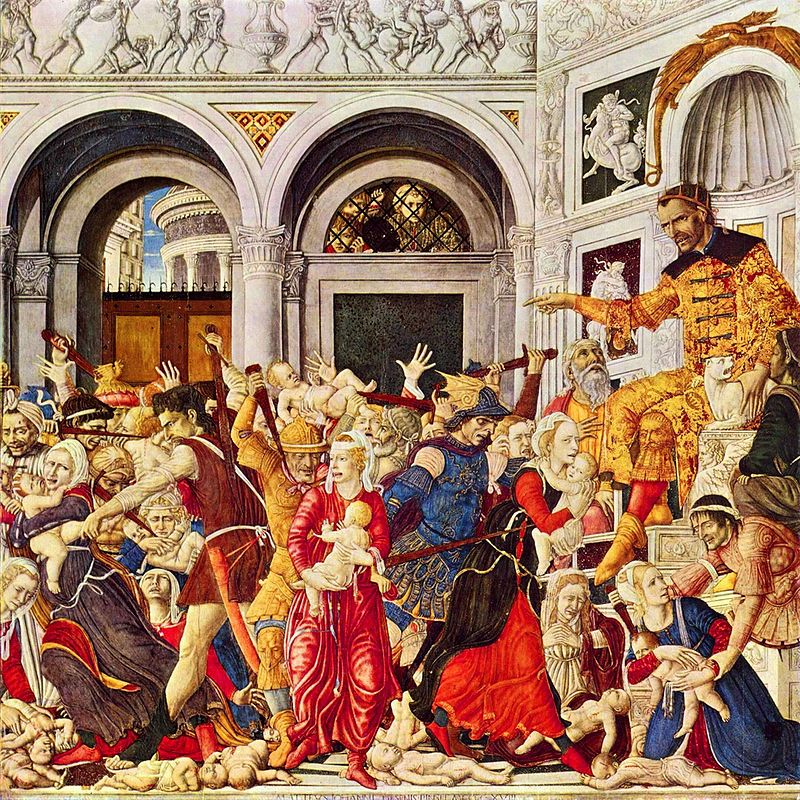
Herod's Massacre of the Innocents
Then what had been spoken through Jeremiah the prophet (prophetes) was fulfilled (pleroo) - Note the phrase spoken through indicating Jeremiah (and all prophets) were in essence "conduits" through whom God would speak to the world, "for no prophecy was ever made by an act of human will, but men moved by the Holy Spirit spoke from God."(2 Pet 1:21). The quotation in the next verse is taken from Jer 31:15, which depicts the wailing at the time of Israel's exile. That calamity and Herod's new atrocity are viewed as part of the same broad picture.
It is surprising that Jeremiah is named three times in Matthew (Mt 2:17, 16:14; 27:9) and nowhere else in the entire New Testament.
Matthew 2:18 "A VOICE WAS HEARD IN RAMAH, WEEPING AND GREAT MOURNING, RACHEL WEEPING FOR HER CHILDREN; AND SHE REFUSED TO BE COMFORTED, BECAUSE THEY WERE NO MORE."
NET "A voice was heard in Ramah, weeping and loud wailing, Rachel weeping for her children, and she did not want to be comforted, because they were gone."
GNT Φωνὴ ἐν Ῥαμὰ ἠκούσθη, κλαυθμὸς καὶ ὀδυρμὸς πολύς· Ῥαχὴλ κλαίουσα τὰ τέκνα αὐτῆς, καὶ οὐκ ἤθελεν παρακληθῆναι, ὅτι οὐκ εἰσίν.
NLT "A cry was heard in Ramah-- weeping and great mourning. Rachel weeps for her children, refusing to be comforted, for they are dead."
KJV In Rama was there a voice heard, lamentation, and weeping, and great mourning, Rachel weeping for her children, and would not be comforted, because they are not.
ESV "A voice was heard in Ramah, weeping and loud lamentation, Rachel weeping for her children; she refused to be comforted, because they are no more."
NIV "A voice is heard in Ramah, weeping and great mourning, Rachel weeping for her children and refusing to be comforted, because they are no more."
- Ramah - Jer 31:15
- lamentation - Jer 4:31 Jer 9:17-21 Eze 2:10 Rev 8:13
- Rachel - Ge 35:16-20
- REFUSED - Ge 37:30,33-35 Ge 42:36 Job 14:10
Related Passages:
Jeremiah 31:15 Thus says the LORD, “A voice is heard in Ramah, Lamentation and bitter weeping. Rachel is weeping for her children; She refuses to be comforted for her children, Because they are no more.”
Jeremiah 31:16,17 Thus says the LORD, “Restrain your voice from weeping And your eyes from tears; For your work will be rewarded,” declares the LORD, “And they will return from the land of the enemy." There is hope for your future (SEE VERSES BELOW!),” declares the LORD, “And your children will return to their own territory.
Jeremiah 31:31-34 Behold, days are coming,” declares the LORD, “when I will make a new covenant with the house of Israel and with the house of Judah, 32 not like the covenant which I made with their fathers in the day I took them by the hand to bring them out of the land of Egypt, My covenant which they broke, although I was a husband to them,” declares the LORD. 33 “But this is the covenant which I will make with the house of Israel after those days,” declares the LORD, “I will put My law within them and on their heart I will write it; and I will be their God, and they shall be My people. 34 “They will not teach again, each man his neighbor and each man his brother, saying, ‘Know the LORD,’ for they will all know Me, from the least of them to the greatest of them,” declares the LORD, “for I will forgive their iniquity, and their sin I will remember no more.”
Jeremiah 40:1 The word which came to Jeremiah from the LORD after Nebuzaradan captain of the bodyguard had released him from Ramah, when he had taken him bound in chains among all the exiles of Jerusalem and Judah who were being exiled to Babylon.
Matthew 8:12 ( but the sons of the kingdom will be cast out into the outer darkness; in that place there will be weeping (klauthmos) and gnashing of teeth.”
THE TEARS OF RACHEL AND
THE TRAGEDY OF HEROD
A VOICE WAS HEARD IN RAMAH, WEEPING (klauthmos - loud wailing) AND GREAT MOURNING (odurmos) - All caps indicated a direct OT quote (Jer 31:15). In Jeremiah's original context, Ramah was a town approximately five miles north of Jerusalem, (Jer 40:1) and Jeremiah’s day it was the gathering point where the captives of Judah were assembled in chains before being deported to Babylon. Weeping and great mourning describe uncontrollable grief.
TECHNICAL NOTE - Matthew introduces this quotation differently from the others in his opening chapters. In Mt 1:22, 2:15, and 2:23 he writes “in order that (hina - term of purpose) what was spoken… might be fulfilled.” Here he writes, “Then ( tote - See also five functions of "THEN" τότε)) what had been spoken through Jeremiah the prophet was fulfilled” (Mt 2:17). He uses the same “then” formula only once more, for Judas’s blood money (Mt 27:9). Many commentators believe the change is deliberate. Matthew does not say the slaughter happened “in order that” Scripture be fulfilled. He avoids presenting Herod’s evil as God’s intention, while still showing that it fit the pattern the prophet described.
This is the third of four fulfilled prophecies in Matthew - (1) Mt 2:6 fulfilled Micah 5:2 (2) Mt 2:15 fulfilled Hosea 11:1 (3) Mt 2:18 fulfilled Jeremiah 31:15 and (4) Mt 2:23 is said to "fulfill what was spoken through the prophets. There is however no specific prophecy or prophecies that can be definitely linked to Matthew 2:23. See discussion below on OT quotes in the NT. Not just mourning which would be bad enough but great (polus) mourning.
Warren Wiersbe notes that "In order to understand this fulfillment, we must review Jewish history. The first mention of Bethlehem in Scripture is in connection with the death of Jacob’s favorite wife, Rachel (Gen. 35:16–20). Rachel died giving birth to a son whom she named Benoni, “son of my sorrow.” Jacob renamed his son Benjamin, “son of my right hand.” Both of these names relate to Jesus Christ, for He was a “man of sorrows, and acquainted with grief” (Isa. 53:3), and He is now the Son of God’s right hand (Acts 5:31; Heb. 1:3). Jacob put up a pillar to mark Rachel’s grave which is near Bethlehem. Jeremiah’s prophecy was given about 600 years before Christ was born. It grew out of the captivity of Jerusalem. Some of the captives were taken to Ramah in Benjamin, near Jerusalem; and this reminded Jeremiah of Jacob’s sorrow when Rachel died. However, now it was Rachel who was weeping. She represented the mothers of Israel weeping as they saw their sons going into captivity. It was as though Rachel said, “I gave my life to bear a son, and now his descendants are no more.” Jacob saw Bethlehem as a place of death, but the birth of Jesus made it a place of life! Because of His coming, there would be spiritual deliverance for Israel and, in the future (Zech 12:10, Zech 13:8,9, Ro 11:25-29), the establishment of David’s throne and kingdom (2Sa 7:12,13). Israel, “the son of my sorrow,” would one day become “the son of My right hand.” Jeremiah gave a promise to the nation that they would be restored to their land again (Jer. 31:16, 17), and this promise was fulfilled. But he gave an even greater promise that the nation would be regathered in the future, and the kingdom established (Jer. 31:27ff, Ezek 37:21, 22). This promise shall also be fulfilled. Very few people today think of Bethlehem as a burial place; they think of it as the birthplace of Jesus Christ. And because He died for us and rose again, we have a bright future before us. We shall live forever with Him in that glorious city where death is no more and where tears never fall. (Bible Exposition Commentary)
RACHEL WEEPING (klauthmos) FOR HER CHILDREN (teknon); AND SHE REFUSED TO BE COMFORTED (parakaleo), BECAUSE THEY WERE NO MORE (lit - "they are not") : Rachel was the beloved wife of Jacob (Ge 29:20), the mother of Joseph and Benjamin, and so the ancestral “mother” of the northern tribes and of Benjamin. She died giving birth to Benjamin, near Bethlehem (Ge 35:18) "and was buried on the way to Ephrath (that is, Bethlehem)” (Ge 35:19). The name she gave her last son, Ben-oni, means “son of my sorrow.” Jeremiah pictures her rising from her tomb to grieve over her descendants carried off to Babylon. Matthew hears her weeping again, near the same place, over the children of Bethlehem.
Thus Herod's massacre of the innocents recalls Jeremiah's prophecy lamenting the captivity of Rachel's descendants (Jer 31:15). Ramah is located between 5.5-8 mi north of Jerusalem and was the scene of the gathering of the exiles. Jeremiah pictures Rachel's weeping from her tomb over the fate of Jews taken captive by the Babylonians. In the midst of wrath God remembered mercy for although the Babylonian Exile and Herod's atrocity were both horrendous, Matthew employs the event to introduce the New Covenant which Jesus has come to inaugurate in fulfillment of Jeremiah's prophecy (Jer 31:31-34). (See New Covenant in the Old Testament).
Rachel, Jacob's beloved wife, died in Bethlehem (Ge 35:19) and thus the grieving mothers of Bethlehem's slaughtered children are all personified in her name. Rachel was the mother of Benjamin, whose descendants were still associated with the town. Since the slaughter of the children is evidently not recorded in secular history, some have denied that it really happened. However, Bethlehem was a small village, with relatively few young children. In view of Herod's notorious cruelty (he even put one of his wives and his three oldest sons to death), this occurrence was quite in character and probably was accorded little secular notice outside the affected community. The event was prophesied in Jer 31:15, but the prophet also exhorted them to "refrain...from weeping" because the slain children are safe with the Lord and "shall come again from the land of the enemy" (Jer 31:16)
John Butler comments that "Abortion makes Herod's act look like a Sunday School picnic. We kill millions and millions of babies every year and the news media yawns and turns the other way. What we need to learn is that there is a relationship between our lack of affection for Christ and our abortion acts. In fact much evil in our land goes back to our bad attitude for Jesus Christ. The politicians do not understand this for they are part of the problem and they pass laws to allow evil which they cannot control. Those who defend abortion are not friends of Christ. They have more in common with Herod than with Christ."
Ryrie has an interesting note - Since Matthew was writing to those with a Jewish background, he used more quotations from the OT than the other gospel writers. There are 93 such quotations in Matthew, 49 in Mark, 80 in Luke, and 33 in John.
🙏 THOUGHT - Rachel’s weeping is the grief of every parent who has lost a child. Scripture does not hurry past such sorrow. It records it, and God hears it. But Rachel’s lament stands in a chapter of hope, and the Child who escaped that night came to defeat death itself. Beloved, if you are grieving, the Savior’s promise is for you: “Blessed are those who mourn, for they shall be comforted” (Mt 5:4). One day “He will wipe away every tear from their eyes; and there will no longer be any death; there will no longer be any mourning, or crying, or pain; the first things have passed away” (Rev 21:4). SEE JOHN MACARTHUR'S BOOK - Safe in the arms of God : truth from heaven about the death of a child - BORROW FROM ARCHIVE.ORG
Weeping (2805) (klauthmos from klaio = to weep or bewail) is a noun which describes a strong inner emotion which is evoked in weeping, crying, lamentation (cries of grief, the act of bewailing as an expression of sorrow). Matt. 2:18; Matt. 8:12; Matt. 13:42; Matt. 13:50; Matt. 22:13; Matt. 24:51; Matt. 25:30; Lk. 13:28; Acts 20:37
Mourning (3602) odurmos from oduromai = to lament) expresses a very intense and deep sense of sorrow, a loud and grievous expression of mourning or remorse. It can include the idea of wailing which means to utter a prolonged, inarticulate, mournful cry, usually high-pitched or clear-sounding, as in grief or suffering. Found only in Mt 2:18, 2 Cor 7:7 Once in the Septuagint of Jer 31:15 "“A voice is heard in Ramah, Lamentation and bitter weeping." Matthew's use indicates that this word describes audible mourning as an expression of sorrow.
Thayer has this note on synonyms - dakruo (cf dakruon), klaio, oduromai (cf odurmos), threneo, alalazo (ololuzo) stenazo: strictly, dakruo denotes to shed tears, weep silently; klaio to weep audibly, to cry as a child; oduromai to give verbal expression to grief, to lament; Bp to give formal expression to grief, to sing a dirge; alalazo to wail in oriental style, to howl in a consecrated, semi-liturgical fashion; stenazo to express grief by inarticulate or semi-articulate sounds, to groan.
Oduromai - Liddell-Scott - 1. c. acc. pers., Hom., Soph.; c. acc. mourned for it, i.e. for the want of it, 2. c. gen. pers. to mourn for, for the sake of, Hom. 3. c. dat. pers. to wail or lament to or before others, Id. 4. absol. to wail, mourn, Id., Eur.
TDNT - oduromai a. intr. “to wail,” “to lament,” “to grieve,” “to be distressed,” esp. for outward expressions of grief, often with tears, Hom. Od., 9, 13 (ὀδυρόμενος στεναχίζω); 14, 129 (ὀδυρομένῃ βλεφάρων ἄπο δάκρυα πίπτει); 16, 144 f. (στοναχῇ τε γόῳ τε); 18, 203 (κατά θυμόν); b. trans. “to bewail,” “to bemoan,” Hom. Il., 24, 714 (δάκρυ χέοντες); Soph. Ant., 693; Muson., p. 41, 4; 43, 2 (the exile). ὀδυρμός, “wailing,” “lamentation,” “weeping,” Eur. Tro., 609; Plat. Resp. 3, 398d (with θρῆνοι); Isoc. Panegyricus, 169 (δυστυχίας ἀνδρῶν); Plut. Demetr., 47, 3 (τῆς τύχης); Philo Migr. Abr., 156. In the LXX the verb occurs only in Jer 31:18 for נוד hithp (lit. “to shake,” shaking the head as a sign of grief), “to lament.” For the noun ὀδυρμός cf. Ἰερ. 38:15 (31:15) (with θρῆνος and κλαυθμός, Heb. בְּכִי תַמְרוּרִים, bitter weeping) for the loud (ἠκούσθη) and violent lamentation of the mother at the loss of her children; also 2 Macc. 11:6 (μετὰ ὀδυρμῶν καὶ δακρύων ἱκέτευον). The only NT examples of odurmos are in Mt. 2:18 (quoting Ἰερ. 38:15 [31:15] → supra) for loud and grievous lamentation at a most bitter loss, and 2 C. 7:7 for violent expressions of bitter remorse.
QUESTION - How does Jesus fulfill the prophecy that begins “a voice was heard in Ramah? GotQuestions.org
ANSWER - The Gospel of Matthew was written to prove that Jesus is Israel’s promised Messiah. Matthew quoted the Old Testament prophets more than any other gospel writer. His purpose was to demonstrate that the prophets’ words were fulfilled in Jesus Christ. In Matthew’s narrative of the birth of Jesus Christ, we find this quotation from Jeremiah: “A voice was heard in Ramah, weeping and loud lamentation, Rachel weeping for her children; she refused to be comforted, because they are no more” (Matthew 2:18ESV).
Matthew 2:16–18 recounts King Herod’s massacre of infant boys in Bethlehem and surrounding towns. Ramah was an Judean town about five miles north of Jerusalem. Jeremiah’s specific prophecy, given about six centuries before the birth of Jesus, concerns the captivity of Judah and the killing of innocent Jewish children during the Babylonian conquest (Jeremiah 31:15). But Matthew, seeing the striking parallel, applied it to the slaughter of babies by Herod the Great as another fulfillment of Old Testament prophecy.
In Matthew 2, wise men from the East arrive in Jerusalem with news of a newborn “king of the Jews” in Bethlehem (Matthew 2:2, 5). Fearing a threat to his kingship, the ruthless and powerful King Herod orders all male children two years old or under be put to death in the region.
In Scripture, Bethlehem is first mentioned in connection with the death of Rachel, who was Jacob’s favored wife (Genesis 35:16–20). Rachel died giving birth to their son, whom she called Ben-Oni, meaning “son of my sorrow.” Jacob changed the boy’s name to Benjamin, “son of my right hand.” Both names prophetically point to Jesus Christ, who was “a man of sorrows, acquainted with deepest grief” (Isaiah 53:3NLT), and who is now exalted to God’s “own right hand as Prince and Savior” (Acts 5:31NLT; Hebrews 1:3). Jacob marked Rachel’s grave by setting a pillar near Bethlehem.
“Rachel weeping for her children” represents the countless Jewish mothers grieving the loss of their children. Israel’s time of captivity in Babylon was undoubtedly one of the most sorrowful times in the nation’s history. Thus, Matthew links this Old Testament passage to the time of Jesus’ birth as further evidence that Jesus is the long-awaited Messiah in whom Israel can place its hope. In Jeremiah’s prophecy, the Lord promised the nation of Israel, “There is hope for your future” (Jeremiah 31:17). That promise was also fulfilled in Jesus Christ. Jacob and Jeremiah associated Bethlehem with death and mourning, but Messiah’s birth transformed it into a symbol of hope and life.
Matthew strategically included statements such as “a voice was heard in Ramah, weeping and loud lamentation” to show that the details of Jesus Christ’s birth, life, ministry, death, and resurrection were all in total harmony with the Old Testament. God made His Son’s identity clear. Israel’s Savior was destined to identify with His people’s historical suffering and exile as well as their exodus from slavery (Matthew 2:15). Jesus is explicitly and inseparably tied with the history of His people—not only with the Jews but all believers whose spiritual history and life before salvation involve mourning, exile, and slavery to sin.
“A voice was heard in Ramah” is just one of several hundred biblical prophecies fulfilled in Jesus Christ. Matthew’s skillful allusion to some of those prophecies supplied sufficient evidence that Jesus is indeed Israel’s promised Messiah.
See also Massacre of the Innocents
Matthew 2:19 But when Herod died, behold, an angel of the Lord appeared in a dream to Joseph in Egypt, and said,
NET After Herod had died, an angel of the Lord appeared in a dream to Joseph in Egypt
GNT Τελευτήσαντος δὲ τοῦ Ἡρῴδου ἰδοὺ ἄγγελος κυρίου φαίνεται κατ᾽ ὄναρ τῷ Ἰωσὴφ ἐν Αἰγύπτῳ
NLT When Herod died, an angel of the Lord appeared in a dream to Joseph in Egypt.
KJV But when Herod was dead, behold, an angel of the Lord appeareth in a dream to Joseph in Egypt,
ESV But when Herod died, behold, an angel of the Lord appeared in a dream to Joseph in Egypt,
NIV After Herod died, an angel of the Lord appeared in a dream to Joseph in Egypt
- Herod - Ps 76:10 Isa 51:12 Da 8:25 Da 11:45
- an angel - Mt 2:13 Mt 1:20 Ps 139:7 Jer 30:10 Eze 11:16
Related Passages:
Matthew 1:20 (But when he had considered this, behold, an angel of the Lord appeared to him in a dream, saying, “Joseph, son of David, do not be afraid to take Mary as your wife; for the Child who has been conceived in her is of the Holy Spirit.
Matthew 2:13 Now when they had gone, behold, an angel of the Lord *appeared to Joseph in a dream and said, “Get up! Take the Child and His mother and flee to Egypt, and remain there until I tell you; for Herod is going to search for the Child to destroy Him.”
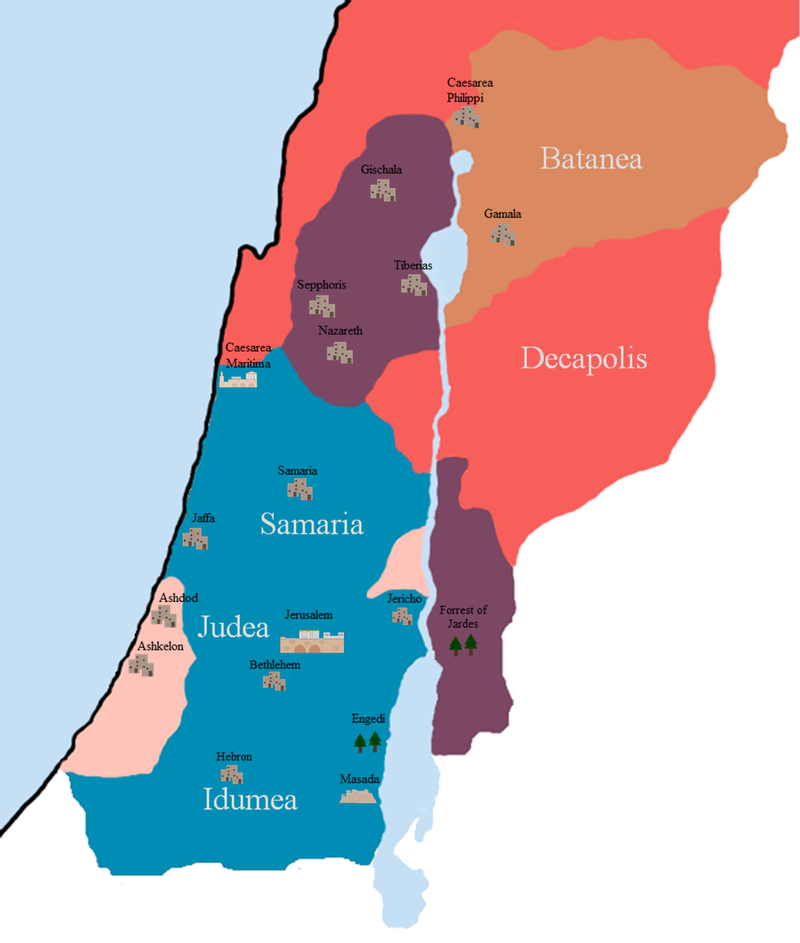
Turquoise = Archelaus
Brown = Herod Antipas
Tan = Philip the Tetrarch
HEROD'S DEATH MARKS
RETURN FROM EGYPT
But (term of contrast) when Herod died (teleutao) - Notice God's perfect timing when Herod died. His timing is perfect in our lives also beloved. Herod the Great died in 4 B.C. and his kingdom was divided up among his three sons (see map above): Archelaus, who ruled over Judea (where Bethlehem was located, Mt 2:22); Philip, who became tetrarch of Iturea and Trachonitis (cf. Lk 3:1); and Antipas, who became tetrarch of Galilee (location of Nazareth).
Broadus on when Herod died - The death of Herod (comp. on v. 1) occurred in the spring (just before the Passover) of the year of Rome 750. Josephus mentions an eclipse of the moon (“Ant.,” 17, 6, 4) as taking place shortly before his death, and astronomical calculations enable us to fix the year with practical certainty. (Wieseler, Andrews, Caspari, Nicholson.) The birth of Jesus must have preceded Herod’s death by several months, if not longer, and must therefore have occurred at least four years before the common Christian era, the first year of which coincides with the year of Rome 754. The poor old tyrant died of a most loathsome and torturing disease (see Jos. “Ant.,” 17, 6, 5), in the seventieth year of his life, and the thirty-seventh of his nominal, or thirty-fourth of his actual reign. (Jos. “War,” 1, 33, 8; “Ant.,” 17, 8, 1.)
Behold (idou), an angel (angelos) of the Lord appeared in a dream to Joseph in Egypt, and said - Heb 1:1 says God "spoke long ago to the fathers in the prophets in many portions and in many ways" and here speaks in a dream.
Note that this is an angel of the Lord, not "the Angel of the LORD" (OT Christophany), but a literal angel created by the the Angel of the LORD. Presumably this is the same angel as in Mt 2:13 who declared "remain there until I tell you; for Herod is going to search for the Child to destroy Him.” And now he tells Joseph. Angel of the Lord (angelos kyriou) appears in Matthew only around Jesus’ birth (1:20, 24; 2:13, 19) and at His resurrection (28:2). It's as if God’s messengers stand at the beginning and end of the Gospel which makes me think of the two cherubim over the Ark of the Covenant (See picture).
To Joseph - Joseph does not speak a single recorded word in the Gospels. What Scripture records is his obedience. Each time God speaks, Joseph acts at once and exactly as told (Mt 1:24; 2:14). Recall that Matthew introduced him with one description: “And Joseph her husband, being a righteous man and not wanting to disgrace her, planned to send her away secretly” (Mt 1:19) and we repeatedly see his righteousness shown in his quiet, prompt obedience.
In Egypt - The parallels with Genesis are striking. Another Joseph, son of Jacob, went down to Egypt and received dreams from God which preserved the family of the promised Seed, the Messiah. Now Joseph the husband of Mary, guided by dreams, has taken the Promised Seed to Egypt to preserve His life! Matthew has already shown that the return from Egypt fulfills God’s word: “When Israel was a youth I loved him, and out of Egypt I called My son” (Hos 11:1; Mt 2:15).
There is somewhat of a parallel with Moses too. The angel’s message in the next verse, “for those who sought the Child’s life are dead” (Mt 2:20), echoes God’s words to Moses: “Now the LORD said to Moses in Midian, ‘Go back to Egypt, for all the men who were seeking your life are dead’” (Ex 4:19). Moses escaped a king’s massacre of Hebrew infants and was later called back when his enemies had died. Jesus escaped a king’s massacre and was called back when His enemy had died. The One greater than Moses had come.
Matthew Henry - Mt 2:19-23. Egypt may serve to sojourn in, or take shelter in, for awhile, but not to abide in. Christ was sent to the lost sheep of the house of Israel, to them he must return. Did we but look upon the world as our Egypt, the place of our bondage and banishment, and heaven only as our Canaan, our home, our rest, we should as readily arise and depart thither, when we are called for, as Joseph did out of Egypt. The family must settle in Galilee. Nazareth was a place held in bad esteem, and Christ was crucified with this accusation, Jesus the Nazarene. Wherever Providence allots the bounds of our habitation, we must expect to share the reproach of Christ; yet we may glory in being called by his name, sure that if we suffer with him, we shall also be glorified with him.
🙏 THOUGHT - Joseph waited in Egypt until God said “Go,” and God did not speak until Herod was dead. God’s timing is exact. He knows when to hide His people and when to call them out. Beloved, if you are in an “Egypt” season, waiting for God’s word to move, rest in His timing: “My times are in Your hand; deliver me from the hand of my enemies and from those who persecute me” (Ps 31:15).
Died (5053)(teleutao) means to complete, to come to an end, hence to die. Note especially Mt 9:18 and Jn 11:39 which refer to persons raised from the dead by Jesus. Friberg - "intransitively in the NT come to an end; euphemistically die." Thayer - "to have an end or close, come to an end; hence, to die, very often so from Aeschylus and Herodotus down." Liddell-Scott - to complete, finish, accomplish (to fulfil an oath or promise; to bring about an evil day for one), to bring to an end, esp. to finish life, i.e. to die. Intransitively. 1. to be accomplished, Id. 2. to come to an end.
Teleutao - 13x in 13v - deceased (1), die (4), died (5), dying (1), put (2). - Mt. 2:19; Mt. 9:18; Mt. 15:4; Mt. 22:25; Mk. 7:10; Mk. 9:44; Mk. 9:46; Mk. 9:48; Lk. 7:2 (" was sick and about to die."); Jn 11:39 ("Martha, the sister of the deceased"); Acts 2:29 ("the patriarch David that he both died and was buried"); Acts 7:15; Heb. 11:22
Teleutao in the Septuagint - In the Septuagint teleutao almost always translates the Hebrew term mûth, meaning “die” or “end one’s life,” especially in reference to physical death. Ge. 6:17 (Heb = gava = perish; Lxx = teleutao); Gen. 25:32; Gen. 30:1; Gen. 44:31; Gen. 50:16; Gen. 50:26; Exod. 1:6; Exod. 2:23; Exod. 4:19; Exod. 7:18; Exod. 7:21; Exod. 8:13; Exod. 9:4; Exod. 9:6; Exod. 9:7; Exod. 9:19; Exod. 11:5; Exod. 19:12; Exod. 21:16; Exod. 21:17; Exod. 21:34; Exod. 21:35; Exod. 21:36; Exod. 22:10; Exod. 35:2; Lev. 16:1; Lev. 21:11; Lev. 24:16; Num. 3:4; Num. 6:6; Num. 20:1; Num. 35:16; Deut. 17:5; Deut. 25:6; Deut. 32:50; Deut. 34:5; Deut. 34:7; Jos. 1:2; Jos. 24:33; Jdg. 2:8; 1 Chr. 29:28; 2 Chr. 13:20; 2 Chr. 16:13; 2 Chr. 24:15; Job 1:19; Job 2:9; Job 3:11; Job 12:2; Job 14:8; Job 14:10; Job 21:25; Job 27:15; Job 34:15; Job 42:17; Prov. 5:23; Prov. 10:21; Prov. 11:7; Prov. 15:10; Isa. 66:24; Jer. 11:22; Ezek. 6:12; Ezek. 7:15; Ezek. 12:13; Ezek. 17:16; Ezek. 18:17; Amos 7:11; Amos 7:17; Amos 9:10;
Behold (2400)(idou) is the second person singular aorist middle imperative of eidon which means to see, perceive, look at. In the NT idou is used as a demonstrative particle that draws attention to what follows. Idou in the middle voice means "you yourself look, see, perceive!" The aorist imperative is a command emphasizing "Do it now! Don't delay!"Spurgeon reminds us that "Behold is a word of wonder; it is intended to excite admiration. Wherever you see it hung out in Scripture, it is like an ancient sign-board, signifying that there are rich wares within, or like the hands which solid readers have observed in the margin of the older Puritanic books, drawing attention to something particularly worthy of observation." I would add, behold is like a divine highlighter, a divine underlining of an especially striking or important text. It says in effect "Listen up, all ye who would be wise in the ways of Jehovah!"
IDOU IN MATTHEW - Matt. 1:20; Matt. 1:23; Matt. 2:13; Matt. 2:19; Matt. 3:16; Matt. 3:17; Matt. 4:11; Matt. 7:4; Matt. 8:24; Matt. 8:34; Matt. 9:10; Matt. 10:16; Matt. 11:10; Matt. 11:19; Matt. 12:2; Matt. 12:18; Matt. 12:41; Matt. 12:42; Matt. 12:46; Matt. 12:47; Matt. 12:49; Matt. 13:3; Matt. 17:3; Matt. 17:5; Matt. 19:27; Matt. 20:18; Matt. 21:5; Matt. 22:4; Matt. 23:34; Matt. 23:38; Matt. 24:23; Matt. 24:25; Matt. 24:26; Matt. 25:6; Matt. 26:45; Matt. 26:46; Matt. 26:47; Matt. 26:51; Matt. 27:51; Matt. 28:2; Matt. 28:7; Matt. 28:9; Matt. 28:20
Appeared (5316)(phaino) is a Greek verb meaning to shine, to give light, and in the middle and passive voices to appear, to become visible, to be seen, and by extension to seem, to appear to be. It comes from the root pha-, “light,” the same root found in phōs (G5457), “light.” The basic idea is bringing something into the light so that it can be seen. English words derived from this root include phenomenon (something that appears), phantom, phase, emphasis, and diaphanous (light shining through). Related New Testament words include phaneroō (G5319), “to make manifest, reveal”; epiphainō (G2014), “to appear, shine upon”; epiphaneia (G2015), “appearing,” used of Christ’s comings; and phantasma (G5326), “apparition, ghost” (Mt 14:26). The verb occurs about thirty times in the New Testament.
PHAINO - 31V - Matt. 1:20; Matt. 2:7; Matt. 2:13; Matt. 2:19; Matt. 6:5; Matt. 6:16; Matt. 6:18; Matt. 9:33; Matt. 13:26; Matt. 23:27; Matt. 23:28; Matt. 24:27; Matt. 24:30; Mk. 14:64; Mk. 16:9; Lk. 9:8; Lk. 24:11; Jn. 1:5; Jn. 5:35; Rom. 7:13; 2 Co. 13:7; Phil. 2:15; Heb. 11:3; Jas. 4:14; 1 Pet. 4:18; 2 Pet. 1:19; 1 Jn. 2:8; Rev. 1:16; Rev. 8:12; Rev. 18:23; Rev. 21:23
To shine, give light. In the active voice, phainō describes light shining. John uses it of Christ, the true Light (Jn 1:5: “The Light shines in the darkness, and the darkness did not comprehend it.”), and of John the Baptist (Jn 5:35: “He was the lamp that was burning and was shining and you were willing to rejoice for a while in his light.”). Peter uses it of God’s prophetic word (2 Pet 1:19: “So we have the prophetic word made more sure, to which you do well to pay attention as to a lamp shining in a dark place, until the day dawns and the morning star arises in your hearts.”). John saw the glorified Christ, “and His face was like the sun shining in its strength” (Rev 1:16), and in the New Jerusalem no sun is needed (Rev 21:23: “And the city has no need of the sun or of the moon to shine on it, for the glory of God has illumined it, and its lamp is the Lamb.”). Believers are called to shine in the same way (Phil 2:15: “so that you will prove yourselves to be blameless and innocent, children of God above reproach in the midst of a crooked and perverse generation, among whom you appear as lights in the world,”).
To appear, become visible. Matthew uses phainō four times in his birth narrative to describe divine manifestations. Three times an angel of the Lord appeared to Joseph in a dream (Mt 1:20; 2:13, 19), and once Herod inquired about “the exact time the star appeared” (Mt 2:7). In 2:7 the verb is a present participle, literally “the appearing star,” and some take it to suggest the star continued to appear over a period of time. Matthew also uses the verb in connection with Christ’s return. Jesus’ coming will be as sudden and visible as lightning that “flashes even to the west” (Mt 24:27), and “the sign of the Son of Man will appear in the sky” (Mt 24:30). So a light in the sky marked His first coming, and a sign in the sky will mark His second. Mark uses the verb of the risen Lord, who “first appeared to Mary Magdalene” (Mk 16:9). James applies it to the brevity of human life (Jas 4:14: “Yet you do not know what your life will be like tomorrow. You are just a vapor that appears for a little while and then vanishes away.”).
To seem, to be seen by others. In the Sermon on the Mount, Jesus uses phainō to expose religion performed for an audience. Hypocrites pray “so that they may be seen by men” (Mt 6:5), and they disfigure their faces “so that they will be noticed by men when they are fasting” (Mt 6:16). Jesus instead calls His followers to fast “so that you will not be noticed (phainō) by men... but by your Father who is in secret” (Mt 6:18). He later exposed the scribes and Pharisees with the same word (Mt 23:28: “So you, too, outwardly appear righteous to men, but inwardly you are full of hypocrisy and lawlessness.”). Appearances can deceive. What matters is not how we appear to men but how we appear before God.
Matthew 2 and the gospel. In Matthew 2, the word contrasts the light God gives with the darkness of Herod’s heart. Herod wanted to know exactly when the star appeared, not to follow its light to worship, but to snuff out the Light it announced. Yet God, who caused the star to appear, also caused His angel to appear to Joseph (Mt 2:13), and Herod’s plot failed. The related verb epiphainō sums up the purpose of Christ’s first coming (Titus 2:11: “For the grace of God has appeared, bringing salvation to all men,”), and Zacharias prophesied that the Sunrise from on high would visit us “TO SHINE (epiphainō) UPON THOSE WHO SIT IN DARKNESS AND THE SHADOW OF DEATH” (Lk 1:79).
THOUGHT: The same star that appeared to the Magi appeared to Herod’s informants, yet the Magi followed it to worship while Herod used it to plan murder. Light does not change hearts by itself; it reveals them. Jesus said, “I am the Light of the world; he who follows Me will not walk in the darkness, but will have the Light of life” (Jn 8:12). The Light has appeared. The question is whether we follow it like the Magi or resist it like Herod. And having received the Light, may we “appear as lights in the world” (Phil 2:15), not to be seen by men like the hypocrites, but so that men may see our Father in us.
Matthew 2:20 "Get up, take the Child and His mother, and go into the land of Israel; for those who sought the Child's life are dead."
NET saying, "Get up, take the child and his mother, and go to the land of Israel, for those who were seeking the child's life are dead."
GNT λέγων, Ἐγερθεὶς παράλαβε τὸ παιδίον καὶ τὴν μητέρα αὐτοῦ καὶ πορεύου εἰς γῆν Ἰσραήλ· τεθνήκασιν γὰρ οἱ ζητοῦντες τὴν ψυχὴν τοῦ παιδίου.
NLT "Get up!" the angel said. "Take the child and his mother back to the land of Israel, because those who were trying to kill the child are dead."
KJV Saying, Arise, and take the young child and his mother, and go into the land of Israel: for they are dead which sought the young child's life.
ESV saying, "Rise, take the child and his mother and go to the land of Israel, for those who sought the child's life are dead."
NIV and said, "Get up, take the child and his mother and go to the land of Israel, for those who were trying to take the child's life are dead."
- Get up - Mt 2:13 Pr 3:5,6
- for - Ex 4:19 1Ki 11:21,40 1Ki 12:1-3
ANOTHER DREAM
MESSAGE
This is the third communication from God to Joseph using a dream (Mt 1:20, Mt 2:12, Mt 2:19, Mt 2:22). This is another example of God's sovereign initiative and intervention in the lives of His people. These are the one's we are aware of, but given that God is in total control, there are doubtless many other sovereign acts not recorded. The one's that are recorded should always remind us that there are countless others and this is true of our lives beloved! You can count on a God Who is in control! (Even if your present circumstances seem out of control!)
Get up (egeiro), take (paralambano) the Child (paidion) and His mother, and go into the land of Israel - One fascinating factoid is that this is the only mention of the phrase the land of Israel in the entire NT! One writer has an interesting thought "This expression, used nowhere else in the NT, suggests that Jesus’ return from Egypt was like ancient Israel’s leaving Egyptian slavery to dwell in the Promised Land." Note carefully that Matthew always lists “the Child” first and calls Mary “His mother,” never “Joseph’s wife,” in these scenes (Mt 2:11, 13, 14, 20, 21). Joseph is guardian and protector, but the Child is not his son by nature. The wording preserves the truth of the virgin birth (Mt 1:18-25).
Get up (egeiro) means literally to wake up which is likely the sense here as the angel had spoke to Joseph in a dream. Get up (egeiro) is the same instruction (surprisingly it is not a command in the Greek) the angel gave when he sent the family to Egypt (Mt 2:13). Then the angel gives a command to take in the aorist imperative meaning "Do this now!" "Don't delay!"
It is interesting to note that the verb egeiro is also the word Matthew uses for Jesus’ resurrection declaring “He is not here, for He has risen (egeiro), just as He said. Come, see the place where He was lying” (Mt 28:6).
Go is the present imperative, a command to keep on going. It is not flee as before (Mt 2:13) but go. It is interesting that this command is almost identical (but the opposite direction) to that Jehovah gave to Moses in Ex 4:19 "“Go back to Egypt, for all the men who were seeking your life are dead.” This is basically a reversal of the similar warning commands to take and flee in Mt 2:13.
And go into the land of Israel - “Land of Israel” (gē Israēl) appears in the New Testament only here and in the next verse. It is the covenant name for the land God promised to the patriarchs. That land was promised to Jacob himself, whom God renamed Israel (Ge 28:4) Ezekiel often uses this phrase, especially in his promises of restoration. One of them pictures God’s people being brought back to the land as if from the grave (Ezek 37:12). God’s Son, the King of the Jews, the King of Israel, now returns from exile into the land of Israel.
For those who sought (zeteo) the Child's (paidion) life are dead (thnesko) - Note those is plural, so while Herod was the primary perpetrator of the assassination, it implies that there were others who were at least sympathetic accomplices! Think of the Jewish religious leadership whose power base would be totally disrupted if this one really were King of the Jews. While we cannot be definitive as to His age, clearly Jesus is no longer an infant and is probably between 2-4 years old, give that Herod died in 6 BC.
Dead (thnesko) is in the perfect tense meaning “they have died and remain dead” so that the danger was past.
🙏 THOUGHT - God told Joseph “remain there until I tell you,” and He kept His word to the letter. The enemies died, the Child lived, and the family came home. Every word God speaks will be kept: “God is not a man, that He should lie, nor a son of man, that He should repent; has He said, and will He not do it? Or has He spoken, and will He not make it good?” (Nu 23:19). Beloved, is there a promise you are waiting on? He has not forgotten it.
Take (3880)(paralambano from para = beside + lambano = appropriate, receive) means to receive from another, to receive alongside or to take to oneself (into close association) in order to carry away, here of the baby Jesus, and one day Jesus taking us away in John 14:3 "I will come again and receive (paralambano) you to Myself." (The Rapture!)
PARALAMBANO IN MATTHEW - Matt. 1:20; Matt. 1:24; Matt. 2:13; Matt. 2:14; Matt. 2:20; Matt. 2:21; Matt. 4:5; Matt. 4:8; Matt. 12:45; Matt. 17:1; Matt. 18:16; Matt. 20:17; Matt. 24:40; Matt. 24:41; Matt. 26:37; Matt. 27:27
Sought (2212)(zeteo) is a verb meaning to seek, to search for, to look for, and by extension to strive for, to desire, to aim at, to demand, to require, and to inquire. Its etymology is uncertain. The verb occurs about 117 times in the New Testament and describes an active, purposeful search, whether for something lost, something desired, or someone to be harmed.
NIV has "those who were trying" reflecting the present tense of zeteo indicating this was a continuous effort to destroy the Christ Child. This was a persistent effort! Death snuffed out Herod's efforts to put Jesus to death.
Seeking what is lost. Zēteō describes the search for something or someone missing, as when Mary and Joseph searched anxiously for the twelve-year-old Jesus (Lk 2:48-49) Most wonderfully, it describes the mission of Christ Himself (Lk 19:10: “For the Son of Man has come to seek and to save that which was lost.”), and the Father’s search for true worshipers (Jn 4:23).
Seeking as a priority of life. Jesus calls His disciples to make God’s kingdom the object of their pursuit (Mt 6:33: “But seek first His kingdom and His righteousness, and all these things will be added to you.”) and promises that earnest seeking will be rewarded (Mt 7:7) Paul uses the present imperative to command a continual orientation of the heart (Col 3:1) Paul also uses the verb of self-centered seeking (Phil 2:21)
ZETEO IN MATTHEW - Matt. 2:13; Matt. 2:20; Matt. 6:33; Matt. 7:7; Matt. 7:8; Matt. 12:43; Matt. 12:46; Matt. 12:47; Matt. 13:45; Matt. 18:12; Matt. 21:46; Matt. 26:16; Matt. 26:59; Matt. 28:5
🙏 THOUGHT: Matthew 2 is a chapter of seekers. The Magi sought the Child to worship Him. Herod sought the Child to destroy Him. The Magi found Him, and Herod died without finding Him. Behind it all stood another Seeker, the God Who sent His Son to seek and to save the lost. Herod’s search ended at his grave, but the Child he sought to kill grew up to die willingly for sinners like us, and then rose again. This begs the question of what am I seeking? Am I like Herod, seeking to keep Christ off the throne of my life? Or am I like the self-seekers of Philippians 2:21, pursuing my own interests? Or, finally, amy I like the Magi, seeking Him to worship Him and present myself to Him as a living sacrifice (Ro 12:1)? He promises that those who seek Him with all their heart will find Him.
Matthew 2:21 So Joseph got up, took the Child and His mother, and came into the land of Israel.
NET So he got up and took the child and his mother and returned to the land of Israel.
GNT ὁ δὲ ἐγερθεὶς παρέλαβεν τὸ παιδίον καὶ τὴν μητέρα αὐτοῦ καὶ εἰσῆλθεν εἰς γῆν Ἰσραήλ.
NLT So Joseph got up and returned to the land of Israel with Jesus and his mother.
KJV And he arose, and took the young child and his mother, and came into the land of Israel.
ESV And he rose and took the child and his mother and went to the land of Israel.
NIV So he got up, took the child and his mother and went to the land of Israel.
- Ge 6:22 Heb 11:8
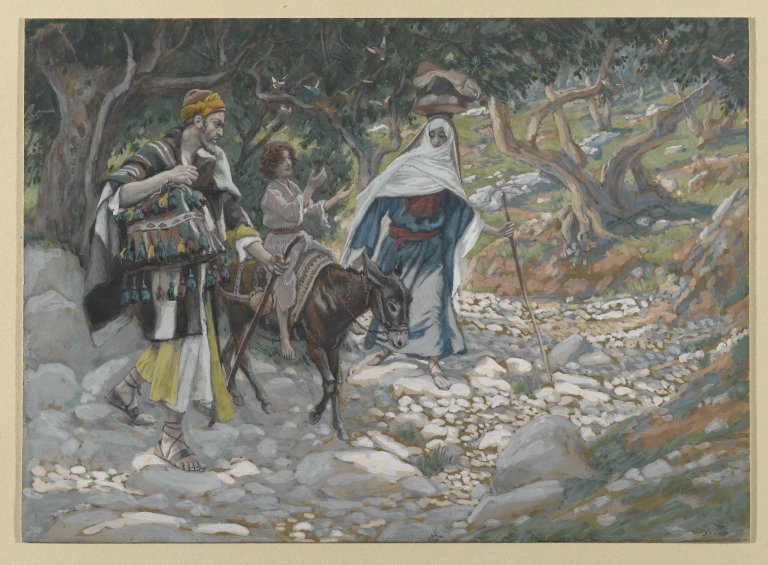
The Return from Egypt by James Tissot
JOSEPH'S OBEDIENCE:
FROM EGYPT TO ISRAEL
So Joseph got up, took the Child and His mother, and came into the land of Israel - The verse repeats the angel’s command almost word for word, now as action. Again note Joseph's unquestioning obedience. There is no delay, no debate, and no recorded word from Joseph, only exact obedience. He is a man with a willing, submissive spirit. Matthew presents Joseph this way every time God speaks to him. After the first dream (Mt 1:24) and after the second dream (Mt 2:14). This pattern, God’s command followed by obedience described in the same words, is one of Scripture’s ways of commending a faithful servant. It is how Genesis describes Noah: “Thus Noah did; according to all that God had commanded him, so he did” (Ge 6:22).
Joseph’s obedience was not easy. It meant moving his young family a second time, across the desert again, to an uncertain future. He did not even know yet where in Israel they would live. That was revealed only one step at a time, through a further warning (2:22). Like Abraham, he obeyed without seeing the whole road: “By faith Abraham, when he was called, went out to a place which he was to receive for an inheritance; and he went out, not knowing where he was going” (Heb 11:8). Jacob’s return to the land followed the same pattern. He obeyed when God said, “Return to the land of your fathers” (Ge 31:3).
And the first area the family would have come to was Judea, which was ruled by Archelaus.
Warren Wiersbe adds that "We cannot help but admire Joseph for his faithfulness in obeying God and caring for both Mary and Jesus." (BORROW Wiersbe's Expository Outlines)
Arnold Fruchtenbaum - They would have spent one to two years in Egypt, based on Josephus’ account of Herod dying in Jericho in 4 B.C.
Henry Morris suggests that "Joseph apparently intended to return to the house in Bethlehem (Mt 2:9) where they had been living before their quick flight to Egypt. Instead, in response to another divine warning (Mt 2:22), he took the family back to Nazareth where they had lived before journeying to Bethlehem. The parallel account in Luke makes no mention of the visit of the Magi or of the flight to Egypt. It simply notes that they returned to Nazareth after a short visit to Jerusalem to dedicate Jesus to the Lord and to offer the appropriate sacrifice after his mother's month of purification (Lu 2:21-24,39 Lev 12:1-8). They evidently had returned to Bethlehem from Jerusalem, which was only a few miles away, by the time that the Magi came several months later." (Defender's Study Bible)
David Guzik adds that "There have been some who falsely teach that Egyptian magicians or sorcerers influenced Jesus and His later miracles were really just Egyptian tricks. It is important to note that there is no evidence for such claims, and significant evidence against such claims. Particularly, the teaching and style of ministry of Jesus is completely influenced by Old Testament Judaism, not by Egyptian mysticism." (Matthew 2 Commentary)
🙏 THOUGHT - Joseph heard and he obeyed, every time. He is a quiet hero of the Christmas story. He never preached a sermon or spoke a recorded word, but by simple, prompt obedience he protected the Son of God. Beloved, how quickly do you obey when God makes His will known? “But He said, ‘On the contrary, blessed are those who hear the word of God and observe it’” (Lk 11:28).
Matthew 2:22 But when he heard that Archelaus was reigning over Judea in place of his father Herod, he was afraid to go there. Then after being warned by God in a dream, he left for the regions of Galilee,
NET But when he heard that Archelaus was reigning over Judea in place of his father Herod, he was afraid to go there. After being warned in a dream, he went to the regions of Galilee.
GNT ἀκούσας δὲ ὅτι Ἀρχέλαος βασιλεύει τῆς Ἰουδαίας ἀντὶ τοῦ πατρὸς αὐτοῦ Ἡρῴδου ἐφοβήθη ἐκεῖ ἀπελθεῖν· χρηματισθεὶς δὲ κατ᾽ ὄναρ ἀνεχώρησεν εἰς τὰ μέρη τῆς Γαλιλαίας,
NLT But when he learned that the new ruler of Judea was Herod's son Archelaus, he was afraid to go there. Then, after being warned in a dream, he left for the region of Galilee.
KJV But when he heard that Archelaus did reign in Judaea in the room of his father Herod, he was afraid to go thither: notwithstanding, being warned of God in a dream, he turned aside into the parts of Galilee:
ESV But when he heard that Archelaus was reigning over Judea in place of his father Herod, he was afraid to go there, and being warned in a dream he withdrew to the district of Galilee.
NIV But when he heard that Archelaus was reigning in Judea in place of his father Herod, he was afraid to go there. Having been warned in a dream, he withdrew to the district of Galilee,
- he was - Ge 19:17-21 1Sa 16:2 Ac 9:13,14
- being - Mt 2:12 Mt 1:20 Ps 48:14 Ps 73:24 Ps 107:6,7 Ps 121:8 Isa 30:21 Isa 48:17,18
- he left for the regions of Galilee - Mt 3:13 Lu 2:39 Joh 7:41,42,52
Turquoise = Archelaus
Brown = Herod Antipas
Tan = Philip the Tetrarch
JOSEPH WARNED
IN ANOTHER DREAM
But when - Term of contrast and expression of time. Joseph's senses of fear had been honed now to know that the Herod family tree is a tree to be avoided! A subsequent dream confirmed Joseph's fears.
He heard that Archelaus was reigning (basileuo) over Judea in place of his father Herod he was afraid (phobeo) to go there - The Roman government divided Herod's kingdom among his 3 sons. Archelaus (4 B.C.-A.D. 6) was a son of Herod the Great by his Samaritan wife Malthace. When Herod died, his kingdom was divided among three sons. Archelaus received Judea, Samaria, and Idumea (see map above). Herod Antipas ruled over Galilee and Perea (he had John the Baptist executed Mt 14:1-2 and examined Christ the night before He was crucified - Lk 23:7-12). Philip became tetrarch of Iturea and Trachonitis (cf. Lk 3:1), regions northeast of the Sea of Galilee.
Archelaus was a bloody king ("like father, like son"), hated by the Jews and even worse in the eyes of Rome was the fact that he was an ineffective ruler. As a result Augustus made him ethnarch a title with less prestige than that of "king." Matthew’s “reigning” (basileuo) describes his actual power rather than his official title.He pursued the building of public works but was a repressive ruler. Early in his reign a riot broke out in Jerusalem during Passover. According to Josephus, early in his reign he had about three thousand people killed in the temple courts at Passover. It is probably this fact that contributed to Joseph's migration to Galilee. After a deputation of the Jewish aristocracy from Judea and Samaria visited Rome to protest the rule of Archelaus, he was deposed and banished by Caesar Augustus in A.D. 6 to Gaul. Judea was then placed under Roman prefects, of whom Pontius Pilate was later one.
A T Robertson points out that "In a fret at last before his death Herod had changed his will again and put Archelaus, the worst of his living sons, in the place of Antipas."
F F Bruce on Archelaus - “A man of kindred nature, suspicious, truculent (Jospehus Antiquities, 17.11.2), to be feared and avoided by such as had cause to fear his father.”
He was afraid (phobeo) to go there - Joseph’s fear was reasonable, not faithless. Herod was dead, but a son with the same instincts now ruled in Bethlehem’s region. Fear itself is not sin. What matters is what we do with it. Joseph was afraid, and God met him in his fear with guidance. David describes the right response: “When I am afraid, I will put my trust in You” (Ps 56:3).
Then after being warned (see chrematizo in Mt 2:12) by God in a dream (onar) he left (anachoreo) for the regions of Galilee - This is the fourth communication from God to Joseph using a dream (onar - Mt 1:20, Mt 2:12, Mt 2:19, Mt 2:22). This is the fourth use of departed (left - anachoreo) in this chapter (Mt 2:12, Mt 2:13, Mt 2:14, Mt 2:22). God confirmed Joseph’s sensible caution but this dream warning gave no mention of which region or town to go to specifically. Wiersbe quips that "Joseph used his “sanctified common sense” and did not return to Judea. God affirmed the decision, and the family moved to Nazareth."
He left (anachoreo) for the regions of Galilee - Left (anachoreo) means to withdraw (used also in Mt 2:12) Galilee lay in the north, under the rule of Antipas rather than Archelaus. Luke 2:39 adds that Galilee was the family’s original home. Matthew tells the story from the perspective of God’s guidance. Luke simply notes that they went home. The two accounts complement each other.
Galilee was not a prestigious region. It had a mixed population and was looked down on by the religious leaders of Jerusalem: “They answered him, ‘You are not also from Galilee, are you? Search, and see that no prophet arises out of Galilee’” (Jn 7:52). Yet that is exactly where God placed His Son, and Matthew later shows that this too fulfilled prophecy: “The land of Zebulun and the land of Naphtali, by the way of the sea, beyond the Jordan, Galilee of the Gentiles—the people who were sitting in darkness saw a great light, and those who were sitting in the land and shadow of death, upon them a light dawned” (Mt 4:15-16; Isa 9:1-2).
Louis Barbieri - Archelaus, noted for tyranny, murder, and instability, was probably insane as a result of close family intermarriages. (See Bible Knowledge Commentary - Page 23)
🙏 THOUGHT - God guided Joseph through (1) news he heard, (2) through a natural fear, and (3) through a dream. Each circumstance led to the place where Jesus would grow up and later shine as the Light of Galilee. God can use our fears to direct our steps when we bring those fears to Him. (Pr 16:9, Ps 34:4, Isa 41:10, Php 4:6,7). Beloved, are you bringing your fears to Him for guidance rather than letting them paralyze you? “Trust in the LORD with all your heart and do not lean on your own understanding. In all your ways acknowledge Him, and He will make your paths straight” (Pr 3:5,6).
Alfred Edersheim has this background on Herod's dreadful demise - The cup of Herod’s misdeeds, but also of his misery, was full. During the whole latter part of his life, the dread of a rival to the throne had haunted him, and he had sacrificed thousands, among them those nearest and dearest to him, to lay that ghost. And still the tyrant was not at rest. A more terrible scene is not presented in history than that of the closing days of Herod. Tormented by nameless fears; ever and again a prey to vain remorse, when he would frantically call for his passionately-loved, murdered wife Mariamme, and her sons; even making attempts on his own life; the delirium of tyranny, the passion for blood, drove him to the verge of madness. The most loathsome disease, such as can scarcely be described, had fastened on his body, and his sufferings were at times agonising. By the advice of his physicians, he had himself carried to the baths of Callirhoe (east of the Jordan), trying all remedies with the determination of one who will do hard battle for life. It was in vain. The namelessly horrible distemper, which had seized the old man of seventy, held him fast in its grasp, and, so to speak, played death on the living. He knew it, that his hour was come, and had himself conveyed back to his palace under the palm-trees of Jericho. They had known it also in Jerusalem, and, even before the last stage of his disease, two of the most honoured and loved Rabbis—Judas and Matthias—had headed the wild band, which would sweep away all traces of Herod’s idolatrous rule. They began by pulling down the immense golden eagle, which hung over the great gate of the Temple. The two ringleaders, and forty of their followers, allowed themselves to be taken by Herod’s guards. A mock public trial in the theatre at Jericho followed. Herod, carried out on a couch, was both accuser and judge. The zealots, who had made noble answer to the tyrant, were burnt alive; and the High-Priest, who was suspected of connivance, deposed.
After that the end came rapidly. On his return from Callirhoe, feeling his death approaching, the King had summoned the noblest of Israel throughout the land to Jericho, and shut them up in the Hippodrome, with orders to his sister to have them slain immediately upon his death, in the grim hope that the joy of the people at his decease would thus be changed into mourning. Five days before his death one ray of passing joy lighted his couch. Terrible to say, it was caused by a letter from Augustus allowing Herod to execute his son Antipater—the false accuser and real murderer of his half-brothers Alexander and Aristobulus. The death of the wretched prince was hastened by his attempt to bribe the jailer, as the noise in the palace, caused by an attempted suicide of Herod, led him to suppose his father was actually dead. And now the terrible drama was hastening to a close. The fresh access of rage shortened the life which was already running out. Five days more, and the terror of Judæa lay dead. He had reigned thirty-seven years—thirty-four since his conquest of Jerusalem. Soon the rule for which he had so long plotted, striven, and stained himself with untold crimes, passed from his descendants. A century more, and the whole race of Herod had been swept away.
We pass by the empty pageant and barbaric splendour of his burying in the Castle of Herodium, close to Bethlehem. The events of the last few weeks formed a lurid back-ground to the murder of ‘the Innocents.’ As we have reckoned it, the visit of the Magi took place in February 750 A.U.C. On the 12th of March the Rabbis and their adherents suffered. On the following night (or rather early morning) there was a lunar eclipse; the execution of Antipater preceded the death of his father by five days, and the latter occurred from seven to fourteen days before the Passover, which in 750 took place on the 12th of April.
It need scarcely be said, that Salome (Herod’s sister) and her husband were too wise to execute Herod’s direction in regard to the noble Jews shut up in the Hippodrome. Their liberation, and the death of Herod, were marked by the leaders of the people as joyous events in the so-called Megillath Taanith, or Roll of Fasts, although the date is not exactly marked. Henceforth this was to be a Yom Tobh (feast-day), on which mourning was interdicted. (Life and Time of Messiah - Chapter 9 - The Child - Life in Nazareth)
QUESTION - What is the significance of Galilee in the Bible? - GotQuestions.org
ANSWER - Galilee is most notable for being the home of our Lord Jesus Christ. More specifically, Lower Galilee is where Jesus grew up and spent the better part of His earthly life and ministry.
Galilee occupies the northernmost territory of the land of Israel. Lebanon borders it on the north, the Jezreel Valley on the south, the Upper Jordan River and Sea of Galilee on the east, and the Plain of Acre on the west. With the highest elevation in Israel, Galilee enjoys the coolest climate with abundant winter rains and numerous springs to keep the land well-watered.
The territory is divided into two sections—Upper and Lower Galilee—with a deep valley running between. Upper Galilee climbs to heights more than 3,000 feet above sea level, while Lower Galilee contains broad valleys with rich soil well-suited to agriculture and farming.
The first mention of Galilee in the Bible refers to the location of Kedesh, a city of refuge in the hill country of Naphtali (Joshua 20:7; 21:32; 1 Chronicles 6:76). In the allotment of land among the tribes of Israel, Galilee is associated initially with the tribes of Naphtali, Asher, Issachar, and Zebulun (Joshua 19). Later, the tribe of Dan moved to the outskirts of Upper Galilee (verses 40–48).
The name Galilee derives from two Hebrew words meaning “circuit” or “district.” The region has been called Galilee since at least the seventh century BC. In the Old Testament, Galilee lacked significance in the story of the Israelite people, but by New Testament times, the area came into the spotlight as it had grown into a major population center.
Abundant streams flow from the northern highlands to supply the well-watered and fertile terrain of Lower Galilee, making it the ideal setting for densely populated settlements. Also, the Sea of Galilee is in Lower Galilee. As the only substantial freshwater lake in the region, the Sea of Galilee added a flourishing fishing industry to the region’s other lucrative commercial activities including the exportation of olives and grains.
Upper Galilee is sometimes referred to as “Galilee of the Gentiles” in Scripture (Matthew 4:16), probably because it hosted various non-Jewish inhabitants, including Phoenicians, Syrians, and Sidonians. Jews living in other parts of Israel often looked askance at the Galileans as backward, unsophisticated people; sometimes their contempt for Galileans was recorded in Scripture (e.g., John 7:52). Not helping matters was the fact that the Galileans had a distinctive dialect, readily discerned by the Judeans (Mark 14:70).
Jesus’ boyhood years were spent in Nazareth, a town in Lower Galilee. Most of the Gospel narratives are also set in Lower Galilee. With several major roadways of the Roman Empire crossing through Galilee, the land provided Jesus and His disciples with a strategic initial mission field to launch the gospel message into the world.
Numerous recorded miracles of Jesus took place in Galilee (Matthew 4:23–25; 28:16; John 1:46; 7:41–42). His first miracle—turning water into wine at the wedding in Cana (John 2:1, 11; 4:46)—happened in Galilee. And from the shores of the Sea of Galilee, Jesus called the first of His disciples to become “fishers of men” (Mark 1:16). Peter, Andrew, James, and John were all working as fishermen earning a living on the Sea of Galilee when Jesus called them up for service (Matthew 4:13–22).
More than 700 years before our Savior walked the land of Galilee, the prophet Isaiah foresaw the region as the gateway of salvation and peace for the nations through the preaching of Jesus Christ: “Nevertheless, there will be no more gloom for those who were in distress. In the past he humbled the land of Zebulun and the land of Naphtali, but in the future he will honor Galilee of the nations, by the Way of the Sea, beyond the Jordan” (Isaiah 9:1). We know the person spoken of here refers to Christ because this same passage is cited in Matthew 4:13–15 and applied to Jesus. The lands of Zebulun and Naphtali had been devastated by the Assyrian army but were uniquely honored by the presence of the Messiah and His loving ministry, which brought light, joy, and salvation to the people of the world.
Related Resources:
- Who were the Galileans in the Bible? - GotQuestions.org
- What is the significance of the Sea of Galilee in the Bible?- GotQuestions.org
Matthew 2:23 and came and lived in a city called Nazareth. This was to fulfill what was spoken through the prophets: "He shall be called a Nazarene."
NET He came to a town called Nazareth and lived there. Then what had been spoken by the prophets was fulfilled, that Jesus would be called a Nazarene.
GNT καὶ ἐλθὼν κατῴκησεν εἰς πόλιν λεγομένην Ναζαρέτ· ὅπως πληρωθῇ τὸ ῥηθὲν διὰ τῶν προφητῶν ὅτι Ναζωραῖος κληθήσεται.
NLT So the family went and lived in a town called Nazareth. This fulfilled what the prophets had said: "He will be called a Nazarene."
KJV And he came and dwelt in a city called Nazareth: that it might be fulfilled which was spoken by the prophets, He shall be called a Nazarene.
ESV And he went and lived in a city called Nazareth, so that what was spoken by the prophets might be fulfilled, that he would be called a Nazarene.
NIV and he went and lived in a town called Nazareth. So was fulfilled what was said through the prophets: "He will be called a Nazarene."
- Nazareth - Joh 18:5,7 Joh 19:19 Acts 2:22
- He shall - Mt 26:71 Nu 6:13 Judges 13:5 1Sa 1:11 Ps 69:9,10 Isa 53:1,2 Am 2:10-12 Joh 1:45,46 Ac 24:5
Related Passages:
Matthew 26:71 When he had gone out to the gateway, another servant-girl saw him and *said to those who were there, “This man was with Jesus of Nazareth.”
Mark 1:24 (DEMONS) saying, “What business do we have with each other, Jesus of Nazareth? Have You come to destroy us? I know who You are–the Holy One of God!”
Luke 4:34 (DEMONS) “Let us alone! What business do we have with each other, Jesus of Nazareth? Have You come to destroy us? I know who You are–the Holy One of God!”
Luke 18:37 They told him that Jesus of Nazareth was passing by.
John 1:45 Philip *found Nathanael and *said to him, “We have found Him of whom Moses in the Law and also the Prophets wrote–Jesus of Nazareth, the son of Joseph.”
Acts 10:38 “You know of Jesus of Nazareth, how God anointed Him with the Holy Spirit and with power, and how He went about doing good and healing all who were oppressed by the devil, for God was with Him.
Acts 26:9 “So then, I thought to myself that I had to do many things hostile to the name of Jesus of Nazareth.
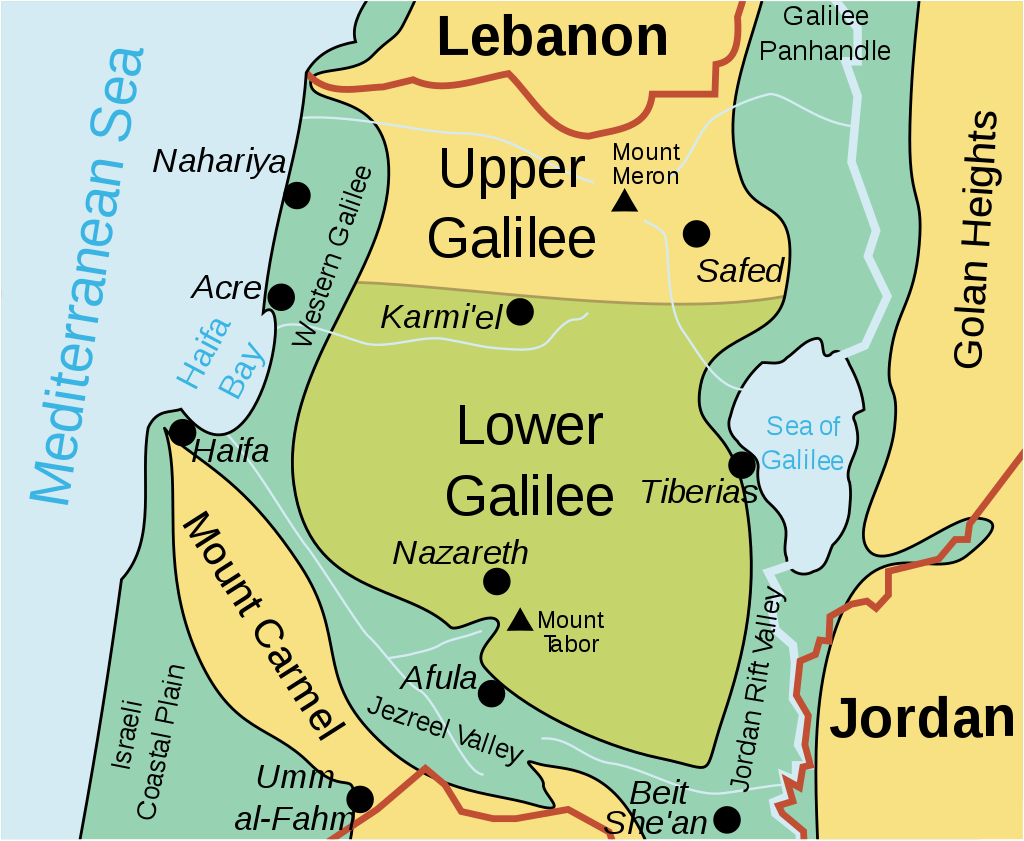

JESUS SHALL BE
CALLED A NAZARENE
And came and lived (katoikeo - settled down, made their home) in a city called Nazareth (See another map which shows Jerusalem or here) - That they came and lived here makes sense as Nazareth is where Gabriel was sent to announce to Mary she would be the mother of Jesus (Lk 1:26-30, cf Lk 2:4). Nazareth was a no name town, thought to be home of nobody, but when Joseph moved his family there after returning from Egypt, Nazareth became the home of the greatest Somebody in the history of the world! But when looked at in the historical context (see more on Nazareth below), Jesus came out of a region (Galilee) and town (Nazareth) that were held in low esteem by most Jews, especially the Jews in Judea. Nazareth was in fact a small, obscure village in the hills of lower Galilee, probably home to a few hundred people. It is never mentioned in the Old Testament, in Josephus, or in the early rabbinic writings. Excavations have confirmed a small first-century village there.


While not everyone agrees with the following interpretation Barbieri notes that "Isaiah said the Messiah would be “from [Jesse’s] roots” like “a Branch” (Isa. 11:1). “Branch” is the Hebrew word neṣer, which has consonants like those in the word “Nazarene” and which carry the idea of having an insignificant beginning. (See Bible Knowledge Commentary - Page 23)
Some have suggested that “Nazarene” is a reference to the Heb. word for branch in Isaiah 11:1. Others point out that Matthew’s statement that “prophets” had made this prediction may be a reference to verbal prophecies nowhere recorded in the OT. A still more likely explanation is that Matthew is using “Nazarene” as a synonym for someone who is despised or detestable—for that was how people from the region were often characterized (cf. John 1:46). If that is the case, the prophecies Matthew has in mind would include Ps. 22:6–8; Is. 49:7; Is 53:3.
This was to fulfill (pleroo) what was spoken through the prophets (prophetes): "He shall be called a Nazarene." - (1) Mt 2:6 fulfilled Micah 5:2 (2) Mt 2:15 fulfilled Hosea 11:1 (3) Mt 2:18 fulfilled Jeremiah 31:15 and (4) Mt 2:23 is said to "fulfill what was spoken through the prophets." Note the fourth prophecy has one difference. Everywhere else he cites “the prophet” (singular). Here he says “the prophets” (plural), and he does not name anyone. That is the strongest clue to his meaning, which would support he was not quoting a single verse. It supports the premise that he was summarizing what several prophets together foretold about the Messiah. The exact words “He shall be called a Nazarene” do not appear in the Old Testament. See discussion below on OT quotes in the NT.
He shall be called a Nazarene - Three main explanations have been offered, and the first two are often combined.
1. The despised One. This is most likely Matthew’s main point. Nazōraios is simply Matthew’s word for “from Nazareth.” Nazareth was an obscure village held in contempt, even by other Galileans: “Nathanael said to him, ‘Can any good thing come out of Nazareth?’ Philip said to him, ‘Come and see’” (Jn 1:46). “Nazarene” later became a term of scorn for Jesus’ followers: “For we have found this man a real pest and a fellow who stirs up dissension among all the Jews throughout the world, and a ringleader of the sect of the Nazarenes” (Ac 24:5). D. A. Carson observes that Jesus grew up “not as ‘Jesus the Bethlehemite,’ with its Davidic overtones, but as ‘Jesus the Nazarene,’ with all the opprobrium of the sneer.” That fits the plural “prophets,” because Matthew is summarizing a theme found across the prophets. As Carson puts it, “He is not saying that a particular OT prophet foretold that the Messiah would live in Nazareth; he is saying that the OT prophets foretold that the Messiah would be despised.” The psalmist foresaw it: “But I am a worm and not a man, a reproach of men and despised by the people” (Ps 22:6). Isaiah called the Servant “the despised One”: “Thus says the LORD, the Redeemer of Israel and its Holy One, to the despised One, to the One abhorred by the nation, to the Servant of rulers, ‘Kings will see and arise, princes will also bow down, because of the LORD who is faithful, the Holy One of Israel who has chosen You’” (Isa 49:7). And again: “He was despised and forsaken of men, a man of sorrows and acquainted with grief; and like one from whom men hide their face He was despised, and we did not esteem Him” (Isa 53:3). Matthew returns to this theme often (cf. Mt 8:20; 11:16-19).
2. The Branch. There may also be a discreet allusion to the Hebrew netser (05342), “branch, shoot,” whose sound is close to the name Nazareth. Isaiah used the word for the Messiah who would grow from David’s fallen family tree: “Then a shoot will spring from the stem of Jesse, and a branch (netser) from his roots will bear fruit” (Isa 11:1). Jewish interpreters, including the Targums and the Dead Sea Scrolls, read this verse as messianic, and Jerome among the early church writers connected it with Nazareth. The two explanations fit together. The Branch of Isaiah 11:1 also comes from humble obscurity, a shoot from a stump: “For He grew up before Him like a tender shoot, and like a root out of parched ground; He has no stately form or majesty that we should look upon Him, nor appearance that we should be attracted to Him” (Isa 53:2). Carson writes: “Jesus is King Messiah, Son of God, Son of David; but he was a branch from a royal line hacked down to a stump and reared in surroundings guaranteed to win him scorn.” (Other prophets also call the Messiah the “Branch” [Jer 23:5; Zec 3:8; 6:12], but they use a different Hebrew word, tsemach, so they support this theme only indirectly.)
3. A Nazirite. Some have connected the word with the Nazirite vow (Nu 6), seeing Jesus as a second Samson (Jdg 13:5). That is unlikely. Jesus was not a Nazirite. He drank wine and touched the dead (Mt 11:19; 9:25). The Greek spelling also differs: the Septuagint uses Naziraios for “Nazirite,” while Matthew writes Nazōraios. Carson also rejects attempts to link the term to some pre-Christian sect, calling the evidence “feeble” and the connection with Nazareth “merely verbal.”
The title that began in contempt became a title of glory. It was written over His cross: “Pilate also wrote an inscription and put it on the cross. It was written, ‘JESUS THE NAZARENE, THE KING OF THE JEWS’” (Jn 19:19). And the risen, glorified Lord still used it when He spoke from heaven to Saul: “And I answered, ‘Who are You, Lord?’ And He said to me, ‘I am Jesus the Nazarene, whom you are persecuting’” (Ac 22:8).
🙏 THOUGHT - The phrase spoken through the prophets is interesting indicating that the prophets did not just record these words but spoke them. And if they spoke what God's Spirit inspired them to speak (2 Pe 1:21), when we read their "spoken words," we are reading the words God Himself had spoken. In short, when the Bible speaks, God speaks. Oh, how we need to continually go to this Holy Book to hear from our Father! Are you in the Book every day, so that the Book can get into you and renew your mind? If not, then rest assured that your mind is being "unrenewed" (so to speak) by the godless, God hating world system that bombards us with it's vile anti-God propaganda under the guise of advertisements, etc.
There is one more significant takeaway from the title Nazarene. The Son of God grew up in a village people mocked and carried its name for the rest of His life, even in glory (Ac 22:8)! He chose humility at every step: “but emptied Himself, taking the form of a bond-servant, and being made in the likeness of men. Being found in appearance as a man, He humbled Himself by becoming obedient to the point of death, even death on a cross” (Php 2:7, 8). And because He humbled Himself, the Father exalted Him: “For this reason also, God highly exalted Him, and bestowed on Him the name which is above every name” (Php 2:9).
Beloved, are you willing to be identified with Jesus the Nazarene, even when His Name brings contempt instead of honor? How do you respond in a conversation when someone uses His glorious Name, “Jesus,” (or "Christ") as a curse word? Our response should be gracious, not self-righteous: “Let your speech always be with grace, as though seasoned with salt, so that you will know how you should respond to each person” (Col 4:6). And here's a way you can might a response with gentleness and reverence (1Pe 3:15) and it could even open a door for the Gospel (Col 4:3 - send up an "arrow prayer" before you make the following statement!) - “That’s the Name of my Savior. He means a great deal to me.” Or "That’s the name I pray to every day. Would you like to hear why He matters so much to me?”
Spurgeon on Nazarene - He meant that the prophets have described the Messiah as one that would be despised and rejected of men. They spoke of him as a great prince and conqueror when they described his second coming, but they set forth his first coming when they spoke of him as a root out of a dry ground without form or comeliness, who when he should be seen would have no beauty that men should desire him. The prophets said that he would be called by a despicable title, and it was so, for his countrymen called him a Nazarene.....Certainly he has long been called a ‘Nazarene,’ both by Jews and violent unbelievers. Spitting on the ground in disgust, many a time has his fierce adversary hissed out the name ‘Nazarene,’ as if it were the climax of contempt.....There is always some city or village or another whose inhabitants seem to be the butt of every joke and the object of scorn. The people of such places are thought to be low, uncultured, not-very-smart. That is the kind of place Nazareth was.
Toussaint has an excellent summation of Matthew introductory chapters - “The first relates to the Gentiles. The Magi come from the East and worship the King of the Jews. A glimmering foreview of all the nations of the earth being blessed in Abraham is seen in this act. . . . The second point Matthew makes concerns the Jews. They are shown to be unconcerned and indifferent to any report concerning Him. Finally, Matthew, by his use of the Old Testament, proves that Jesus is the promised Messiah. He is the fulfillment of all that is anticipated in their Scriptures. These three things form the basis of Matthew’s Gospel. Jesus is presented as the Messiah prophesied and promised in the Old Testament. The Jews reject Him. Because of this rejection the King turns to the Gentiles and the kingdom program for the Jews is postponed. “Chapter one declares the theanthropic character of the person of the Messiah. The reception which is to be given the claims of the Messiah is set forth in chapter two. Matthew three begins the narrative of the historical account of the presentation of Israel’s Messiah to that nation.”
Nazareth (3478)(Nazaret) is a transliteration of the Greek word. It is located about 14 miles west, southwest from the Sea of Galilee, 6 miles west and NW of Mount Tabor and about 60 miles due north of Jerusalem. Mark refers to it as "Nazareth in Galilee" (Mk 1:9). Nazareth had such a low reputation, it was not even mentioned in the Old Testament, Josephus, the Talmud or even any of the classic Greek writers before the time of Christ! While the region of Galilee in Jesus' day generally had a negative reputation, and was looked down on by Judeans (Jerusalem and Bethlehem were in Judea), Nazareth was even more looked down upon. In Jn 1:46 "Nathanael said to him, “Can any good thing come out of Nazareth?” Philip said to him, “Come and see (REFERRING TO MESSIAH)." There were no rabbinic schools in Galilee in Jesus' day for they were all in Judea. The rabbis had a saying “if you want to get rich, go north, if to get wise, go south.” It was situated on a mountain (Luke 4:29) within the province of Galilee (Mark 1:9) and near Cana (John 2:1, 2, 11). There was a precipice near the town from which the people proposed to cast Jesus (Luke 4:29). The angel appeared to Mary at Nazareth, which was also the home of Joseph (Luke 1:26; Lk 2:39). Joseph and Mary returned to Nazareth after their flight into Egypt (Mt 2:23). Jesus preached in its synagogue, but was rejected by the people. He was known as "Jesus of Nazareth" (see "the Nazarene" = Acts 2:22; Acts 3:6; Acts 4:10; Acts 6:14) and His disciples were called Nazarenes. When the Turks conquered Palestine in a.d. 1517, the Christians were driven from the town. In a.d. 1620 the Franciscan monks gained a foothold there and began to rebuild the village. At the Battle of Mount Tabor in a.d. 1799, Napoleon and his army encamped near Nazareth. Nazaret is cited in both literature (Eusebius HE i.7.6-12) and inscriptions (Israel Exploration Journal 12 [1962] 137ff.), and archaeological discoveries have confirmed a continuous habitation of the site since ca. 900 b.c. See notes on "The Puzzling Problem of Nazareth"
NAZARET - 12x in 12v and not in Septuagint- Matt. 2:23; Matt. 4:13; Matt. 21:11; Mk. 1:9; Lk. 1:26; Lk. 2:4; Lk. 2:39; Lk. 2:51; Lk. 4:16; Jn. 1:45; Jn. 1:46; Acts 10:38
Nazarene (3480)(Nazoraios) means an inhabitant of Nazareth and all uses refer to Jesus the Nazarene, with the exception of Acts 24:5 which refers to Christians in a derogatory sense. Vincent says Nazarene is "A term of contempt (compare Jn 1:46, Jn 7:52)." Despite the low esteem accorded the term Nazarene, Peter, filled with the Holy Spirit and boldness is not ashamed to refer to Jesus as the Nazarene not only in his inaugural sermon at Pentecost (Acts 2:22), but at other times (Acts 3:6, Acts 4:10). Paul states in one of his versions of his conversion experience that the One he encountered identified Himself as Jesus the Nazarene, so even after His resurrection and ascension Jesus is not ashamed of this Name! (Acts 22:8) Nazoraios occurs 13x in 13 verses and is translated in the NAS as Nazarene (9), Nazarenes (1), Nazareth (3).
NAZORAIOS - 13V - Matt. 2:23; Matt. 26:71; Lk. 18:37; Jn. 18:5; Jn. 18:7; Jn. 19:19; Acts 2:22; Acts 3:6; Acts 4:10; Acts 6:14; Acts 22:8; Acts 24:5; Acts 26:9
QUESTION - What prophecy is Matthew 2:23 referring to regarding Jesus being a Nazarene? GotQuestions.org
ANSWER - Matthew 2:23 says about Jesus, “He went and lived in a town called Nazareth. So was fulfilled what was said through the prophets, that he would be called a Nazarene.” Where is this prophecy in the Old Testament?
Matthew is obviously not quoting a prophecy directly, as there is no Old Testament passage with the wording he uses. Three major options exist for interpreting this verse.
First, it may be that Matthew is associating the word Nazarene with the Hebrew word netser (“branch or sprout”). The “Branch” was a common term for the Messiah, such as in Isaiah 11:1: “A shoot will come up from the stump of Jesse; from his roots a Branch will bear fruit.”
Hebrew was written with only consonants, and netser would have appeared as NZR—the same main consonants as Nazareth. In fact, in Aramaic, the common language of Jesus’ day, the word for “Nazareth” and the Hebrew word for “branch” sounded very much alike. Matthew’s point could be that Jesus was “sprouting up” from an obscure village in Galilee; Jesus was the Branch predicted by the prophets, and the name of the town He grew up in happens to sound just like the prophets’ word for “branch.”
A second option is that Matthew is citing a prophecy not found in the Old Testament but in another source. If so, Matthew referred to a prophecy known to his original audience yet unknown to us today. However, this is unlikely and an argument from silence.
A third option is that Matthew uses the word Nazarene in reference to a person who is “despised and rejected.” In the first century, Nazareth was a small town about 55 miles north of Jerusalem, and it had a negative reputation among the Jews. Galilee was generally looked down upon by Judeans, and Nazareth of Galilee was especially despised (see John 1:46). If this was Matthew’s emphasis, the prophecies Matthew had in mind could include these two passages concerning the Messiah:
“But I am a worm and not a man, scorned by everyone, despised by the people. All who see me mock me; they hurl insults, shaking their heads” (Psalm 22:6–7).
It’s true that Nazarenes were “scorned by everyone,” and so one could see this messianic prophecy as an allusion to Jesus’ hometown of Nazareth.
“He was despised and rejected by mankind, a man of suffering, and familiar with pain. Like one from whom people hide their faces he was despised, and we held him in low esteem” (Isaiah 53:3).
Again, in Jesus’ day, Nazarenes were “despised and rejected,” and so Isaiah’s prophecy could be viewed as an indirect reference to Jesus’ background as the supposed son of a carpenter from Nazareth.
If Psalm 22:6–7 and Isaiah 53:3 are the prophecies that Matthew had in mind, then the meaning of “He shall be called a Nazarene” is something akin to “He shall be despised and mocked by His own people.” Jesus not only identified with humanity by coming to our world; He also identified with the lowly of this world. His upbringing in an obscure and despised town served as an important part of His mission. Jesus identified Himself as “Jesus of Nazareth” during His encounter with Saul on the road to Damascus (Acts 22:7–8). After his conversion, Paul mentioned Jesus of Nazareth (Acts 26:9). One of the names of the early Christians was “Nazarenes” (Acts 24:5), and the term Nasara, meaning “Nazarene,” is still used today by Muslims to identify a Christian.
QUESTION - Why is Jesus often referred to as Jesus of Nazareth? GotQuestions.org
ANSWER - Jesus was referred to as “Jesus of Nazareth” for several reasons. For one thing, in Bible times people were often identified by their native area or place of residence. The man who carried Jesus’ cross when He was no longer able to, for example, was called Simon of Cyrene, noting his name and his place of residence (Luke 23:26). This distinguishes him from all other Simons and from all other residents of Cyrene who were not named Simon. Although Bethlehem was the place of Jesus’ birth, Nazareth was the place where Jesus had lived until He began His public ministry, and therefore He is said to be “of Nazareth.”
Matthew 2:23 tells us that Joseph settled his family in Nazareth—after returning from Egypt where he had fled to protect Jesus from Herod—in order to fulfill “what was said through the prophets: ‘He will be called a Nazarene.’” The words here are not found in any of the books of the Old Testament, and there has been much difficulty in ascertaining the meaning of this passage. Most commentators agree that the prophecies respecting the coming Messiah were that He was to be of humble origin and would be despised and rejected (Isaiah 53; Psalm 22) and that the phrase “he shall be called” means the same as “He shall be.” When Matthew says, therefore, that the prophecies were “fulfilled,” his meaning is that the predictions of the prophets that the Messiah would be of a low and despised condition and would be rejected, were fully accomplished in His being an inhabitant of Nazareth.
The phrase “Jesus of Nazareth” is first used in the Bible by Phillip who, after being called by Jesus to follow Him, told Nathanael, "We have found him of whom Moses in the Law and also the prophets wrote, Jesus of Nazareth, the son of Joseph" (John 1:45). By calling Him Jesus of Nazareth, Phillip may also have been making a statement about the lowliness of His birth. The character of the people of Nazareth was such that they were despised and condemned. Nathanael’s response, “Can anything good come from Nazareth?” (John 1:46) would seem to indicate such. To come from Nazareth, therefore, or to be a Nazarene, was the same as to be despised, or to be esteemed of low birth. The Messiah who would come to save His people would be “a root out of dry ground, having no form or comeliness” (Isaiah 53:2). He would be “despised and rejected of men” from whom men hid their faces and “esteemed him not” (Isaiah 53:3).
Jesus of Nazareth was born and grew up in humble circumstances, but His impact on the world has been greater than anyone ever born before or since. He came to “save His people from their sins” (Matthew 1:21), a feat that could be accomplished by none other than God incarnate.
HE SHALL BE CALLED A NAZARENE
THE BIRTH NARRATIVES of the Lord Jesus Christ are a stunning testimony to the inviolability of the prophetic word. That the Messiah should come forth out of Bethlehem, Mic. 5:2, and be summoned from Egypt, Hos. 11:1, and be called a Nazarene, Matt. 2:23, seems to human intelligence wholly irreconcilable. Yet (and the believer should keep this much in mind) men are always wrong and God is always right! As the details unfolded the perfection of the word became apparent. Exactly the same flawless precision will be seen when the Lord Jesus returns to fulfil an even more extensive and perplexing series of prophetic pronouncements.
The Nazarene prediction is particularly interesting because it seems to have no exact source in the Old Testament. But we should note that the Spirit of God refers specifically to ‘the prophets’, as opposed to ‘the prophet’, 2:5, 17. It is not, then, one particular passage which is being pointed out, but the general drift of many which made it clear that God’s Messiah would be shunned and scorned, growing up in poverty rather than plenty. He was ‘despised and rejected of men’, Isa. 53:3, ‘a reproach of men, and despised of the people’, Ps. 22:6, He demonstrates that ‘the poor man’s wisdom is despised’, Eccles. 9:16, ‘the reproaches of them that reproached thee are fallen upon me’, Ps. 69:9—thus the Holy Spirit testified in advance to the terrible repudiation of God’s chosen One. And how completely was this fulfilled! Nathanael illustrates the average Israelite’s viewpoint: ‘Can there any good thing come out of Nazareth?’, John 1:46. The entire Galilee area was held unclean by orthodox Jews: it lay on the very borders of the land and was called ‘Galilee of the nations’, Isa. 9:1, 2, whose people walked in darkness.
Pride in birth, breeding, religious tradition, education, profession, affluence—all our smug human pretensions are shattered because God’s own dear Son was raised in Nazareth. God forbid that we should glory save in the Lord Jesus and in His finished work, Gal. 6:14. Those who belong to a humble Saviour should be humble too, Jas. 4:6. (Cyril Hocking - Day by Day- Moments with the Master)
MATTHEW 2:23—Didn’t Matthew make a mistake by claiming a prophecy that is not found in the OT?
PROBLEM: Matthew claims that Jesus moved to Nazareth to live, in order “that it might be fulfilled which was spoken by the prophets, He shall be called a Nazarene” (Matt. 2:23). However, no such prophecy is found in any OT prophet. Did Matthew make a mistake?
SOLUTION: Matthew did not say that any particular OT “prophet” (singular) stated this. He simply affirmed that the OT “prophets” (plural) predicted that Jesus would be called a Nazarene. So we should not expect to find any given verse, but simply a general truth found in many prophets to correspond to His Nazarene-like character. There are several suggestions as to how Jesus could have “fulfilled” (brought to completion) this truth.
Some point to the fact that Jesus fulfilled the righteous requirements of the OT Law (Matt. 5:17–18; Rom. 8:3–4), one part of which involved the holy commitment made in the vow of the “Nazarite.” The Nazarite took this vow “to separate himself to the Lord” (Num. 6:2), and Jesus perfectly fulfilled this. However, the word is different both in Hebrew and Greek, and Jesus never took this particular vow.
Others point to the fact that Nazareth comes from the basic word netzer (branch). And many prophets spoke of the Messiah as the “Branch” (cf. Isa. 11:1; Jer. 23:5; Jer 33:15; Zech. 3:8; Zech 6:12).
Still others note that the city of Nazareth, where Jesus lived, was a despised place “on the other side of the tracks.” This is evident in Nathaniel’s response, “Can anything good come out of Nazareth?” (John 1:46) In this sense, “Nazarene” was a term of scorn appropriate to the Messiah whom the prophets predicted would be “despised and rejected of men” (Isa. 53:3; cf. Ps. 22:6; Dan. 9:26; Zech. 12:10).(Norman Geisler - When Critics Ask)
Note that this material is a compilation from Arnold Fruchtenbaum's handout entitled "Life of Messiah", notes from "Messianic Christology." and comments from David Cooper's Messiah: His Historical Appearance
INTRODUCTION - Note that between 1/4 and 1/3 of the Bible is devoted to prophecy and some have been fulfilled, but a greater portion of has not, but awaits materialization in the future. Because sometimes the context of the Old Testament quotation does not seem to fit the New Testament context, some have questioned the validity of the New Testament’s use of the Old Testament. When the New Testament quotes the Old Testament, it does so in four different ways. Every Old Testament quotation found within the New Testament will always fit into one of these four categories. There is one example of each of the four ways in Matthew Two, so this will be used as the basis for explaining them. These four ways of quoting the Old Testament are the ways the rabbis in 1st century Israel quoted them in rabbinic writings. Because of so very much unscientific exegesis of the Scriptures, many honest, sincere men and women have reached the conclusion that prophecy cannot be understood, and that it is a waste of time to try to understand it. There is no occasion for such gross and fantastic misinterpretation of prophecy. Essentially, history and prophecy are written upon the same basic principles. History tells what has occurred; predictive prophecy tells what will be. The same fundamental laws of logic and of language govern in both instances. If one gets these facts clearly in mind and approaches prophecy just as he does history, recognizing that the same principles obtain in both cases, he is in a position to understand prophecy more nearly accurately than is usually the case. (Adapted from David Cooper - Messiah-His Historical Appearance)
CATEGORY (1) Literal prophecy plus literal fulfillment - Matthew 2:6 quotes Micah 5:2.
Matthew 2:6 ‘AND YOU, BETHLEHEM, LAND OF JUDAH, ARE BY NO MEANS LEAST AMONG THE LEADERS OF JUDAH; FOR OUT OF YOU SHALL COME FORTH A RULER WHO WILL SHEPHERD MY PEOPLE ISRAEL.’”
Micah 5:2 “But as for you, Bethlehem Ephrathah, Too little to be among the clans of Judah, From you One will go forth for Me to be ruler in Israel. His goings forth are from long ago, From the days of eternity.”
Note a specific point for point fulfillment, even predicting that Messiah would be born in Bethlehem of Judea (not in Bethlehem of Galilee) and this is the easiest kind of prophetic fulfillment to spot. That is the literal meaning, the literal interpretation of Micah 5:2; the Messiah, when He is born, will be born in the town of Bethlehem, within the tribal territory of Judah.
In these cases, the Old Testament literally speaks of a specific event in the future. When that specific event is literally fulfilled in the context of the New Testament, the New Testament quotes that particular prophecy as a point-by-point fulfillment. Many of the quotations of the Old Testament in the New Testament fall into this category.
Other examples of Category (1)
- Mt 1:22-23 quoting Isaiah 7:14,
- Mt 3:3 quoting Isaiah 40:3,
- Mark 1:2 quoting Malachi 3:1
- Luke 4:18–19 quoting Isaiah 61:1–2.
- Matthew 4:13–16 quoting Isaiah 8:22–9:2.
- Matthew 21:5 quoting Zechariah 9:9
- John 12:38 quoting Isaiah 53:1
- John 19:24 quoting Psalm 22:18
- Matthew 27:46 quoting Psalm 22:1
NOTE THAT THE NASB HELPS IDENTIFY OT PROPHECIES BY PUTTING THE PROPHECY IN ALL CAPITAL LETTERS, A FEATURE NOT FOUND IN ANY OTHER POPULAR TRANSLATION.
(2) Literal prophecy plus typical fulfillment - a typology -
Matthew 2:15 He remained there until the death of Herod. This was to fulfill what had been spoken by the Lord through the prophet: “OUT OF EGYPT I CALLED MY SON.”
Hosea 11:1 When Israel was a youth I loved him, And out of Egypt I called My son.
In this OT passage from Hosea, the literal meaning of Hosea 11:1 is describing ISRAEL being called out of Egypt. It is calling Israel God’s son. Look at Exodus 4:22-23. It is not a prophecy per se, but a historical event which foreshadows a future event. In this passage the calling of Israel out of Egypt is used as a TYPE, or parallel, or similar event, to God bringing Jesus out of Egypt. Many of the citations in the Book of Hebrews of Exodus and Leviticus fall into this category.
(3) Literal prophecy plus application
Matthew 2:17-18 Then what had been spoken through Jeremiah the prophet was fulfilled: 18“A VOICE WAS HEARD IN RAMAH, WEEPING AND GREAT MOURNING, RACHEL WEEPING FOR HER CHILDREN; AND SHE REFUSED TO BE COMFORTED, BECAUSE THEY WERE NO MORE.”
Jeremiah 31:15 (Thus says the LORD, “A voice is heard in Ramah, Lamentation and bitter weeping. Rachel is weeping for her children; She refuses to be comforted for her children, Because they are no more.”
In this type of usage of Old Testament Scripture, there is one point of similarity, but also many differences. Matthew 2:17-18 uses Jeremiah 31:15 which in the original context is Jeremiah witnessing an event in his day as he sees the women of Ramah, where Rachel (she was the symbol of Jewish motherhood) was buried, crying as they see their sons being taken to exile in Babylon. They would never see them again. The events of Jeremiah have a point of similarity with the events in Bethlehem, since the Jewish mothers are weeping for sons they will never see again. However Ramah and Bethlehem are different towns, and the Babylonian exiles weren’t going to their death as were the infants of Bethlehem. Everything is radically different except the mothers weeping.
This is what many pastors use in sermons today. They take a scripture and make a modern application from a single point of similarity.
(4) Summation - a summary
Matthew 2:23.and came and lived in a city called Nazareth. This was to fulfill what was spoken through the prophets: “He shall be called a Nazarene.”
There is no exact quotation or prophecy, but when the word prophet switches from singular to plural, it is a summation. “That it might be fulfilled which was spoken by the prophets” is a clue, when prophet becomes prophets, plural insead of singular, you are getting a summary. If you search the Old Testament for a mention of Nazareth, the only remote similarity in the is Isaiah 11:1, which calls Messiah a Netzer, which means branch, and sounds similar to Nazareth. However, the point that Matthew is making is that Jesus would be despised and rejected of men, as the Nazarenes were despised in their culture. Isaiah 53:3 and other scriptures foretell this. “He was despised and forsaken of men.” Other scriptures are: Isaiah 49;7, Psalm 22:6. “As spoken by the prophets” refers to prophecies such as these.
PP - Pardes
The rabbinic concept of PaRDeS is an acronym for the four ways in which Scripture was used. It was a useful acronym to remind them of the four ways that Old Testament Scripture could be utilized.
• Pshat - the simple basic meaning of the text. Literal plus literal
• Remez - a hint. Literal plus typical
• Drash - exposition. Literal plus application
• Sod - secret. Summation
In summary, this was the rabbinic way of remembering valid ways to quote Old Testament Scripture. These four categories were used by the writers of the New Testament, as shown by the examples in these passages. If one does not understand the ways in which Scripture is being used, one can mistakenly conclude that Scripture is in error.