Genesis 27:2
Genesis 27:3
Genesis 27:4
Genesis 27:5
Genesis 27:6
Genesis 27:7
Genesis 27:8
Genesis 27:9
Genesis 27:10
Genesis 27:11
Genesis 27:12
Genesis 27:13
Genesis 27:14
Genesis 27:15
Genesis 27:16
Genesis 27:17
Genesis 27:18
Genesis 27:19
Genesis 27:20
Genesis 27:21
Genesis 27:22
Genesis 27:23
Genesis 27:24
Genesis 27:25
Genesis 27:26
Genesis 27:27
Genesis 27:28
Genesis 27:29
Genesis 27:30
Genesis 27:31
Genesis 27:32
Genesis 27:33
Genesis 27:34
Genesis 27:35
Genesis 27:36
Genesis 27:37
Genesis 27:38
Genesis 27:39
Genesis 27:40
Genesis 27:41
Genesis 27:42
Genesis 27:43
Genesis 27:44
Genesis 27:45
Genesis 27:46
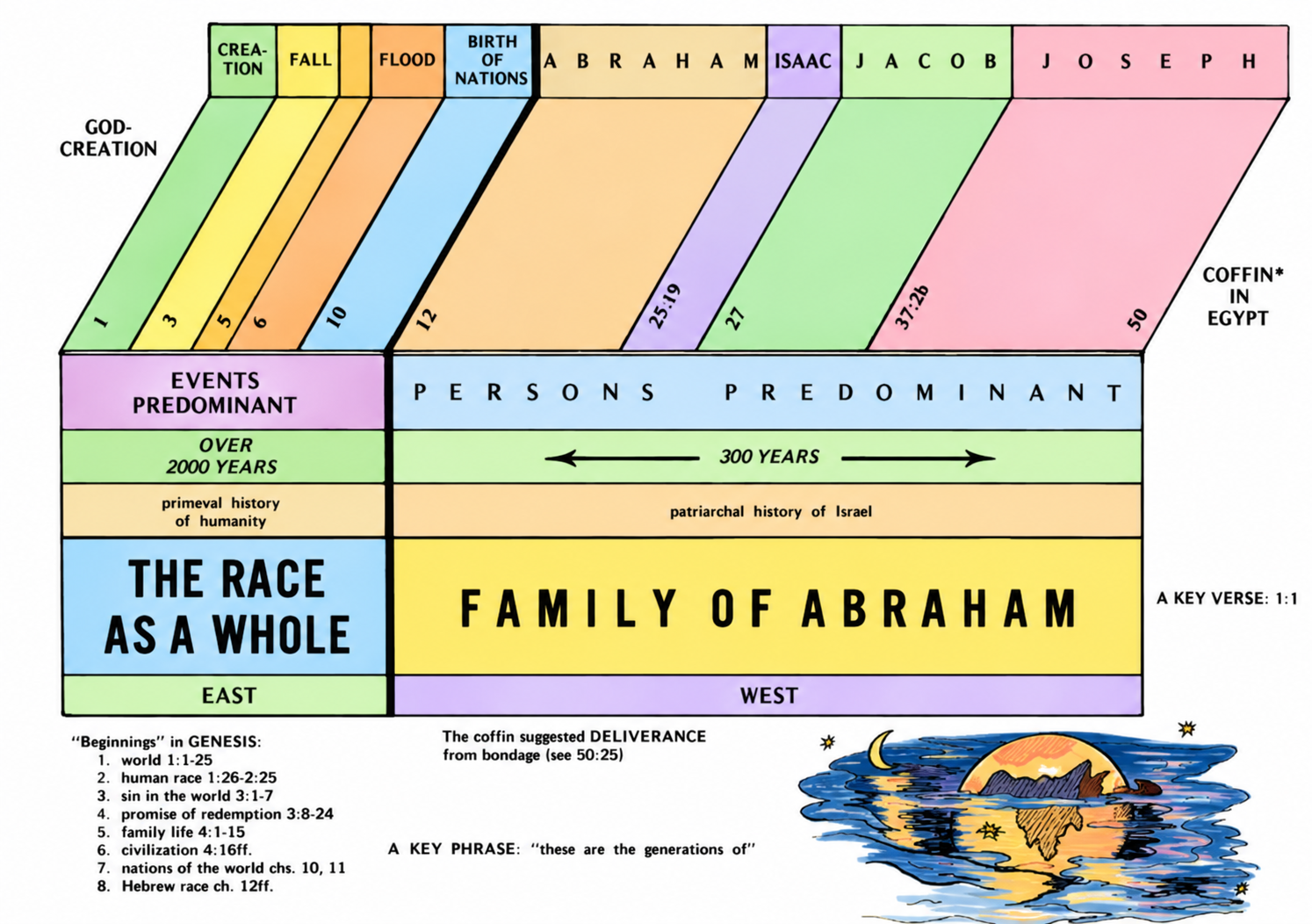
Click chart to enlarge
Chart from recommended resource Jensen's Survey of the OT - used by permission
| Summary Chart of The Book of Genesis |
||||||||
| Focus | Foundation Events (Four Events) (Events Predominant) |
Foundation People (Four People) (People Predominant) |
||||||
| Divisions | Creation (Ge 1-2) |
Fall (Ge 3-5) |
Flood (Ge 6-9) |
Nations (Ge 10-12) |
Abraham's Faith (Ge 12-24) |
Isaac's Family (Ge 25-26) |
Jacob's Conflicts (Ge 27-36) |
Joseph's Calamity (Ge 37-50) |
| Topics | Beginning of the Human Race (Race As A Whole) |
Beginning of the Hebrew Race (Family of Abraham) |
||||||
| Faithfulness of Mankind (Noah) |
Faithfulness of One Man's Family (Abraham) |
|||||||
| Historical | Biographical | |||||||
| Place | Eastward From Eden to Ur |
Westward From Canaan to Egypt |
||||||
| Time | ~2000+ Years (20% of Genesis) (~4004-2090BC) |
About 300 Years 193 Yr in Canaan, 93 Yr in Egypt (80% of Genesis) (2090-1804BC) |
||||||
| Primeval History of Humanity |
Patriarchal History of Israel |
|||||||
| Author | Moses | |||||||
Genesis 27:1 Now it came about, when Isaac was old and his eyes were too dim to see, that he called his older son Esau and said to him, “My son.” And he said to him, “Here I am.”
KJV And it came to pass, that when Isaac was old, and his eyes were dim, so that he could not see, he called Esau his eldest son, and said unto him, My son: and he said unto him, Behold, here am I.
NET When Isaac was old and his eyes were so weak that he was almost blind, he called his older son Esau and said to him, "My son!" "Here I am!" Esau replied.
NLT One day when Isaac was old and turning blind, he called for Esau, his older son, and said, "My son." "Yes, Father?" Esau replied.
ESV When Isaac was old and his eyes were dim so that he could not see, he called Esau his older son and said to him, "My son"; and he answered, "Here I am."
NIV When Isaac was old and his eyes were so weak that he could no longer see, he called for Esau his older son and said to him, "My son." "Here I am," he answered.
- dim (KJV): Ge 48:10 1Sa 3:2 Ec 12:3 Joh 9:3
- eldest son (KJV): Ge 25:23-25
Related Passages:
Genesis 48:10 Now the eyes of Israel were so dim from age that he could not see. Then Joseph brought them close to him, and he kissed them and embraced them.
Deuteronomy 34:7 Although Moses was one hundred and twenty years old when he died, his eye was not dim (SAME WORD USED FOR ISAAC), nor his vigor abated.
1 Samuel 3:2 It happened at that time as Eli was lying down in his place (now his eyesight had begun to grow dim and he could not see well),
Genesis 25:23-25 The LORD said to her, “Two nations are in your womb; And two peoples will be separated from your body; And one people shall be stronger than the other; And the older shall serve the younger.” 24 When her days to be delivered were fulfilled, behold, there were twins in her womb. 25 Now the first came forth red, all over like a hairy garment; and they named him Esau.
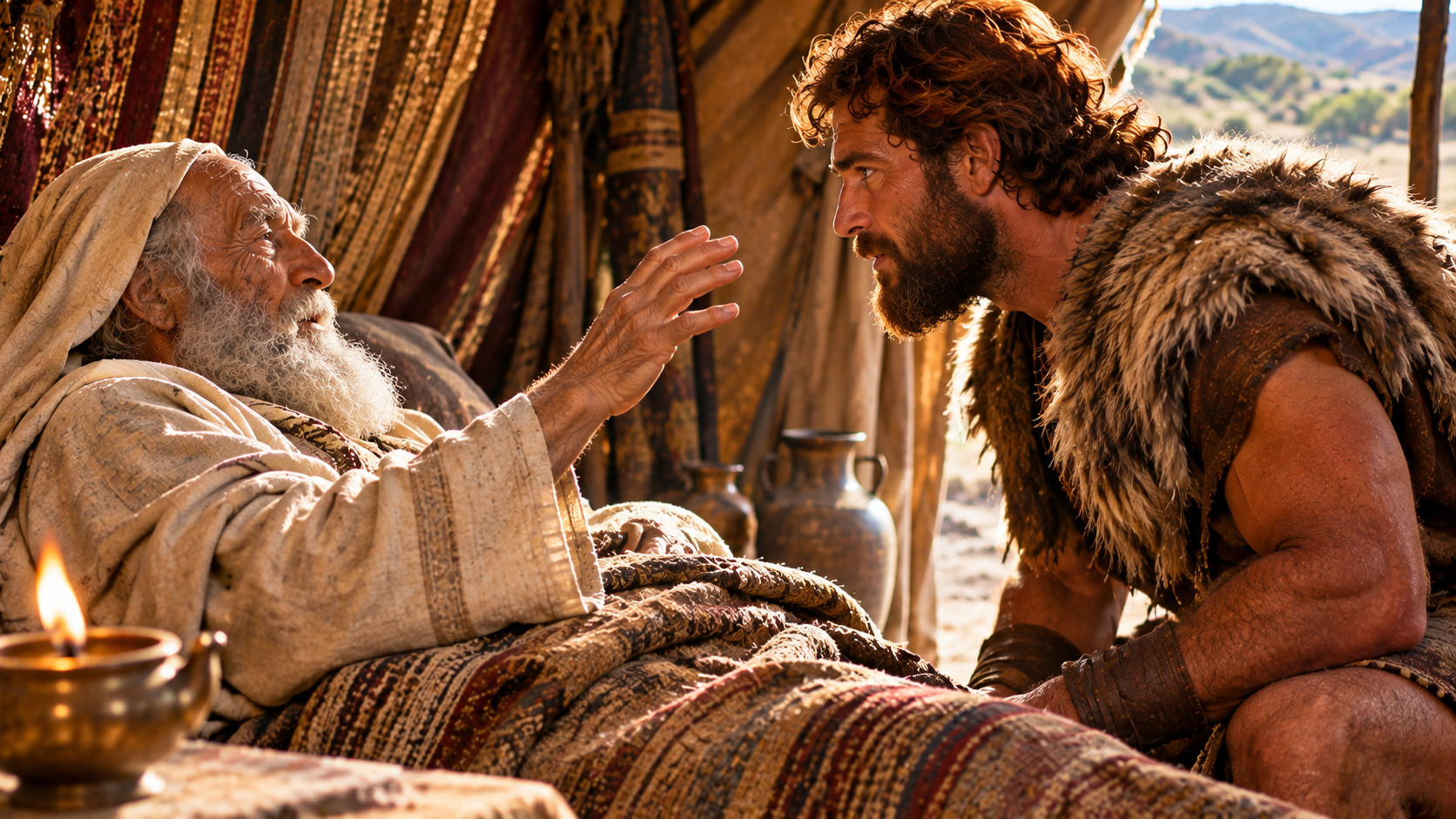
PHYSICAL BLINDNESS SETS STAGE
FOR SPIRITUAL BLINDNESS
Now it came about - This phrase opens a new episode and follows directly after the note that Esau’s Hittite wives “brought grief to Isaac and Rebekah” (Ge 26:35). Here's where the "spiritual blindness" in the title comes in. Isaac’s eyes were dim, but so was his spiritual perception. He knew the oracle of Genesis 25:23, yet he set out to bless Esau, and his motive was largely his appetite (Ge 25:28) Isaac knew Esau had married outside the covenant line, yet he still intends to give him the blessing.
Allen Ross - This chapter portrays an entire family attempting to carry out their responsibilities by their physical senses, without faith. (See The Bible Knowledge Commentary)
when Isaac was old (zaqen) - How old (zaqen) is Isaac now? Comparing the dates in Genesis puts Isaac at about 137 at this point. He was 60 when the twins were born (Ge 25:26), and Jacob was probably 77 when he fled to Haran although that seems a bit old to take your first wife! But is 137 is correct (and we should avoid dogmatism), Isaac lived another 43 years, for he died at 180 (Ge 35:28). Some suggest he expected to die because Ishmael, his half-brother, had died at 137 (Ge 25:17). Either way, Isaac acted in haste on an assumption about his death that proved wrong.
and his eyes were too dim to see - Hebrew - "and his eyes were weak from seeing." Isaac's physical blindness is central to the story. It made the deception possible. But who allowed Isaac to be blind? God is clearly sovereign, so Isaac's blindness is not an accident but a providential occurrence. In Exodus 4:11 Yahweh asks Moses “Who has made man’s mouth? Or who makes him mute or deaf, or seeing or blind? Is it not I, the LORD?" Isaac’s failing eyesight was under God’s sovereign hand. God had already declared His purpose before the twins were born (Ge 25:23). Isaac’s blindness became the circumstance through which that word was fulfilled. As Solomon observed, “Many plans are in a man’s heart, But the counsel of the LORD will stand” (Pr 19:21). Isaac could no longer see with his eyes, but he had stopped seeing God’s purpose long before. This reminds me of Eli, another father who failed to restrain his sons and whose “his eyesight had begun to grow dim and he could not see well” (1Sa 3:2).
Although God was sovereign over Isaac's eyesight, it does not excuse sin. In fact God’s providence used Isaac’s blindness, but it did not make Rebekah’s scheme or Jacob’s lies righteous. God does not need our deception to accomplish His promises, and He certainly is never the author of sin (Jas 1:13). It is an immutable principle that human guilt and divine sovereignty stand side by side, as Joseph later explained in Ge. 50:20 declaring “As for you, you meant evil against me, but God meant it for good in order to bring about this present result, to preserve many people alive.” And we recall Peter's declaration in Acts 2:23: “this Man, delivered over by the predetermined plan and foreknowledge of God, you nailed to a cross by the hands of godless men and put Him to death.” Thus we see God's sovereignty side by side with man's responsibility!
Bob Utley - "when Isaac was old, and his eyes were too dim to see" Eye problems must have been a significant disease in the Ancient Near East (cf. Jacob in Gen. 48:10; Eli in 1 Sam. 3:2 and later, Paul in Gal. 4:13-15; 6:11; 2 Cor. 12:7).▣ "he called his older son Esau" This shows the favoritism of Isaac toward Esau (cf. Gen. 25:28), which will become obvious as the chapter develops and the cultural expectation of the oldest (i.e., lit. "great," BDB 152, i.e., in age, cf. Gen. 10:21; 44:12) son's special place in the family
that he called his older son Esau The favoritism announced in Genesis 25 now comes into the open: “Now Isaac loved Esau, because he had a taste for game” (Ge 25:28). Isaac was led by his appetite more than by God’s revealed will (cf. Ge 27:4).
and said to him, “My son.” And he said to him, “Here I am.” - Here I am (hinneh) is usually translated "behold" and so is the classic response of readiness and availability. It is the word Abraham spoke when God called him to Moriah (Ge 22:1, 11), and the word Isaac himself spoke on the way up that mountain “Isaac spoke to Abraham his father and said, ‘My father!’ And he said, ‘Here I am (hinneh), my son’” (Ge 22:7). What a fascinating contrast for on Mount Moriah, “Here I am” was spoken by a father to his son surrendered to God’s will. Now it is spoken by a son to a father who was planning to circumvent God's will. And ironically Jacob willuse the same word in the deception “Then he came to his father and said, ‘My father.’ And he said, ‘Here I am (hinneh). Who are you, my son?’” (Ge 27:18).
In spite of Isaac's failures God overruled the Isaac's favoritism and even remembered Isaac for faith the writer of Hebrews declaring “By faith Isaac blessed Jacob and Esau, even regarding things to come” (Heb 11:20).
Allen Ross - All participants were at fault. Isaac knew of God’s oracle to Rebekah (25:23) that the elder would serve the younger; yet he set out to thwart it by blessing Esau! Esau, agreeing to the plan, broke the oath he had made with Jacob (25:33). Rebekah and Jacob, with a just cause, each tried to achieve God’s blessing by deception, without faith or love. Theirs would be the victory, but they would reap hatred and separation for Rebekah never saw Jacob again! So the conflict between Jacob and Esau was greatly deepened by Jacob’s pursuit—he wanted what belonged to the firstborn, the blessing. Yet the story is not just about Jacob. He alone did not destroy the family; parental preference did. (See The Bible Knowledge Commentary)
🙏 THOUGHT: Isaac’s dim eyes remind us that God is never limited by human weakness, whether physical frailty or spiritual dullness. He will accomplish His word (which is His will) even through or despite our failures. Yet the lesson for us is not “the end justifies the means,” but rather to walk by faith in what God has said rather than by sight, taste, or touch (2Cor5:7). Rebekah and Jacob did not need to scheme. Isaac did not need to resist. All of them needed simply to trust the God Who had already spoken. Beloved, when God has spoken, may our faith rest in His trustworthy word rather than resorting to human schemes or trusting our human senses (our "instincts").
Old (02204) zaqen is a Hebrew stative verb meaning to be old, to become old, to grow old. It is closely related to the adjective zāqēn (H2205, “old, elder”) and is probably derived from the noun zāqān (H2206, “beard”). The beard is the visible mark of a mature, and eventually aged, man, so the word pictures old age as “the bearded (and graying) years.” In the Qal stem the verb describes the state of life that follows youth. The classic contrast is with naʿar (H5288, “youth”), as in Psalm 37:25: “I have been young and now I am old, Yet I have not seen the righteous forsaken Or his descendants begging bread.” The word is used of men (Gen. 24:1; Josh. 13:1; 1 Sam. 12:2), of women (Gen. 18:13; Prov. 23:22), and figuratively even of a tree’s roots (Job 14:8: “Though its roots grow old in the ground And its stump dies in the dry soil”). In the Hiphil it expresses the process of aging, as in Proverbs 22:6: “Train up a child in the way he should go, Even when he is old he will not depart from it.”
ZAQEN - 26V - am so old(1), am old(3), am...old(1), being old(1), grow old(1), grown old(1), old(17), reached a old(1), reached old(1). Gen. 18:12; Gen. 18:13; Gen. 19:31; Gen. 24:1; Gen. 27:1; Gen. 27:2; Jos. 13:1; Jos. 23:1; Jos. 23:2; Ruth 1:12; 1 Sam. 2:22; 1 Sam. 4:18; 1 Sam. 8:1; 1 Sam. 8:5; 1 Sam. 12:2; 1 Sam. 17:12; 2 Sam. 19:32; 1 Ki. 1:1; 1 Ki. 1:15; 2 Ki. 4:14; 1 Chr. 23:1; 2 Chr. 24:15; Job 14:8; Ps. 37:25; Prov. 22:6; Prov. 23:22
Scripture often joins zāqēn with fuller idioms: “old, advanced in age” (Gen. 24:1: “Now Abraham was old, advanced in age; and the LORD had blessed Abraham in every way”) and “old and full of days” (1 Chr. 23:1). The verb marks the season when certain things cease. Marriage and childbearing are no longer expected (Ruth 1:12; 2 Kings 4:14; Gen. 18:12-13: “Shall I indeed bear a child, when I am so old?”). Leadership must be handed on (1 Sam. 8:1: “And it came about when Samuel was old that he appointed his sons judges over Israel”; Josh. 13:1: “You are old and advanced in years, and very much of the land remains to be possessed”; 1 Chr. 23:1). Eli in his old age could not restrain his sons (1 Sam. 2:22). The body weakens: sight dims (Gen. 27:1: “when Isaac was old and his eyes were too dim to see”; cf. 1 Sam. 3:2; 4:15), warmth fails (1 Kings 1:1: “Now King David was old, advanced in age; and they covered him with clothes, but he could not keep warm”), and falls become dangerous (1 Sam. 4:18). Ecclesiastes 12:1-5 gives the Bible’s great poetic portrait of these declining years. When used of individuals, zāqēn frequently signals that death is near (Gen. 19:31; 27:1-2; Josh. 23:1-2; 2 Chr. 24:15).
Old age is nevertheless honorable in Scripture, not contemptible. The aged are to be respected (Lev. 19:32: “You shall rise up before the grayheaded and honor the aged, and you shall revere your God; I am the LORD”) and never despised (Prov. 23:22: “Listen to your father who begot you, And do not despise your mother when she is old”). The gray head carries the wisdom of long experience with God’s faithfulness (Ps. 37:25). As for the span of life, sixty appears to divide the mature from the aged in the valuation laws (Lev. 27:1-8), though Levites retired from service at fifty (Num. 4:3, 23, 30). Seventy years is the normal span and eighty exceptional (Ps. 90:10), and in the monarchy Barzillai at eighty was counted “very old” (2 Sam. 19:32).
In summary, zāqēn describes the “bearded,” gray-haired stage of life that follows youth. It is a time of diminishing strength, of laying down responsibilities, and of nearing death. It is also a time when God’s people are to be honored for their years and can testify to His unfailing faithfulness across a lifetime.
Here I am (behold) (02009) hinneh is an interjection meaning behold, look, now; if. It is also used in the phrase "Here I am." "It is used often and expresses strong feelings, surprise, hope, expectation, certainty, thus giving vividness depending on its surrounding context." (Baker) Hinneh generally directs our mind to the text, imploring the reader to give it special attention. In short, the Spirit is trying to arrest our attention! And so hinneh is used as an exclamation of vivid immediacy (e.g., read Ge 6:13)! Hinneh is a marker used to enliven a narrative, to express a change a scene, to emphasize an idea, to call attention to a detail or an important fact or action that follows (Isa 65:17, Ge 17:20, 41:17). The first use of hinneh in Ge 1:29 and second in Ge 1:31 - "And God saw all that He had made, and behold, it was very good. And there was evening and there was morning, the sixth day." Hinneh is oftn used in the idiom "Here I am" in Ge 22:1, 7,11 Ge 27:1,18, Ge 31:11, Ge 46:2 Ex 3:4 1Sa 3:4, 3:16, 12:3, 2Sa 1:7, Isa 52:6, Isa 58:9. Hinneh is used most often to point out people but also to point out things (Ge 31:41, 17:4). God uses hinneh to grab man's attention before He brings destruction (Ge 6:13, 17). God uses hinneh when He establishes covenants (Ge 9:9, 15:12, 17 [when Jehovah cut the Abrahamic covenant], Ge 17:4, cp Ge 28:13, 15), when He provided a sacrificial substitute for Isaac (foreshadowing His giving us His only Son!) (Ge 22:13). Hinneh marks the "chance (The Providence of God)" arrival of Boaz at the field where Ruth was gleaning (Ru 2:4-read about this "chance romance" - Indeed, "Behold!"). Hinneh is used to announce the Lord’s sending of a child as a sign and a prophecy of Immanuel-Emmanuel, the Messiah (Isa. 7:14). In fact W E Vine says that it is notable that when behold (hinneh) is used in Isaiah, it always introduces something relating to future circumstances.
Warren Wiersbe - Philosopher George Santayana called the human family “one of nature’s masterpieces.” If that’s true, then many of these masterpieces have become nothing but pieces because they forgot the Master. Genesis 27 describes such a family.....During the twenty-three years he was president of Moody Bible Institute in Chicago, Dr. William Culbertson frequently asked at the close of his public prayers, “Lord, help us to end well.” God answered his prayer, and Dr. Culbertson did end his race in victory, but that isn’t true of every believer. A good beginning doesn’t guarantee a good ending. That’s one of the repeated lessons taught in Scripture; and it’s tragically confirmed in the lives of people like Lot, Gideon, Samson, King Saul, King Solomon, Demas, and a host of others. Let’s add Isaac to that list. If ever a man was blessed with a great beginning, it was Isaac. Yet he ended his life under a cloud. (Bible Exposition Commentary)
Steven Cole (My Way or God's Way) - Frank Sinatra’s well-known song, “I Did It My Way,” was shocking for its blatant ungodliness. Of course what Sinatra stated plainly in that song, “I did it my way,” is true of every person who does not submit his life to Jesus Christ. Most people just aren’t as open as Sinatra in stating the controlling force of their lives.
In Genesis 27, four people sing Sinatra’s song. Isaac does things his way by trying to bestow the family blessing on Esau, in opposition to God’s revealed will. Esau tries to take back what he had already sold to his brother Jacob. When he is foiled, he plans to kill his brother. Rebekah deceives her aging husband into giving the blessing to her favorite son, Jacob. And Jacob lies to his father and outsmarts his brother. Rebekah and Jacob could argue that they were only trying to bring about the will of God, since God had told Rebekah that her older son would serve the younger. But I’m not persuaded by those who attribute high motives to Rebekah and Jacob. I think that what you have here are four self-centered people seeking their own advantage. They all did it their way, not God’s way. In the end they all came up empty and paid a high price for their selfishness.
Every person must have as a theme song in life either “I Did It My Way” or “I Did It God’s Way.” You would think that the lines would be clearly drawn: Every person outside of Christ would sing, “I Did It My Way”; every Christian would sing, “I Did It God’s Way.” But I find that many who profess to believe in Christ are really just living for themselves, often using God as the means to self-fulfillment. But the genuine Christian life is a matter of God’s confronting our self-centeredness and enthroning Christ as Lord in our hearts. While the process takes a lifetime, I question whether the person who is not involved in the process of dying to self is truly a child of God. Genesis 27 teaches the principle that ...
When we seek our own way,
we never get what we wanted and we pay a high price.
The drama is marked by some undercurrents which run through the chapter. The first is haste or urgency. Isaac seems to be near death’s door when he summons Esau to his bedside. Actually, Isaac, who was 137, lived 43 more years. But you get the feeling that he has one foot in the grave and the other on a banana peel—Esau needs to get on with his mission. While Esau is gone, Rebekah quickly summons Jacob, and there is a flurry of activity as they prepare to deceive the blind old man before Esau returns from his hunt. Jacob barely makes it out the door before Esau comes back. There is haste in Rebekah’s urgent words to Jacob, “... arise, flee to Haran ...!” (Ge 27:43).
There is often a sense of haste when people are trying to pull off their own schemes, even if it’s under the guise of doing God’s will. If you’re not trusting God to orchestrate circumstances for you, then you work under the false impression that you’ve got to pull your own strings. So you rush around like a one-armed man putting on a show with 50 dancing marionettes, trying to keep all the strings going at the right time. There are exceptions, but generally when you’re trusting God to work things out in His time and way, you aren’t running around in eleventh hour haste, trying to rescue the situation.
A second undercurrent which runs through the drama is deception or conspiracy. In the famous words of Sir Walter Scott, “Oh, what a tangled web we weave, When first we practise to deceive.” There is an air of secrecy when old Isaac calls Esau to his bedside. Normally, the blessing would have been given before the entire family (see Genesis 49). It was an oral will which legally determined the disposition of all the father possessed. But Isaac calls Esau without Rebekah or Jacob. He knew that Rebekah would oppose his move; she always had favored Jacob. So Esau is sent out secretly.
But, Rebekah was secretly eavesdropping on Isaac’s meeting with Esau. So she secretly calls Jacob and works out her plot to deceive her blind husband. Later, when she thinks that Esau will kill Jacob, Rebekah schemes again by telling Isaac that she is tired of living because of Esau’s Hittite wives. If Jacob marries women like these, life will not be worth living (Ge 27:46). So without telling Isaac of the real reason, she secures his blessing on Jacob before he sends him away to Haran to find a wife from Rebekah’s relatives. Throughout the whole drama is this web of deception, conspiracy, and secrecy.
A third undercurrent is mistrust. You can’t carry on secrets and manipulative plots in a family without eroding trust. Isaac didn’t trust Rebekah or Jacob or he would have included them in the plan to give away his blessing. Rebekah didn’t trust Isaac or she wouldn’t have gone to such elaborate lengths to deceive him. Jacob knew that his father wouldn’t trust him, as seen in his comment to his mother, “Perhaps my father will feel me, then I shall be as a deceiver [mocker] in his sight; ...” (Ge 27:12). Neither Jacob nor Esau trusted each other. It was a family riddled with mistrust because it operated on the basis of deception and secrecy instead of honesty and openness.
Each character illustrates the theme: When we seek our own way, we never get what we wanted and we pay a high price.
The theme is illustrated with Isaac.
This is not a pretty picture of Isaac. Some try to excuse him by saying that maybe he didn’t know or had forgotten about God’s prophecy to Rebekah, that the older son would serve the younger. But surely Rebekah would have told and have frequently reminded Isaac of that prophecy, especially when she sensed Isaac’s favoritism toward Esau and wanted to assert her own favoritism toward Jacob. Isaac knew.
This is a premeditated plot on Isaac’s part to overthrow the revealed purpose of God. Sadly, Isaac’s reasons were based totally on the flesh: He had a taste for Esau’s game (Ge 25:28; Ge 27:3-4). Here, on what Isaac thought was his deathbed, he can only think of indulging himself once more with his favorite meal prepared by his favorite son. He was gratifying his sensual desires in opposition to God’s plan. It’s a sorry picture.
The picture grows even darker when we read (in Ge 26:34-35) that Esau had taken two Hittite wives. Abraham had been emphatic that his son Isaac should not take a wife from the Canaanites (Ge 24:3-9). He knew that those pagan women would pollute God’s plan to bless all nations through his descendants. Isaac’s charge to Jacob not to take a wife from the Canaanites (Ge 28:1) shows that he knew the importance of the heir having a godly wife. Why hadn’t he given both sons this charge years before? Yet he set aside that requirement when he made up his mind to give the blessing to Esau.
Isaac wanted his way, not God’s way. He liked Esau and his game over Jacob. No matter that Esau was a godless man, that he had despised his birthright, that he had married Canaanite wives. Isaac liked him, so he planned to give everything to Esau, as is clear from the mistaken blessing on Jacob (Ge 27:28--29, 37-38).
But did Isaac get what he wanted? Instead of wild game, he got spiced up goat. Instead of blessing Esau, he put him under a curse, because he ordained that whoever cursed Jacob should be cursed, and Esau planned to kill Jacob. His family was riddled with rivalry and his sons were separated from him. He and his wife were at odds and didn’t trust each other. Isaac sought his own way, didn’t get what he wanted, and paid a high price.
Victor Hamilton - Chapter 27 represents the third round of battle and manipulation between Jacob and Esau. The first was at birth (25:21–28). The second was over a birthright (25:29–34). Now the third is over a blessing. (See The Book of Genesis, Chapters 18-50 - Page 109)
The Influence and Integrity of Isaac By Dr. Melvin Worthington
SCRIPTURE: Genesis 27–28
INTRODUCTION: Genesis 27 records God’s providence in controlling the affairs of men and protecting the kingdom of God. Isaac’s legacy is one which should encourage every believer.
1. Isaac’s Blessing (Gen. 27–28). Isaac’s diminishing stature (Gen. 27:1–4), the designed scheme (Gen. 27:5–17), the deceptive son (Gen. 27:18–29), the disappointed son (Gen. 27:30–40), and the despising son (Gen. 27:45).
2. Isaac’s Belief (Heb. 11:20). Isaac had the proper attitude regarding his family focus, faith, future, and failures.
3. Isaac’s Behavior (Gen. 21–28). The overall bent of Isaac’s life was one of loyalty in his place, to his posterity, and as a picture of Christ.
CONCLUSION: Isaac serves as a beacon for believers who would serve God loyally. There are no insignificant Christians; we all have a role in God’s work. Every believer has significance in God’s eyes.
Croft Pentz - Jacob’s Deception Genesis 27:1–46
I. THE DESIRE—vv. 1–4
A. Desire of old age. Isaac was old, and wanted venison before he died. He sent Esau to get it. Esau was the older of the twin brothers, Esau and Jacob.
B. Dangers of old age. Old age can be a dangerous time. Often one looks back to the past and does little in the present.
II. THE DECEIT—vv. 6–10
A. Problem—vv. 6–7. Rebekah loved Jacob and Isaac loved Esau. Parents should love all the children the same.
B. Plot—v. 8. Rebekah had a deceitful plan. Deceit is of the devil. It destroys.
C. Plan—vv. 9–10. Rebekah told Jacob to kill a goat and deceive his father. One of Satan’s favorite tools is deceit. It is a form of lying, and lying is sin (Rev. 21:8).
III. THE DECEPTION—vv. 11–29
A. Problem—vv. 11–13. Esau was a “hairy man.” Jacob was a man with “smooth skin.” Rebekah told Jacob she would take care of all things, and thus deceive her husband, Jacob’s father
B. Plan—vv. 14–16. Rebekah took the goat skin and covered Jacob’s arms, making him hairy like Esau.
C. Presentation—vv. 17–20. Jacob presented the meat. He lied, saying, “I am Esau, thy first born.” When the father asked how he had found the food so quickly, he lied, saying God had helped him.
D. Promise—vv. 21–29. Isaac was old and could not see Jacob, but he felt of his arms and then, thinking he was Esau, blessed him.
IV. THE DESPAIR—vv. 30–46
A. Deceived—vv. 30–33. Esau returned, finding how Jacob had deceived him and his father.
B. Despair—vv. 34–40. Isaac had already blessed Jacob. He already had made certain promises in his blessing.
C. Despised—vv. 41–46. Esau hated Jacob. He vowed to kill Jacob after his father died. Rebekah sent Jacob to the home of her brother Laban to be safe.
R C Sproul - An Oblivious Father GENESIS 27:1–4
“Take your weapons, your quiver and your bow, and go out to the field and hunt game for me, and prepare for me delicious food, such as I love, and bring it to me so that I may eat, that my soul may bless you before I die”
(Gen. 27:3–4).
Most of us probably have seen parents who overlook the sins of their children. Despite reasonable evidence to the contrary, some mothers and fathers cannot believe that their “innocent” child is capable of the mischief of which he is often accused.
As the second patriarch to inherit the covenant blessings first promised to Abraham, we find it surprising that Isaac is guilty of being one of these oblivious parents. His son Esau has proved himself not to be one of Abraham’s spiritual sons, and thus he is not part of the woman’s seed (Gen. 3:15). Esau willingly surrenders his birthright and the covenant benefits found therein for the sake of some “red stew” (25:29–34), and he later marries two Hittite women who served the gods of Canaan (26:34–35). Plainly, Esau lacks a future-reaching faith in God’s promises; he is a slave to the moment, ignoring the long-term consequences of his decisions.
But Isaac cares little for these facts; he loves Esau “because he ate of his game” (25:28). His faith in the Lord may be authentic, but it is also immature and often finds itself ruled by his taste buds. This is evident in today’s passage, which begins Isaac’s last will and testament. The patriarch’s “soul” wants to bless Esau before he dies (27:4), meaning that Isaac wants to give his first-born son the fullness of the familial blessing. Willing to ignore God’s word that Jacob is to have the place of privilege (25:23) and quick to pass over the strife caused by Esau’s foreign wives (26:34–35), Isaac will give the inheritance to Esau if his son will simply bring him one more serving of the “delicious food” that he loves (27:1–4). Unlike Abraham, who is most concerned to find a godly wife for Isaac in his last recorded speech (24:1–9), Isaac devotes his attention to his palate and is willing to approve of his covenant-breaking son.
Like Isaac, our faith may be weakened if we are intent on satisfying ourselves and not our Father in heaven. It is far too easy to create idols and then try and circumvent the Lord’s plan, all the while convinced we are doing the right thing. Let us therefore seek first the kingdom of God (Matt. 6:33) that our judgment may not falter.
CORAM DEO When we seek our satisfaction apart from God’s will and make our own happiness an end in itself, we can end up, consciously or not, plotting against Him. For example, we may consider marriage for purely selfish reasons, thereby making it easier to entertain the prospect of divorce. Or, we can seek our own happiness first as we raise our children and therein live our lives vicariously through them. Consider the idols in your life and flee from them this day.
Spurgeon Expositon - Genesis 27:1-4
A sad misfortune to lose the sight of the eyes! How greatly, how much more than we do, ought we to thank God for the prolongation of our sight, and it has been well remarked by one of our greatest men of science “that we seldom hear Christian men thank God as they should for the use of spectacles in these modern times.” A philosopher has written a long paper concerning the blessings which he found in old age from this invention, and we, enabled still to read the Word when our sight decays, should be exceedingly grateful for it. After all, with all alleviations, it is a very great trial to be deprived of one’s eyesight, but those who are are in good company. Whilst they have some of the greatest divines in modern history, they have here one of the best of men—one of the patriarchs whose eyes were dim so that he could not see. He seems to have had some sort of mistiness of soul about this time which was far worse, and so he desired to give the blessing to Esau, whom God had determined should never have it.
Genesis 27:2 Isaac said, “Behold now, I am old and I do not know the day of my death.
KJV And he said, Behold now, I am old, I know not the day of my death:
NET Isaac said, "Since I am so old, I could die at any time.
NLT "I am an old man now," Isaac said, "and I don't know when I may die.
ESV He said, "Behold, I am old; I do not know the day of my death.
NIV Isaac said, "I am now an old man and don't know the day of my death.
- I know not (KJV): Ge 48:21 1Sa 20:3 Pr 27:1 Ec 9:10 Isa 38:1,3 Mk 13:35 Jas 4:14
Related Passages:
Genesis 35:28 Now the days of Isaac were one hundred and eighty years.
Proverbs 27:1 Do not boast about tomorrow, For you do not know what a day may bring forth.
Psalm 90:12 So teach us to number our days, That we may present to You a heart of wisdom.
James 4:14 Yet you do not know what your life will be like tomorrow. You are just a vapor that appears for a little while and then vanishes away.
Mark 13:35 “Therefore, be on the alert–for you do not know when the master of the house is coming, whether in the evening, at midnight, or when the rooster crows, or in the morning–
Ecclesiastes 9:10 Whatever your hand finds to do, do it with all your might; for there is no activity or planning or knowledge or wisdom in Sheol where you are going.
Ecclesiastes 9:12 Moreover, man does not know his time: like fish caught in a treacherous net and birds trapped in a snare, so the sons of men are ensnared at an evil time when it suddenly falls on them.
NUMBERING OUR DAYS
IN LIGHT OF ETERNITY
Isaac said, “Behold (hinneh) now - This opening indicates Isaac is about to say something weighty to his son.
I am old (zaqen) and I do not know the day of my death - NET - "Since I am so old, I could die at any time." As discussed above Isaac seems to have been around 137 at this time, but since he lived to be 180, some 43 years later (Ge 35:28) he certainly proved he did not know the day of his death! Both sons ask him to “arise” (Ge 27:19, 31), suggesting he is bed-stricken.
Years later Jacob made a similar statement "Then Israel said to Joseph, “Behold, I am about to die (cf Ge 47:29), BUT GOD will be with you, and bring you back to the land of your fathers." So does Joseph: “Joseph said to his brothers, ‘I am about to die, BUT GOD will surely take care of you and bring you up from this land to the land which He promised on oath to Abraham, to Isaac and to Jacob’” (Ge 50:24). It is clear that in the ancient Near East deathbed blessings carried great weight. There is even a text from Nuzi in which an oral blessing given by a dying father was upheld in court. That background helps explain why Isaac could not take the blessing back once he had given it: “and he shall be blessed” (Ge 27:33).
🙏 THOUGHT - Now that I am over 80 (cf Ps 90:10), I can somewhat identify with Isaac’s words. And yet Isaac lived probably another forty-three years after he said this (Ge 35:28)! The real issue is not how many years remain, but how we use the days God gives us (and they are His gift!). Isaac seemed to spend his “last days” pursuing a savory meal and resisting God’s revealed will. This prompts me to continually recall Moses’ prayer, “So teach us to number our days, That we may present to You a heart of wisdom” (Ps 90:12). Notice that Moses says days, not years. We do not live our lives a year at a time but a day at a time, and each day is a gift to be invested for eternity. Similarly Paul exhorts us to be “making the most of ("redeeming") your time ("opportunities"), because the days are evil” (Eph 5:16). Redeeming (exagorazo) means to buy up as a merchant who seizes a bargain before it is gone. The word for time (kairos) is not mere clock time (chronos) but the right time, the favorable time, the opportunity. Each day brings God-given opportunities that, once past, never return. Since none of us knows the day of our death (James 4:14: “Yet you do not know what your life will be like tomorrow. You are just a vapor that appears for a little while and then vanishes away.”), may we each pray daily, “LORD, make me to know my end and what is the extent of my days. Let me know how transient I am” (Ps 39:4), and then buy up every opportunity for His glory. Whether we have many years or few, God asks us to number our days and buy up each day’s opportunities for His Kingdom and His glory. Are you redeeming your days? See Redeem the Time.
Adoniram Judson once wrote
A life once spent is irrevocable. It will remain to be contemplated through eternity… If it has been a useless life, it can never be improved. Such will stand forever and ever. The same may be said of each day. When it is once past, it is gone forever. All the marks which we put upon it, it will exhibit forever… Each day will not only be a witness of our conduct, but will affect our everlasting destiny (Note: Not in loss of salvation but of rewards - cp 1Co 3:11-15, Jn 15:5, 2Co 5:10, cp 1Ti 4:7, 8). No day will lose its share of influence in determining where shall be our seat in heaven. How shall we then wish to see each day marked with usefulness! It will then be too late to mend its appearance. It is too late to mend the days that are past. The future is in our power. Let us, then, each morning, resolve to send the day into eternity in such a garb as we shall wish it to wear forever. And at night let us reflect that one more day is irrevocably gone, indelibly marked. (See page 33-34 of A memoir of the life and labors of the Rev. Adoniram Judson)
This is "Coram Deo" living before the face of God, "Carpe Diem" seizing the day, because "Tempus Fugit", time flies and so our daily prayer should be "So teach us to number our days, that we may present to Thee a heart of wisdom." (Ps 90:12- note)
Adoniram Judson, the famed missionary to Burma, spent long, tiresome years translating the Bible for that people group. He was eventually put into prison because of his work, and while there his wife died. After being released, he contracted a serious disease that sapped what little energy he had left. Nevertheless he prayed,
"Lord, let me finish my work. Spare me long enough to put the saving Word into the hands of the people….The motto of every missionary, whether preacher, printer, or schoolmaster, ought to be "Devoted for life."
Lord, help us to end well.
Warren Wiersbe wrote that "During the twenty-three years he was president of Moody Bible Institute in Chicago, Dr. William Culbertson frequently asked at the close of his public prayers, “Lord, help us to end well.” God answered his prayer, and Dr. Culbertson did end his race in victory, but that isn’t true of every believer. A good beginning doesn’t guarantee a good ending (ED: ISAAC HAD A GREAT BEGINNING IN Ge 22:1-24). That’s one of the repeated lessons taught in Scripture and it’s tragically confirmed in the lives of people like Lot, Gideon, Samson (Jdg 16:20), King Saul (1Sa 15:8-15, 22, 23), King Solomon (1Ki 11:1-14), Demas (2Ti 4:10), and a host of others. Let’s add Isaac to that list. If ever a man was blessed with a great beginning, it was Isaac. Yet he ended his life under a cloud. (Bible Exposition Commentary)
Genesis 27:3 “Now then, please take your gear, your quiver and your bow, and go out to the field and hunt game for me;
KJV Now therefore take, I pray thee, thy weapons, thy quiver and thy bow, and go out to the field, and take me some venison;
NET Therefore, take your weapons– your quiver and your bow– and go out into the open fields and hunt down some wild game for me.
NLT Take your bow and a quiver full of arrows, and go out into the open country to hunt some wild game for me.
ESV Now then, take your weapons, your quiver and your bow, and go out to the field and hunt game for me,
NIV Now then, get your weapons--your quiver and bow--and go out to the open country to hunt some wild game for me.
- please take your gear: Ge 10:9 25:27,28
- hunt game for me, Ge 25:27,28 1Co 6:12
Related Passages:
Genesis 25:27-28 When the boys grew up, Esau became a skillful hunter, a man of the field, but Jacob was a peaceful man, living in tents. (25:28) Now Isaac loved Esau, because he had a taste for game, but Rebekah loved Jacob.
Philippians 3:19 whose end is destruction, whose god is their appetite, and whose glory is in their shame, who set their minds on earthly things.
WHEN APPETITE
INFLUENCES JUDGMENT
Now then - NET - "Therefore" give Isaac's conclusion based on verse 2. Isaac does not know whether he might die soon, so wants to be sure and act now.
Please take your gear, your quiver and your bow, and go out to the field and hunt game for me - Isaac's favoritism for Esau and his taste for game took over his thinking. Whenever personal preference becomes more important than God's revealed Word, judgment is in danger of becoming compromised! It is worth noticing that Genesis presents all its hunters, Nimrod (Ge 10:9), Ishmael (Ge 21:20), and Esau, outside the line of promise.
David Guzik - The fact Isaac tried to dispense the blessing secretly showed he knew what he wanted to do was wrong. Sadly, in this house, no one trusted anyone else.
Parunak: Seventeen years pass after Esau’s marriage, seventeen years in which Isaac and Rebekah mourn their son’s choice of spouses (26:35). It ought to be clear to him that Esau is no fit vehicle for the patriarchal blessing. In addition, he must have known of the promise God made to Rebekah (25:23) that “the elder shall serve the younger.” In spite of that, when Isaac thinks that the time has come for him to die, he attempts to deliver the blessing to Esau, and not to Jacob. . . his motive is wrong: he views offering the blessing as a way to gain yet another bowl of Esau’s stew. He is willing to trade the blessing, properly belonging to Jacob, to Esau in exchange for food, just as Esau was willing to exchange the birthright, properly his own, to Jacob in exchange for food. The same weakness we have seen in the son is here evident in the father. . . Isaac’s sin is that he views the blessing as his personal possession, to dispense how he will, rather than seeing it as a trust from God for which he is the steward, and which he must discharge according to God’s command. Here is an important difference between the spiritual and the carnal Christian. Both recognize God as the source of their blessings, but one feels that now they are his absolutely to dispose of as he pleases, while the other recognizes that they are held in trust and under divine authority.....
A recurrent theme in this story is how faith and carnality blend in inextricable ways. How deceitful are our hearts (Jer 17:9), and how guarded we must be, lest the flesh run away with our spiritual values. Ends do not justify the means. Faith in God means not only desiring what he desires, but trusting him to bring it about, even when everything we see appears ranged against it. (Notes on Gen 27)
Genesis 27:4 and prepare a savory dish for me such as I love, and bring it to me that I may eat, so that my soul may bless you before I die.”
KJV And make me savoury meat, such as I love, and bring it to me, that I may eat; that my soul may bless thee before I die.
NET Then prepare for me some tasty food, the kind I love, and bring it to me. Then I will eat it so that I may bless you before I die."
NLT Prepare my favorite dish, and bring it here for me to eat. Then I will pronounce the blessing that belongs to you, my firstborn son, before I die."
ESV and prepare for me delicious food, such as I love, and bring it to me so that I may eat, that my soul may bless you before I die."
NIV Prepare me the kind of tasty food I like and bring it to me to eat, so that I may give you my blessing before I die."
- that I may eat: Ge 27:7,23,25,27 Ge 14:19 Ge 24:60 Ge 28:3 Ge 48:9,15-20 Ge 49:28 Lev 9:22,23 Dt 33:1-29 Jos 14:13 Josh 22:6 Lu 2:34 Lk 24:51 Heb 11:20
Related Passages:
Genesis 25:28 Now Isaac loved Esau, because he had a taste for game, but Rebekah loved Jacob.
WHEN PREFERENCE
CLOUDS OBEDIENCE
and prepare a savory dish for me such as I love, and bring it to me that I may eat - The same appetite that had contributed to Isaac's favoritism toward Esau now appears in the setting of the patriarchal blessing. What a striking contrast! Esau had despised his birthright for a bowl of stew (Ge 25:29–34), while Isaac now requests a favorite meal before bestowing his blessing.
Isaac's palate governed his heart.
Warren Wiersbe - Someone has well said, “The end of life reveals the ends of life.” When sideshow promoter P.T. Barnum was dying, he asked, “What were today’s receipts?” (ED: NOT ENOUGH TO PAY HIS DEBT! Ro 6:23) Napoleon cried out on his death bed, “Army! Head of the army!” Naturalist Henry David Thoreau said only two words: “Moose … Indian.” (ED: Herbert Lockyer has a fascinating book - Last Words of Saints and Sinners) But Isaac, the man who meditated and prayed in the fields at evening (Ge 24:63), and who petitioned God on behalf of his wife (Ge 25:21), wanted only one thing: a savory meal of venison. Instead of seeking to heal the family feud that he and his wife had caused by their selfish favoritism, Isaac perpetuated the feud and destroyed his own family!....Isaac was a declining believer, living by the natural instead of the supernatural, and trusting his own senses instead of believing and obeying the Word of God. He was blind and bedfast and claimed to be dying, but he still had a good appetite. With a father like that leading the home, is it any wonder that the family fell apart? (Bible Exposition Commentary)
Reliance on one’s senses for spiritual discernment
not only proves fallible, but often fouls up life unduly.
Allen Ross - All the natural senses play a conspicuous part—especially the sense of taste in which Isaac prided himself, but which gave him the wrong answer. Reliance on one’s senses for spiritual discernment not only proves fallible, but often fouls up life unduly. Most importantly, however, the story is about deception.” (See The Bible Knowledge Commentary: An Exposition of the Scriptures)
Gordon Wenham - Isaac’s sensuality is more powerful than his theology. (See Genesis 16-50, Volume 2 - Page 206)
So that (term of purpose/result) my soul may bless (barak; LXX - eulogeo) you before I die - We are surprised by Isaac's spiritual blindness in his old age. After all, recall that he is the same man who had put himself on the altar in obedience to the Lord (Ge 22:7-9; cf Ro 12:1–2), the one who had trusted God to choose his wife for him (Ge 24), and the one who loved the wife God sent (Ge 24:67) and finally the one who knew how to pray and seek the mind of the Lord (Ge 25:19-23). But now we come to chapter 27 and Isaac seeks to bless the son who had married pagan wives and who had sold his birthright! It seems Isaac's favoristism and his appetite for savory stew had distorted his thinking regarding the will of the LORD. The fallen flesh has a way of doing that to our thinking doesn't it?
Parunak on So that (term of purpose/result) - This shows that his motive is wrong: he views offering the blessing as a way to gain yet another bowl of Esau’s stew. He is willing to trade the blessing, properly belonging to Jacob, to Esau in exchange for food, just as Esau was willing to exchange the birthright, properly his own, to Jacob in exchange for food. The same weakness we have seen in the son is here evident in the father.
Calvin: “Wonderfully was the faith of the holy man blended with a foolish and inconsiderate carnal affection.”
My soul is an emphatic way of saying “I myself” or “with all my being.” Isaac uses the phrase four times in this chapter (Ge 27:4, 19, 25, 31).
Gordon Wenham - The use of “my soul” rather than “I” seems to express Isaac’s strong desire to bless Esau (cf. Deut 12:20; 14:26; Ps 84:3 [2]; Cant 1:7; 3:1–4). He is quite deliberately prepared to overlook Esau’s misdemeanors and the God-given oracle. Isaac’s will is pitted against God’s and Rebekah’s. (See Genesis 16-50, Volume 2 - Page 206)
Before I die - Isaac’s sense of urgency drives the whole plan. He apparently believes this is his last chance to set the family’s future, and he means to set it according to his own preference of Esau over Jacob.
Sadly Isaac seems to either forget or ignore God's words to his wife in Ge 25:23 that “Two nations are in your womb; And two peoples will be separated from your body; And one people shall be stronger than the other; And the older shall serve the younger.” In spite of this clear word from Yahweh, Isaac is making plans to overturn God's will regarding the passing of the Abrahamic covenant!
NET NOTE - Heb “so that my soul may bless you.” The use of נַפְשִׁי (nafshi, “my soul”) as the subject emphasizes that the blessing will be made with all Isaac’s desire and vitality. The conjunction “so that” closely relates the meal to the blessing, suggesting that this will be a ritual meal in conjunction with the giving of a formal blessing.
J Vernon McGee - Evidently Isaac, the father, didn’t believe God or he would never have attempted to bypass Jacob and give the blessing to Esau. He followed his own feelings and appetite in contradiction to the distinct Word of God. (See Thru the Bible - Genesis 16-33)
🙏 THOUGHT - Beloved, what “savory dish” might be influencing your choices more than God’s word? “Whether, then, you eat or drink or whatever you do, do all to the glory of God” (1Co 10:31).
Alexander Whyte - Old Isaac, with his eyes so dim that he could not see, is the father of all those men who make their god their belly, who think too much and too often of what they shall eat and what they shall drink, who value their friends by the table they keep, and who are never so happy as when they are sitting over their venison and their wine. (Whyte's Dictionary of Bible Characters)
William Blaiklock has a wise saying - “We should make it our prayer to end well. To know how to grow old is a task for wisdom, the most difficult chapter in the book of living.” (Quoted by Thomas Constable)
Years ago I read a prayer by the godly theologian Robertson McQuilkin whose wife suffered from Alzheimer's disease for approximately 25 years and it necessitated his quitting his theology work in order to take care of his beloved. In 1990, after 22 years as president, he resigned his prestigious position to care for her full-time. His explanation was remarkable: "It's not that I have to, it's that I get to." He explained that Muriel had sacrificed for him throughout their marriage, and caring for her was both his privilege and his fulfillment of their marriage vows. Little did I know that a decade later my wife would develop dementia and I would be place in the same role as Dr McQuilkin and by God's amazing grace He has given me the privilege and the power to joyfully take care of my wife of 57 years. Dr McQuilkin's poem is solace to my old 80+ year old soul and the title is the prayer of my heart. (Borrow Crawford Loritts' book Make it Home Before Dark)
Let Me Get Home Before Dark
It’s sundown, Lord.
The shadows of my life stretch back
into the dimness of the years long spent.
I fear not death, for that grim foe betrays himself at last,
thrusting me forever into life:Life with You, unsoiled and free.
But I do fear.
I fear the Dark Spectre may come too soon
- or do I mean, too late?
That I should end before I finish or
finish, but not well.
That I should stain Your honor, shame Your name,
grieve Your loving heart.Few, they tell me, finish well . . .
Lord, let me get home before dark.The darkness of a spirit
grown mean and small,
fruit shriveled on the vine,
bitter to the taste of my companions,
burden to be borne by those brave few
who love me still.
No, Lord. Let the fruit grow lush and sweet,
A joy to all who taste;
Spirit-sign of God at work,
stronger, fuller, brighter at the end.
Lord, let me get home before dark.The darkness of tattered gifts,
rust-locked, half-spent or ill-spent,
A life that once was used of God
now set aside.
Grief for glories gone or
Fretting for a task God never gave.
Mourning in the hollow chambers of memory,
Gazing on the faded banners of victories long gone.
Cannot I run well unto the end?
Lord, let me get home before dark.The outer me decays -
I do not fret or ask reprieve.
The ebbing strength but weans me from mother earth
and grows me up for heaven.
I do not cling to shadows cast by immortality.
I do not patch the scaffold lent to build the real, eternal me.
I do not clutch about me my cocoon,
vainly struggling to hold hostage
a free spirit pressing to be born.But will I reach the gate
in lingering pain, body distorted, grotesque?
Or will it be a mind
wandering untethered among light phantasies or grim terrors?Of Your grace, Father, I humbly ask. . .
Let me get home before dark.
Genesis 27:5 Rebekah was listening while Isaac spoke to his son Esau. So when Esau went to the field to hunt for game to bring home,
KJV And Rebekah heard when Isaac spake to Esau his son. And Esau went to the field to hunt for venison, and to bring it.
NET Now Rebekah had been listening while Isaac spoke to his son Esau. When Esau went out to the open fields to hunt down some wild game and bring it back,
NLT But Rebekah overheard what Isaac had said to his son Esau. So when Esau left to hunt for the wild game,
ESV Now Rebekah was listening when Isaac spoke to his son Esau. So when Esau went to the field to hunt for game and bring it,
NIV Now Rebekah was listening as Isaac spoke to his son Esau. When Esau left for the open country to hunt game and bring it back,
Related Passages:
Genesis 25:23 The LORD said to her, “Two nations are in your womb; And two peoples will be separated from your body; And one people shall be stronger than the other; And the older shall serve the younger.”
Genesis 25:27 When the boys grew up, Esau became a skillful hunter, a man of the field, but Jacob was a peaceful man, living in tents.
Psalm 37:7 Rest in the LORD and wait patiently for Him (WHAT REBEKAH SHOULD HAVE DONE); Do not fret because of him who prospers in his way, Because of the man who carries out wicked schemes (AS REBEKAH DID).
WHEN LISTENING
LEADS TO SCHEMING
Rebekah was listening (shama) while Isaac spoke to his son Esau - Isaac, knowing he was wrong in deciding to transmit the blessing to Esau, undoubtedly was secretive about his plans. But Rebekah was listening (shama) a participle describing ongoing action, picturing her eavesdropping on a conversation Isaac did not intend for her to hear. Later, when Esau revealed that he planned to kill his brother, Rebekah also heard that (Ge 27:42); so she must have been adept at eavesdropping and keeping abreast of family affairs. Rebekah knew that God's will was "the older shall serve the younger” (Ge 25:23) but instead of trusting God to bring this about, she began scheming to make sure Jacob received the blessing. This scene recalls Sarah "listening (shama) at the tent door" (Ge 18:10). Both women overheard words about the promise, and both responded in the flesh: Sarah laughed, and Rebekah schemed. Note this is the only interaction she has with Esau. He clearly was not her favorite!
There is an interesting parallel between Sarah and Rebekah as Rebekah followed the same path as Sarah before her. Sarah had God’s promise that she would bear a son but in her barreness sought to bring it about by her own plan. "So Sarai said to Abram, “Now behold, the LORD has prevented me from bearing children. Please go in to my maid; perhaps I will obtain children through her.” And Abram listened (shama) to the voice of Sarai." (Ge 16:2) And we know what that led to!
Warren Wiersbe - it’s tragic when a husband and wife, once so dedicated to the Lord and each other, have excommunicated each other and no longer discuss God’s Word or pray together. (Bible Exposition Commentary) (Dear husband or wife, are you convicted?)
So when Esau went to the field to hunt for game to bring home - On hearing Isaac's plan, Rebekah springs into action with her scheme to deceive. Sadly Rebekah had not heard the words...
“O what a tangled web we weave
When first we practice to deceive.”
--Sir Walter Scott in his poem Marmion
R C Sproul - A Plot Is Hatched GENESIS 27:5–13
“His mother said to him, ‘Let your curse be on me, my son; only obey my voice, and go, bring them to me’ ” (Gen. 27:13).
When we first read of Rebekah a few chapters ago, we saw how she must be regarded as a woman of strong faith. She embodied Scripture’s call for the people of God to be hospitable to strangers (Lev. 19:33–34; Deut. 10:18–19; Heb. 13:2) when she performed the arduous task of watering the camels belonging to Abraham’s servant (Gen. 24:15–21). Her concern for the things of the Lord was also evident when she agreed to go out from her homeland to a country she did not know to marry a man she had never met (vv. 58–59), just as Abraham left Ur after the God of creation called him (12:1–9).
In today’s passage, this woman of faith reemerges as a pivotal actor in the drama of redemption. Hearing her husband’s stubborn plan to deliver the patriarchal blessing to Esau, she hatches a plot to foil his intent (27:5–8). Rebekah knows that Jacob has been elected to supplant his older brother (25:23) and is likely aware of Esau’s willingness to trade his birthright for a bowl of soup (vv. 29–34). Out of a love for Jacob and, as many Old Testament scholars assert, a desire to see God’s word come true, Rebekah moves to ensure that the son who loved sin will not inherit the promises.
To remove any possibility that Jacob might not go along with her scheme, Rebekah alters the words Isaac spoke to Esau when she reports their dialogue to her younger son. In order to temper any possible fear of reprisal, she omits Isaac’s reference to Esau’s weapons (27:3) and pledges to take upon herself any dreaded curse (v. 13). Rebekah also emphasizes the Lord’s presence in the offered blessing (v. 7), alerting Jacob to the gravity of the situation.
Rebekah’s intent was noble, but as we will see tomorrow, her methods were not. We conclude today with the remarks of John Calvin: Rebekah’s faith “was mixed with an unjust and immoderate zeal. This is to be carefully observed, in order that we may understand that a pure and distinct knowledge does not always so illuminate the minds of the pious as to cause them to be governed, in all their actions, by the Holy Spirit.” May our zeal always include a concern for holiness so that our intentions and our methods might please God.
CORAM DEO Oftentimes the most zealous for the faith are new converts who lack knowledge and thus may promote an erroneous view of the Lord. Unfortunately, those with the most knowledge of biblical truth are sometimes the least zealous for the Gospel. If you are a new convert, make sure you are studying Scripture and sitting under sound doctrinal teaching. If you lack zeal, spend time with a spirited Christian so that some of their enthusiasm may encourage you.
Spurgeon Expositon - Genesis 27:5-11
He does not appear to have raised any objection to what she proposed on moral grounds, but only on the ground of the difficulty of it and the likelihood of being discovered. It only shows how low the moral sense may be in some who, nevertheless, have a desire towards God and have a faith in him. In those darker days we can hardly expect to find so much of the excellences of the spirit as we ought to find now-a-days in those who possess the spirit of God fully.
Steven Cole (My Way or God's Way) The theme is illustrated with Rebekah.
Rebekah wanted God’s choice (Jacob), but for selfish reasons. He was her favorite. He was her pawn in her power struggle against her husband. So even though on the surface she could claim, “I just want God’s will,” the claim was a pious fraud. Rebekah wanted her way. She was willing to deceive her blind husband and to draw her son into deception to gain her goal.
Of course, Rebekah could have rationalized: “What could I do? If I hadn’t acted as I did, God’s promise wouldn’t have been fulfilled. The whole Messianic program was at stake! You can’t just sit back and trust God at a time like that. You have to take decisive action. Besides, it worked! God’s blessing through Abraham and Isaac came to Jacob, just as God ordained.”
The fallacy in that line of thinking is that deception was the only alternative. Rebekah could have sought the Lord and then appealed to Isaac based on what he knew to be God’s purpose. Having done that, she could have left the matter with God, trusting that if He needed to, God could reverse Isaac’s wrong action.
That’s the fallacy of situation ethics. It poses a false dilemma, then tells you that you have no choice except to violate God’s moral absolutes. There’s often time pressure. I can imagine Rebekah thinking, “If I don’t act now, God’s plan will be thwarted. I don’t like lying, but I have no choice.” But, almost always, there are other choices. I will grant that, in a fallen world, there are some ethical dilemmas; but they are really rare. Almost always, there is a way not to sin.
Did Rebekah get what she was after? On the surface, yes, Jacob got the blessing. But in the end, no. What she feared (Ge 27:45) happened when she lost both her sons. Jacob fled to Haran and Esau moved to Edom. She sought to get the inheritance for Jacob, but he had to leave it behind and flee for his life. She sought to make Jacob the ruler over all that Isaac had; instead, Jacob became the indentured servant of Laban.
And what about the cost? Rebekah calculated that the whole thing would blow over soon (Ge 27:44-45): “Stay with him a few days, until your brother’s fury subsides, until your brother’s anger against you subsides, and he forgets what you did to him. Then I shall send and get you from there.” The “few days” turned out to be 20 years, and Rebekah probably never saw her favorite son again. When he returns, Isaac is mentioned, but not Rebekah. In the only other mention of her name in Genesis, Jacob on his deathbed states that they buried Rebekah in the cave of Machpelah (Ge 49:31, implying that he was not there). So Rebekah spent her final years bereft of her sons, emotionally estranged from her blind husband. She sought her own way, didn’t get what she wanted, and paid a high price.
Genesis 27:6 Rebekah said to her son Jacob, “Behold, I heard your father speak to your brother Esau, saying,
KJV And Rebekah spake unto Jacob her son, saying, Behold, I heard thy father speak unto Esau thy brother, saying,
NET Rebekah said to her son Jacob, "Look, I overheard your father tell your brother Esau,
NLT she said to her son Jacob, "Listen. I overheard your father say to Esau,
ESV Rebekah said to her son Jacob, "I heard your father speak to your brother Esau,
NIV Rebekah said to her son Jacob, "Look, I overheard your father say to your brother Esau,
Related Passages:
Genesis 37:3-4 Now Israel loved Joseph more than all his sons, because he was the son of his old age; and he made him a varicolored tunic. 4 His brothers saw that their father loved him more than all his brothers; and so they hated him and could not speak to him on friendly terms.
WHEN FAVORITISM
LEADS TO MANIPULATION
Rebekah said to her son Jacob, Notice the deliberate identification of Jacob as “her son” versus "his son" in Ge 27:5, emphasizing the split within the family. Although both twins were Rebekah's children, Moses has already revealed that “Rebekah loved Jacob,” while Isaac loved Esau (Ge 25:28). This divided parental affection now becomes a driving force in the unfolding family deception. Rebekah immediately approaches her favored son, preparing to enlist him in her scheme.
Gordon Wenham - Note how Jacob is called “her son,” whereas in v 5 Esau is called “his son,” thus reminding us of the rift that divides the family (Ge 25:28). (See Genesis 16-50, Volume 2 - Page 206)
Warren Wiersbe - Knowing that Jacob was chosen to receive the covenant blessing, Rebekah immediately took matters into her own hands to make sure her favorite son got what the Lord had promised him. Had she and Jacob talked with Isaac while Esau was out hunting, perhaps he would have seen the light and agreed with them. Instead, however, Rebekah chose to control Jacob and deceive her husband. The New Testament commentary on this scene is James 3:13–18. Isaac was depending on his own physical senses, but Rebekah was depending on the wisdom of the world. However, the world’s wisdom always leads to trouble. “For where envy and self-seeking exist, confusion and every evil thing will be there” (James 3:16, NKJV). (Bible Exposition Commentary)
Behold, I heard your father speak to your brother Esau, saying - Rebekah reveals that she overheard Isaac's private conversation with Esau. The information itself was not the problem; what she intended to do with it was! Rather than speaking directly with Isaac about God's earlier declaration concerning Jacob (Ge 25:23), she secretly begins arranging events to secure the blessing for her favorite son. The family is now divided into opposing alliances, with each parent favoring a different child.
It is interesting to observe that everyone in this home was listening to someone’s voice: Isaac to his appetite, Esau to his father, Jacob to his mother. No one stopped to listen to the voice of the LORD!
🙏 THOUGHT - Favoritism does more than divide affections; it can divide an entire family! (cf. Ge 37:3–4). To say it another way when parents choose favorites, their children may become rivals rather than brothers!
Jon Courson on Rebekah's response to Isaac's plan - As we saw earlier, it was clear Jacob was to be the blessed one (Genesis 25:23). Because Rebekah knew this, when she heard Isaac was about to bless Esau, we see her doing what you and I can fall into oh, so subtly: knowing God’s Word and doing God’s work—but not in God’s way. You might have a sincere heart and pure motives in wanting to see God’s work done in the ministry or in your family. But God’s work must be done God’s way. (Read Courson's entire well done lengthy note on this section - Jon Courson's Application Commentary)
Genesis 27:7 ‘Bring me some game and prepare a savory dish for me, that I may eat, and bless you in the presence of the LORD before my death.’
KJV Bring me venison, and make me savoury meat, that I may eat, and bless thee before the LORD before my death.
NET 'Bring me some wild game and prepare for me some tasty food. Then I will eat it and bless you in the presence of the LORD before I die.'
NLT 'Bring me some wild game and prepare me a delicious meal. Then I will bless you in the LORD's presence before I die.'
ESV 'Bring me game and prepare for me delicious food, that I may eat it and bless you before the LORD before I die.'
NIV 'Bring me some game and prepare me some tasty food to eat, so that I may give you my blessing in the presence of the LORD before I die.'
- in the presence of the LORD De 33:1 Jos 6:26 1Sa 24:19
Related Passages:
Genesis 27:3-4 “Now then, please take your gear, your quiver and your bow, and go out to the field and hunt game for me; 4and prepare a savory dish for me such as I love, and bring it to me that I may eat, so that my soul may bless you before I die.”
THE SOLEMNITY OF THE
PATRIARCHAL BLESSING
Bring me some game and prepare a savory dish for me, that I may eat and bless you in the presence of the LORD before my death - Rebekah repeats Isaac's plan to bless Esau explaining it revolves around Esau securing food for a savory dish for his dad. Once that is accomplished Isaac promised to pass the blessing of the Abrahamic covenant to Esau. Rebekah's knowledge of the details would enable her to devise a convincing deception. Notice that Rebekah leaves out "my soul" (Ge 27:4) but adds the phrase in the presence of the LORD to stress how serious this matter is. The point is that this would not be a father’s private wish but a solemn blessing spoken before Yahweh Himself, and so binding and beyond recall.
Rebekah was right that the blessing would be given “in the presence of the LORD.” But she forgot that her scheme would be carried out in His presence too. We cannot use the name of the LORD for a plan that dishonors Him.
Gordon Wenham - Rebekah seems to be playing down the strength of Isaac’s desire to bless Esau, while by adding “in the LORD’s presence,” she is emphasizing the importance of what Isaac proposes to do(See Genesis 16-50, Volume 2 - Page 206)
Bob Utley - "and bless you in the presence of the Lord before my death" The very fact that God's name is mentioned (in the text by Rebekah, not Isaac, cf. Gen. 27:4) shows the significance of the patriarchal blessing. It was almost viewed as having an independent power and once given could not be recalled. It was very significant because of God's promises to Abraham and subsequent promises to Isaac, Jacob, and his twelve children.
J Vernon McGee - Jacob is her favorite; so she conceives this deceitful plan. It is absolute trickery, and it cannot be condoned on any basis whatever. God is recording it as history, but He condemns it. We will see that. Remember the things that are being done here, and later you will see the chickens come home to roost for Jacob. (See Thru the Bible - Genesis 16-33)
Warren Wiersbe - Remember, faith is living without scheming; and faith means obeying God no matter how we feel, what we think, or what might happen. The obedience of faith was the secret of Abraham’s life (Heb. 11:8), but the absence of obedient faith brought trouble to the home of Isaac and Rebekah. (Bible Exposition Commentary)
Genesis 27:8 “Now therefore, my son, listen to me as I command you.
KJV Now therefore, my son, obey my voice according to that which I command thee.
NET Now then, my son, do exactly what I tell you!
NLT Now, my son, listen to me. Do exactly as I tell you.
ESV Now therefore, my son, obey my voice as I command you.
NIV Now, my son, listen carefully and do what I tell you:
- Ge 27:13 25:23 Ac 4:19 5:29 Eph 6:1
A MOTHER'S
MISGUIDED COMMAND
Now therefore, my son, listen (shama) to me as I command you - Hebrew "listen to my voice" is an idiom which means "to comply" or "to obey." ESV has "obey my voice as I command you." Rebekah's words are emphatic and authoritative. The Hebrew verb shama (“listen”) often carries the sense of hearing with the intention of obeying. Notice that she does not invite Jacob to consider her plan but commands him to follow it! The mother who had received God's revelation concerning Jacob's future (Ge 25:23) now uses her parental authority to enlist him in a scheme to deceive his father. Her maternal concern may have been sincere, but sincerity cannot justify deception. Rebekah was commanding Jacob to do something that God's moral law would never approve.
Gordon Wenham on command - It is most unusual for the verb צוה “command” to be used with a feminine subject (cf. Esth 4:5). This is the only example of the feminine participle of the verb in the OT. Here, then, Rebekah is portrayed as exerting all the maternal authority she can muster in order to make Jacob carry out her scheme. (See Genesis 16-50, Volume 2 - Page 206)
Parunak on command - This language reveals her authoritative, domineering manner. The only use of the verb “to command” in Abraham’s household is in 18:19, where God recognizes that Abraham will “command his children and his household after him.” The only use in Isaac’s household is of Rebekah. Thus it is that Sarah, and not Rebekah, becomes the model for the godly wife in the NT (1 Pet 3:1-6).
David Guzik - When we are willing to abandon the question of right and wrong, and when our only concern is what works, we agree with the modern idea of pragmatism, as many in the church do today.
Genesis 27:9 “Go now to the flock and bring me two choice young goats from there, that I may prepare them as a savory dish for your father, such as he loves.
KJV Go now to the flock, and fetch me from thence two good kids of the goats; and I will make them savoury meat for thy father, such as he loveth:
NET Go to the flock and get me two of the best young goats. I'll prepare them in a tasty way for your father, just the way he loves them.
NLT Go out to the flocks, and bring me two fine young goats. I'll use them to prepare your father's favorite dish.
ESV Go to the flock and bring me two good young goats, so that I may prepare from them delicious food for your father, such as he loves.
NIV Go out to the flock and bring me two choice young goats, so I can prepare some tasty food for your father, just the way he likes it.
- two (KJV): Judges 13:15 1Sa 16:20
- savoury : to taste or relish: Ge 27:4
Related Passages:
Genesis 25:28 Now Isaac loved Esau, because he had a taste for game, but Rebekah loved Jacob.
REBEKAH'S CAREFULLY
CRAFTED DECEPTION
Go now to the flock and bring me two choice young goats from there - Rebekah's scheme now takes shape. The plan was both practical and calculated for the goats were readily available, eliminating the uncertainty and delay of hunting wild game, which was not Jacob's forte! The two goats would provide meat for the meal and skins for Jacob's disguise (Ge 27:16). Every detail was being arranged to deceive Isaac's failing senses.
It is surprising that Rebekah choose domesticated animals, for normally they have a different taste than wild game (I know from my time on the farm eating beef versus eating venison). Obviously this was not perceived to be a problem for Isaac's palate! Perhaps it reflected Rebekah's culinary skills! Leopold adds "Rebekah must have had rare culinary gifts to presume to make a mess of kid’s meat taste like game.”
Allen Ross - Rebekah seemed certain she could duplicate the taste of meat from wild game with goat’s meat (v. 9) (See The Bible Knowledge Commentary: An Exposition of the Scriptures)
that (term of purpose) I may prepare them as a savory dish (tasty food) for your father, such as he loves - Rebekah evidently knew exactly how Isaac liked his food prepared and intended to reproduce the dish he expected from Esau. Notice the repeated emphasis on “such as he loves” (Ge 27:4, 9, 14). Isaac's fondness for Esau's cooking had become a vulnerability that Rebekah intended to exploit to win the blessing for Jacob. Instead of trusting God, she is appealing to her husband’s fleshly desires.
Bob Utley - "such as he loves" Rebekah knew how to cook Isaac's favorite food. Apparently she did not do it often or he would not have requested it from Esau.
Morris - meat for thy father. Although Isaac professed to "love" Esau's venison (Genesis 27:4), Rebekah could prepare goat meat to taste exactly the same. Thus it must have been his son's physical exploits, shared vicariously by Isaac, that he really loved.
Genesis 27:10 “Then you shall bring it to your father, that he may eat, so that he may bless you before his death.”
KJV Genesis 27:10 And thou shalt bring it to thy father, that he may eat, and that he may bless thee before his death.
NET Genesis 27:10 Then you will take it to your father. Thus he will eat it and bless you before he dies."
NLT Genesis 27:10 Then take the food to your father so he can eat it and bless you before he dies."
ESV Genesis 27:10 And you shall bring it to your father to eat, so that he may bless you before he dies."
NIV Genesis 27:10 Then take it to your father to eat, so that he may give you his blessing before he dies."
WHEN THE END IS USED
TO JUSTIFY THE MEANS
Then you shall bring it to your father, that he may eat - Rebekah’s plan divides the work. She cooks and Jacob serves. Jacob must personally deliver the prepared meal, allowing his nearly blind father to mistake him for Esau. Jacob is not merely being asked to carry food but to participate actively in deceiving his father. What began with Rebekah's overhearing a conversation (Ge 27:5–6) has developed into a deliberate plan of deception.
So that (term of purpose) he may bless (barak; LXX - eulogeo) you before his death - Rebekah's plan rests on the meal for if Isaac eats and is satisfied, he will bless the one who served him. And this was Rebekah's ultimate objective to secure the patriarchal blessing for Jacob rather than Esau. Remember, God had already declared that “the older shall serve the younger” (Ge 25:23), but Rebekah attempts to accomplish God's revealed will through dishonest means. She was seeking the blessing God had promised, but not by a method God authorized! But notice what is missing, for in Ge 27:7 she spoke of a blessing “in the presence of the LORD.” Now, as she lays out her own plan, the LORD’s Name drops out. The blessing has become something to obtain by method, so by getting the food in, the blessing will come out!
before his death - Rebekah adopts Isaac’s urgency (Ge 27:2, 4, 7), and the fear of running out of time drives her plan as it drove his.
Henry Morris has an interesting thought regarding Rebekah's motive for her scheme - Rebekah was so resolved that Isaac should not sin against God in blessing Esau (thus bringing almost certain divine retribution upon both Isaac and Esau) that she was willing to risk everything to prevent it. She knew that her stratagem, even if successful, would be discovered as soon as Esau returned, with possibly tragic consequences. However, she apparently felt that God's wrathful judgment upon her husband and her eldest son if they persisted in trifling with God's most solemn covenants and commandments in this fashion, was to be feared even more. Lest Jacob should demur from pushing himself forward like this, Rebekah invoked her right to filial obedience in commanding him to do so (Genesis 27:8). Confronted with this forced choice between two divine commandments (obedience or truthfulness), Jacob chose the course more in line with God's ultimate purpose. (Defender's Study Bible)
Genesis 27:11 Jacob answered his mother Rebekah, “Behold, Esau my brother is a hairy man and I am a smooth man.
KJV And Jacob said to Rebekah his mother, Behold, Esau my brother is a hairy man, and I am a smooth man:
NET "But Esau my brother is a hairy man," Jacob protested to his mother Rebekah, "and I have smooth skin!
NLT "But look," Jacob replied to Rebekah, "my brother, Esau, is a hairy man, and my skin is smooth.
ESV But Jacob said to Rebekah his mother, "Behold, my brother Esau is a hairy man, and I am a smooth man.
NIV Jacob said to Rebekah his mother, "But my brother Esau is a hairy man, and I'm a man with smooth skin.
- hairy man (KJV): Ge 25:25
Related Passages:
Genesis 25:25 Now the first came forth red, all over like a hairy garment; and they named him Esau.
Genesis 27:19 (LIE) Jacob said to his father, “I am Esau your firstborn; I have done as you told me. Get up, please, sit and eat of my game, that you may bless me.”
Genesis 27:20 Isaac said to his son, “How is it that you have it so quickly, my son?” (LIE) And he said, “Because the LORD your God caused it to happen to me.”
Genesis 27:24 And he said, “Are you really my son Esau?” (LIE) And he said, “I am.”
Genesis 39:9 “There is no one greater in this house than I, and he has withheld nothing from me except you, because you are his wife. How then could I do this great evil and sin against God?”
CONCERNED ABOUT DETECTION
NOT ABOUT DECEPTION!
Jacob answered his mother Rebekah - Jacob finally speaks, but notice what he does not say! He raises no moral objection to deceiving his father. He does not say “This is wrong” or “This is deceiving my father.” Instead, his concern centers on whether the deception will succeed. His response suggests that he was more concerned about being discovered than about being dishonest!
“Behold, (hen)("but look" - NLT) Esau my brother is a hairy (sa'yr) man and I am a smooth man - NLT = "my skin is smooth." The physical contrast between the twins was unmistakable. Esau had been unusually hairy from birth (Ge 25:25), whereas Jacob's skin was smooth. Although Isaac's eyesight was failing, his sense of touch remained intact. Jacob immediately recognizes a serious weakness in his mother's plan. If Isaac touched him, the deception could be exposed (Ge 27:12). Ironically, Jacob's objection would prompt Rebekah to devise an even more elaborate disguise using goatskins (Ge 27:16).
It is interesting that Jacob described his skin as smooth, but the word fit his tongue as well. In the scene that follows, the smooth man proves smooth in speech, telling one lie after another (Ge 27:19, 20, 24).
Ryrie - Ge 27:11-17 Rebekah answered all of Jacob's objections to the scheme by offering to take any curse that might follow if Isaac discovered the deception of dressing Jacob in Esau's clothes and placing hairy goatskins on Jacob's hands and neck, and of skillfully preparing a substitute meal. (Borrow Ryrie Study Bible)
🙏 THOUGHT - Beloved, Jacob's response exposes a subtle but dangerous distinction between the fear of sin and the fear of being caught in sin! How often are we more troubled by the possibility of exposure than by the offense our actions bring against a holy God? Jacob’s primay worry was getting caught. He feared exposure, not God. Joseph demonstrated the opposite attitude when tempted by Potiphar's wife, declaring, “How then could I do this great evil, and sin against God?” (Ge 39:9). Joseph's primary concern was not whether someone might discover his sin, but that God would see it! The fear of being caught may restrain our behavior, but only the fear of the LORD can transform our character! (Pr 9:10)
Beloved, when you face temptation, is your first question “Will anyone find out?” or “How could I sin against God?” “By lovingkindness and truth iniquity is atoned for, and by the fear of the LORD one keeps away from evil” (Pr 16:6).
Steven Cole (My Way or God's Way) The theme is illustrated with Jacob
Again, I must disagree with commentators who exonerate Jacob. Some say that he was valuing spiritual things and, after all, he was only obeying his mother. But remember, the man wasn’t a teenager—he was probably 77 years old! He should have rebuked his mother for her deceptive scheme. Clearly, Jacob is not a spiritually-minded man. He does not fear God or His moral law; he only fears that the scheme might not work and he might get cursed instead of blessed. He wanted the wealth and advantage which went along with the blessing. Like Rebekah, Jacob was seeking his own way under the guise of seeking God’s way.
Note the extremes he was willing to take to get what he wanted. His blind old father asks, “Who are you, my son?” Jacob flatly lies, “I am Esau your firstborn; I have done as you told me” (Ge 27:18-19). When Isaac questions how he could have returned so quickly, Jacob crassly gives God the credit (Ge 27:20)! But because of Jacob’s voice, Isaac still has doubts. So he calls Jacob to him so he can feel his skin. After feeling the deceptive goatskins on Jacob’s arms, he asks again, “Are you really my son Esau?” And Jacob baldly lies again, “I am” (Ge 27:24). He caps the whole thing off with a kiss! Where is Jacob’s conscience?
Jacob’s actions seem incredible—until you get honest with yourself. If you know your heart, you can see yourself right there in Jacob’s sandals, doing the same thing. Haven’t you ever bent the truth when you were under pressure or when you thought it was for a good cause? And once you tell the first lie, it’s harder to bail out. So you dig yourself in deeper and deeper.
Did Jacob get what he was after? On the surface, yes, he got the blessing. But it didn’t quite do for him what he was expecting. He had to flee from his brother who wanted to kill him. The blessing stipulated that he would be master of his brothers (vs. 29), but before Esau bowed to Jacob, Jacob would bow before Esau and call him lord (Ge 33:3, 8). He thought the blessing would put him in a position of influence, but before that it forced him to become the indentured servant of a man who deceived him. Later the sons of this deceiver would deceive their father concerning his beloved son, Joseph, telling him that the animals had killed the boy. For 20 years he mourned for that son, thinking him to be dead before he found out the truth. So Jacob sought his own way, didn’t get what he wanted, and paid high installment payments for years to come.
Genesis 27:12 “Perhaps my father will feel me, then I will be as a deceiver in his sight, and I will bring upon myself a curse and not a blessing.”
KJV My father peradventure will feel me, and I shall seem to him as a deceiver; and I shall bring a curse upon me, and not a blessing.
NET My father may touch me! Then he'll think I'm mocking him and I'll bring a curse on myself instead of a blessing."
NLT What if my father touches me? He'll see that I'm trying to trick him, and then he'll curse me instead of blessing me."
ESV Perhaps my father will feel me, and I shall seem to be mocking him and bring a curse upon myself and not a blessing."
NIV What if my father touches me? I would appear to be tricking him and would bring down a curse on myself rather than a blessing."
- feel (KJV): Ge 27:22 Job 12:16 2Co 6:8
- a deceiver (KJV): Ge 27:36 25:27 1Th 5:22
- and I shall (KJV): Ge 9:25 De 27:18 Jer 48:10 Mal 1:14
Related Passges:
Genesis 27:22 So Jacob came close to Isaac his father, and he felt him and said, “The voice is the voice of Jacob, but the hands are the hands of Esau.”
Genesis 27:36 Then he said, “Is he not rightly named Jacob, for he has supplanted me these two times? He took away my birthright, and behold, now he has taken away my blessing.” And he said, “Have you not reserved a blessing for me?”
Genesis 9:25-27 So he said, “Cursed be Canaan; A servant of servants He shall be to his brothers.” 26He also said, “Blessed be the LORD, The God of Shem; And let Canaan be his servant. 27“May God enlarge Japheth, And let him dwell in the tents of Shem; And let Canaan be his servant.”
FEARING THE CURSE
BUT NOT THE SIN
Perhaps my father will feel me - NIV - "What if my father touches me?" Jacob fears being caught by Isaac, not sinning against God. Feel (mashash) means to feel, touch, or grope, the way a blind person does. Jacob’s fear proved well founded, because that is exactly what Isaac did (Ge 27:22).
Jacob had no guilt—only fear
—regarding the plan.
-- Allen Ross
then I will be as a deceiver in his sight - Deceiver (ta'a) is a rare verb that means to trick someone into believing something false about him (Jacob). Some lexicons say the meaning of ta'a is to mock. The only other use of the verb ta'a in the OT is in 2Ch 36:16, where it describes how Israel mocked God’s messengers until he sent them into captivity in Babylon. Jacob’s fear was not only that he would be called a liar, but would be seen as one who mocked his father and made sport of an old man’s blindness. “In his sight” is literally “in his eyes,” a painful irony, since Isaac’s eyes could no longer see (Ge 27:1). The Law later pronounced a curse on exactly this kind of act: “‘Cursed is he who misleads a blind person on the road.’ And all the people shall say, ‘Amen’” (Dt 27:18). God also warned, “You shall not curse a deaf man, nor place a stumbling block before the blind, but you shall revere your God; I am the LORD” (Lev 19:14).
NET NOTE - Heb "Perhaps my father will feel me and I will be in his eyes like a mocker." The Hebrew expression "I will be in his eyes like" means "I would appear to him as."
and I will bring upon myself a curse (qelalah; LXX - katara - human utterance wishing evil on someone imprecation) and not a blessing (berakah; LXX - eulogia - of persons invoking God's favor on other persons) - Here is Jacob's greatest concern! Instead of receiving the coveted patriarchal blessing, he fears provoking his father's curse. In the patriarchal setting, such pronouncements were regarded as solemn and consequential (cf. Ge 9:25–27). Jacob understands the potential consequences of being discovered, yet he does not question the dishonesty of the scheme itself. He wants the blessing but fears the consequences of the very deception intended to secure it! The sad part is that Jacob feared receiving a curse from his father more than committing a sin against his heavenly Father!
Morris - deceiver. "Deceiver" is better translated "mocker." At this point, Jacob hoped that he would not actually have to lie verbally to his father, but he did fear that he might seem to be mocking his blindness by dressing, smelling and feeling like Esau. Rebekah assured him she would take the blame.
Warren Wiersbe - Jacob’s concern wasn’t “Is it right?” but “Is it safe?” He was worried about the eleventh commandment: “Thou shalt not get caught.” (Bible Exposition Commentary)
Life Application Study Bible - How we react to a moral dilemma often exposes our real motives. Frequently we are more worried about getting caught than about doing what is right. Jacob did not seem concerned about the deceitfulness of his mother's plan; instead he was afraid of getting in trouble while carrying it out. If you are worried about getting caught, you are probably in a position that is less than honest. Let your fear of getting caught be a warning to do right. Jacob paid a huge price for carrying out this dishonest plan. Jacob hesitated when he heard Rebekah's deceitful plan. Although he questioned it for the wrong reason (fear of getting caught), he protested and thus gave her one last chance to reconsider. But Rebekah had become so wrapped up in her plan that she no longer saw clearly what she was doing. Sin had trapped her and was degrading her character. Correcting yourself in the middle of doing wrong may bring hurt and disappointment, but it also will bring freedom from sin's control. (See Life Application Study Bible - Page 51)
Jon Courson - Jacob doesn’t say, “If I do this, I’ll be a deceiver.” He says, “If I do this, I’ll seem like a deceiver.” Isn’t this where our culture finds itself? Reputation is what people think I am. Character is what I know I am. And most people today, like Jacob, are concerned about reputation over character. How do you know what your character really is? You’ll know by what you do when no one is around(Read Courson's entire well done lengthy note on this section - Jon Courson's Application Commentary)
🙏 THOUGHT - Jacob wanted God's blessing, but he was willing to obtain it by means God would later explicitly condemn, deceiving the blind (Lev 19:14; Dt 27:18). God's blessing can never justify sinful methods! Solomon reminds us, “It is the blessing of the LORD that makes rich, And He adds no sorrow to it” (Pr 10:22). Jacob obtained the words of the blessing that day, but his deception was followed by painful consequences: twenty years away from home (Ge 27:43–44; 31:38, 41), a brother's murderous hatred (Ge 27:41–42), deception at the hands of Laban (Ge 29:25–26; 31:7), and later deception by his own sons (Ge 37:31–35). Near the end of his life, Jacob would confess, “Few and unpleasant have been the years of my life” (Ge 47:9). Although Scripture does not attribute every hardship directly to his deception, the painful irony is unmistakable. Jacob received the blessing, but his sinful methods brought sorrow he might otherwise have avoided! Beloved, are you trying to obtain by crooked means what God has promised to give by grace? Remember, God's promises never require us to compromise God's principles!
Curse (07045) qelalah from verb qalal) קְלָלָה means curse, a cursing, execration, imprecation, the action and formula of cursing, the invoking of divine harm under certain conditions, with a focus on the content of the oath, and describes the general speaking of ill-will against another (2Sa 16:12; Ps. 109:17, 18); as well as the official pronouncement on a person, as Jacob feared he would receive from Isaac (Ge 27:12, 13); or on a nation, as Balaam gave to Moab (Dt. 23:5; Neh. 13:2). God’s curse is on the disobedient (Dt. 11:28; Dt 28:15; Jer. 44:8); while His blessing, berāḵāh, is on the righteous (Dt. 11:26; 30:19). The primary emphasis is the absence (or reversal) of a blessed or rightful state and lowering to a lesser state. qĕ lālâ also stresses the formula whereby this is expressed.
QELALAH - 33V - accursed(1), curse(27), curses(2), cursing(3), imprecation(2). Gen. 27:12; Gen. 27:13; Deut. 11:26; Deut. 11:28; Deut. 11:29; Deut. 21:23; Deut. 23:5; Deut. 27:13; Deut. 28:15; Deut. 28:45; Deut. 29:27; Deut. 30:1; Deut. 30:19; Jos. 8:34; Jdg. 9:57; 2 Sam. 16:12; 1 Ki. 2:8; 2 Ki. 22:19; Neh. 13:2; Ps. 109:17; Ps. 109:18; Prov. 26:2; Prov. 27:14; Jer. 24:9; Jer. 25:18; Jer. 26:6; Jer. 29:22; Jer. 42:18; Jer. 44:8; Jer. 44:12; Jer. 44:22; Jer. 49:13; Zech. 8:13
Blessing (01293) berakah from barak) is a feminine noun referring to something that brings prosperity and life. It designates the good favor bestowed on someone as by giving a gift (Ge 33:11, 1 Sa 25:27) or by giving words of blessing (Ge 27:36, 49:28), which were a verbal picture of tangible blessing. Berakah most often describes divine favor bestowed on the righteous (Ge 12:2, Mal 3:10).
Berakah - Lev 25:21 is the only use in Leviticus of the noun berakah (01293)("blessing"). It comes from the verb brk, which means to "kneel, bless" [BDB, 138]. The verb is used twice in Leviticus 9:22, 23. The noun can mean either "the verbal enduement with good things or a collective expression for the good things themselves (Ezek. 34:26; Mal. 3:10)" [J. Oswalt, TWOT, 1:132]. In the context of Lev. 25:21 the blessing was an abundant harvest that would suffice for the time the land was allowed its Sabbatical. While blessing could be in the form of spiritual values, for the Israelite the land and blessing of it was all an essential and indispensable part of God's promise to them as a nation. See Lev. 9:22 for the use of the verb barak. (Bramer)
BERAKAH - 64V - benefit(1), blessed(1), blessing(48), blessings(11), generous(1), gift(3), most blessed(1), peace(2), present(1). Gen. 12:2; Gen. 27:12; Gen. 27:35; Gen. 27:36; Gen. 27:38; Gen. 27:41; Gen. 28:4; Gen. 33:11; Gen. 39:5; Gen. 49:25; Gen. 49:26; Gen. 49:28; Exod. 32:29; Lev. 25:21; Deut. 11:26; Deut. 11:27; Deut. 11:29; Deut. 12:15; Deut. 16:17; Deut. 23:5; Deut. 28:2; Deut. 28:8; Deut. 30:1; Deut. 30:19; Deut. 33:1; Deut. 33:23; Jos. 8:34; Jos. 15:19; Jdg. 1:15; 1 Sam. 25:27; 1 Sam. 30:26; 2 Sam. 7:29; 2 Ki. 5:15; 2 Ki. 18:31; Neh. 9:5; Neh. 13:2; Job 29:13; Ps. 3:8; Ps. 21:3; Ps. 21:6; Ps. 24:5; Ps. 37:26; Ps. 84:6; Ps. 109:17; Ps. 129:8; Ps. 133:3; Prov. 10:6; Prov. 10:7; Prov. 10:22; Prov. 11:11; Prov. 11:25; Prov. 11:26; Prov. 24:25; Prov. 28:20; Isa. 19:24; Isa. 36:16; Isa. 44:3; Isa. 65:8; Ezek. 34:26; Ezek. 44:30; Joel 2:14; Zech. 8:13; Mal. 2:2; Mal. 3:10
Spurgeon Expositon - Genesis 27:12-15
And Esau, altogether a man of the world, one very like the sons of other families around about, took care to adorn himself in goodly raiment. It seems always more becoming to the worldling than the Christian. Jacob had a suit good enough for this occasion, but the worldly man had not. I would that those who fear God were less careful about the adornments of their persons. There are far better ornaments than gold can buy—ornaments neat, and raiment comely—may we all possess them.
Genesis 27:13 But his mother said to him, “Your curse be on me, my son; only obey my voice, and go, get them for me.”
KJV And his mother said unto him, Upon me be thy curse, my son: only obey my voice, and go fetch me them.
NET So his mother told him, "Any curse against you will fall on me, my son! Just obey me! Go and get them for me!"
NLT But his mother replied, "Then let the curse fall on me, my son! Just do what I tell you. Go out and get the goats for me!"
ESV His mother said to him, "Let your curse be on me, my son; only obey my voice, and go, bring them to me."
NIV His mother said to him, "My son, let the curse fall on me. Just do what I say; go and get them for me."
- Your curse be on me: Ge 25:23,33 Ge 43:9 1Sa 14:24-28,36-45 25:24 2Sa 14:9 Mt 27:25
Related Passages:
Genesis 27:8 “Now therefore, my son, listen to me as I command you.
Genesis 27:43 “Now therefore, my son, obey my voice, and arise, flee to Haran, to my brother Laban!
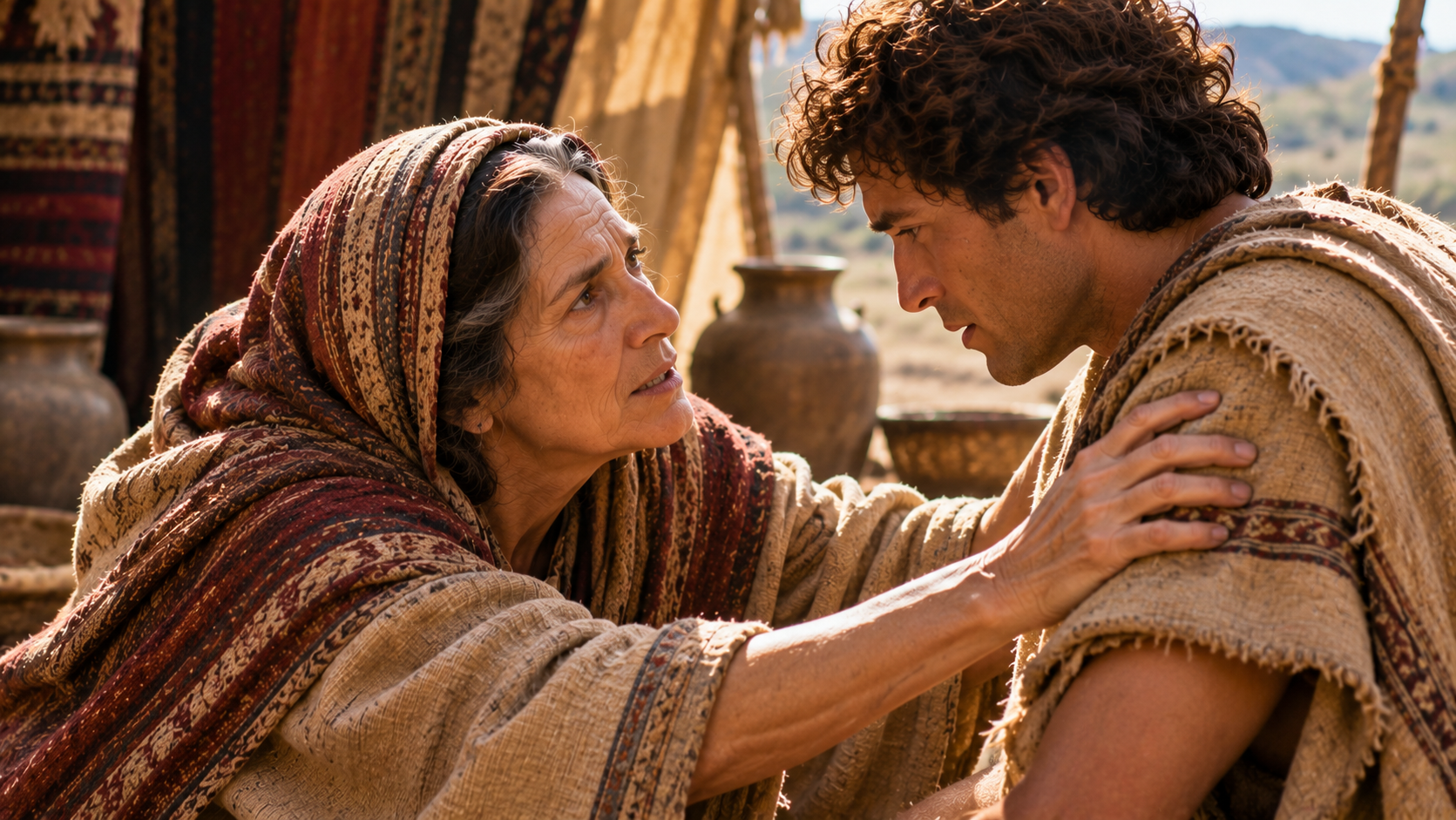
YOUR CURSE
BE ON ME
But his mother said to him, “Your curse (qelalah; LXX - katara - human utterance wishing evil on someone imprecation) be on me, my son - Hebrew reads literally “Upon me your curse, my son.” Rebekah answers Jacob’s fear by pronouncing a curse on herself, offering to take the consequences in his place. Rebekah did suffer for her scheme, but that did not spare Jacob. Both of them reaped what they had sown. Her fear that day came true in a way she did not expect: “until your brother’s anger against you subsides and he forgets what you did to him. Then I will send and get you from there. Why should I be bereaved of you both in one day?” (Ge 27:45). She lost the son she loved to a long exile, and she never lived to send for him.
Rebekah’s words recall another rash self-imprecation in Scripture: “And all the people said, ‘His blood shall be on us and on our children!’” (Mt 27:25). People speak such words easily, but no one can lift the consequences of sin from another person. The principle stands: “The person who sins will die. The son will not bear the punishment for the father’s iniquity, nor will the father bear the punishment for the son’s iniquity; the righteousness of the righteous will be upon himself, and the wickedness of the wicked will be upon himself” (Eze 18:20).
Rebekah meant well when she said “Your curse be on me,” but no parent, spouse, or friend can carry the guilt of our sin for us. Only Jesus Christ could bear the curse in our place, and He did (Gal 3:13, 1Pe 2:24)!
Only - Only means “just” (obey) and seeks to brush Jacob’s fears as if to say “Don’t worry about the consequences. Just do as I say.”
Obey (shama; LXX - hupakouo - obey, submit to) my voice - Hebrew = "Only listen to my voice." Just as she had commanded in Ge 27:8. She will use it a third time when she sends him away (Ge 27:43).
And go, get them for me - She gives two more rapid fire commands, for they have to pull this off before Esau returns
Warren Wiersbe - “My son, let the curse fall on me” was her word of encouragement to Jacob (v. 13), but little did she know what she was saying. For after Jacob left for Haran, she never saw her favorite son again. Isaac’s philosophy was “If it feels good, it is good”; but Rebekah’s philosophy was “The end justifies the means.” She couldn’t trust God to fulfill His plan; she had to help God out because it was for a good cause. But there’s no place for deception in the life of the believer; for Satan is the deceiver (2 Cor. 11:3), but Jesus Christ is the truth (John 14:6). “Blessed is the man … in whose spirit is no deceit” (Ps. 32:2). (Bible Exposition Commentary)
Genesis 27:14 So he went and got them, and brought them to his mother; and his mother made savory food such as his father loved.
KJV And he went, and fetched, and brought them to his mother: and his mother made savoury meat, such as his father loved.
NET So he went and got the goats and brought them to his mother. She prepared some tasty food, just the way his father loved it.
NLT So Jacob went out and got the young goats for his mother. Rebekah took them and prepared a delicious meal, just the way Isaac liked it.
ESV So he went and took them and brought them to his mother, and his mother prepared delicious food, such as his father loved.
NIV So he went and got them and brought them to his mother, and she prepared some tasty food, just the way his father liked it.
- mother: Ge 27:4,7,9,17,31 25:28 Ps 141:4 Pr 23:2,3 Lu 21:34
Related Passages:
Genesis 27:4 and prepare a savory dish for me such as I love, and bring it to me that I may eat, so that my soul may bless you before I die.”
Genesis 27:9 “Go now to the flock and bring me two choice young goats from there, that I may prepare them as a savory dish for your father, such as he loves.
JACOB QUICKLY SECURES MEAT
REBEKAH COOKS IT UP
So (term of conclusion) he went and got them and brought them to his mother - Without additional objections and without delay Jacob obeys. There is no further protest, no hesitation, and no prayer, just prompt compliance. While Rebekah conceived the plan, Jacob chose to carry it out, and thus her command did not remove his responsibility.
and his mother made savory food such as his father loved - Rebekah had "cooked" up the plot and now cooks up the meal! Isaac’s love for this dish was his weak point, and the one who knew him best used it against him. Rebekah’s intimate knowledge of her husband’s tastes, gained over decades of marriage, became the tool of his deception. And as alluded to earlier somehow she was able to disguise the taste of the goat meat so that it did not arouse Isaac's suspicions.
R C Sproul - Jacob Deceives Isaac GENESIS 27:14–25
“He said, ‘Are you really my son Esau?’ He answered, ‘I am.’ Then he said, ‘Bring it near to me, that I may eat of my son’s game and bless you.’ So he brought it near him, and he ate; and he brought him wine, and he drank” (Gen. 27:24–25).
Rebekah’s plan to secure the patriarchal blessing for Jacob in Genesis 27:5–13 confronts us with an important question: Did the Lord approve of her deceit? This issue is thorny because, as today’s passage reveals, Jacob successfully received the benediction intended for Esau. But does this mean God was completely happy with Jacob?
Other biblical texts indicate that deception may sometimes serve the cause of righteousness and please the Lord (see Ex. 1:8–22). However, this does not seem to be true of Rebekah and Jacob’s plot. As is typical in Hebrew narrative, there is no explicit moral commentary on their act, but there are hints that God was not pleased with the way in which the patriarchal blessing was obtained.
First, Rebekah makes no attempt to convince Isaac to change his mind about Esau (27:5–13). If Isaac remained intent on disobeying God and blessing Esau after being reminded of Jacob’s election (25:23), Rebekah’s deeds may have been more commendable. More tellingly, Moses never mentions Rebekah’s death. Unlike the other patriarchal wives, she is given no memorial or record of burial, probably because of the way she seized the blessing ordained for Jacob.
Second, Jacob’s life evidences the Lord’s disapproval of his methods. His protest in 27:11–12 reflects worry that he might get caught, not that he might dishonor Isaac, and he blasphemes in his lie that the Lord gave him success in his hunt (v. 20). Moreover, the deceptive theft of the blessing causes strife with Esau, causing Jacob to flee (vv. 41–45). In fact, Jacob himself is deceived later on (29:1–30), which is probably talionic (“eye for an eye”) retribution for his own lies.
Nevertheless, Jacob is ordained for a specific calling in God’s redemptive plan, and so He allows the craftiness of mother and son to pass the blessing from Isaac to Jacob. God’s providence is such that His plans will never be thwarted, though He never approves of His people’s sin, even if it contributes to His ends (Rom. 6:1–2). John Calvin’s comments on 27:11 remind us that just because the Lord often uses our perverse acts for our final good, we cannot therefore take this grace as a license to sin.
CORAM DEO In line with His promise in Romans 8:28, God worked through Jacob’s sin for the final good of His plan. Though Jacob grasped at spiritual benefits through unspiritual means, thereby getting himself into trouble, the Lord was pleased to allow it in His plan of redemption. We must never use this truth as a license to sin, but let us never erroneously assume God cannot use our mistakes to contribute to His glory, and therefore our good, in the end.
Genesis 27:15 Then Rebekah took the best garments of Esau her elder son, which were with her in the house, and put them on Jacob her younger son.
KJV And Rebekah took goodly raiment of her eldest son Esau, which were with her in the house, and put them upon Jacob her younger son:
NET Then Rebekah took her older son Esau's best clothes, which she had with her in the house, and put them on her younger son Jacob.
NLT Then she took Esau's favorite clothes, which were there in the house, and gave them to her younger son, Jacob.
ESV Then Rebekah took the best garments of Esau her older son, which were with her in the house, and put them on Jacob her younger son.
NIV Then Rebekah took the best clothes of Esau her older son, which she had in the house, and put them on her younger son Jacob.
- best garments: Heb. desirable, Ge 27:27 The Septuagint translates it "a goodly robe," which was a long garment that great men used to wear, (Lu 20:46; 15:22.) The priest afterwards in the law had "holy garments" to minister in, (Ex 28:2-4.) Whether the first-born before the law had such to minister in is not certain: for, had they been common garments, why did not Esau himself or his wives keep them? But being, in likelihood, holy robes, received from their ancestors, the mother of the family kept them in sweet chests, from moths and the like
Related Passages:
Genesis 25:23 (Ge 25:23) - [Copy][Go][to List]
(25:23) The LORD said to her, “Two nations are in your womb; And two peoples will be separated from your body; And one people shall be stronger than the other; And the older shall serve the younger.”
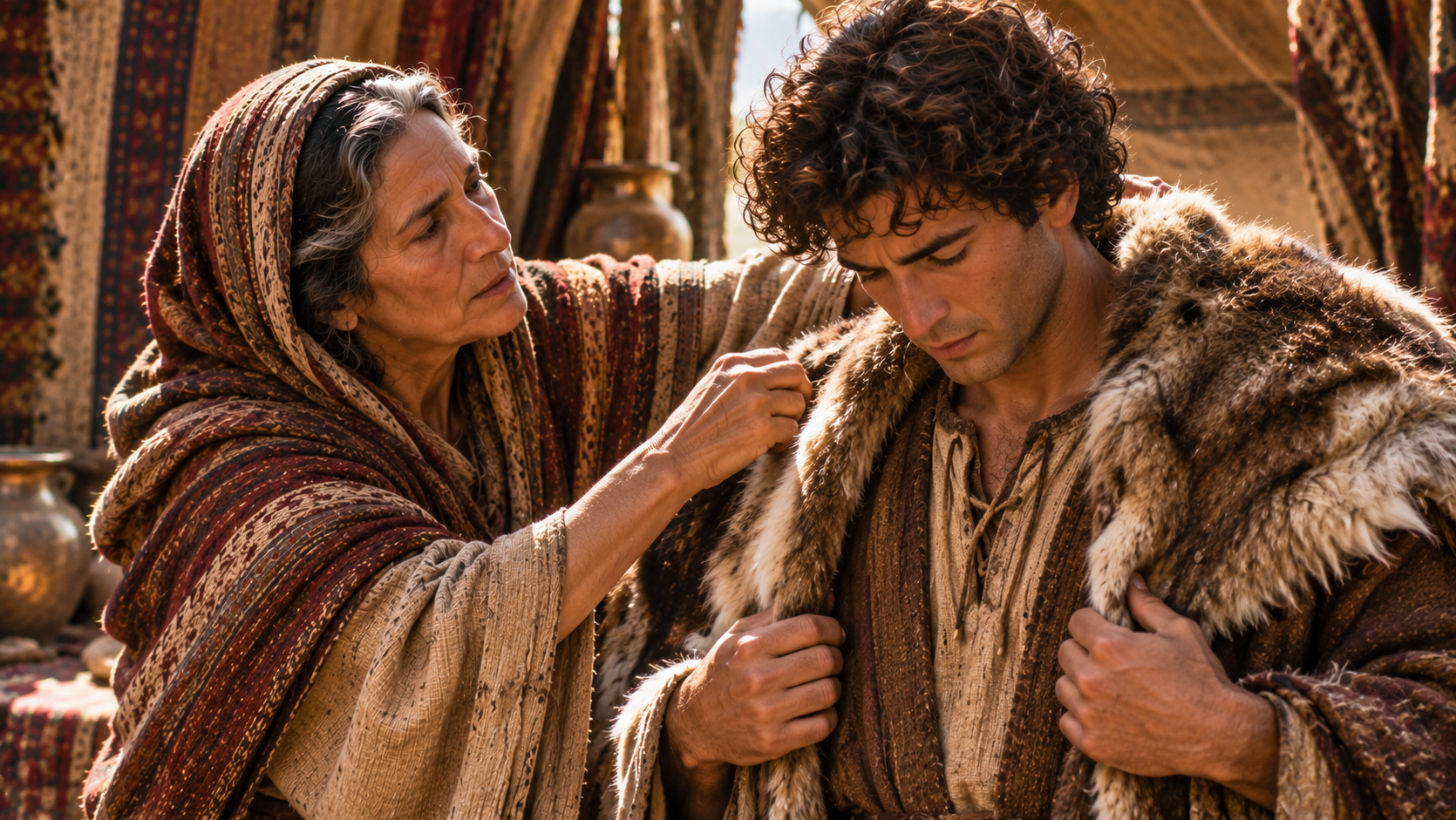
DRESSED FOR
DECEPTION
Then Rebekah took the best garments of Esau her elder son - Rebekah was carefully preparing to deceive not only Isaac's sense of taste but also his sense of smell! Esau was a married man with two wives (Ge 26:34), yet his best clothes were kept in his mother’s tent. Had they been with his Hittite wives, there may not have been an opportunity to "borrow" them! God's providence is surely at play.
It is interesting to note that garments run as a thread through Jacob’s whole family story. Jacob deceived his father with his brother’s garment, and his sons later deceived him with Joseph’s blood-stained tunic (Ge 37:31-33; see Ge 27:9). Tamar used a change of clothes to deceive Judah (Ge 38:14). Potiphar’s wife used Joseph’s garment as false evidence (Ge 39:12).
which were with her in the house, and put them on Jacob her younger son - Note the contrast "Esau her elder" and "Jacob her younger" which reminds us of the birth order which she was proceeding to reverse! The irony is striking for God had already chosen Jacob to receive the covenant promises (Ge 25:23), yet Jacob was now being dressed to obtain the blessing through deception. He did not need to become Esau to receive what God had promised Jacob!
🙏 THOUGHT – Beloved, Jacob's borrowed garments illustrate a timeless spiritual danger: We can change our outward appearance without changing the truth about who we are! Jacob could wear Esau's clothing, imitate his voice, and claim his identity, but beneath the disguise he remained Jacob. How easily we can put on an outward appearance of spirituality while concealing what is really in our hearts! Jesus warned against those who outwardly appear righteous while inwardly harboring hypocrisy (Mt 23:27,28). God looks beyond appearances and examines the heart (1Sa 16:7). We may successfully disguise ourselves before people, but we can never disguise ourselves before God! (Heb 4:13).
Genesis 27:16 And she put the skins of the young goats on his hands and on the smooth part of his neck.
KJV And she put the skins of the kids of the goats upon his hands, and upon the smooth of his neck:
NET She put the skins of the young goats on his hands and the smooth part of his neck.
NLT She covered his arms and the smooth part of his neck with the skin of the young goats.
ESV And the skins of the young goats she put on his hands and on the smooth part of his neck.
NIV She also covered his hands and the smooth part of his neck with the goatskins.
- skins (KJV): Travellers inform us, that the Eastern goats have long, fine, and beautiful hair, of the most delicate silky softness; indeed the animals generally in those hot countries are not covered with so thick a coat of hair as they are in more northerly regions; so that Isaac might easily be deceived, when his eyes were dim, and his feeling no less impaired than his sight.
Related Passages:
Proverbs 28:13 He who conceals his transgressions will not prosper, But he who confesses and forsakes them will find compassion.
1 Samuel 19:13 Michal took the household idol and laid it on the bed, and put a quilt of goats’ hair at its head, and covered it with clothes.
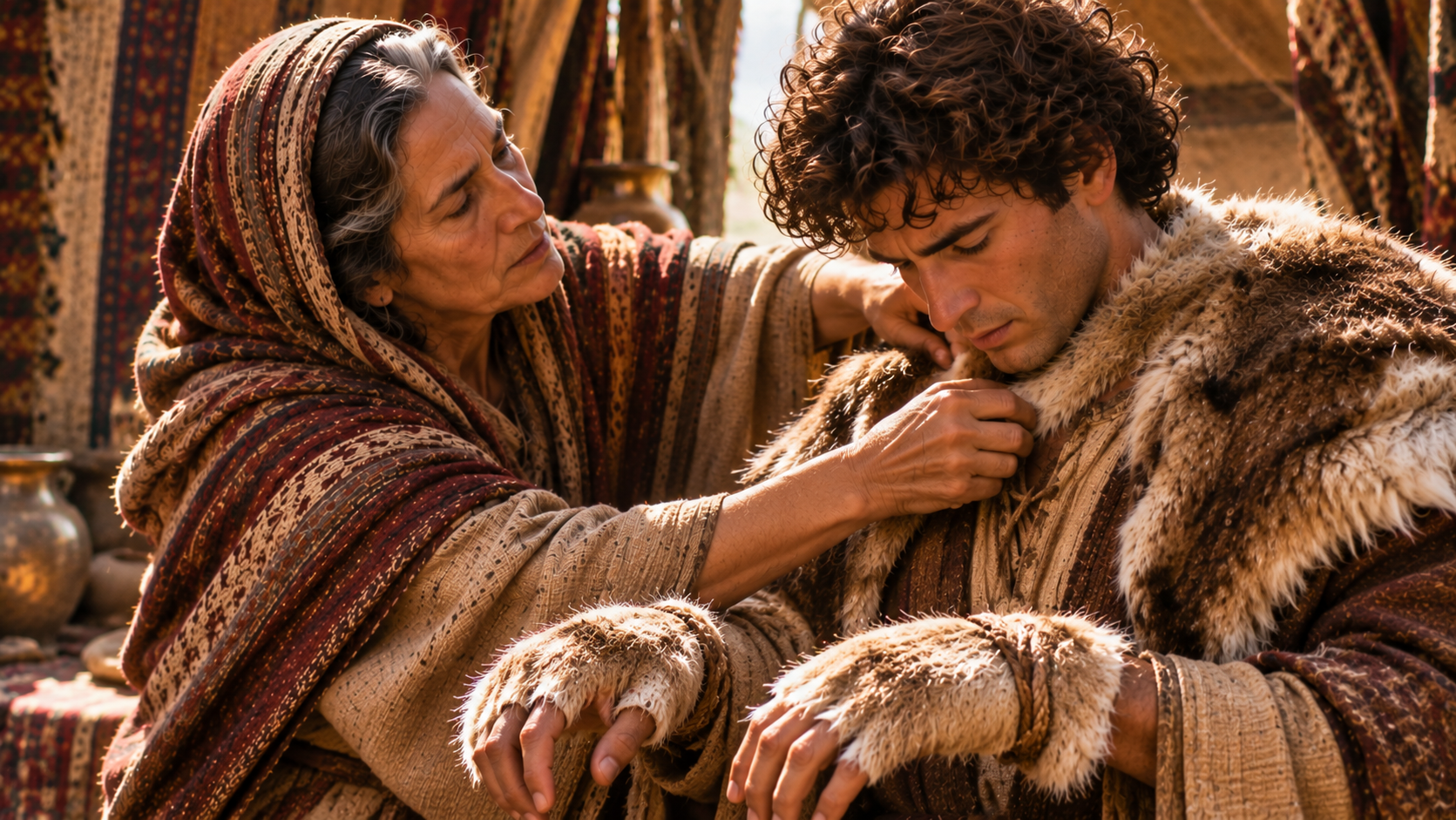
THE GUILE OF
GOATSKIN HANDS
And she put the skins of the young goats on his hands and on the smooth part of his neck - Knowing that Isaac might touch Jacob, she carefully covers his hands with goatskins to imitate Esau's hairy skin. Rebekah covered Jacob's smooth skin with goatskins, but no disguise could conceal their deception from the all-seeing God! Rebekah was proactive and so covered the neck because she expected Isaac to embrace his son which he did (Ge 27:26,27).
Covering sin always takes careful planning,
but it never brings peace.
Constable - People used the black, silk-like hair of the camel-goat of the East (“young goats,” v. 16) as a substitute for human hair as late as the Roman period.1122
NET NOTE - The word "hands" probably includes the forearms here. How the skins were attached is not specified in the Hebrew text; cf. NLT "she made him a pair of gloves."
The neck reappears later in the story. In Isaac’s word to Esau, he says, “By your sword you shall live, and your brother you shall serve; but it shall come about when you become restless, that you will break his yoke from your neck” (Ge 27:40). Twenty years later, the neck that had been disguised with goatskins was the neck Esau embraced in reconciliation: “Then Esau ran to meet him and embraced him, and fell on his neck and kissed him, and they wept” (Ge 33:4). By then grace had done what deception never could.
🙏 THOUGHT - Beloved, is there something you are carefully covering today? God offers a better covering than goatskins: “How blessed is he whose transgression is forgiven, whose sin is covered!” (Ps 32:1).
Spurgeon Expositon - Genesis 27:16-19
Which, whatever may be said about it, was a plain lie, and is not to be excused upon any theory whatever. It was as much a sin in Jacob as it would be in us, except that perhaps he had less light, and the general cunning of those who surrounded him may have made it more easy with him and a less tax on conscience for him to do this than it would be in our case. “I am Esau,” said he. Why is all this recorded in the Bible? It is not to the credit of these men. No! the Holy Spirit does not write for the credit of man: he writes for the glory of God’s grace. He writes for the warning of believers now, and these things are examples unto us that we may avoid the blots and flaws in good men, and may thereby ourselves become more what we should be.
Genesis 27:17 She also gave the savory food and the bread, which she had made, to her son Jacob.
KJV And she gave the savoury meat and the bread, which she had prepared, into the hand of her son Jacob.
NET Then she handed the tasty food and the bread she had made to her son Jacob.
NLT Then she gave Jacob the delicious meal, including freshly baked bread.
ESV And she put the delicious food and the bread, which she had prepared, into the hand of her son Jacob.
NIV Then she handed to her son Jacob the tasty food and the bread she had made.
Related Passages:
Proverbs 12:22 Lying lips are an abomination to the LORD, But those who deal faithfully are His delight.
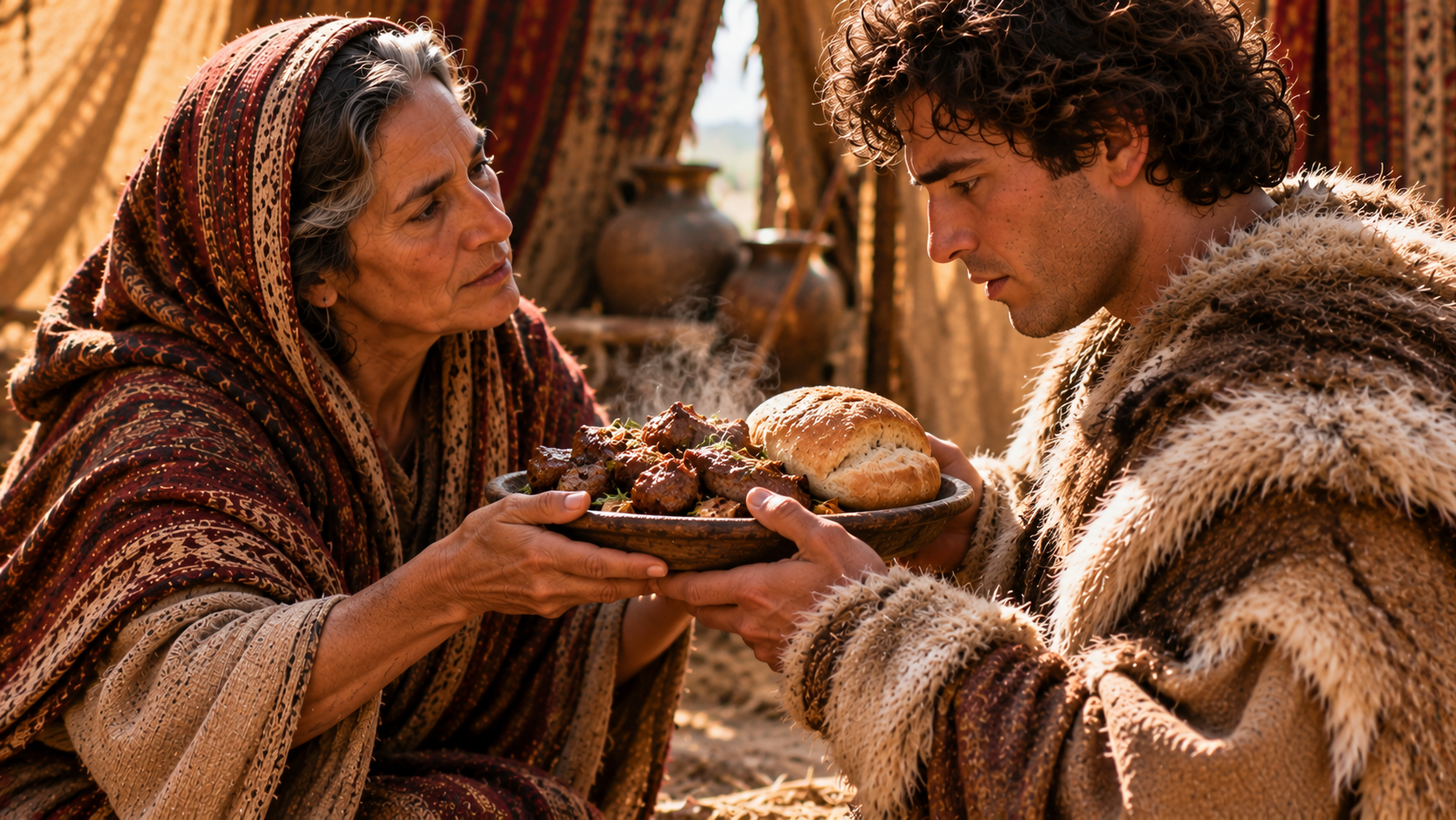
A MEAL PREPARED
TO DECEIVE
She also gave the savory food and the bread, which she had made, to her son Jacob - Rebekah's preparations are now complete. The savory food would satisfy Isaac's appetite, the garments would provide Esau's familiar scent, and the goatskins would imitate his hairy skin (Ge 27:15–16). Even the bread was prepared for the occasion. Every detail was designed to make Jacob's impersonation convincing. The pairing of bread with a cooked dish also recalls an earlier scene. Jacob bought the birthright with “bread and lentil stew” (Ge 25:34; see 27:4). Now he goes to get the blessing with bread and savory food. How ironic that both times Jacob used food to reach for what God had already promised him.
🙏 THOUGHT - Jacob went in with food in his hands to obtain a blessing. Rebekah could get him ready, but she could not go in with him. One day each of us will stand before God, and no one else’s preparation will count for us. The good news is that we do not come bringing bread to earn His favor. He offers Bread to us: “Jesus said to them, ‘I am the bread of life; he who comes to Me will not hunger, and he who believes in Me will never thirst’” (Jn 6:35).
Parunak - Application: Rebekah’s sin is the opposite of Isaac’s. He neglected the revelation of God’s will concerning the proper heir. She was so zealous for it that she sought to achieve it in her own strength, even at the expense of deception and reversing the home order, rather than trusting God to bring it about. Fleshly zeal is as wrong as disobedience.
Genesis 27:18 Then he came to his father and said, “My father.” And he said, “Here I am. Who are you, my son?”
KJV And he came unto his father, and said, My father: and he said, Here am I; who art thou, my son?
NET He went to his father and said, "My father!" Isaac replied, "Here I am. Which are you, my son?"
NLT So Jacob took the food to his father. "My father?" he said."Yes, my son," Isaac answered. "Who are you-- Esau or Jacob?"
ESV So he went in to his father and said, "My father." And he said, "Here I am. Who are you, my son?"
NIV He went to his father and said, "My father." "Yes, my son," he answered. "Who is it?"
Related Passages:
Proverbs 10:9 He who walks in integrity walks securely, But he who perverts his ways will be found out.
THE DECEPTION
BEGINS
Then he came to his father and said, “My father.” - The moment of truth has arrived! Jacob may have kept it short on purpose, fearing that his voice would give him away. His simple greeting conceals an elaborate deception. The son who should have honored his father is preparing to exploit his blindness.
And he said, “Here I am. Who are you, my son?” - One can imagine Isaac's response made Jacob's heart skip a beat! Isaac's question introduces the central issue of the encounter which is identity!
Here I am - It was Esau’s answer to his father at the start of the chapter. On Moriah it was Isaac’s own answer to his father Abraham (Ge 22:7). Now the old father gives the same answer of trust and availability, and he gives it to a son who has come to deceive him.
Who are you, my son?” - Isaac seems uncertain from the start. He questions how fast “Esau” returned (27:20), he asks to feel him (27:21), and he questions him again: “And he said, ‘Are you really my son Esau?’ And he said, ‘I am’” (Ge 27:24). Each time, Jacob answers with a lie.
NET NOTE - Which are you, my son? Isaac's first question shows that the deception is going to require more subterfuge than Rebekah had anticipated. Jacob will have to pull off the deceit.
The question “Who are you?” follows Jacob for twenty years. At the Jabbok, the Angel of the LORD asked him nearly the same thing: “So he said to him, ‘What is your name?’ And he said, ‘Jacob’” (Ge 32:27). This time Jacob told the truth. He gave the name that meant “heel-grabber, supplanter” (Ge 25:26; 27:36), and in effect confessed his character. Only then did God give him a new name, Israel (Ge 32:28). The man who said “I am Esau” to his earthly father had to say “I am Jacob” to his heavenly Father before he could be changed.
Warren Wiersbe - In cooperating with the scheme, Jacob was only obeying his mother, but he could have refused and suggested that they just face the situation honestly and confront Isaac. But once Jacob donned Esau’s clothes and took the savory meal in his hands, the die was cast and he had to play the part successfully. See how one lie led to another, for deception can be defended only by more deception. Jacob was weaving the tangled web. (Bible Exposition Commentary)
Genesis 27:19 Jacob said to his father, “I am Esau your firstborn; I have done as you told me. Get up, please, sit and eat of my game, that you may bless me.”
KJV And Jacob said unto his father, I am Esau thy firstborn; I have done according as thou badest me: arise, I pray thee, sit and eat of my venison, that thy soul may bless me.
NET Jacob said to his father, "I am Esau, your firstborn. I've done as you told me. Now sit up and eat some of my wild game so that you can bless me."
NLT Jacob replied, "It's Esau, your firstborn son. I've done as you told me. Here is the wild game. Now sit up and eat it so you can give me your blessing."
ESV Jacob said to his father, "I am Esau your firstborn. I have done as you told me; now sit up and eat of my game, that your soul may bless me."
NIV Jacob said to his father, "I am Esau your firstborn. I have done as you told me. Please sit up and eat some of my game so that you may give me your blessing."
- I am (KJV): Ge 27:21,24,25 25:25 29:23-25 1Ki 13:18 14:2 Isa 28:15 Zec 13:3,4 Mt 26:70-74
- that thy (KJV): Ge 27:4
Related Passages:
Proverbs 12:22 Lying lips are an abomination to the LORD, But those who deal faithfully are His delight.
John 8:44 “You are of your father the devil, and you want to do the desires of your father. He was a murderer from the beginning, and does not stand in the truth because there is no truth in him. Whenever he speaks a lie, he speaks from his own nature, for he is a liar and the father of lies.
WHEN DECEPTION
SPEAKS
Jacob said to his father “I am Esau your firstborn (bekor; LXX - prototokos) - With these words Jacob crosses the line from disguise to outright falsehood. The Hebrew text begins emphatically, “I am Esau.” The designation “your firstborn” is especially significant because Esau had already sold his birthright to Jacob (Ge 25:29–34). Jacob had acquired the firstborn’s rights. He bought them from Esau years before (Ge 25:33). Legally the birthright (bekorah) was his, but that did not make him Esau, nor justify his ruse. It is interesting that mixing a legal right with a false identity is typical of deception, which often hides behind some element of truth.
I have done as you told me - A second deliberate lie! He went to the flock, not the field, and his mother did the cooking (Ge 27:9, 14). Each lie made the next one necessary. There is a principle here we often see in life and it is that one lie often requires another to sustain the deception. How tempting it is to bend the truth when we believe the outcome will benefit us! And once we begin to bend the truth, sin seldom stays small. One deception leads to the next.
Get up, please (a polite and respectful request), sit and eat of my game - Three quick commands. Isaac was apparently lying down, old and weak (Ge 27:1-2). Notice the third lie "MY game." In one breath Jacob has lied about his identity, his actions, and his food. Remember that Jacob was seeking through falsehood what God had already determined according to His sovereign purpose!
That (term of purpose) you may bless (barak; LXX - eulogeo) me - The Hebrew reads literally “that your soul may bless me.” Jacob repeats his father’s exact words to Esau: “so that my soul may bless you” (Ge 27:4). Rebekah had passed Isaac’s words to him nearly word for word (Ge 27:7)
NET NOTE - Heb "so that your soul may bless me." These words, though not reported by Rebekah to Jacob (see Ge 27:7) accurately reflect what Isaac actually said to Esau (see Ge 27:4). Perhaps Jacob knew more than Rebekah realized, but it is more likely that this was an idiom for sincere blessing with which Jacob was familiar. At any rate, his use of the precise wording was a nice, convincing touch.
Genesis 27:20 Isaac said to his son, “How is it that you have it so quickly, my son?” And he said, “Because the LORD your God caused it to happen to me.”
KJV And Isaac said unto his son, How is it that thou hast found it so quickly, my son? And he said, Because the LORD thy God brought it to me.
NET But Isaac asked his son, "How in the world did you find it so quickly, my son?" "Because the LORD your God brought it to me," he replied.
NLT Isaac asked, "How did you find it so quickly, my son?" "The LORD your God put it in my path!" Jacob replied.
ESV But Isaac said to his son, "How is it that you have found it so quickly, my son?" He answered, "Because the LORD your God granted me success."
NIV Isaac asked his son, "How did you find it so quickly, my son?" "The LORD your God gave me success," he replied.
- Because (KJV): Ex 20:7 Job 13:7
Isaac said to his son, “How is it that you have it so quickly, my son?” - Hebrew reads literally “What is this you hurried to find, my son?” NET - "But Isaac asked his son, "How in the world did you find it so quickly, my son?" Isaac immediately notices something unusual. Hunting wild game, preparing it, and returning with a meal should have required considerable time (Ge 27:3,4). Rebekah’s plan relied on speed, and the speed nearly gave it away. Notice Isaac's Isaac’s tender “my son” shows how much he wanted to believe what he heard. Nevertheless, his question suggests suspicion, or at least surprise, at the extraordinary speed. Jacob's deception has encountered its first serious test.
Parunak - As the hunters among us can testify, capturing a wild animal is not like dropping in at the supermarket. One might expect to take a few days.
And he said, “Because the LORD your God caused it to happen (qarah)(the language of providence) to me - Jacob responds with his most disturbing lie yet! This is Jacob's fourth lie. ESV = "Because the LORD your God granted me success." He not only lies about his identity and the meal but now invokes the Name of Yahweh to authenticate his deception! The Hebrew expression caused it to happen to me conveys the idea that the LORD providentially brought the game into his path. Jacob attributes to divine providence something that actually resulted from his mother's carefully calculated scheme.
Notice the words “the LORD your God,” not “my God.” Jacob speaks of Yahweh as his father’s God, not his own. It will be years before he can say anything else. At Bethel, fleeing for his life, he vows: “and I return to my father’s house in safety, then the LORD will be my God” (Ge 28:21).While this wording in Ge 27:20 does not necessarily indicate that Jacob lacked personal faith, it is striking that he invokes his father's God while deceiving his father. He uses the language of faith to give credibility to a lie!
Parunak - Jacob’s answer is the first use of the phrase “thy God” in the Bible: “Because the LORD thy God brought it to me.” He does not yet acknowledge the Lord as his own God. His talk with God at Bethel (Ge 28:21) shows that he recognizes this difference. Here indeed is a case of taking the name of the Lord in vain.
Jacob's most serious deception was not merely lying to his father,
but invoking God's name to make the lie believable!
Spurgeon - Here he draws God’s name into this lie, and this is worse still.
John MacArthur - Isaac's perfectly legitimate question in v. 20 (hunting took time and Jacob had come so quickly with goats from the pen) afforded Jacob an escape route—confess and stop the deceit! Instead, Jacob, with consummate ease, knowing he needed Isaac's irrevocable confirmation even though he had bought the birthright, ascribed success in the hunt to God's providence. A lie had to sustain a lie, and a tangled web had begun to be woven (vv. 21-24). Although Jacob received Isaac's blessing that day, the deceit caused severe consequences: 1) he never saw his mother after that; 2) Esau wanted him dead; 3) Laban, his uncle, deceived him; 4) his family life was full of conflict; and 5) he was exiled for years from his family. By the promise of God he would have received the birthright (Ge 25:23). He didn't need to scheme this deception with his mother. (See MacArthur Study Bible)
Henry Morris - caused it to happen to me - Jacob no doubt hoped that Isaac would not question him at all. But Isaac did, and so there was no way of accomplishing Rebekah's plan now except by overt lying and even by taking God's name in vain. Jacob and Rebekah were godly and sensitive people, and it must have grieved them greatly to break God's commandments like this, especially knowing that it could only be a matter of an hour or so before it would all be exposed with all the wrath and recriminations that would follow. The whole episode can only really be understood in light of their hope that Isaac's sudden knowledge that his beloved wife and faithful son would go to such lengths to prevent him from blaspheming God and His will might shock him to his senses (as, indeed, it did). It is significant that God never spoke to either Rebekah or Jacob by way of rebuke over this incident. In fact, God later explicitly confirmed Isaac's blessing to Jacob (Genesis 28:13-15). The rebuke was solely for Esau, and the repentance was Isaac's, not Jacob's.
🙏 THOUGHT – Beloved, Jacob's words expose a particularly dangerous form of deception of using God's name to make our own actions appear divinely approved. How easily we can say, “The Lord led me,” or “God opened the door,” when we are actually following our own desires! To use God’s name to make a lie believable is to profane it. The third commandment warns against taking the LORD's name in vain (Ex 20:7, cf Lev 19:12). Religious deception is especially serious, because it treats God as an accomplice. Peter’s rebuke to Ananias applies: “While it remained unsold, did it not remain your own? And after it was sold, was it not under your control? Why is it that you have conceived this deed in your heart? You have not lied to men but to God” (Acts 5:4). Before attributing a decision or circumstance to God's direction, we should ask whether it agrees with His revealed Word. Never use the language of providence to conceal the practice of disobedience! It is possible to use spiritual language, even credit God with our successes, while our hearts are far from Him. Beloved, is the LORD only your parents’ God, or your church’s God, or is He your God? And when you speak His name, is it in truth?
Happen (befall, met) (07136) qarah means to have happen, to ordain, to meet with (i.e., without pre-arrangement), to befall, to encounter. It describes something that happens or comes about, whether good or bad. Qarah can also mean to build beams.
Abraham’s servant used the same verb qarah when he prayed for a wife for Isaac: “He said, ‘O LORD, the God of my master Abraham, please grant me success (qarah) today, and show lovingkindness to my master Abraham’” (Ge 24:12). There, “grant me success” was a sincere prayer that God answered with Rebekah. Now Rebekah’s son uses the same word for providence to cover a fraud. He credits God with something God had not done.
Genesis 27:21 Then Isaac said to Jacob, “Please come close, that I may feel you, my son, whether you are really my son Esau or not.”
KJV And Isaac said unto Jacob, Come near, I pray thee, that I may feel thee, my son, whether thou be my very son Esau or not.
NET Then Isaac said to Jacob, "Come closer so I can touch you, my son, and know for certain if you really are my son Esau."
NLT Then Isaac said to Jacob, "Come closer so I can touch you and make sure that you really are Esau."
ESV Then Isaac said to Jacob, "Please come near, that I may feel you, my son, to know whether you are really my son Esau or not."
NIV Then Isaac said to Jacob, "Come near so I can touch you, my son, to know whether you really are my son Esau or not."
- Come (KJV): Ps 73:28 Isa 57:19 Jas 4:8
- may feel (KJV): Ge 27:12
Related Passages:
Proverbs 14:15 The naive believes everything, But the sensible man considers his steps.
Acts 17:11 Now these were more noble-minded than those in Thessalonica, for they received the word with great eagerness, examining the Scriptures daily to see whether these things were so.
1 John 4:1 Beloved, do not believe every spirit, but test the spirits to see whether they are from God, because many false prophets have gone out into the world.
ISAAC'S SUSPICION CALLED
FOR EXAMINATION
Then Isaac said to Jacob, “Please come close, that I may feel you, my son - Despite Jacob's confident claim, “I am Esau your firstborn” (Ge 27:19), Isaac is not fully persuaded by Jacob's explanation. His failing eyesight (Ge 27:1) forces him to rely on touch to establish his son's identity. Rebekah had anticipated precisely this possibility and covered Jacob's hands and neck with goatskins (Ge 27:16). Jacob’s greatest fear is now coming true: “Perhaps my father will feel me” (Ge 27:12). This was the most dangerous moment of the deception. Rebekah’s goatskins were about to be tested.
Whether you are really my son Esau or not.” - NLT - "make sure that you really are Esau" The Hebrew is emphatic: “whether you are this one, my son Esau, or not.” Isaac’s suspicion is growing. The voice did not sound right, and the hunt was too quick (Ge 27:20). So Isaac falls back on another sense. Throughout this scene he relies on his bodily senses to establish the truth: hearing (Ge 27:22), touch (Ge 27:21-23), taste (Ge 27:25), and smell (Ge 27:27). His sight is gone, and each of the remaining senses is deceived in turn. What Isaac never does is seek the LORD. He tests the son with his hands, but he never asks God for discernment.
🙏 THOUGHT – Beloved, Isaac's request illustrates the importance of testing what we hear rather than accepting every claim at face value. Solomon warns, “The naive believes everything, But the prudent man considers his steps” (Pr 14:15). The Bereans were commended because they examined the Scriptures daily to determine whether Paul's teaching was true (Acts 17:11). Yet Isaac's experience also reminds us that even sincere investigation can be misled when evidence has been manipulated. Physical senses can be fooled, but God’s word cannot. Beloved, when something does not seem right, do you lean only on what you can see, hear, and feel, or do you bring it to the LORD and to His word? “Trust in the LORD with all your heart and do not lean on your own understanding” (Pr 3:5, cf Php 1:9,10).
Genesis 27:22 So Jacob came close to Isaac his father, and he felt him and said, “The voice is the voice of Jacob, but the hands are the hands of Esau.”
KJV And Jacob went near unto Isaac his father; and he felt him, and said, The voice is Jacob's voice, but the hands are the hands of Esau.
NET So Jacob went over to his father Isaac, who felt him and said, "The voice is Jacob's, but the hands are Esau's."
NLT So Jacob went closer to his father, and Isaac touched him. "The voice is Jacob's, but the hands are Esau's," Isaac said.
ESV So Jacob went near to Isaac his father, who felt him and said, "The voice is Jacob's voice, but the hands are the hands of Esau."
NIV Jacob went close to his father Isaac, who touched him and said, "The voice is the voice of Jacob, but the hands are the hands of Esau."
- The voice: How wonderful, says Mr. Scott, is that difference which there is betwixt the faces and the voices of the several individuals of the human species! Scarcely any two of the innumerable millions are exactly alike in either, and yet the difference cannot be defined or described! The power, wisdom, and kindness of our Creator should be admired and adored in this remarkable circumstance; for they are very visible. This description of Jacob is not unaptly accommodated to the character of a hypocrite: his voice, his language, is that of a Christian; his hands, or conduct, that of an ungodly man: but the judgment will proceed from God, the Judge of all, at the last day, as in the present case, not by the voice, but by the hands. Ge 27:22
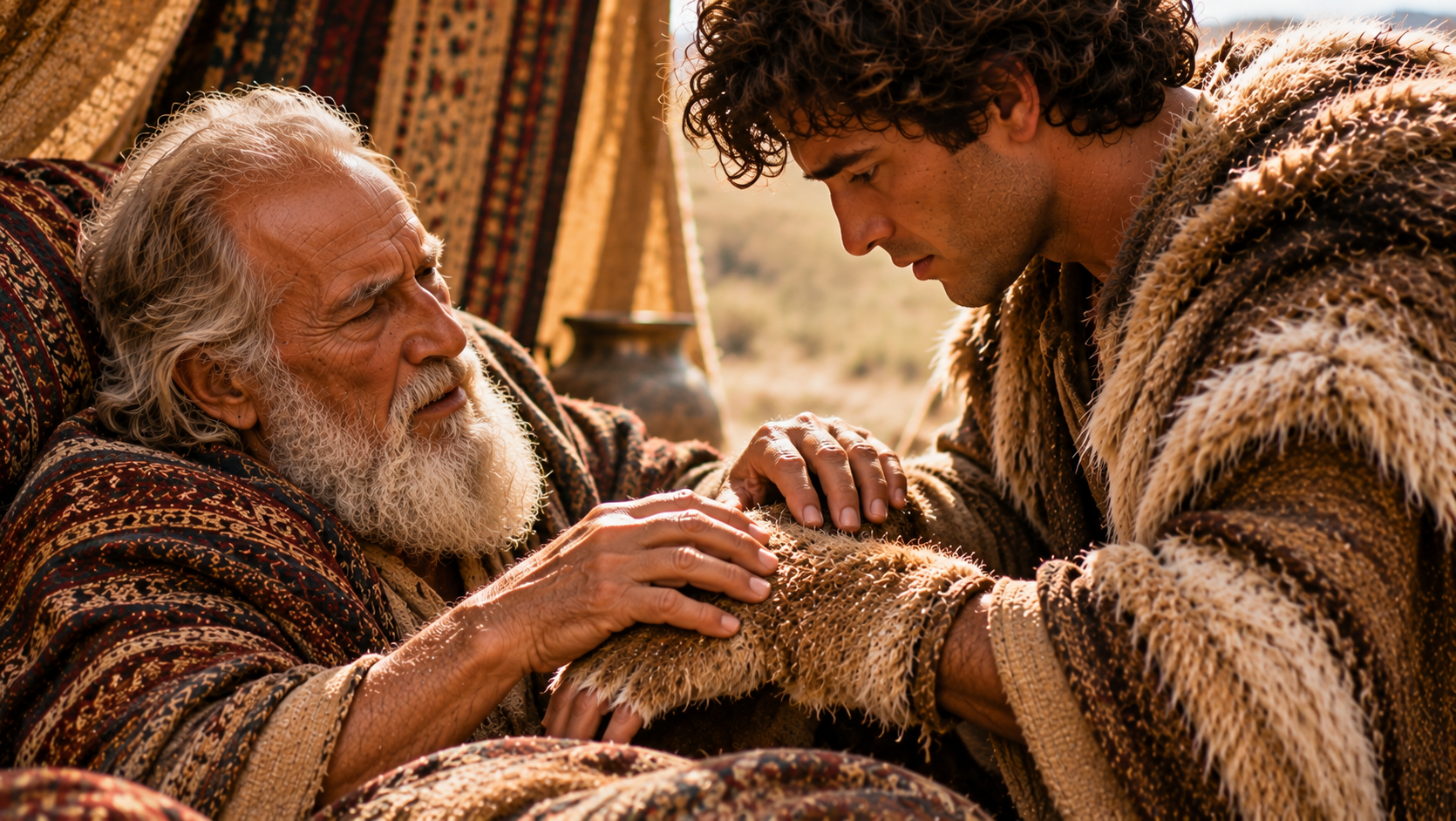
WHEN THE
SENSES DISAGREE
So Jacob came close to Isaac his father, and he felt him - Jacob submits to the very examination he had dreaded (Ge 27:11,12).The narrator says “Isaac his father,” a reminder that this is a son deceiving his own father as Isaac gropes over the goatskins. The moment of greatest danger had come, and the disguise held.
and said, “The voice is the voice of Jacob, but the hands are the hands of Esau - What a remarkable observation! Isaac recognizes something familiar in Jacob's voice, yet his sense of touch contradicts what he hears. Isaac’s words have become proverbial for a contradiction between what is heard and what is seen, or between what is said and what is done. The tragedy is that Isaac’s ears told him the truth. The voice was Jacob’s. He had the right answer and set it aside, trusting the evidence of his hands over his ears. The hairy goatskins outweighed the voice he had known for decades.
This verse serves as a mirror. Here the voice and the hands did not match. One said “Jacob” and the other said “Esau.” The same can be true of us when our words say one thing and our deeds another: “They profess to know God, but by their deeds they deny Him, being detestable and disobedient and worthless for any good deed” (Tit 1:16). James calls for voice and hands that agree: “But someone may well say, ‘You have faith and I have works; show me your faith without the works, and I will show you my faith by my works’” (Jas 2:18).
Notice the important conjunction “but.” Isaac has conflicting evidence before him. His ears tell him one thing; his hands tell him another. Tragically, he will ultimately accept the misleading evidence of touch rather than the warning conveyed by the familiar voice (Ge 27:23).
A voice is hard to disguise, because it carries a person’s identity. In fact scammers are using this truth to commit fraud. Beware when you receive a spam call or call from an unknown number! Do not say anything! Your voice pattern can be recorded and replicated by AI and allow the perpetrators to carry out a scam! Saul recognized David by his voice: “When David had finished speaking these words to Saul, Saul said, ‘Is this your voice, my son David?’ Then Saul lifted up his voice and wept” (1Sa 24:16). Jesus said His sheep know Him the same way: “My sheep hear My voice, and I know them, and they follow Me” (Jn 10:27). Isaac knew his son’s voice, but he did not trust what he knew.
🙏 THOUGHT - Isaac heard the truth and chose to believe the disguise. How often we hear God’s voice through His word and then trust instead what we can touch and see (been ther, done that). Beloved, when the “voice” of Scripture and the “hands” of circumstance seem to disagree, which will you trust? Do your words and your hands tell the same story about who you are?
Jewish tradition gave Isaac’s words a famous spiritual application. The “voice of Jacob” was taken to mean prayer and the study of God’s word, and the “hands of Esau” to mean violence and force. The saying went that when the voice of Jacob is heard in the houses of prayer, the hands of Esau have no power. That is a later reading, not the plain sense of the text, but it reflects a true principle: God’s people prevail by the voice of prayer, not by the hands of the flesh.
VOICE AND HANDS Genesis 27:22 - John Butler - Sermon Starters
“The voice is Jacob’s voice, but the hands are the hands of Esau” (Genesis 27:22).
Isaac, in rebellion to the will of God, wanted to give the patriarchal blessing to Esau who earlier had sold his birthright to Jacob. Isaac who favored Esau, acted rather clandestinely about the whole thing and did some evil conniving to try and get his plan accomplished. But Rebekah, who favored Jacob, heard Isaac’s plan and disguised Jacob as Esau so that Isaac, who could not see well, would think Jacob was Esau and give Jacob the blessing instead. It was a strange bit of thinking but God used all of this evil conniving to give the birthright, patriarchal, and covenant blessing to Jacob instead of Esau. In all of this action is a statement by Isaac that is loaded with instruction. In feeling Jacob to see if he was actually Esau (for the voice of Jacob had made Isaac suspicious), Isaac said the voice sounds like Jacob but the disguised hands (hairy like Esau) felt like Esau. There is a lot of that still today. Many things have the voice of Jacob but the hands of Esau. We note a few of them.
FIRST—THE CAROLS OF MEN
Music really reflects this problem. We are referring to Christian music. The voice (words) may be Christian, but the hands (beat and tune) are definitely not Christian. To justify the evil music some would tell us that music is amoral. But that is a lie straight from the pit of hell. Music inspires conduct. A band march causes a person to want to do different things than a hymn, such as, “Just as I am,” does. When you witness a dungaree clad person up on the rostrum strumming a guitar and crooning a song of praise at church you are witnessing what Isaac did, namely, hands and voice that do not match.
SECOND—THE CHURCH MEMBERS OF MEN
Then this problems is seen amongst church members. Their voice makes a wonderful confession of faith. And you think they are a fine Christian. They sound so noble, and so loyal, and this deceives even the best of members at church. But the hands are of Esau. The hands speak of the conduct of the church members. They reveal the hypocrisy in all the talk of the voice. The talk (voice) and walk (hands) do not match.
THIRD—THE CLERGY OF MEN
The hypocrisy at church is not just among the members but it is also seen in the clergy. Their voice (messages) sounds so good but their hands (conduct) are so bad that you wish the preacher would never leave the pulpit.
FOURTH—THE CONGRESSMEN OF MEN
Politicians often exhibit this problem. They give fine campaign speeches (voice). But what they do (hands) after election is another thing. They promise the moon to get elected but cannot bring safety to the streets of earth after election. The voice and hands do not match.
Genesis 27:23 He did not recognize him, because his hands were hairy like his brother Esau’s hands; so he blessed him.
KJV And he discerned him not, because his hands were hairy, as his brother Esau's hands: so he blessed him.
NET He did not recognize him because his hands were hairy, like his brother Esau's hands. So Isaac blessed Jacob.
NLT But he did not recognize Jacob, because Jacob's hands felt hairy just like Esau's. So Isaac prepared to bless Jacob.
ESV And he did not recognize him, because his hands were hairy like his brother Esau's hands. So he blessed him.
NIV He did not recognize him, for his hands were hairy like those of his brother Esau; so he blessed him.
- his hands (KJV): Ge 27:16
- he blessed (KJV): Ro 9:11-12 Heb 11:20
Related Passages:
Romans 9:11-12 for though the twins were not yet born and had not done anything good or bad, so that God’s purpose according to His choice would stand, not because of works but because of Him who calls, 12 it was said to her, “THE OLDER WILL SERVE THE YOUNGER.”
Hebrews 11:20 By faith Isaac blessed Jacob and Esau, even regarding things to come.
DECEIVED BY
HIS TOUCH
He did not recognize (nakar; LXX - epiginosko - know exactly or completely) him - Isaac heard the voice but failed to acknowledge it was actually Jacob and not Esau. His hearing was accurate but his touch misleading.
NOTE - The verb nakar becomes one of the key words of the family history in Genesis. Recognition is repeatedly tested, and repeatedly misled, by disguise and by objects. Jacob deceived his father so that Isaac “did not recognize” him. Years later Jacob’s sons handed him Joseph’s bloody tunic and said, “please examine (haker-na, ‘please recognize’) it to see whether it is your son’s tunic or not” (Ge 37:32). Jacob, once the deceiver, was now deceived through the same act of recognition. Then Judah was confronted the same way: “It was while she was being brought out that she sent to her father-in-law, saying, ‘I am with child by the man to whom these things belong.’ And she said, ‘Please examine and see, whose signet ring and cords and staff are these?’ Judah recognized them, and said, ‘She is more righteous than I, inasmuch as I did not give her to my son Shelah.’ And he did not have relations with her again” (Ge 38:25-26). Finally, the theme reaches Egypt: “But Joseph had recognized his brothers, although they did not recognize him” (Ge 42:8). What began with a blind father’s failure to recognize his son repeats itself through two generations.
Because (term of explanation) - Explains why Isaac was deceived. Isaac failed to recognize Jacob because he trusted the feel of Esau's hands more than the sound of Jacob's voice!
His hands were hairy like his brother Esau’s hands - Isaac defaulted to touch over voice. Rebekah's goatskins accomplished their intended purpose (Ge 27:16).
So (term of conclusion) he blessed (barak; LXX - eulogeo) him - The actual words of blessing come only in Ge 27:27-29, after Isaac has questioned him once more, eaten, and kissed him. So this clause is best understood as a summary statement. Hebrew narrative often states the outcome first and then fills in the details. The decision was made at this point because the hands persuaded Isaac, and the blessing would follow.
Behind the scene stood the sovereign purpose of God. Isaac planned to bless Esau. Rebekah planned for Jacob to steal the blessing. Both plans were carried out in the flesh, yet God’s word from before the twins’ birth was fulfilled (Ge 25:23). God never approved the deception, and He disciplined everyone involved. But He was not defeated by it: “Many plans are in a man’s heart, but the counsel of the LORD will stand” (Pr 19:21). Joseph would later state the same truth: “As for you, you meant evil against me, but God meant it for good in order to bring about this present result, to preserve many people alive” (Ge 50:20).
Jon Courson - Although Jacob didn’t sound like Esau, he smelled like Esau and felt like Esau. Therefore he must be Esau, thought Isaac, trusting his senses rather than the word that he heard. Whenever we make decisions based upon what we feel or what we smell or what we see rather than upon what we hear in the Word, we will be deceived. (See Jon Courson's Application Commentary)
Recognize (acknowledge) (05234) nakar means to scrutinize, look intently at and thus conveys the idea of "inspecting" or "looking over" something with the intention of recognizing it. In the present context Ruth is asking Boaz in essence why are you even choosing to pay attention to me or "even give me the time of day" to one so low in rank and unworthy? The first use in Ge 27:23 nakar describes Jacob's successful ruse to masquerade as Esau for Isaac "did not recognize (Lxx = epiginosko - know exactly or completely) him, because his hands were hairy like his brother Esau’s hands; so he blessed him."
Nakar is used to describe examining to see if was Joseph's tunic (Ge 37:32,33) Judah examined and recognized the " signet ring and cords and staff " he had given to Tamar when he had illicit relations with her (Ge 38:25-26). Nakar describes when Joseph recognized his brothers but they failed to recognize him (Ge 42:7-8). In Deut 1:17 Moses instructed the judges 'You shall not show partiality (in Hebrew nakar + panim = face - you shall not "know face" which equates with treat them with partiality, as you you knew them for example. Lxx has epiginosko + prosopon = the face) in judgment." (cp similar use Dt 16:19, Pr 24:23, 28:21) Job's friends did not recognize him (Job 2:12) In Ezra 3:13 " the people could not distinguish (nakar; Lxx = epiginosko) the sound of the shout of joy from the sound of the weeping of the people, for the people shouted with a loud shout, and the sound was heard far away." In Neh 6:12, Nehemiah said "Then I perceived (Lxx = epiginosko) that surely God had not sent him, but he uttered his prophecy against me because Tobiah and Sanballat had hired him."
Genesis 27:24 And he said, “Are you really my son Esau?” And he said, “I am.”
KJV And he said, Art thou my very son Esau? And he said, I am.
NET Then he asked, "Are you really my son Esau?" "I am," Jacob replied.
NLT "But are you really my son Esau?" he asked."Yes, I am," Jacob replied.
ESV He said, "Are you really my son Esau?" He answered, "I am."
NIV "Are you really my son Esau?" he asked. "I am," he replied.
- I am (KJV): 1Sa 21:2,13 27:10 2Sa 14:5 Job 13:7,8 15:5 Pr 12:19,22 30:8 Zec 8:16 Ro 3:7,8 Eph 4:25 Col 3:9
Related Passages:
Exodus 20:16 “You shall not bear false witness against your neighbor.
Proverbs 12:22; Lying lips are an abomination to the LORD, But those who deal faithfully are His delight.
Proverbs 28:13 He who conceals his transgressions will not prosper, But he who confesses and forsakes them will find compassion.
Matthew 5:37 “But let your statement be, ‘Yes, yes’ or ‘No, no’; anything beyond these is of evil.
Ephesians 4:25 Therefore, laying aside falsehood, SPEAK TRUTH EACH ONE of you WITH HIS NEIGHBOR, for we are members of one another.
Colossians 3:9 Do not lie to one another, since you laid aside the old self with its evil practices,
ONE FINAL QUESTION
A ONE WORD LIE!
And he said, “Are you really my son Esau?” - This is Isaac’s third and most direct test and the question shows that Isaac was still not 100% convinced. The hands had convinced him, but the voice still troubled him. First he asked, “Who are you, my son?” (Ge 27:18). Then he felt his son’s hands (Ge 27:21-22). Now he asks the question outright: “Are you this one, my son Esau?”
And he said, “I am.” - In Hebrew this is a single word, ‘ani (0589), “I.” It is the shortest and starkest lie in the chapter. In verse 19 Jacob had answered with an elaborate speech: “I am Esau your firstborn; I have done as you told me.” Now he needs only one word. The first lie took effort and explanation. By the third test he lies without hesitation. Sin hardens one's heart as it goes, which is why Scripture warns, “But encourage one another day after day, as long as it is still called ‘Today,’ so that none of you will be hardened by the deceitfulness of sin” (Heb 3:13). Recall that even Peter’s denials of Christ follow a similar course. Each time he was questioned, his denial grew stronger: “And again he denied it with an oath, ‘I do not know the man’” (Mt 26:72). Then: “Then he began to curse and swear, ‘I do not know the man!’ And immediately a rooster crowed” (Mt 26:74).
🙏 THOUGHT - Jacob's first lie took him a whole sentence, but this lie took only one word. Each time we resist the voice of conscience, it becomes easier to resist again. Beloved, if your conscience is pressing you today with a direct question, answer it honestly while it is still “Today.” “If we confess our sins, He is faithful and righteous to forgive us our sins and to cleanse us from all unrighteousness” (1Jn 1:9).
Life Application Study Bible - Although Jacob got the blessing he wanted, deceiving his father cost him dearly. These are some of the consequences of that deceit: (1) He never saw his mother again; (2) his brother wanted to kill him; (3) he was deceived by his uncle, Laban; (4) his family became torn by strife; (5) Esau became the founder of an enemy nation; (6) he was exiled from his family for years. Ironically, Jacob would have received the birthright and blessing anyway (Ge 25:23). Imagine how different his life would have been had he and his mother waited for God to work his way, in his time! (See Life Application Study Bible - Page 51)
Genesis 27:25 So he said, “Bring it to me, and I will eat of my son’s game, that I may bless you.” And he brought it to him, and he ate; he also brought him wine and he drank.
KJV And he said, Bring it near to me, and I will eat of my son's venison, that my soul may bless thee. And he brought it near to him, and he did eat: and he brought him wine, and he drank.
NET Isaac said, "Bring some of the wild game for me to eat, my son. Then I will bless you." So Jacob brought it to him, and he ate it. He also brought him wine, and Isaac drank.
NLT Then Isaac said, "Now, my son, bring me the wild game. Let me eat it, and then I will give you my blessing." So Jacob took the food to his father, and Isaac ate it. He also drank the wine that Jacob served him. Then Isaac said to Jacob,
ESV Then he said, "Bring it near to me, that I may eat of my son's game and bless you." So he brought it near to him, and he ate; and he brought him wine, and he drank.
NIV Then he said, "My son, bring me some of your game to eat, so that I may give you my blessing." Jacob brought it to him and he ate; and he brought some wine and he drank.
- that my (KJV): Ge 27:4
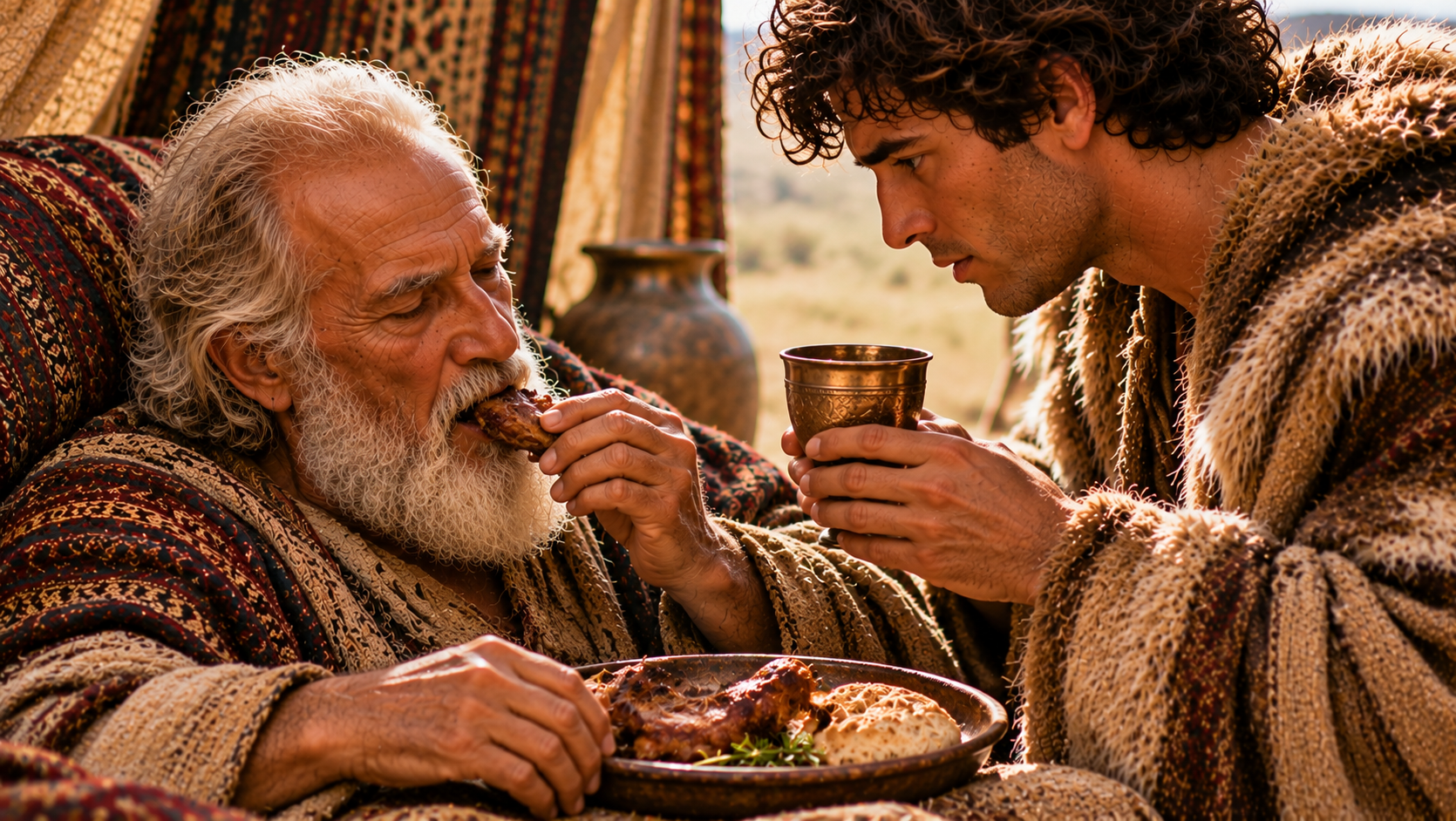
ISAAC FOOLED
BY THE TOUCH
So he said, “Bring it to me, and I will eat of my son’s game - Jacob had drawn near in Ge 27:21,22, and now the food is drawn near. Isaac's lingering suspicions have apparently been sufficiently quieted by Jacob's repeated assurances (Ge 27:22–24). He now proceeds with the meal he had requested from Esau (Ge 27:3–4). As alluded to earlier Isaac's His physical appetite has become the occasion for a profound family deception.
that I may bless (barak; LXX - eulogeo) you.” - Literally “that my soul may bless you."
NET NOTE - Heb "so that my soul may bless you." The presence of "my soul" as subject emphasizes Isaac's heartfelt desire to do this. The conjunction indicates that the ritual meal must be first eaten before the formal blessing may be given.
And he brought it to him, and he ate - Isaac tastes, and the goat prepared “such as he loved” (Ge 27:14) passes for venison. Rebekah’s cooking does its work.
he also brought him wine and he drank - Isaac eats unsuspectingly, while Jacob knows that every bite brings him closer to obtaining what his father intended for Esau. Isaac's palate now deceives him, just as his sense of touch had done.
🙏 THOUGHT - Isaac ate and drank, satisfied that all was well, while the truth was hidden from him. People can feel content in their own judgment while missing what matters most. Beloved, do you come to the Lord’s Table remembering that the blessing it represents is not earned by what you bring, but given by what He gave? “For as often as you eat this bread and drink the cup, you proclaim the Lord’s death until He comes” (1Co 11:26).
Genesis 27:26 Then his father Isaac said to him, “Please come close and kiss me, my son.”
KJV And his father Isaac said unto him, Come near now, and kiss me, my son.
NET Then his father Isaac said to him, "Come here and kiss me, my son."
NLT "Please come a little closer and kiss me, my son."
ESV Then his father Isaac said to him, "Come near and kiss me, my son."
NIV Then his father Isaac said to him, "Come here, my son, and kiss me."
Related Passages:
Psalms 2:12 Do homage to the Son, that He not become angry, and you perish in the way, For His wrath may soon be kindled. How blessed are all who take refuge in Him!
Genesis 29:11 Then Jacob kissed Rachel, and lifted his voice and wept.
Genesis 33:4 Then Esau ran to meet him and embraced him, and fell on his neck and kissed him, and they wept.
Genesis 45:15 He kissed all his brothers and wept on them, and afterward his brothers talked with him.
Genesis 48:10 Now the eyes of Israel were so dim from age that he could not see. Then Joseph brought them close to him, and he kissed them and embraced them
WHEN AFFECTION
MEETS DECEPTION
Then his father Isaac said to him, “Please come close and kiss (nashaq) me, my son.” - Earlier Isaac had asked Jacob to come close so he could feel his hands (Ge 27:21). Now he requests another approach, this time for a kiss. Isaac's request is entirely natural for a father preparing to bless his beloved son. Yet the scene is filled with tragic irony: Isaac is expressing genuine fatherly affection toward a son who is deliberately deceiving him! The kiss will also provide the final confirmation of Jacob's supposed identity. When Jacob approaches, Isaac will smell Esau's garments and associate their scent with a field blessed by the LORD (Ge 27:27). Thus, the very garments Rebekah selected (Ge 27:15) will complete the deception.
This is the first occurrence of the verb in Scripture. The Bible’s first recorded kiss is a deceiver’s kiss, given to a blind father to secure a stolen blessing. From there the kisses in Jacob’s story trace his journey. In Haran he kissed Rachel in honest joy: “Then Jacob kissed Rachel, and lifted his voice and wept” (Ge 29:11). On his return Esau kissed him in reconciliation (Ge 33:4). Joseph later kissed the brothers who had sold him: “He kissed all his brothers and wept on them, and afterward his brothers talked with him” (Ge 45:15).
The most striking parallel comes at the end of Jacob’s life. Like his father, he was old and nearly blind when he blessed the next generation: “Now the eyes of Israel were so dim from age that he could not see. Then Joseph brought them close to him, and he kissed them and embraced them” (Ge 48:10). Like Isaac, Jacob put the younger ahead of the older, but he did it knowingly and in faith, over Joseph’s objection: “But his father refused and said, ‘I know, my son, I know; he also will become a people and he also will be great. However, his younger brother shall be greater than he, and his descendants shall become a multitude of nations’” (Ge 48:19). The deceiver of Genesis 27 became the clear-sighted, blessing patriarch of Genesis 48.
The kiss of deception reached its darkest form in Gethsemane: “Now he who was betraying Him gave them a sign, saying, ‘Whomever I kiss, He is the one; seize Him.’ Immediately Judas went to Jesus and said, ‘Hail, Rabbi!’ and kissed Him” (Mt 26:48-49). Jesus’ question exposed it: “But Jesus said to him, ‘Judas, are you betraying the Son of Man with a kiss?’” (Lk 22:48). As Solomon warned, “Faithful are the wounds of a friend, but deceitful are the kisses of an enemy” (Pr 27:6).
Kiss (05401) nashaq is a verb meaning “to kiss,” and in a few places “to touch lightly.” It occurs about 35 times in the Old Testament. In 31 of those it means “to kiss”: 25 in the simple (Qal) stem, 5 in the intensive (Piel) stem, and once in the causative (Hiphil). The four remaining uses, all in the Qal, mean “to be armed” or “to take one’s place in rank.” Most scholars treat these as a separate homonym, though some see a connection between the two meanings. The related noun neshiqah (H5390), “kiss,” occurs twice (SS 1:2; Pr 27:6). Its first occurrence in Scripture is the deceiving kiss of Genesis 27: “Then his father Isaac said to him, ‘Please come close and kiss me, my son’” (Ge 27:26). “So he came close and kissed him; and when he smelled the smell of his garments, he blessed him” (Ge 27:27). The Septuagint usually renders nashaq with phileō (G5368) or the intensified kataphileō (G2705), “to kiss fervently,” and the New Testament uses the same words.
NASHAQ - 32V - do homage(2), kiss(8), kissed(18), kisses(2), threw a kiss(1), touching(1). Gen. 27:26; Gen. 27:27; Gen. 29:11; Gen. 29:13; Gen. 31:28; Gen. 31:55; Gen. 33:4; Gen. 41:40; Gen. 45:15; Gen. 48:10; Gen. 50:1; Exod. 4:27; Exod. 18:7; Ruth 1:9; Ruth 1:14; 1 Sam. 10:1; 1 Sam. 20:41; 2 Sam. 14:33; 2 Sam. 15:5; 2 Sam. 19:39; 2 Sam. 20:9; 1 Ki. 19:18; 1 Ki. 19:20; Job 31:27; Ps. 2:12; Ps. 85:10; Prov. 7:13; Prov. 24:26; Cant. 1:2; Cant. 8:1; Ezek. 3:13; Hos. 13:2
The kiss of family affection. In the ancient Near East a kiss was the ordinary greeting and farewell among relatives and close friends, but it always carried meaning. Sons kissed fathers: “Then Joseph fell on his father’s face, and wept over him and kissed him” (Ge 50:1). Brothers kissed: “Now the LORD said to Aaron, ‘Go to meet Moses in the wilderness.’ So he went and met him at the mountain of God and kissed him” (Ex 4:27). A son-in-law kissed his father-in-law: “Then Moses went out to meet his father-in-law, and he bowed down and kissed him; and they asked each other of their welfare and went into the tent” (Ex 18:7). Farewells were sealed with a kiss: “He left the oxen and ran after Elijah and said, ‘Please let me kiss my father and my mother, then I will follow you.’ And he said to him, ‘Go back again, for what have I done to you?’” (1Ki 19:20). A kiss could also mark the point where two lives went separate ways: “And they lifted up their voices and wept again; and Orpah kissed her mother-in-law, but Ruth clung to her” (Ru 1:14). Friendship expressed itself the same way: “When the lad was gone, David rose from the south side and fell on his face to the ground, and bowed three times. And they kissed each other and wept together, but David wept the more” (1Sa 20:41).
The intensive kiss. The Piel stem seems to express a more demonstrative affection. Laban greeted his nephew warmly: “So when Laban heard the news of Jacob his sister’s son, he ran to meet him, and embraced him and kissed him and brought him to his house. Then he related to Laban all these things” (Ge 29:13). Later he complained that Jacob had fled without letting him say goodbye: “and did not allow me to kiss my sons and my daughters? Now you have done foolishly” (Ge 31:28). When Joseph revealed himself, “He kissed all his brothers and wept on them, and afterward his brothers talked with him” (Ge 45:15). A kiss could also mark acceptance and restored relationship. After Absalom’s long estrangement, “So when Joab came to the king and told him, he called for Absalom. Thus he came to the king and prostrated himself on his face to the ground before the king, and the king kissed Absalom” (2Sa 14:33).
The kiss of homage and blessing. A kiss could express respect, loyalty, or submission to authority. When Samuel anointed Israel’s first king, “Then Samuel took the flask of oil, poured it on his head, kissed him and said, ‘Has not the LORD anointed you a ruler over His inheritance?’” (1Sa 10:1). A ruler could kiss a loyal subject as an honor: “All the people crossed over the Jordan and the king crossed too. The king then kissed Barzillai and blessed him, and he returned to his place” (2Sa 19:39). As in Genesis 27, the kiss there accompanies a blessing. Pharaoh’s words to Joseph are literally “upon your mouth all my people shall kiss,” probably meaning they would submit to his commands, as subjects kissed what came from a superior: “You shall be over my house, and according to your command all my people shall do homage; only in the throne I will be greater than you” (Ge 41:40).
The kiss of the Son. The highest use of the kiss of homage is in the second Psalm, where rebellious kings are called to submit to God’s Messiah: “Do homage to the Son, that He not become angry, and you perish in the way, for His wrath may soon be kindled. How blessed are all who take refuge in Him!” (Ps 2:12). The Hebrew reads literally “kiss the Son,” using the Piel of nashaq. Some modern versions emend the text (RSV, “kiss his feet”), and the Septuagint paraphrases it as “lay hold of instruction.” But the traditional reading fits the context, since the same psalm says, “I will surely tell of the decree of the LORD: He said to Me, ‘You are My Son, today I have begotten You’” (Ps 2:7; cf. Heb 1:5). The kiss of homage once given to kings is owed above all to God’s Son.
The kiss of deception. Because a kiss signaled love and trust, it could be used to cover treachery. Absalom used kisses to steal hearts: “And when a man came near to prostrate himself before him, he would put out his hand and take hold of him and kiss him” (2Sa 15:5). Joab used a kiss to cover murder: “Joab said to Amasa, ‘Is it well with you, my brother?’ And Joab took Amasa by the beard with his right hand to kiss him. But Amasa was not on guard against the sword which was in Joab’s hand so he struck him in the belly with it and poured out his inward parts on the ground, and did not strike him again, and he died” (2Sa 20:9-10). The adulteress uses it to lure her victim: “So she seizes him and kisses him and with a brazen face she says to him” (Pr 7:13). Solomon draws the lesson: “Faithful are the wounds of a friend, but deceitful are the kisses of an enemy” (Pr 27:6). Jacob’s kiss in Genesis 27 is the first in this line. Judas’s kiss in Gethsemane is the darkest: “Immediately Judas went to Jesus and said, ‘Hail, Rabbi!’ and kissed Him” (Mt 26:49), using kataphileō.
The kiss of idolatry. In pagan worship people kissed idols as an act of devotion. God reserved for Himself a remnant who refused: “Yet I will leave 7,000 in Israel, all the knees that have not bowed to Baal and every mouth that has not kissed him” (1Ki 19:18). Hosea mocked the practice: “And now they sin more and more, and make for themselves molten images, idols skillfully made from their silver, all of them the work of craftsmen. They say of them, ‘Let the men who sacrifice kiss the calves!’” (Hos 13:2). Job denied even the gesture of blowing a kiss to the heavenly bodies: “If I have looked at the sun when it shone or the moon going in splendor, and my heart became secretly enticed, and my hand threw a kiss from my mouth, that too would have been an iniquity calling for judgment, for I would have denied God above” (Job 31:26-28).
Romantic and figurative uses. In the Song of Solomon the kiss expresses married love: “May he kiss me with the kisses of his mouth! For your love is better than wine” (SS 1:2; cf. 8:1). Proverbs uses the kiss as a picture of honest speech: “He kisses the lips who gives a right answer” (Pr 24:26). The psalmist uses it for the harmony of God’s attributes in salvation: “Lovingkindness and truth have met together; righteousness and peace have kissed each other” (Ps 85:10). In Ezekiel’s vision the verb means a light touch: “And I heard the sound of the wings of the living beings touching one another and the sound of the wheels beside them, even a great rumbling sound” (Eze 3:13).
“Armed” and “archers.” In its second range of meaning nashaq describes soldiers equipped with weapons: “The sons of Ephraim were archers equipped with bows, yet they turned back in the day of battle” (Ps 78:9; cf. 1Ch 12:2; 2Ch 17:17). Some suggest a link with the basic meaning, the archer seeming to “kiss” the bowstring as he draws it to his face, but the connection is uncertain.
New Testament fulfillment. The New Testament carries both the tender and the treacherous kiss forward. The father’s kiss in Jesus’ parable is a picture of God’s welcome to the repentant sinner: “So he got up and came to his father. But while he was still a long way off, his father saw him and felt compassion for him, and ran and embraced him and kissed him” (Lk 15:20). A forgiven woman expressed her love by kissing Jesus’ feet: “and standing behind Him at His feet, weeping, she began to wet His feet with her tears, and kept wiping them with the hair of her head, and kissing His feet and anointing them with the perfume” (Lk 7:38). Believers who loved Paul kissed him goodbye: “And they began to weep aloud and embraced Paul, and repeatedly kissed him” (Ac 20:37). The church’s greeting was a sanctified kiss (philēma, G5370): “Greet one another with a holy kiss. All the churches of Christ greet you” (Ro 16:16), and “Greet one another with a kiss of love. Peace be to you all who are in Christ” (1Pe 5:14). The Bible’s first kiss came from a deceiver at a blind father’s bedside. Scripture’s final word on the kiss calls God’s people to a love that is holy and sincere, and calls every person to give the Son the kiss of homage.
Genesis 27:27 So he came close and kissed him; and when he smelled the smell of his garments, he blessed him and said, “See, the smell of my son Is like the smell of a field which the LORD has blessed;
- blessed (KJV): Heb 11:20
- the smell of a field (KJV): A field where aromatic plants, flowers, fruits, and spices grew in abundance, with which these garments (see ver. 15) of Esau might probably have been perfumed by being laid up with them. Song 2:13 4:11-14 7:12,13 Ho 14:6,7
- which (KJV): Ge 26:12 Heb 6:7
Related Passages:
Hebrews 11:20 By faith Isaac blessed Jacob and Esau, even regarding things to come.
2 Samuel 20:9 Joab said to Amasa, “Is it well with you, my brother?” And Joab took Amasa by the beard with his right hand to kiss him.
Matthew 26:49 Immediately Judas went to Jesus and said, “Hail, Rabbi!” and kissed Him.

ISAAC FOOLED
BY THE SMELL
So he came close and kissed (nashaq) him - Jacob now completes the deception by responding to Isaac's affectionate invitation (Ge 27:26). The kiss, ordinarily an expression of love and trust, becomes another means of concealing his true identity. Isaac believes he is embracing Esau, unaware that Jacob stands before him. The kiss brought him close enough for the last test.
and when he smelled the smell (reah) of his garments - This is the fourth sense Isaac relies on, after hearing, touch, and taste (Ge 27:21), and like the others it is deceived. The garments were Esau’s best (Ge 27:15), and they carried the scent of the open country where he hunted.
he blessed (barak; LXX - eulogeo) him and said, “See, the smell of my son Is like the smell of a field which the LORD has blessed (barak; LXX - eulogeo) - Isaac associates Esau's fragrance with a fruitful field enjoying Yahweh's favor. This introduces the agricultural imagery of the blessing that follows: “the dew of heaven,” “the fatness of the earth,” and “an abundance of grain and new wine” (Ge 27:28). The irony is remarkable: Isaac smells Esau's garments, but pronounces God's blessing upon Jacob! The patriarch's senses have been deceived, yet God's earlier declaration that the older would serve the younger (Ge 25:23) will ultimately be fulfilled.
Jon Courson - A key component of Hebrew life, the blessing was pronounced by the patriarch primarily upon the oldest son. A declaration of who one is and a revelation of where one is headed, Orthodox Jewish fathers understand the significance of the blessing and bestow it upon their children to this day. Speak a word of valuable evaluation today, Dad, for not hearing from you at all hurts far more than hearing a word of correction from you....When you go into an Orthodox home, the parents will say, “Here is Joey the doctor, and Benny the lawyer”—even though Joey and Benny are only four and five years old. In so doing, they are giving their kids a special future. And they do indeed grow up becoming doctors and lawyers, scientists and rabbis because that is what is pronounced on them. What do you see your son or daughter becoming, Dad? Let them know!....Job, the most righteous man on the face of the earth, rose early every morning and offered a sacrifice for each one of his sons and daughters—a lot of hard, bloody, dirty work. And I can do that as a dad for my kids through intercessory prayer, through doing whatever I can to see God’s power upon them and His work flowing through them. (See Jon Courson's Application Commentary)
Smell (fragrance) (07381) reah from ruach = breath, wind) means scent or odor. Reah refers to the “scent or smell” of a person or thing as when Isaac smelled Jacob's garments and concluded (falsely) that they had the aroma of Esau (Ge 27:27 where reah is used 3x). In Lev 26:31 God is warning if Israel disobeyed (see Lev 26:14-16) "I will not smell your soothing aromas." In Ezekiel 6:13 God said He would punish Judah because "they offered soothing aroma (reah) to all their idols." In Ezekiel 16:19 God accused Judah of making and offering sacrifices to idolatrous images (Ezek 16:17-18) = "offer before them [their idols] for a soothing aroma." (cp similar accusation in Ezek 20:28) See preceding discussion of for use of reah in Ezek 20:14.
The first use is the soothing aroma (reah) given off by Noah's burnt offerings (Ge 8:20-21) where "soothing" (hannihoah) reflects a play on the name "Noah" which means "rest"!
Reah is a significant word. It is used most often for the “soothing aroma” (reach nichoach) of sacrifices offered to God. It first appears after the flood where God smelled an aroma and promised not to curse the ground (Ge 8:20-21). Here Isaac smells an aroma and pronounces a blessing on his son, comparing him to a field the LORD has blessed. The same phrase runs through the Levitical offerings: “an offering by fire of a soothing aroma to the LORD” (Lev 1:9). The New Testament applies it to Christ: “and walk in love, just as Christ also loved you and gave Himself up for us, an offering and a sacrifice to God as a fragrant aroma” (Eph 5:2).
An interesting cluster of uses of reah is found in the intimate love story described in Song of Solomon, where pleasant smells play a major role in the intimate relationship (Song 1:3, 12; Song 2:13; Song 4:10-11; Song 7:8, 13)
Genesis 27:28 Now may God give you of the dew of heaven, And of the fatness of the earth, And an abundance of grain and new wine;
KJV Therefore God give thee of the dew of heaven, and the fatness of the earth, and plenty of corn and wine:
NET May God give you the dew of the sky and the richness of the earth, and plenty of grain and new wine.
NLT "From the dew of heaven and the richness of the earth, may God always give you abundant harvests of grain and bountiful new wine.
ESV May God give you of the dew of heaven and of the fatness of the earth and plenty of grain and wine.
NIV May God give you of heaven's dew and of earth's richness-- an abundance of grain and new wine.
- of the dew (KJV): De 11:11,12 32:2 33:13,28 2Sa 1:21 1Ki 17:1 Ps 65:9-13 133:3 Isa 45:8 Jer 14:22 Ho 14:5-7 Mic 5:7 Heb 11:20
- the fatness (KJV): Ge 27:39 45:18 49:20 Nu 13:20 Ps 36:8 Ro 11:17
- plenty (KJV): De 7:13 8:7-9 33:28 Jos 5:6 1Ki 5:11 2Ch 2:10 Ps 65:9,13 Ps 104:15 Joe 2:19 Zec 9:17
Related Passages:
James 1:17 Every good thing given and every perfect gift is from above, coming down from the Father of lights, with whom there is no variation or shifting shadow.
WHEN GOD OPENS HEAVEN
AND BLESSES EARTH
Now may God give you of the dew of heaven - The blessing takes the form of a prayer and begins with the recognition that God is the ultimate source of prosperity. Give emphasizes divine provision rather than human achievement. Isaac is not merely wishing Jacob success but is invoking God's favor upon him. Significantly, the blessing begins with “God” (Elohim), this Name that stresses God as Creator and Lord over nature, and thus which suits a blessing about dew, soil, and harvest.
Of the dew of heaven – In Canaan almost no rain falls from late spring to early autumn, and the heavy night dew kept crops and pastures alive through the dry months. Dew therefore became a fitting symbol of agricultural fruitfulness and divine favor (Dt 33:13, 28; Hos 14:5). Isaac asks that heaven itself contribute to his son's prosperity.
Bob Utley - "the dew of heaven" Rain comes only during certain seasons in Palestine (early rains, cf. Deut. 11:14; Joel 2:23; late rains, cf. Deut. 11:14; Joel 2:23). The remaining growing season is provided with water by dew. Therefore, "dew" (BDB 378) becomes a metaphor for the grace and provision of God (cf. Deut. 33:13, 28).
And of the fatness of the earth - This refers to the richness or fertility of the land. The imagery is agricultural, not a reference to spiritual blessings detached from the physical earth. Isaac is asking God to grant productive soil and abundant harvests. Heaven's moisture and earth's fertility together testify to God's provision.
And an abundance of grain and new wine - Grain and new wine represent the staple products of a fruitful land. The Hebrew tirosh refers to the produce of the grape harvest, commonly translated “new wine.” New wine is freshly pressed juice or new wine. Grain and new wine, often with oil, became the standard summary of God’s covenant blessing on the land and together they portray agricultural abundance and material prosperity (Dt 7:13; 11:14).
Notice that this first part of the blessing is entirely material: dew, soil, grain, and wine. The specifically Abrahamic promises of descendants and the land are not named here. Isaac would state them explicitly only later, when he blessed Jacob knowingly (Ge 28:3-4).
Genesis 27:29 May peoples serve you, And nations bow down to you; Be master of your brothers, And may your mother’s sons bow down to you. Cursed be those who curse you, And blessed be those who bless you.”
KJV Let people serve thee, and nations bow down to thee: be lord over thy brethren, and let thy mother's sons bow down to thee: cursed be every one that curseth thee, and blessed be he that blesseth thee.
NET May peoples serve you and nations bow down to you. You will be lord over your brothers, and the sons of your mother will bow down to you. May those who curse you be cursed, and those who bless you be blessed."
NLT May many nations become your servants, and may they bow down to you. May you be the master over your brothers, and may your mother's sons bow down to you. All who curse you will be cursed, and all who bless you will be blessed."
ESV Let peoples serve you, and nations bow down to you. Be lord over your brothers, and may your mother's sons bow down to you. Cursed be everyone who curses you, and blessed be everyone who blesses you!"
NIV May nations serve you and peoples bow down to you. Be lord over your brothers, and may the sons of your mother bow down to you. May those who curse you be cursed and those who bless you be blessed."
- Let people (KJV): Ge 9:25,26 22:17,18 49:8-10 2Sa 8:1-18 10:1-19 1Ki 4:21 Ps 2:6-9 Ps 72:8 Isa 9:7 Da 2:44,45 Rev 19:16
- be lord (KJV): Ge 27:37 Ge 25:22-23,33 2Sa 8:14 1Ki 11:15,16 22:47 1Ch 5:2 2Ch 25:11-14 Ps 60:1-12 *title Ps 60:2-12 Isa 63:1-6 Mal 1:2-5 Ro 9:12
- cursed (KJV): Ge 12:3 Nu 22:11,12 23:8 24:9 Zep 2:8,9 Mt 25:40,45
Related Passages:
Genesis 25:22-23; 33 But the children struggled together within her; and she said, “If it is so, why then am I this way?” So she went to inquire of the LORD. 23The LORD said to her, “Two nations are in your womb; And two peoples will be separated from your body; And one people shall be stronger than the other; And the older shall serve the younger.” ....(25:33) And Jacob said, “First swear to me”; so he swore to him, and sold his birthright to Jacob.
THE ABRAHAMIC BLESSING
PASSED TO JACOB
May peoples serve you - Isaac's blessing moves beyond the agricultural prosperity of Ge 27:28 to political supremacy and national dominion. Isaac uses the very verb of the oracle spoken to Rebekah before the twins were born: “and the older shall serve (‘abad) the younger” (Ge 25:23). Without knowing it, Isaac pronounces the destiny God had already announced. He tried to bless the older son, and his words confirm that the older will serve. He will say it outright to Esau: “By your sword you shall live, and your brother you shall serve” (Ge 27:40).
And nations bow down (shachah) to you -The Hebrew shachah (“bow down”) conveys submission or homage. There is a striking irony here. When Jacob, the one who received this blessing, met Esau twenty years later, he was the one who bowed: “But he himself passed on ahead of them and bowed down to the ground seven times, until he came near to his brother” (Ge 33:3). The blessing was not fulfilled in Jacob’s lifetime as he might have expected. Its fulfillment came later and more gradually. Joseph’s brothers bowed to him in Egypt: “Now Joseph was the ruler over the land; he was the one who sold to all the people of the land. And Joseph’s brothers came and bowed down to him with their faces to the ground” (Ge 42:6). Edom became subject to Israel under David: “He put garrisons in Edom. In all Edom he put garrisons, and all the Edomites became servants to David. And the LORD helped David wherever he went” (2Sa 8:14). The full fulfillment points to the Messiah, the greater Son of Jacob: “And let all kings bow down before him, all nations serve him” (Ps 72:11).
Be master of your brothers - NET - "You will be lord over your brothers" Isaac meant to make Esau lord over Jacob, and he made Jacob lord over Esau instead.
NET NOTE on "be" - Heb "and be." The verb is an imperative, which is used rhetorically in this oracle of blessing. It is an invitation to exercise authority his brothers and indicates that he is granted such authority by the patriarch of the family. Furthermore, the blessing enables the recipient to accomplish this. MASTER - The Hebrew word is gevir ("lord, mighty one"). The one being blessed will be stronger and therefore more powerful than his brother. See Ge 25:23.
And may your mother’s sons bow down to you - Isaac speaks in general terms of “brothers” and “your mother’s sons,” the whole family line. Jacob’s own blessing on Judah later uses nearly the same words for the royal tribe: “Judah, your brothers shall praise you; your hand shall be on the neck of your enemies; your father’s sons shall bow down to you” (Ge 49:8). The line of rule runs through Jacob to Judah, to David, and finally to Christ, before whom every knee will bow: “so that at the name of Jesus every knee will bow, of those who are in heaven and on earth and under the earth, and that every tongue will confess that Jesus Christ is Lord, to the glory of God the Father” (Php 2:10-11).
Cursed (arar) be those who curse (arar) you And blessed (barak; LXX - eulogeo) be those who bless (barak; LXX - eulogeo) you.” - Here Isaac's blessing unmistakably echoes God's covenant promise to Abraham (Ge 12:3). This is more than a father's personal wish. It identifies Jacob as the heir of the Abrahamic covenant, through whom God's promises of blessing and protection would continue (Ge 28:13–15; 35:9–12).
Cursed and curse are both arar, the solemn, binding curse first spoken in Eden (Ge 3:14, 17). “Blessed” and “bless” are barak (see 27:4). With these words Isaac passes on the heart of God’s covenant promise to Abraham (Ge 12:3), now spoken over the son God had chosen. Centuries later the hired prophet Balaam, who had been sent to curse Jacob’s descendants, could only repeat the same words: “He couches, he lies down as a lion, and as a lion, who dares rouse him? Blessed is everyone who blesses you, and cursed is everyone who curses you” (Nu 24:9). The blessing Jacob gained by deception, God confirmed in His own faithfulness.
Henry Morris - Isaac's presumption in blessing Esau like this is obvious when contrasted with God's specific instruction given before they were born that Jacob should have this position (Genesis 25:23). 27:29 blesseth thee. Here Isaac repeats God's own original promise to Abraham (Genesis 12:3), again in flagrant disregard of God's will.
Genesis 27:30 Now it came about, as soon as Isaac had finished blessing Jacob, and Jacob had hardly gone out from the presence of Isaac his father, that Esau his brother came in from his hunting.
KJV And it came to pass, as soon as Isaac had made an end of blessing Jacob, and Jacob was yet scarce gone out from the presence of Isaac his father, that Esau his brother came in from his hunting.
NET Isaac had just finished blessing Jacob, and Jacob had scarcely left his father's presence, when his brother Esau returned from the hunt.
NLT As soon as Isaac had finished blessing Jacob, and almost before Jacob had left his father, Esau returned from his hunt.
ESV As soon as Isaac had finished blessing Jacob, when Jacob had scarcely gone out from the presence of Isaac his father, Esau his brother came in from his hunting.
NIV After Isaac finished blessing him and Jacob had scarcely left his father's presence, his brother Esau came in from hunting.
Related Passages:
Numbers 32:23 “But if you will not do so, behold, you have sinned against the LORD, and be sure your sin will find you out.
Psalm 90:8 You have placed our iniquities before You, Our secret sins in the light of Your presence.
Ecclesiastes 12:14 For God will bring every act to judgment, everything which is hidden, whether it is good or evil.
Luke 12:2-3 “But there is nothing covered up that will not be revealed, and hidden that will not be known. 3“Accordingly, whatever you have said in the dark will be heard in the light, and what you have whispered in the inner rooms will be proclaimed upon the housetops.
Hosea 12:2 The LORD also has a dispute with Judah, And will punish Jacob according to his ways; He will repay him according to his deeds.
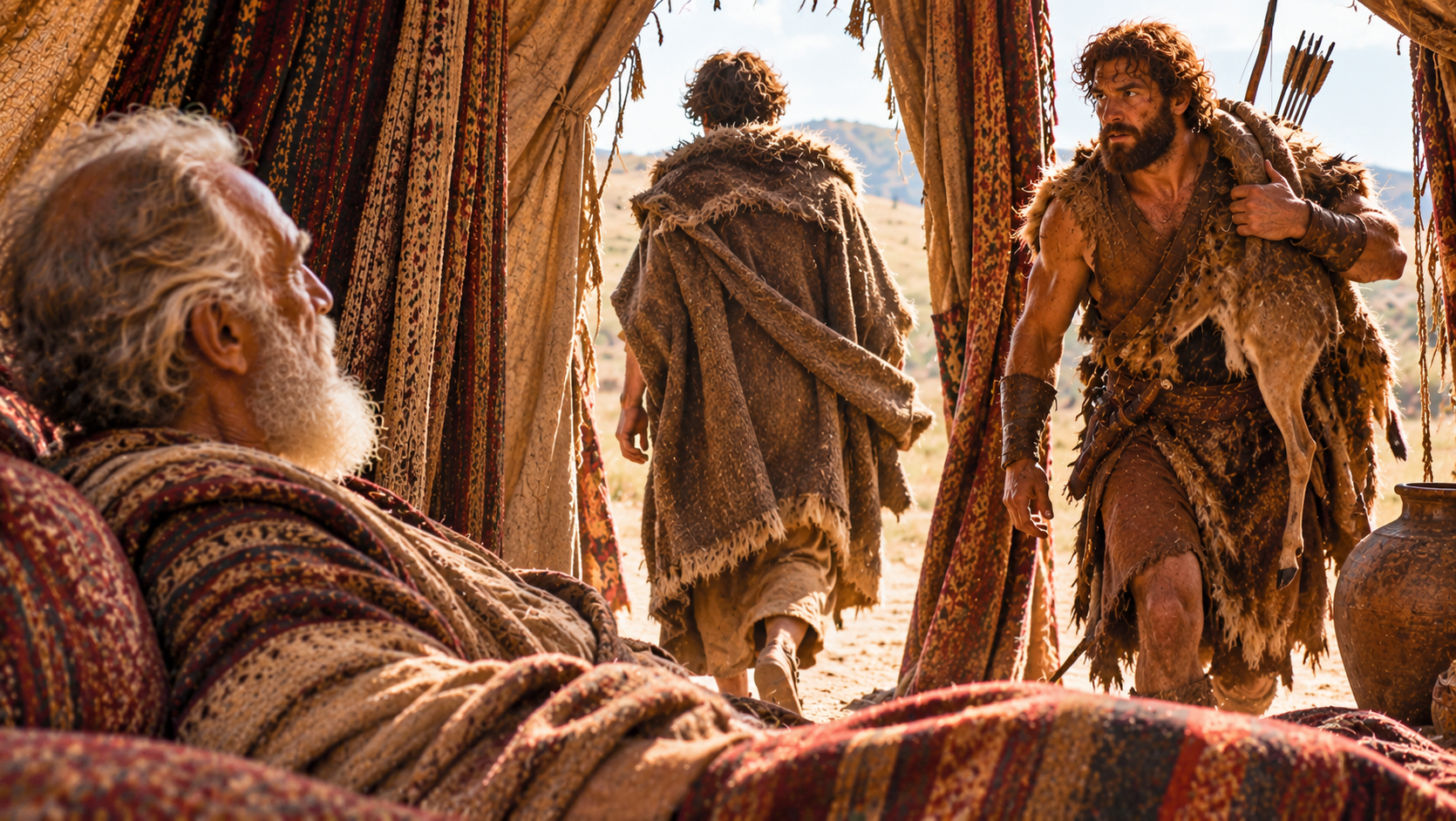
THE SOVEREIGN GOD'S
PROVIDENTIAL TIMING
Now it came about - One might subtitle this passage "Jacob's Narrow Escape!"
As soon as Isaac had finished blessing (barak; LXX - eulogeo) Jacob - The blessing has been pronounced (Ge 27:27–29), and Moses immediately introduces a dramatic reversal. The Hebrew construction emphasizes the precise timing: Isaac had just finished blessing Jacob when the next event unfolded. The covenant blessing had been spoken before Esau could intervene. The blessing had been spoken in full. Nothing more could be added, and as Isaac would soon admit, nothing could be taken back (Ge 27:33). Notice that the narrator says plainly that Isaac blessed Jacob. Whatever Isaac intended, the blessing went to the son who stood before him. It is interesting that Isaac did not say "I bless you Esau" in bestowing the blessing! I think God might have tied his tongue if he had tried to bless Esau! (Speculation of course).
and Jacob had hardly gone out from the presence of Isaac his father - The Hebrew literally reads “only just going out, he had gone out.” The time was apparently down to moments. Jacob was barely through the tent door when Esau arrived. A minute earlier and the whole scheme would have collapsed. Moses wants us to feel how close it was, and to see God’s providence in the timing. A similar providence brought Rebekah to the well at the exact moment Abraham’s servant was praying (Ge 24:15). The same precise providence now governs her son’s escape. God did not approve Jacob’s deceit, but He was carrying out His purpose for Jacob even through the timing of footsteps. To be sure, Jacob escaped discovery by mere moments, but he will not escape the consequences of his deception.
Jacob's escaping immediate discovery is not the same as escaping the consequences of his sin! Jacob left Isaac's presence before Esau arrived, but his deception would soon produce bitter family conflict and force him to flee from his brother's anger (Ge 27:41-45). Solomon warns, “He who walks in integrity walks securely, But he who perverts his ways will be found out” (Pr 10:9). We may temporarily avoid exposure, but concealed wrongdoing can continue producing consequences long after the moment has passed (Nu 32:23, cf Pr 28:13).
A successful escape from human detection
is never an escape from divine accountability!
Here is what is fascinating - The two brothers passed almost at the tent door, and they would not meet again for twenty years (Ge 33:1-4).
That Esau his brother came in from his hunting - Esau did exactly what his father asked. He took his gear, went to the field, hunted, and came back. His effort was real, but it came too late. Esau’s arrival is a moment of tragedy for him because the blessing he had counted on had been irrevocably passed on the Jacob.
🙏 THOUGHT - Esau came in from the field with his hands full, only moments too late. He had despised his birthright when it was within reach (Ge 25:34), and now the blessing slipped past him by minutes. Spiritual opportunities do not wait forever. Beloved, is there something God is calling you to that you have been putting off? “Behold, now is ‘the acceptable time,’ behold, now is ‘the day of salvation’” (2Co 6:2).
Steven Cole (My Way or God's Way) The theme is illustrated with Esau
While we may sympathize with Esau, there is no doubt that he was seeking his own way. Granted, he was the older brother, so the birthright and blessing should have been his. But he had made a legal agreement with his brother to sell his birthright. It was not true, as Esau laments, that Jacob took away his birthright (Ge 27:36). Esau gave it up. Here, he was in cahoots with his father’s secretive plan to get the blessing for himself; he just happened to get outsmarted. As a godless man, not concerned about the spiritual promises God had given to Abraham, Esau was clearly seeking his own way, not God’s way.
His tears (Ge 27:34, 38) may make us feel sorry for him. But remember, Esau wasn’t truly repentant, ready to turn from his self-seeking ways to follow God’s ways. He was just sorry he didn’t get what he was after. He was like the guy who heard at work that his neighbor’s house burned down. Since they didn’t get along too well, he shrugged and said, “Too bad!” Then he drove home and found out that his own house had burned down, too. If he started wailing, you wouldn’t assume that he was sorry for his neighbor or for his own bad attitude. He was just sorry for himself. Esau wasn’t truly repentant toward God; he was just sorry his scheme hadn’t worked.
Clearly, Esau didn’t get the blessing he desired. He ended up estranged from God’s promises to Abraham and his descendants. He became the father of the Edomites, who lived to the east of the Dead Sea and were later subjected by several kings of Israel. They finally succeeded in casting off Israel’s rule, even as Isaac prophesied (Ge 27:40). They sided with Nebuchadnezzar in his overthrow of Jerusalem (587 B.C.) and were overjoyed at its destruction (Ps. 137:7; Lam. 4:21, 22; Obadiah 10-16). Esau, like Isaac, Rebekah, and Jacob, sought his own way, didn’t get what he wanted, and paid a high price.
Genesis 27:31 Then he also made savory food, and brought it to his father; and he said to his father, “Let my father arise and eat of his son’s game, that you may bless me.”
KJV And he also had made savoury meat, and brought it unto his father, and said unto his father, Let my father arise, and eat of his son's venison, that thy soul may bless me.
NET He also prepared some tasty food and brought it to his father. Esau said to him, "My father, get up and eat some of your son's wild game. Then you can bless me."
NLT Esau prepared a delicious meal and brought it to his father. Then he said, "Sit up, my father, and eat my wild game so you can give me your blessing."
ESV He also prepared delicious food and brought it to his father. And he said to his father, "Let my father arise and eat of his son's game, that you may bless me."
NIV He too prepared some tasty food and brought it to his father. Then he said to him, "My father, sit up and eat some of my game, so that you may give me your blessing."
- eat (KJV): Ge 27:4
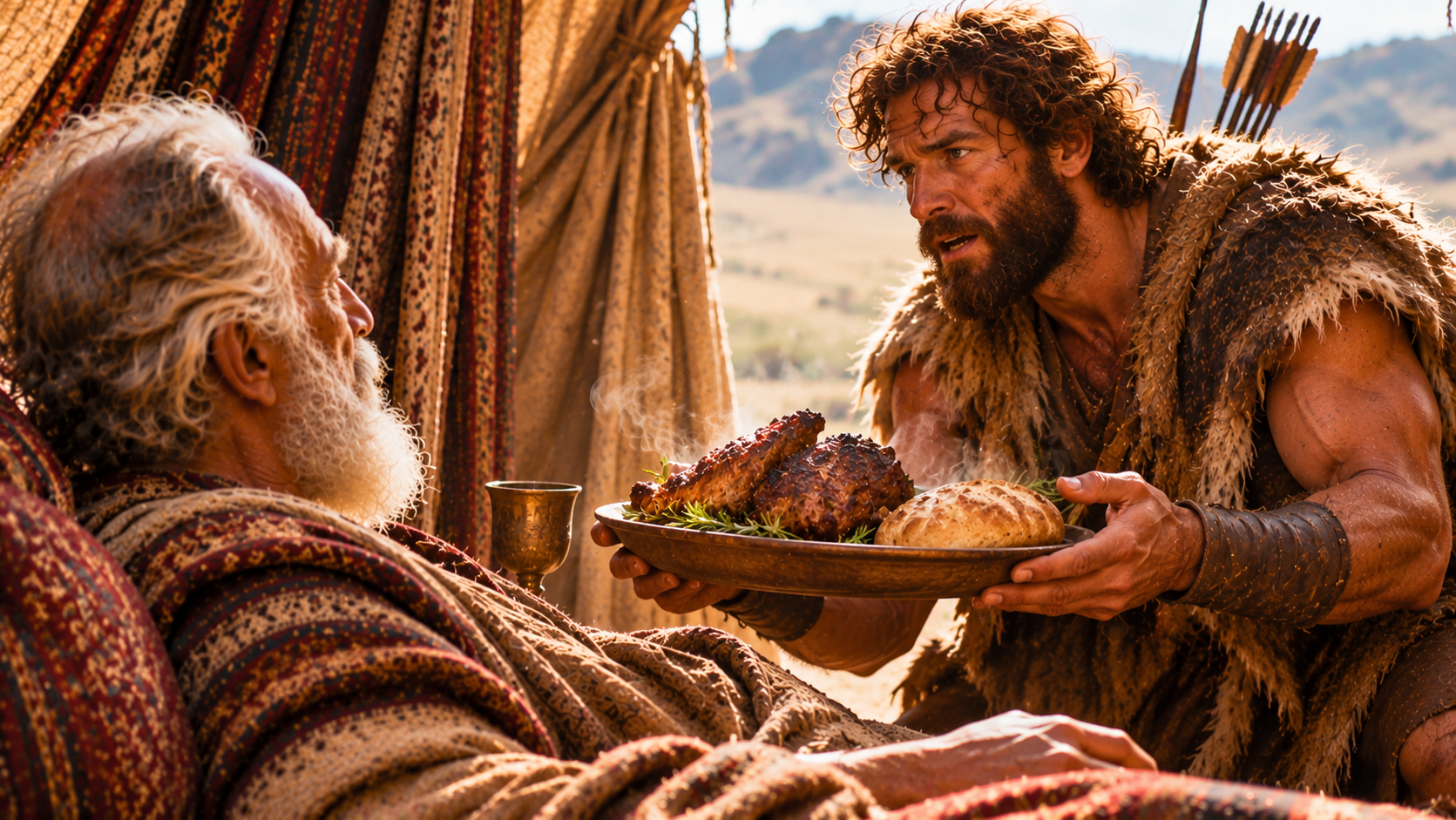
THE REAL MEAL MISSES
THE REAL "DEAL"
Then he also made savory food - Also means in addition to and highlights the tragic parallel between the two brothers. Isaac had already eaten savory food, falling for the counterfeit meal of goat meat dressed as wild game. The counterfeit came first and received the blessing, and the genuine article came second and was too late.
And brought it to his father - Esau did everything Isaac had asked. He hunted, prepared the food, and brought it in (Ge 27:3-4). In this scene he does nothing dishonest. His effort was real and his obedience to his father was complete.
and he said to his father, “Let my father arise and eat of his son’s game, that you may bless (barak; LXX - eulogeo) me - Now comes the moment of shock. Esau has no idea that his brother has already impersonated him and received the blessing whichhe fully expected to receive. The irony is that Esau had previously despised and sold his birthright for a single meal (Ge 25:29–34) and now brings a meal expecting the blessing which has already been given. The story of Esau teaches us that what we treat as insignificant today may become what we desperately wish we had treasured tomorrow!
Genesis 27:32 Isaac his father said to him, “Who are you?” And he said, “I am your son, your firstborn, Esau.”
KJV And Isaac his father said unto him, Who art thou? And he said, I am thy son, thy firstborn Esau.
NET His father Isaac asked, "Who are you?" "I am your firstborn son," he replied, "Esau!"
NLT But Isaac asked him, "Who are you?" Esau replied, "It's your son, your firstborn son, Esau."
ESV His father Isaac said to him, "Who are you?" He answered, "I am your son, your firstborn, Esau."
NIV His father Isaac asked him, "Who are you?" "I am your son," he answered, "your firstborn, Esau."
Related Passages:
Genesis 25:33 And Jacob said, “First swear to me”; so he swore to him, and sold his birthright to Jacob.
TRUTH EXPOSES THE LIE
THE REAL ESAU APPEARS
Isaac his father said to him, “Who are you?” - Imagine Isaac's confusion. What a dramatic reversal! Isaac had asked Jacob essentially the same question earlier (Ge 27:18), and Jacob had falsely answered, “I am Esau your firstborn” (Ge 27:19). Now Isaac hears another voice claiming to be his son.
And he said, “I am your son, your firstborn (bekor; LXX - prototokos), Esau.” - Esau answers with three titles: “your son”, “your firstborn”, and his name, “Esau.” Compare Jacob’s answer in Ge 27:19: “I am Esau your firstborn.” Jacob put the name first, because the name was what he needed to fake. Esau puts the relationship first, “your son,” as one who has no reason to doubt his welcome. Note that every word Esau speaks is true by birth. However, one of the three titles is in question, for while he was the firstborn by birth, he had sold the firstborn’s right years before (Ge 25:33). Esau now claims as his own something he had already traded away.
Genesis 27:33 Then Isaac trembled violently, and said, “Who was he then that hunted game and brought it to me, so that I ate of all of it before you came, and blessed him? Yes, and he shall be blessed.”
KJV And Isaac trembled very exceedingly, and said, Who? where is he that hath taken venison, and brought it me, and I have eaten of all before thou camest, and have blessed him? yea, and he shall be blessed.
NET Isaac began to shake violently and asked, "Then who else hunted game and brought it to me? I ate all of it just before you arrived, and I blessed him. He will indeed be blessed!"
NLT Isaac began to tremble uncontrollably and said, "Then who just served me wild game? I have already eaten it, and I blessed him just before you came. And yes, that blessing must stand!"
ESV Then Isaac trembled very violently and said, "Who was it then that hunted game and brought it to me, and I ate it all before you came, and I have blessed him? Yes, and he shall be blessed."
NIV Isaac trembled violently and said, "Who was it, then, that hunted game and brought it to me? I ate it just before you came and I blessed him--and indeed he will be blessed!"
- trembled violently Job 21:6 37:1 Ps 55:5
- before you came: Ge 27:25
- Yes, and he shall be blessed: Ge 28:3,4 Joh 10:10,28,29 Ro 5:20,21 11:29 Eph 1:3 Heb 11:20
Related Passages:
Genesis 25:23 The LORD said to her, “Two nations are in your womb; And two peoples will be separated from your body; And one people shall be stronger than the other; And the older shall serve the younger.”
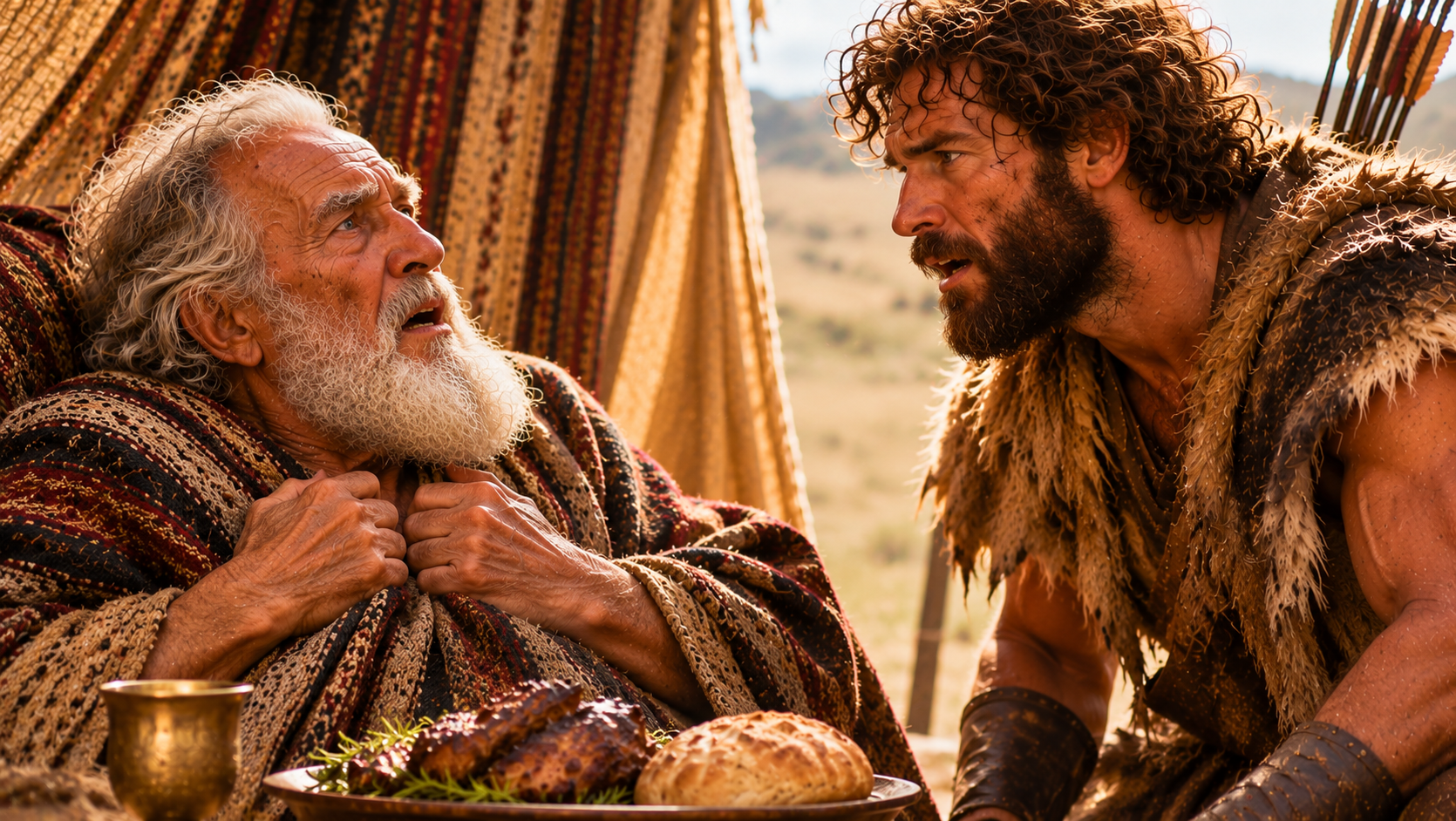
THE BLESSING THAT COULD
NOT BE RECALLED
Then Isaac trembled (charad) violently - Young's Literal = "Isaac trembleth a very great trembling." NLT - "Isaac began to tremble uncontrollably" The Hebrew expression describes an exceedingly great trembling. It is one of the strongest expressions of terror in the Old Testament (cf use in Ex 19:16). The language is unusually emphatic, conveying overwhelming shock and agitation. Isaac suddenly realizes that he has been deceived and that the blessing intended for Esau has been given to Jacob.
Some writers suggest that Isaac trembled so violently because he realized that God had overruled him. He surely knew God's will from Ge 25:23. And yet he set out to bless Esau against the word God had spoken, but God had made sure the blessing went to Jacob.
and said, “Who was he then that hunted game and brought it to me - Isaac's urgent, bewildered question still speaks of “hunted game,” because even now he does not know it was goat from the flock. It is only beginning to dawn on him what happened.
so that I ate of all of it before you came, and blessed (barak; LXX - eulogeo) him? - Isaac stresses that the meal had been completely eaten and the ceremony fully carried out. Nothing was left undone. The blessing had followed the meal exactly as Isaac had planned it, only with the wrong son.
Yes, and he shall be blessed - Hebrew is emphatic “indeed, blessed he shall be!” Isaac makes no attempt to take the blessing back or curse the deceiver. Instead he confirms it. Isaac realized that his blessing had been given in irreversible legal form. This is the turning point of Isaac’s part in the story. The father who had tried to bless according to his appetite now submits to God’s choice. That is why Hebrews can say, “By faith Isaac blessed Jacob and Esau, even regarding things to come” (Heb 11:20). Before Jacob left, Isaac blessed him again, this time knowingly and willingly (Ge 28:1-4).
Life Application Study Bible - In ancient times, a person's word was binding (much like a written contract today), especially when it was a formal oath. This is why Isaac's blessing was irrevocable. (See Life Application Study Bible - Page 51)
NET NOTE - Hebrew = "and Isaac trembled with a great trembling to excess." The verb "trembled" is joined with a cognate accusative, which is modified by an adjective "great," and a prepositional phrase "to excess." All of this is emphatic, showing the violence of Isaac's reaction to the news.
Henry Morris - trembled very exceedingly. Literally, "most excessively with a great trembling." A violent complex of emotions overwhelmed Isaac as he suddenly realized all that had happened. he shall be blessed. Isaac's anger and resentment were overshadowed by his realization that God Himself had intervened. God was going to bless Jacob and there was no way Isaac could change this. In fact, the blessing would have gone to Jacob even if Isaac had succeeded in pronouncing it upon Esau. Man's will cannot thwart God's purposes.
Trembled (startled) (02729) charad means to tremble, quake or shudder and describes human trembling before some strange or fearsome event. It conveys the the idea of movement resulting from agitation, usually trembling coming from emotional trauma as when Isaac realized Jacob had deceived him and received Esau's blessing (Ge 27:33) or when Joseph's brothers who had abandoned him in a pit met him in Egypt (Ge 42:28). In the future Millennium Israel will forget her disgrace and treachery against Yahweh and will live securely in the promised land "with no one to make them afraid." (Ezek 39:26, cf Micah 4:4, cf Mic 4:1-3, also Zeph 3:13) After Jonathan and his armor bearer had slaughtered about 20 Philistines, "there was a trembling (noun form charadah) in the camp, in the field, and among all the people. Even the garrison and the raiders trembled (verb - charad), and the earth quaked so that it became a great trembling (noun form charadah)" (1Sa 14:15, cf Da 10:7).
Genesis 27:34 When Esau heard the words of his father, he cried out with an exceedingly great and bitter cry, and said to his father, “Bless me, even me also, O my father!”
KJV And when Esau heard the words of his father, he cried with a great and exceeding bitter cry, and said unto his father, Bless me, even me also, O my father.
NET When Esau heard his father's words, he wailed loudly and bitterly. He said to his father, "Bless me too, my father!"
NLT When Esau heard his father's words, he let out a loud and bitter cry. "Oh my father, what about me? Bless me, too!" he begged.
ESV As soon as Esau heard the words of his father, he cried out with an exceedingly great and bitter cry and said to his father, "Bless me, even me also, O my father!"
NIV When Esau heard his father's words, he burst out with a loud and bitter cry and said to his father, "Bless me--me too, my father!"
- he cried: 1Sa 30:4 Pr 1:24-28,31 19:3 Lu 13:24-28 Heb 12:17
Related Passages:
Hebrews 12:15-17 See to it that no one comes short of the grace of God; that no root of bitterness springing up causes trouble, and by it many be defiled; 16 that there be no immoral or godless person like Esau, who sold his own birthright for a single meal. 17 For you know that even afterwards, when he desired to inherit the blessing, he was rejected, for he found no place for repentance, though he sought for it with tears.

TOO LITTLE
TOO LATE
When Esau heard (shama) the words of his father, he cried out (tsaaq) with an exceedingly great and bitter (mar; LXX - pikros - literally, of what sharply penetrates the senses) cry - Literally “and he yelled [with] a great and bitter yell to excess." Esau immediately realized his blessing was irretrievable and he matched his father's violent trembling with loud bitter wailing. Imagine the scene in the tent at this moment! It was a cry of both a cry of anguish and distress. It is interesting that in Ge 26:35 Esau's choice of Hittite wives "made life bitter for Isaac and Rebekah." (Ge 26:35ESV) and now he tastes bitterness himself! And as the writer of Hebrews explains, this led to Esaua developing a "root of bitterness" which brought trouble (Heb 12:15).
The phrase “a great and bitter cry” occurs in only one other place, in the book of Esther: “When Mordecai learned all that had been done, he tore his clothes, put on sackcloth and ashes, and went out into the midst of the city and wailed loudly and bitterly” (Est 4:1). Jewish interpreters noticed the link. Mordecai was a descendant of Jacob, and his enemy Haman was an Agagite, traditionally of Amalek, Esau’s descendant (Ge 36:12). An ancient midrash suggests that the bitter cry Jacob caused his brother was repaid centuries later in the bitter cry of Jacob’s descendant. That is a later interpretation, but the verbal echo is real.
And said to his father, “Bless (barak; LXX - eulogeo) me, even me also, O my father! - Literally "Bless me, me also, O my father." The Hebrew emphasis conveys the sense, “Me too! Bless even me, my father!” Esau's addition of "me also" ("me too") shows the desperation of a man who suddenly realizes what he has lost. Hebrews 12:17 is the commentary on this verse - "even afterwards, when he desired to inherit the blessing, he was rejected, for he found no place for repentance, though he sought for it with tears." Esau’s tears were for the blessing he lost, not for the birthright he had despised. Esau’s bitter cry came too late to change the outcome.
Warren Wiersbe - Esau wanted the blessing but he didn’t want to be the kind of man whom God could bless! We may forget our decisions, but our decisions don’t forget us. (Bible Exposition Commentary)
Cried out (06817) tsaaq cry out, to summon. It refers to shouting, complaining loudly, to pleading for relief or justice, calling for help. Gilbrant - The verb occurs nearly fifty times in the Qal with the sense of crying out for help and consolation from suffering or injustice (e.g., 2Ki 8:3, 5; Job 19:7; Isa. 42:2). God heard the blood of Abel, which cried out from the ground for justice (Ge 4:10). Tsāʿaq is frequently used to express the kinds of prayers directed to God in the midst of a despairing crisis. Moses, while leading the Israelites out of Egypt and through the wilderness, faced numerous difficult situations. And with the added complaints of the people, he would often cry out in desperation to the Lord for direction and strength (cf. Exo. 17:4). The verb is used frequently to describe the call for deliverance of the Israelites from the Egyptians and other oppressors (Num. 20:16; Deut. 26:7; Judg. 10:12; Neh. 9:27; Isa. 19:20).
Tsāʿaq is also used to describe a lament of sorrow or even regret. When Esau realized that Jacob had beguiled him out of his birthright and that nothing could be done to reverse the situation, "He cried out with a great and exceeding bitter cry" (Gen. 27:34). The laments of the people became great because of the desolation of the land (Isa. 33:7; Jer. 22:20). Rivers of tears flowed continually over the destruction of Jerusalem (Lam. 2:18). Elisha cried when Elijah was taken up to the heavens (2 Ki. 2:12).
Bitter (04751) mar is an adjective most often used figuratively to express the emotional response to a destructive, heart-crushing situation. It is used in a literal sense - bitter grape clusters (Dt. 32:32); bitter water (Ex 15:23); food in general (Pr 27:7). Although an adjective, mar can function alone as the noun bitterness (Isa. 38:15, 17) or as an adverb, bitterly (Isa 33:7, Ezek 27:30, Zeph 1:14). Mar can describe results of continued fighting (2 Sa 2:26). Figuratively modifies Esau's cry (Ge 27:34; Esther 4:1; Ezek 27:30); bitterness of death (1 Sa 15:32); or to describe a person discontented (1 Sa 22:2); provoked (2 Sa 17:8); anguished (Ezek. 27:31); ruthless (Hab. 1:6). Naomi's name for herself (Ru 1:20).
F B Meyer - Esau cried with an exceeding great and bitter cry.
On this incident the writer to the Hebrews founds the impressive lesson, that the choices of the past may cast a bitter and irrevocable shadow on all our future. When he afterward desired to inherit blessing he was rejected; for he found no place of repentance, though he sought it diligently with tears (Hebrews 12:16–17, R.V.).
Beware of the cravings of appetite. — In an evil moment Esau yielded to these, and sold his birthright to secure their gratification; he found afterwards that the choice made in that hour was irrevocable. How needful that we watch and pray, lest we fall into temptation!
There are four facts which, when borne in mind, guard us against the sudden oversetting of passionate appetite.
- We were once dead in sins. — Surely we do not want to go back again to the charnel-house with its corruption.
- We died for sins in the person of Christ our Representative. — In Him we have met the demands of God’s holy law; but surely that must be an awful thing which cost our Savior so dearly.
- We died to sin with the Lord Jesus. — We have passed with Him on to Resurrection ground; so that we belong to the new heavens and new earth, wherein dwelleth righteousness.
- We are called on to reckon ourselves dead to sin. — The nearer we live to God, the more sensitive we shall be to the most distant suggestion of evil, closing doors and windows against its entrance, reckoning ourselves “not at home” to it, and yielding our members as instruments of righteousness unto God.
Genesis 27:35 And he said, “Your brother came deceitfully and has taken away your blessing.”
KJV And he said, Thy brother came with subtilty, and hath taken away thy blessing.
NET But Isaac replied, "Your brother came in here deceitfully and took away your blessing."
NLT But Isaac said, "Your brother was here, and he tricked me. He has taken away your blessing."
ESV But he said, "Your brother came deceitfully, and he has taken away your blessing."
NIV But he said, "Your brother came deceitfully and took your blessing."
- Ge 27:19-23 2Ki 10:19 Job 13:7 Mal 2:10 Ro 3:7,8 2Co 4:7 1Th 4:6
THE BLESSING STOLEN
BY DECEPTION
And he said, “Your brother came deceitfully (mirmah; LXX - dolos - cunning; taking advantage through craft and underhanded methods) and has taken away your blessing (berakah; LXX - eulogia - of persons invoking God's favor on other persons) - Isaac acknowledges that Jacob had treacherously manipulated his failing eyesight, his sense of touch, and his trust (Ge 27:18–27). Brother had betrayed brother! Note Isaac calls it "your blessing" again ignoring God's will that it was to be Jacob's blessing (Ge 25:23). Isaac’s verdict on Jacob was a single word, deceit. That word followed Jacob through his life and into his family, until God met him at the Jabbok and changed his name.
The seed of Jacob's deceit would come back on Jacob's head when he himself was deceived. Waking to find Leah instead of Rachel, he protests to Laban, “Why then have you deceived me?” (Ge 29:25). The deceiver was deceived. Not only that but the trait was passed on to Jacob’s sons: “Jacob’s sons answered Shechem and his father Hamor with deceit, because he had defiled Dinah their sister” (Ge 34:13). Deceit even became a mark of the nation descended from him, as Hosea says: “Ephraim surrounds Me with lies and the house of Israel with deceit (mirmah); Judah is also unruly against God, even against the Holy One who is faithful” (Hos 11:12).
Deceitfully (treachery)(04820) mirmah from ramah - to beguile, deal treacherously with) means the intentional misleading of someone else through distorting or withholding the truth. Jacob stole Esau’s blessing through deceit (Gen. 27:35; cf. Gen. 34:13). Deceit characterizes those who plan evil (Prov. 12:20; cf. Ps. 36:3; Prov. 12:5, 17; Prov 14:8). David therefore exhorted his children to guard their tongues from evil and their lips from speaking deceit (Ps. 34:13). God also condemns deceit in business: He cannot tolerate dishonest weights (Mic. 6:11), and “a false balance is an abomination to the LORD” (Prov. 11:1).
William White - This participle occurs nearly forty times in the OT with the most frequent usage in Psalms. It initially appears in Genesis 27:35, describing the swindle perpetrated on Esau by Jacob. It is used particularly of treacherous or deceitful speech (Genesis 34:13; Psalm 10:7; Psalm 17:1; Psalm 24:4 et al.). mirmâ is also used of false weighted scales which are said to be "falsifying the scales with deceit" (Amos 8:5). An interesting usage is found in Jeremiah 9:6, "Heaping oppression upon oppression, and deceit upon deceit." The OT makes clear that deceitful speech is one of the most heinous offenses against God. The repetition of the root in Psalms in assurances that the prayer and praise of the righteous is without deceit, reinforces the importance of truth toward the Lord. (Online Theological Wordbook of the Old Testament)
C H Spurgeon - HOUSEHOLD SIN AND SORROW - click for full sermon
Introduction
“And he said, Thy brother came with sublety and hath taken away thy blessing.”—Genesis 27:35.
THERE are some households where all are saved—how happy they should be!—where every son and every daughter, father, and mother are all believers—a church in the house, a church of which the whole of the house is comprised. It is such an unspeakable blessing that those who enjoy it ought never to cease to praise God for it day and night. But there are very many other households that have a share of this blessing, but the blessing is not complete. Like Noah with his household in the ark; Shem, Japheth, and perhaps some of the rest, their wives, believers and saved, but Ham profane and wicked. And here was the family of Isaac, not a very large one—but two boys—and here were father and mother and one son, but there was also one unregenerate, one of the flesh, one carnal-minded and minding earthly things. And in this case this son, Esau, appears to have been a bold, manly, outspoken fellow, who did not keep his irreligion to himself, and made no sort of pretence about it. He despised the birthright. The great blessing which God had promised to the seed of Abraham he thought to be—well, a matter that did not concern him. For he received his pottage and enjoyed it. He was satisfied, for he could put on his goodly garments and disport himself as men of his time did; he was perfectly satisfied. He had not any particular concern about spiritual things—did not want them. And on one occasion he was so profane that he showed the little esteem he had for what his father, and mother, and brother valued beyond life itself, by offering to sell this birthright that they thought so much of, just for a savoury meal. He was a profane person, so the apostle tells us, and I suppose that action to have been one piece of his profanity. He did it out of profane bravado as well as out of a careless disregard for it. He would, to show his profanity, give it up for a mere basin of lentils, and have become a source of great grief to his father and mother by his marriages, for he married a race that had been accursed of God, namely, the Hittites. This, we are told in the chapter preceding the text, was a great grief of mind both to Rebekah and to Isaac. They desired to have no connection with the heathen nations among whom they dwelt, for they were not merely worshippers of idols, but these nations were the most polluted in character. They had committed crimes that are not mentionable. You remember how it was that God destroyed Sodom and Gomorrah. The sins for which those cities were destroyed were common enough in the land, and Isaac did not wish, therefore, to cultivate any acquaintance with the people. He desired to keep his family altogether apart, but where there were two marriages you may readily imagine there was a good deal of connection. There was much sorrow caused to the people at home, because there would be brought home to the tent persons whose language would shock the piety of the household. There would be seen there sometimes re-unions and gatherings that must have made Isaac’s heart and Rebekah’s heart very heavy indeed. Here was a household with all that it wanted of temporals, with the blessing of God upon it, but there was one son in it that caused a world of trial and trouble. I wish sometimes young men who are, as we say, sowing their wild oats would remember something of the sorrow they caused to others, even if they did not think about the ultimate trials which they will be sure to bring upon themselves. If they knew how often the father’s nights are sleepless, and the mother’s cheeks are wet with sorrow, they might at least, perhaps, be not quite so bold in sin and open in it as they now are. Now the worst of it was that the presence of this Esau in the house was the occasion of leading all the others into a piece of business most discreditable to them all, and not to be defended for a single moment. Even one persons in a household may put all the rest into a wrong position. There may be but one who does not fear God, and yet that one may eat, as doth a canker, into the very vitals of the peace of the family, and the character of all the house, though they be godly persons, may be seriously deteriorated through having perpetually to come into contact with that one. And this was the case with that otherwise holy family—the presence of Esau became the occasion of much wrongdoing.
I shall briefly attempt at this time, first, to show you the sin into which the godly members of that household fell. I will show you how they were recovered from it. I will mark to you also some of the afflictions which they had to suffer as the result of it, and then just a word about that ungodly son who had not the blessing.
Here are some memorable quotes from HOUSEHOLD SIN AND SORROW...
On trusting God rather than scheming
“If the Omnipotent and Eternal God cannot fulfil his own purposes, I am sure Rebekah cannot. But she thinks she can.”
“Unbelief is a very prolific sin. Let us doubt the Lord, and I know not what we may do next, and next, and next.”
“We walk rightly when we walk trustfully, when we leave our concerns in the hand of the Lord; but when we will carry our own burdens we shall soon be in mischief.”
“He that carves for himself will soon cut his fingers. He that runs before the cloud of God’s providence may have, ere long, to come back again faster than he went forward.”
“It was not Rebekah’s business, nor yet Jacob’s business to attend to God’s purposes. Their duty was to do the right thing, and let things take their course.”
On doing right regardless of consequences
“As a straight line is the nearest distance between two places, the most efficient way to prosper, after all, is to do the right, and the short cut and the right cut is integrity, and uprightness, and truthfulness.”
“It can never be right, text or no text, for a man to tell a lie.”
“Your serving God is your first business, whether you shall be useful or not. God will see to that.”
“Do right if heaven itself should grieve. If the skies should not be propped except by a lie, let them fall.”
On Isaac’s gentleness becoming a fault
“This was a virtue, but it led him into a fault. He was like some persons who are too gentle to say ‘No,’ too gentle to encounter opposition.”
“There is such a thing as allowing your gentleness to lead you into wrong. Firmness is wanted in every question, and firmness especially where God’s will is concerned.”
“You may be in a great haste through unbelief, and you may have to rue the day in which you were in such a hurry.”
On Jacob’s “business tact”
“He had too much shrewdness, too much business tact, I think they call it now-a-days... Or too much prudence?—that is another fine expression for a very spurious thing.”
“Jacob was too eager, and became untrue in his eagerness to get spiritual things.”
On family openness and harmony
“It is generally a bad thing that a man is going to do when he does not tell his wife of it.”
“I tell you it is a thing which makes angels weep, makes devils rejoice, makes the world say, ‘Is this your Christianity?’”
“Even one person in a household may put all the rest into a wrong position.”
“Oh! for God-fearing households! They are the strength of the Church; they are the glory of the nation.”
On God’s chastening of His children
“God generally pays his people back in their own coin. If we sin against him, somebody very soon sins against us—in the same way too.”
“If you choose to go on your own tack, you may. If you elect to be your own manager, you shall manage and you shall see what comes of it.”
“When his sons deceived him, do not you think he must have recollected that coat that he had put on to deceive his father?”
“There is no punishment for the believer in the world to come, but in this world there are chastisements that will surely follow upon every sin.”
On Esau and worldliness
“Esau wanted to have this world, and the next too. He wanted to have the pottage, and the birth-right.”
“You cannot have the privileges of a Christian unless you have the separated life of a Christian.”
“They would like to serve the devil, or breakfast with the devil and sup with Christ.”
“If you have chosen the world, have the world; if you choose Christ, you must count the riches of Egypt to be as nothing for the sake of his reproach.”
On Bunyan’s Passion and Patience
“Passion would have his best things first; Patience would have his best things last... ‘There is nothing after the last, so the good things of Patience lasted for ever and ever.’”
Genesis 27:36 Then he said, “Is he not rightly named Jacob, for he has supplanted me these two times? He took away my birthright, and behold, now he has taken away my blessing.” And he said, “Have you not reserved a blessing for me?”
KJV And he said, Is not he rightly named Jacob? for he hath supplanted me these two times: he took away my birthright; and, behold, now he hath taken away my blessing. And he said, Hast thou not reserved a blessing for me?
NET Esau exclaimed, "'Jacob' is the right name for him! He has tripped me up two times! He took away my birthright, and now, look, he has taken away my blessing!" Then he asked, "Have you not kept back a blessing for me?"
NLT Esau exclaimed, "No wonder his name is Jacob, for now he has cheated me twice. First he took my rights as the firstborn, and now he has stolen my blessing. Oh, haven't you saved even one blessing for me?"
ESV Esau said, "Is he not rightly named Jacob? For he has cheated me these two times. He took away my birthright, and behold, now he has taken away my blessing." Then he said, "Have you not reserved a blessing for me?"
NIV Esau said, "Isn't he rightly named Jacob? He has deceived me these two times: He took my birthright, and now he's taken my blessing!" Then he asked, "Haven't you reserved any blessing for me?"
- Jacob (KJV): i.e. a supplanter, Ge 25:26,31-34 32:28 Joh 1:47
- he took (KJV): Ge 25:26,33,34
Related Passages:
Genesis 25:26 Afterward his brother came forth with his hand holding on to Esau’s heel, so his name was called Jacob; and Isaac was sixty years old when she gave birth to them.
ESAU'S BITTER ACCUSATION:
JACOB THE SUPPLANTER
Then he said, “Is he not rightly named Jacob - The sense is “Is it not for good reason that his name is called Jacob?” In his bitterness, Esau turned his brother’s name into an accusation. At birth the name recalled the infant grasping Esau’s heel (Ge 25:26) and Esau now associates it with Jacob's character.
For he has supplanted (aqav) me these two times? - Supplanted (aqav) means to take by the heel, overreach, or deceive and comes from the same root as Jacob’s name. To “Jacob” someone was to trip him up from behind and take his place. Jeremiah later used the verb in a bitter wordplay on the nation descended from him: “Let everyone be on guard against his neighbor, and do not trust any brother; because every brother deals craftily (‘aqob ya’qob, literally ‘every brother Jacobs’), and every neighbor goes about as a slanderer” (Jer 9:4). Hosea traces it back to the womb: “In the womb he took his brother by the heel, and in his maturity he contended with God” (Hos 12:3). “These two times” is literally “this twice,” once for the birthright and once for the blessing.
NET NOTE - Heb "Is he not rightly named Jacob?" The rhetorical question, since it expects a positive reply, has been translated as a declarative statement. He has tripped me up. When originally given, the name Jacob was a play on the word "heel" (see Ge 25:26). The name (since it is a verb) probably means something like "may he protect," that is, as a rearguard, dogging the heels. This name was probably chosen because of the immediate association with the incident of grabbing the heel. Esau gives the name "Jacob" a negative connotation here, the meaning "to trip up; to supplant."
🙏 THOUGHT - Galatians 6:7-8 says we reap what we sow and Jacob reaped exactly what he sowed. He deceived a father who could not see, and he was later deceived in the darkness of his wedding night when he could not see Leah (Gen. 29:23-25). He used goat skins and his brother’s garments to deceive his father. Years later his own sons used a goat’s blood and Joseph’s garment to deceive him (Gen. 37:31-33). God’s sovereignty secured the blessing, and God’s justice disciplined the deceiver. This begs the question, beloved, what are you sowing today that you can rest assured will be reaped tomorrow?
He took away my birthright (bekorah) - NLT - "First he took my rights as the firstborn." Esau’s memory is also selective. He says Jacob “took away” his birthright, but Moses recorded that Esau sold it willingly and with contempt (Ge 25:34). See birthright versus blessing.
And behold, now he has taken away my blessing (berakah; LXX - eulogia - of persons invoking God's favor on other persons) - NLT - "and now he has stolen my blessing." Here Esau's accusation is justified. Jacob deliberately impersonated him and deceived Isaac to obtain the paternal blessing (Ge 27:18-29). Yet the distinction between these two events is crucial: Esau willingly surrendered his birthright, but Jacob deceitfully obtained the blessing. Neither brother emerges from the narrative without fault.
And he said, “Have you not reserved (kept back) a blessing (berakah; LXX - eulogia - of persons invoking God's favor on other persons) for me?” . Esau pleads for some portion his father might have held back. His question shows how he understood the blessing, as a supply that could be divided and handed out in portions. But the blessing of Abraham was not divisible and went to only one line, as God had decreed.
🙏 THOUGHT – Beloved, Esau's accusation exposes a common tendency of the human heart: We are often more perceptive about the sins committed against us than about the sins we ourselves have committed! Esau correctly condemned Jacob's deception but failed to acknowledge that he had willingly sold his birthright (Ge 25:33, 34). Jesus warned against noticing the speck in another's eye while overlooking the log in our own (Mt 7:3-5). When someone wrongs us, we should not minimize their wrongdoing, but neither should we allow their sin to blind us to our own responsibility. David's prayer provides a better response: “Search me, O God, and know my heart” (Ps 139:23,24). The ability to recognize another person's sin is no substitute for the humility to acknowledge our own!
Supplanted (deals craftily, restrain, heel)(06117) aqav/aqab verb meaning to grasp at the heel, to follow at the heel, to supplant, to overreach, to deceive. It is a denominative verb, formed from the noun ʿāqēb (עָקֵב, H6119), “heel,” “hoof,” “footprint.” The verb has cognates in several Semitic languages, including Ugaritic and Syriac. It pictures someone who comes up from behind, catches another by the heel, and trips him up in order to take his place. The English word “supplant” carries the same picture. It comes from the Latin supplantare, from sub (“under”) and planta (“sole of the foot”), meaning to trip up by the heel and so to overthrow and replace another. The Septuagint uses a similar heel-word, pternizō (from pterna, “heel”), to trip up by the heel, to outwit. Jacob’s name, Yaʿăqōb (יַעֲקֹב, H3290), is connected to this root, and his story gives the verb its meaning in Scripture.
AQAV - Deals craftily(1), heel(1), restrain(1), supplanted(1), took(1). Gen. 27:36; Job 37:4; Jer. 9:4; Hos. 12:3
The noun ʿāqēb appears at Jacob’s birth, when the second twin emerged “with his hand holding on to Esau’s heel” (Gen 25:26: “Afterward his brother came forth with his hand holding on to Esau’s heel, so his name was called Jacob; and Isaac was sixty years old when she gave birth to them.”). At birth the name described a physical act, “heel-holder.” Some scholars suggest the name may originally have carried a positive sense, such as “may God protect” (as one who guards the rear or the heel). But Esau’s bitter words show how the name came to be understood in light of Jacob’s character. After Jacob stole the blessing, Esau made a wordplay on his brother’s name: “Then he said, ‘Is he not rightly named Jacob, for he has supplanted me these two times? He took away my birthright, and behold, now he has taken away my blessing.’ And he said, ‘Have you not reserved a blessing for me?’” (Gen 27:36). The sense is, “Is he not rightly called Heel-grabber, for he has Jacobed me twice?” The two acts Esau mentions are the birthright (Gen 25:29-34) and the blessing (Gen 27:18-29), and in both cases Jacob came up from behind and took what belonged to the firstborn.
The verb occurs five times in the Old Testament, four in the Qal stem and once in the Piel. In the Qal it means to supplant, to cheat, to overreach. Hosea uses it in its more literal sense when he recalls Jacob’s birth and then contrasts it with his later encounter with God: “In the womb he took his brother by the heel, And in his maturity he contended with God. Yes, he wrestled with the angel and prevailed; He wept and sought His favor. He found Him at Bethel And there He spoke with him,” (Hos 12:3-4). Hosea holds up the patriarch as a mirror to the nation. Israel had inherited Jacob’s grasping, deceitful nature, but it could also follow Jacob in weeping and seeking the Lord’s favor. Jeremiah applies the verb to the moral decay of his own generation, using it emphatically (an infinitive absolute with the finite verb, likely accounting for the count of five): “Let everyone be on guard against his neighbor, And do not trust any brother; Because every brother deals craftily, And every neighbor goes about as a slanderer.” (Jer 9:4). The Hebrew reads literally, “every brother ʿāqôb yaʿqōb,” a clear allusion to Jacob. In other words, “every brother is a thorough Jacob.” The nation had become like its supplanting ancestor in the worst sense. In the Piel stem the meaning shifts to to hold back, to restrain, as one held by the heel is held back. It is found only in Job 37:4: “After it, a voice roars; He thunders with His majestic voice, And He does not restrain the lightnings when His voice is heard.”
Related words from the same root fill out the picture. The adjective ʿāqōb (H6121) means crooked, deceitful, uneven. It describes the human heart in Jeremiah 17:9: “The heart is more deceitful than all else And is desperately sick; Who can understand it?” It also describes “rough” terrain that God will make smooth (Isa 40:4: “Let every valley be lifted up, And every mountain and hill be made low; And let the rough ground become a plain, And the rugged terrain a broad valley;”). The noun ʿoqbâ (H6122) means craftiness, cunning, as in Jehu’s scheme against the worshipers of Baal (2 Kings 10:19: “Now, summon all the prophets of Baal, all his worshipers and all his priests; let no one be missing, for I have a great sacrifice for Baal; whoever is missing shall not live.” But Jehu did it in cunning, so that he might destroy the worshipers of Baal.). The noun “heel” itself carries the idea of attack from behind in the first gospel promise (Gen 3:15: “And I will put enmity Between you and the woman, And between your seed and her seed; He shall bruise you on the head, And you shall bruise him on the heel.”) and in David’s lament over a treacherous friend (Ps 41:9: “Even my close friend in whom I trusted, Who ate my bread, Has lifted up his heel against me.”), which Jesus applied to Judas (John 13:18).
The story of the heel-grabber, however, does not end in deception. At Peniel, God asked Jacob his name, forcing him to confess his character, and then gave him a new one (Gen 32:27-28: “So he said to him, ‘What is your name?’ And he said, ‘Jacob.’ He said, ‘Your name shall no longer be Jacob, but Israel; for you have striven with God and with men and have prevailed.’”). The supplanter became the one who strives with God and is blessed by Him. God’s choice of Jacob rested not on his character but on grace (Mal 1:2: “‘I have loved you,’ says the LORD. But you say, ‘How have You loved us?’ ‘Was not Esau Jacob’s brother?’ declares the LORD. ‘Yet I have loved Jacob;’”).
THOUGHT: Every one of us is a “Jacob” by nature, born with a heart that is ʿāqōb, crooked and deceitful (Jer 17:9), always grasping for what we want by our own schemes. Yet the God of Jacob delights to take heel-grabbers and make them into “Israels.” He did not choose Jacob because he was good, but He made Jacob good by His grace, and He does the same for all who come to Him in Christ (2 Cor 5:17: “Therefore if anyone is in Christ, he is a new creature; the old things passed away; behold, new things have come.”).
God’s grace can turn a heel-grabber into a prince with God, giving a supplanter a new name and a new heart.
QUESTION - What is the difference between a blessing and a birthright? GOTQUESTIONS.ORG
ANSWER - When twins Jacob and Esau were born, Esau came first, technically making him the firstborn. As the firstborn son, Esau automatically held the “birthright.” A birthright was an honor given to the firstborn, bestowing “head of household” status and the right to inherit his father’s estate. The son with the birthright would receive a double portion of whatever was passed down (see Deuteronomy 21:17). Yet, even before the twins were born, the Lord predicted that Esau would serve Jacob (Genesis 25:23).
Later in Genesis 25, Esau sold his birthright, giving it up for a meal because he was hungry. “Thus Esau despised his birthright” (Genesis 25:29-35). When the time came for Isaac to bless his sons, Jacob deceived his father into giving him Esau’s blessing instead (Genesis 27).
A blessing could be given regardless of birthright. However, a greater blessing was given to the one who held the birthright. After Jacob’s deception, Esau complained that “he took my birthright, and now he’s taken my blessing!” (Genesis 27:36). Esau begged his father for some type of blessing to be given to him, and he did receive a secondary, inferior blessing (verses 38-40).
An interesting parallel took place later in the life of Jacob. Jacob’s son Joseph had two sons, Ephraim and Manasseh. Manasseh was the elder son and should have had the birthright. But when Jacob bestowed his blessing upon his grandsons, he crossed his hands, much to Joseph’s surprise, placing his right hand on the younger son. In this way, Ephraim, the younger son, received the greater blessing (Genesis 48).
In Genesis 49, Jacob gave blessings to each of his 12 sons. Reuben, the firstborn, had forfeited his birthright due to an egregious sin (verse 4). The birthright was instead given to Joseph’s sons (1 Chronicles 5:1). All of Jacob’s sons received some sort of blessing.
While a birthright belonged to the firstborn son, anyone could receive a blessing. In the time of the patriarchs, such blessings acted as a “last will and testament” and were highly prized as a means of revealing God’s will.
Isn’t He Rightly Named? By David Jackman
SCRIPTURE: Genesis 27:18–40; especially 27:36.
INTRODUCTION: We must let the God of this story be God in our lives. He is faithful and trustworthy, making and keeping promises.
1. God’s Plans Overthrow Human Convention (25:23). The Lord is overthrowing the conventional rights of primogeniture (the older has the birthright and the blessing). We have many similar social structures, but God is not restricted by them.
2. God’s Plans Overrule Human Scheming (ch. 27). Despite the promise, Isaac attempts to give his older son rule (vv. 1–4) but Esau gets nothing. Rebekah helps Jacob deceive Isaac (vv. 5–10, 13, 15–17); her beloved Jacob later must flee from Esau. How often we think we know better than God, but our schemes gain nothing!
3. Rebellion Is Met by Grace. Isaac and Rebekah die in faith and are numbered with those who eternally belong to God (Matt. 22:32). Esau and Jacob later meet as very different men (see Gen. 35). The God of Jacob always works out His promises, not in spite of, but even through the rebellion of sinful human beings like us.
CONCLUSION: The Cross of Jesus is the supreme example that God works through human rebellion, making and keeping promises. But isn’t He rightly named the Lord Jesus Christ, King of kings, Anointed Ruler, and Savior of all who turn to Him!
Genesis 27:37 But Isaac replied to Esau, “Behold, I have made him your master, and all his relatives I have given to him as servants; and with grain and new wine I have sustained him. Now as for you then, what can I do, my son?”
KJV And Isaac answered and said unto Esau, Behold, I have made him thy lord, and all his brethren have I given to him for servants; and with corn and wine have I sustained him: and what shall I do now unto thee, my son?
NET Isaac replied to Esau, "Look! I have made him lord over you. I have made all his relatives his servants and provided him with grain and new wine. What is left that I can do for you, my son?"
NLT Isaac said to Esau, "I have made Jacob your master and have declared that all his brothers will be his servants. I have guaranteed him an abundance of grain and wine-- what is left for me to give you, my son?"
ESV Isaac answered and said to Esau, "Behold, I have made him lord over you, and all his brothers I have given to him for servants, and with grain and wine I have sustained him. What then can I do for you, my son?"
NIV Isaac answered Esau, "I have made him lord over you and have made all his relatives his servants, and I have sustained him with grain and new wine. So what can I possibly do for you, my son?"
- I have (KJV): Ge 27:29 25:23 2Sa 8:14 Ro 9:10-12
- with (KJV): Ge 27:28-29
Related Passages:
Genesis 27:28-29 Now may God give you of the dew of heaven, And of the fatness of the earth, And an abundance of grain and new wine; 29 May peoples serve you, And nations bow down to you; Be master of your brothers, And may your mother’s sons bow down to you. Cursed be those who curse you, And blessed be those who bless you.”
2 Samuel 8:13-14 So David made a name for himself when he returned from killing 18,000 Arameans in the Valley of Salt. 14 He put garrisons in Edom. In all Edom he put garrisons, and all the Edomites became servants to David. And the LORD helped David wherever he went.
THE BLESSING THAT COULD
NOT BE RESERVED
But - The conjunction “But” marks the painful contrast between Esau's desperate request for another blessing (Ge 27:36) and Isaac's inability to grant him the same blessing already pronounced upon Jacob. Isaac does not offer false reassurance. Instead, he explains why Esau's request cannot be fulfilled as he desires.
Isaac replied to Esau, “Behold, (hen) I have made him your master (gebir - lord), and all his relatives (Lit - "all his brothers') I have given to him as servants ('ebed) - Isaac repeats the substance of his earlier blessing (Ge 27:29) This corresponds to God's declaration before the twins were born: “The older shall serve the younger” (Ge 25:23). The blessing anticipates the historical relationship between Israel and Edom, including Edom's subjugation under David (2Sa 8:13,14).
and with grain and new wine I have sustained (samak) him - Isaac recalls the agricultural abundance promised in Ge 27:28, establishing Jacob's future prosperity through the blessing he pronounced. Note that Isaac's words are prospective, describing what he has conferred through the patriarchal blessing, not material wealth Jacob already possesses.
Now as for you then, what can I do, my son?” - This heartbreaking question reveals Isaac's helplessness. He cannot simply transfer Jacob's blessing back to Esau. The solemn pronouncement stands (Ge 27:33). Isaac's question reminds us that some decisions carry consequences that cannot simply be undone.
Sailhamer -“By showing that the blessing was irrevocable, even by the father who gave the blessing, the writer underscores an important feature of the blessing—its fulfillment is out of human hands.” (See The Pentateuch as Narrative: A Biblical-Theological Commentary)
🙏 THOUGHT - “What can I do, my son?” No parent can secure God’s blessing for a child by effort, favoritism, or love alone. What a parent can do is pray and point that child to the Lord, who alone gives the blessing. Beloved, are you entrusting your children to God, who gives “every good thing” (Jas 1:17), rather than trying to arrange their future in your own strength? “Behold, children are a gift of the LORD, the fruit of the womb is a reward” (Ps 127:3).
Behold (02005) hen is a Hebrew particle that functions as a demonstrative interjection, behold! look! see!, calling the hearer to stop and pay attention to what follows. In some contexts it functions as a conjunction meaning if, since, or though. It occurs about one hundred times in the Old Testament and is, at least in some uses, a shorter form of the more common hinnēh (הִנֵּה, H2009). A similar particle, hn, appears in Ugaritic. Unlike hinnēh, which is spread evenly throughout the Old Testament, more than half the occurrences of hēn are in Isaiah and Job, with most of the rest in the Pentateuch. The Septuagint usually translates it with idou (ἰδού, G2400), the same “behold” that echoes throughout the New Testament.
The basic use of hēn is to emphasize the statement that follows, as if to say, “Take note of this!” Joseph used it when announcing that the Egyptians had become Pharaoh’s servants (Gen 47:23: “Then Joseph said to the people, ‘Behold, I have today bought you and your land for Pharaoh; now, here is seed for you, and you may sow the land.’”). It appears in the account of Jacob and Esau, when Isaac tells Esau the blessing cannot be reversed (Gen 27:37: “But Isaac replied to Esau, ‘Behold, I have made him your master, and all his relatives I have given to him as servants; and with grain and new wine I have sustained him. Now as for you then, what can I do, my son?’”). God Himself uses it to draw attention to solemn realities, as after the fall (Gen 3:22: “Then the LORD God said, ‘Behold, the man has become like one of Us, knowing good and evil; and now, he might stretch out his hand, and take also from the tree of life, and eat, and live forever’—”) and at Babel (Gen 11:6: “The LORD said, ‘Behold, they are one people, and they all have the same language. And this is what they began to do, and now nothing which they purpose to do will be impossible for them.’”).
Sometimes the emphasis falls on a person rather than a statement. The most important example is God’s presentation of His Servant, the Messiah (Isa 42:1: “Behold, My Servant, whom I uphold; My chosen one in whom My soul delights. I have put My Spirit upon Him; He will bring forth justice to the nations.”), a verse Matthew applies to Jesus (Matt 12:18: “BEHOLD, MY SERVANT WHOM I HAVE CHOSEN; MY BELOVED IN WHOM MY SOUL is WELL-PLEASED; I WILL PUT MY SPIRIT UPON HIM, AND HE SHALL PROCLAIM JUSTICE TO THE GENTILES.”). Isaiah uses hēn repeatedly to fix the reader’s eyes on God’s greatness and the emptiness of everything else (Isa 40:15: “Behold, the nations are like a drop from a bucket, And are regarded as a speck of dust on the scales; Behold, He lifts up the islands like fine dust.” and Isa 41:29: “Behold, all of them are false; Their works are worthless, Their molten images are wind and emptiness.”). It also introduces one of Isaiah’s great assurances (Isa 59:1: “Behold, the LORD’S hand is not so short That it cannot save; Nor is His ear so dull That it cannot hear.”). Job likewise uses it to stress the incomprehensible greatness of God (Job 36:26: “Behold, God is exalted, and we do not know Him; The number of His years is unsearchable.”).
Hēn can also introduce the basis for a following assertion or request, where it is best rendered since or seeing that. Abram’s complaint is an example (Gen 15:3: “And Abram said, ‘Since You have given no offspring to me, one born in my house is my heir.’”). Isaiah’s plea for mercy likewise rests on a reason introduced by hēn (Isa 64:9: “Do not be angry beyond measure, O LORD, Nor remember iniquity forever; Behold, look now, all of us are Your people.”). It can also express strong agreement, as when Laban eagerly accepted Jacob’s wage proposal, literally “Behold! Let it be according to your word” (Gen 30:34: “Laban said, ‘Good, let it be according to your word.’”).
The information introduced by hēn may be only a supposition, and in such cases the particle shades into a conditional meaning, what if or if. Moses voiced his fear in this way (Ex 4:1: “Then Moses said, ‘What if they will not believe me or listen to what I say? For they may say, “The LORD has not appeared to you.”’“), as did Israel’s anticipated question about the sabbatical year (Lev 25:20: “But if you say, ‘What are we going to eat on the seventh year if we do not sow or gather in our crops?’”). The best-known conditional use is God’s promise at the dedication of Solomon’s temple, where hēn stands in parallel with the usual word for “if,” ʾim (H518): “If I shut up the heavens so that there is no rain, or if I command the locust to devour the land, or if I send pestilence among My people, and My people who are called by My name humble themselves and pray and seek My face and turn from their wicked ways, then I will hear from heaven, will forgive their sin and will heal their land.” (2 Chr 7:13-14). Other conditional uses include Isaiah 54:15 (“If anyone fiercely assails you it will not be from Me. Whoever assails you will fall because of you.”) and Job 40:23 (“If a river rages, it is not alarmed; He is confident, though the Jordan rushes to his mouth.”). It can also mean whether, as in Jeremiah’s challenge to search the nations (Jer 2:10: “For cross to the coastlands of Kittim and see, And send to Kedar and observe closely And see if there has been such a thing as this!”). This conditional sense may reflect the influence of the Aramaic hēn, which means “if” exclusively. The Ugaritic hn apparently is not used this way.
A famous example of the particle’s flexibility is Job 13:15. The KJV and NASB render hēn as a concessive “though”: “Though He slay me, I will hope in Him. Nevertheless I will argue my ways before Him.” The ASV and RSV render it as “behold”: “Behold, he will slay me.” The difference also reflects a textual issue in the verse, between the written Hebrew lōʾ (“not”) and the marginal reading lô (“in Him”). The traditional reading gives one of Scripture’s greatest expressions of faith under trial.
THOUGHT: Hēn is God’s way of tapping us on the shoulder and saying, “Look! Don’t miss this!” Most often He points us to Himself: to His Servant (Isa 42:1), to His greatness (Job 36:26), and to His saving power (Isa 59:1). The prophetic “behold” finds its fulfillment in John the Baptist’s cry, “Behold, the Lamb of God who takes away the sin of the world!” (John 1:29). Each time we read “behold,” may we slow down, look closely, and see what God wants us to see.
Every “behold” in Scripture is God’s invitation to stop,
look, and see what He wants us to see, above all His Son.
HEN - 95V -behold(79), even(1), good(1), here(1), if(12), lo(1), look(1), see(1), since(1), though(1). Gen. 3:22; Gen. 4:14; Gen. 11:6; Gen. 15:3; Gen. 19:34; Gen. 27:11; Gen. 27:37; Gen. 29:7; Gen. 30:34; Gen. 39:8; Gen. 44:8; Gen. 47:23; Exod. 4:1; Exod. 5:5; Exod. 6:12; Exod. 6:30; Exod. 8:26; Lev. 10:18; Lev. 10:19; Lev. 25:20; Num. 17:12; Num. 23:9; Num. 23:24; Num. 31:16; Deut. 5:24; Deut. 10:14; Deut. 31:14; Deut. 31:27; 2 Chr. 7:13; Job 4:18; Job 8:19; Job 8:20; Job 12:14; Job 12:15; Job 13:1; Job 13:15; Job 15:15; Job 19:7; Job 21:16; Job 21:27; Job 23:8; Job 24:5; Job 25:5; Job 26:14; Job 27:12; Job 28:28; Job 31:35; Job 32:11; Job 33:6; Job 33:10; Job 33:12; Job 33:29; Job 36:5; Job 36:22; Job 36:26; Job 36:30; Job 40:4; Job 40:23; Job 41:9; Ps. 51:5; Ps. 51:6; Ps. 68:33; Ps. 78:20; Ps. 139:4; Prov. 11:31; Prov. 24:12; Isa. 23:13; Isa. 32:1; Isa. 33:7; Isa. 40:15; Isa. 41:11; Isa. 41:24; Isa. 41:29; Isa. 42:1; Isa. 44:11; Isa. 49:16; Isa. 49:21; Isa. 50:1; Isa. 50:2; Isa. 50:9; Isa. 50:11; Isa. 54:15; Isa. 54:16; Isa. 55:4; Isa. 55:5; Isa. 56:3; Isa. 58:3; Isa. 58:4; Isa. 59:1; Isa. 64:5; Isa. 64:9; Jer. 2:10; Jer. 3:1; Ezek. 18:4; Hag. 2:12
An interjection demanding attention, "look!" "see!" and sometimes in context, "if." It is used one hundred times. It is, at least in some uses, a short form of hinnēh (q.v.). It or hinnēh or both are in Ugaritic reflected in the hn of similar meaning.
hēn is mainly used to emphasize the information which follows it, "behold, I have bought you" (Genesis 47:23), although sometimes the emphasis is on a person, "behold my servant" (Isaiah 42:1). The information may be only an assumption, "Behold, they will not believe me" (Exodus 4:1). When the assumption is a condition it is translated "if," e.g. "if I shut up heaven . . . , or if I command the locusts" (2 Chron. 7:13). In this passage hēn is parallel to ʾim, meaning "if I send pestilence." The KJV uses "though" to introduce a condition in Job 13:15, "though he slay me" (but ASV and RSV, "behold, he will slay me"). "If" is also used in the sense of "whether," "and see if there be such a thing" (Jeremiah 2:10). This usage for "if" may be not the equivalent of "behold" but derived from the Aramaic hēn which means "if" exclusively. The Ugaritic hn apparently is not used for "if."
Over half of the instances of this word are in Isaiah and Job, with the others mainly confined to the Pentateuch. This is in contrast to the use of hinnēh which is evenly distributed throughout the OT.
A particle serving as a demonstrative interjection meaning behold, since, and as a conditional conjunction meaning if. It may point out and stress a following word or clause: behold or "Since you have given no offspring to me" (Gen. 15:3, nasb); behold [since] the man... (Gen. 3:22). It introduces a statement that lays the basis for a following assertion or plea (Isa. 64:9[8]) or indicates a strongly felt agreement, good, behold, followed by an assertion (Gen. 30:34). It also, in some contexts, introduces conditional sentences, meaning if (Ex. 4:1; Lev. 25:20; Job 40:23; Isa. 54:15).
Genesis 27:38 Esau said to his father, “Do you have only one blessing, my father? Bless me, even me also, O my father.” So Esau lifted his voice and wept.
KJV And Esau said unto his father, Hast thou but one blessing, my father? bless me, even me also, O my father. And Esau lifted up his voice, and wept.
NET Esau said to his father, "Do you have only that one blessing, my father? Bless me too!" Then Esau wept loudly.
NLT Esau pleaded, "But do you have only one blessing? Oh my father, bless me, too!" Then Esau broke down and wept.
ESV Esau said to his father, "Have you but one blessing, my father? Bless me, even me also, O my father." And Esau lifted up his voice and wept.
NIV Esau said to his father, "Do you have only one blessing, my father? Bless me too, my father!" Then Esau wept aloud.
- Ge 27:34,36 49:28 Pr 1:24-26 Isa 32:10-12 65:14 Heb 12:17
Related Passages:
Hebrews 12:17 For you know that even afterwards, when he desired to inherit the blessing, he was rejected, for he found no place for repentance, though he sought for it with tears.
THE DIFFERENCE BETWEEN
REGRET AND REPENTANCE
Esau said to his father, “Do you have only one blessing (berakah; LXX - eulogia - of persons invoking God's favor on other persons), my father? - Literally "“Is it one blessing you have, my father?” Esau cannot comprehend why his father has no comparable blessing left for him. His anguished question reveals that he still hopes Isaac can pronounce a blessing that will compensate for what Jacob has received.
There was only one covenant blessing, the promise given to Abraham and passed down one line. God’s purpose to bless the world ran through one chosen seed, not several. Paul makes the point: “Now the promises were spoken to Abraham and to his seed. He does not say, ‘And to seeds,’ as referring to many, but rather to one, ‘And to your seed,’ that is, Christ” (Gal 3:16). The one blessing of Abraham pointed to one Seed, and through Him it is now offered to all who believe, Jew and Gentile, Jacob’s line and Esau’s.
Bless (barak; LXX - eulogeo) me, even me also, O my father.” - This is the second time Esau has made this desperate appeal (Ge 27:34). There is genuine pathos in the address, “my father.” (Ge 27:31, 34, 38) The repetition shows a son pleading with all his heart, but he cannot change what has been spoken.
The Septuagint adds a phrase not found in the original Hebrew - " And Isaac being troubled (katanussomai - literally pierced through, idiomatically, of the sharp pain felt in the heart from conviction or remorse - Acts 2:37), Esau cried aloud and wept."
Parunak - He threw the birthright away, then later wanted to have the blessing. Some who initially disregard the things of God think that they can come back later and take possession of them.
So Esau lifted his voice and wept - This is a common biblical expression for deep, open grief. It was used of Hagar as she waited for her son to die (Ge 21:16). The parallel is striking. Ishmael and Esau were both sons of the patriarchs who stood outside the line of promise, and both were the cause of bitter tears.
🙏 THOUGHT – Beloved, Esau's weeping teaches us that sorrow over consequences is not necessarily the same as repentance over sin. Esau deeply regretted losing the blessing, but Scripture does not record him confessing his earlier contempt for the birthright (Ge 25:34). Paul distinguishes between “the sorrow that is according to the will of God,” which produces repentance, and “the sorrow of the world,” which produces death (2Co 7:10). The crucial question is not merely whether our sin makes us weep, but whether it leads us to turn from that sin to God. David provides the contrast when he confesses, “Against You, You only, I have sinned” (Ps 51:4). True repentance grieves not merely over what sin has cost us, but over how sin has offended God!
C H Spurgeon - WARNING AND ENCOURAGEMENT Genesis 27:38.
YOU know the story of Esau and Jacob.* Esau was the elder of the twin sons of Isaac and Rebekah; the birthright was his by right, but he despised it. He was a profane person, who did not prize the hereditary privilege which was really his, and actually sold his right to it to his younger brother, Jacob, for a mess of “pottage of lentiles.” Time rolled on, and Isaac, feeling the infirmities of age creeping upon him, determined to give to Esau the blessing to which, as his elder son, he was entitled. Rebekah wanted the blessing to be given to her younger son, and therefore resorted to a stratagem in order to make the poor blind father believe that Jacob was Esau, and in that way he gained the blessing by fraud. When Esau came in, and found that the blessing was given to Jacob, and that it could not be revoked, he cried bitterly, and besought his father to give him “but one blessing.”
The whole story reflects no credit upon any of the persons concerned. It certainly brings no credit to Isaac; he was a true believer in God, but he was a man of an easy-going, gentle spirit, who did not control his household as he ought to have done; and it appears that, in his later days, he craved dainty dishes to tempt his appetite, “savoury meat,” such as he asked Esau to prepare for him, and so he did not wait upon God for guidance as to the bestowal of his paternal blessing; but, in direct opposition to the divine purpose, determined to give the blessing to the son whom God had not chosen. It was a bad thing for the household to be divided as it was,—the husband and wife at cross purposes, Rebekah seeking the blessing for her favourite son, and Isaac preferring the bolder spirit of the wilder man. I cannot excuse either Rebekah or Jacob; they were acting very wickedly in trying to get Isaac’s blessing by fraud and falsehood; neither can I justify Esau, for he was trying to keep what he had sold to his brother, and what he had despised, and contemptuously called “this birthright.”
One thing is certain; God’s providence, notwithstanding their sin, carried out God’s purpose. It was no business of theirs, as it is no business of ours, to try to fulfil God’s decrees. God would have managed the whole affair far better without Rebekah’s meddling, and the foolish mother would not have had to send from home her darling son, nor would he have had to go away as an exile, to endure all that he had to endure at the hands of the grasping Laban. Still, God over-ruled the evil, and his design was accomplished, as it ever is and will be.
My special purpose, at this time, is to take this exceedingly bitter cry of the disappointed Esau, and use it for two purposes; first, by way of warning; and, secondly, by way of encouragement, taking it then out of its immediate context. (Click for full sermon)
Memorable Quotations from WARNING AND ENCOURAGEMENT...
On God’s providence overruling sin
“One thing is certain; God’s providence, notwithstanding their sin, carried out God’s purpose. It was no business of theirs, as it is no business of ours, to try to fulfil God’s decrees.”
“God would have managed the whole affair far better without Rebekah’s meddling.”
“Still, God over-ruled the evil, and his design was accomplished, as it ever is and will be.”
On selling the eternal for the temporal
“How many nowadays are selling their souls just as cheaply as Esau sold his birthright!”
“Foolish creatures of the day; I would to God that ye were only creatures of a day, that would die like the insects of a summer’s evening! But for immortal souls to barter eternal happiness for present joys is folly indeed.”
“With many, the glitter of the thirty pieces of silver is more fascinating than the Christ of God.”
“You have turned your back on heaven, and are going down to hell, merely to escape the jeers and sneers of sinners like yourself!”
“Some... have preferred their ‘mistress’ to the Messiah.”
“Is it worth while to make such a bargain as that,—to buy a mess of red pottage at the price of your immortal soul?”
On the folly of worldly gain
“If you amass a great store of gold and silver, it must all be left to your heirs, who will probably laugh at the thought of the fool who hoarded so much for them to scatter.”
On eternity
“Isaac could not recall what he had said, and God will never alter what he has said.”
“He who is righteous when he dies will be righteous for ever, and he who is unrighteous then will be unrighteous for ever.”
“It is no pleasure to me to have to utter this solemn message; I deliver it, from an aching heart, as the burden of the Lord.”
On the abundance of God’s grace
“You are not talking to Isaac, you are talking to Jehovah.”
“If he should withhold the blessing, he would be none the richer, and if he should give it, he would be none the poorer, for he is an infinite God.”
“If I knew that only three or four persons could be saved, I would not rest till I knew that I was one of them.”
“With the infinite Father, and the infinite Redeemer, and the infinite Spirit, you need not say, ‘Hast thou but one blessing?’ but you may open your mouth wide, that God may fill it.”
“The hospital of grace has room in it for all the patients who ever will come to it; and never did the porters have to shut the door, and say, ‘There is no room for any more.’”
On the seeker’s hope
“The shower has fallen all around me; am I to be left for ever dry?”
“You cannot put your finger upon a single passage of Scripture which proves that you will be lost.”
“Never imagine that you are excluded from his pardoning mercy till he himself says that you are; and he has never said that yet.”
“Is anybody (except Satan) praying that you may not be saved?”
On the welcoming Savior
“Look at his wounds; do they say, ‘Sinner, keep away from me’?”
“Look at his widely-extended arms upon the cross; do they repel you? Nay, rather, are they not kept open that the biggest sinners may get at his heart, and find peace and pardon there?”
“If the Spirit convinces you of sin, it is not in order to make you despair;—except to make you despair of saving yourself.”
“Has he broken your idols in pieces? If so, it is that you may worship the one living and true God.”
On reasons for hope
“If you have been a big black sinner, Christ will have a specially good servant if he converts you from the error of your ways.”
“They would set all the bells a-ringing with celestial carillons, because another sinner had been saved from going down to the pit.”
The closing appeal
“He sought in vain, but you will not seek in vain.”
“With his blessing, there is heaven for you; without it, there is hell.”
“One believing look at him saves the soul for ever.”
Genesis 27:39 Then Isaac his father answered and said to him, “Behold, away from the fertility of the earth shall be your dwelling, And away from the dew of heaven from above.
KJV And Isaac his father answered and said unto him, Behold, thy dwelling shall be the fatness of the earth, and of the dew of heaven from above;
NET So his father Isaac said to him, "Indeed, your home will be away from the richness of the earth, and away from the dew of the sky above.
NLT Finally, his father, Isaac, said to him, "You will live away from the richness of the earth, and away from the dew of the heaven above.
ESV Then Isaac his father answered and said to him: "Behold, away from the fatness of the earth shall your dwelling be, and away from the dew of heaven on high.
NIV His father Isaac answered him, "Your dwelling will be away from the earth's richness, away from the dew of heaven above.
- Behold: Ge 36:6-8 Jos 24:4 Heb 11:20
- away from the fertility of the earth Ge 27:28
Related Passages:
Hebrews 11:20 By faith Isaac blessed Jacob and Esau, even regarding things to come.
Malachi 1:3 but I have hated Esau, and I have made his mountains a desolation and appointed his inheritance for the jackals of the wilderness.”
ESAU'S PORTION A DWELLING
AWAY FROM ABUNDANCE
Then Isaac his father answered and said to him - Although he cannot revoke Jacob's blessing, he now pronounces a prophetic declaration concerning Esau and his descendants, the Edomites. The contrast with Jacob's blessing is striking.
“Behold, (hinneh) away from the fertility of the earth shall be your dwelling - This is interpreted two ways - Positively in the KJV " thy dwelling shall be the fatness of the earth." Negatively in most other versions - ESV - "Behold, away from the fatness of the earth." In other words, some translations understand Isaac to promise Esau fertile land, while others understand him to predict that Esau will dwell away from fertile land.
Bishop Newton says "that as to temporal advantages, the two brothers should be much alike. (See ver. 28.) Esau had cattle, beasts, and substance in abundance, and he went to dwell in Mount Seir of his own accord. When the Israelites desired leave to pass through the territories of Edom, the country abounded with fruitful fields and vineyards. (Nu 20:17.)"
And away from the dew of heaven from above - Isaac repeats another expression from Jacob's blessing (Ge 27:28), but again with a negative sense. In the relatively dry climate of the ancient Near East, dew was an important source of moisture for vegetation. The absence of abundant dew suggests a harsher environment and more difficult agricultural conditions.
Historically, Esau's descendants settled in the mountainous region of Seir, southeast of the Dead Sea (Ge 36:8; Dt 2:4–5). Although parts of Edom were agriculturally productive, much of its territory was rugged and comparatively arid.
🙏 THOUGHT - Esau’s portion lay “away from” the dew and the fatness of the land. His was an earthly lot with little heavenly refreshment. Many people live that way, provided for in this life but far from the refreshing presence of God. The believer has a better portion, one that drought cannot touch: “My flesh and my heart may fail, but God is the strength of my heart and my portion forever” (Ps 73:26). Beloved, can you say with Jeremiah, even in a dry land, “‘The LORD is my portion,’ says my soul, ‘Therefore I have hope in Him’” (La 3:24)?
Genesis 27:40 “By your sword you shall live, And your brother you shall serve; But it shall come about when you become restless, That you will break his yoke from your neck.”
KJV And by thy sword shalt thou live, and shalt serve thy brother; and it shall come to pass when thou shalt have the dominion, that thou shalt break his yoke from off thy neck.
NET You will live by your sword but you will serve your brother. When you grow restless, you will tear off his yoke from your neck."
NLT You will live by your sword, and you will serve your brother. But when you decide to break free, you will shake his yoke from your neck."
ESV By your sword you shall live, and you shall serve your brother; but when you grow restless you shall break his yoke from your neck."
NIV You will live by the sword and you will serve your brother. But when you grow restless, you will throw his yoke from off your neck."
- thy sword (KJV): Ge 32:6 Mt 10:34
- serve (KJV): Ge 25:23 2Sa 8:14 1Ki 11:15-17 2Ki 14:7,10 1Ch 18:11-13 2Ch 25:11,12 Ps 60:8 Ob 1:17-21
- that thou (KJV): 2Ki 8:20-22 2Ch 21:8,10 28:17
Related Passages:
Amos 1:11 Thus says the LORD, “For three transgressions of Edom and for four I will not revoke its punishment, Because he pursued his brother with the sword, While he stifled his compassion; His anger also tore continually, And he maintained his fury forever.
2 Kings 8:20-22 In his days Edom revolted from under the hand of Judah, and made a king over themselves. 21Then Joram crossed over to Zair, and all his chariots with him. And he arose by night and struck the Edomites who had surrounded him and the captains of the chariots; but his army fled to their tents. 22So Edom revolted against Judah to this day. Then Libnah revolted at the same time.
2 Chronicles 21:8-10 In his days Edom revolted against the rule of Judah and set up a king over themselves. 9Then Jehoram crossed over with his commanders and all his chariots with him. And he arose by night and struck down the Edomites who were surrounding him and the commanders of the chariots. 10So Edom revolted against Judah to this day. Then Libnah revolted at the same time against his rule, because he had forsaken the LORD God of his fathers.
2 Chronicles 28:16; 17 At that time King Ahaz sent to the kings of Assyria for help. 17 For again the Edomites had come and attacked Judah and carried away captives.
EDOM'S REBELLION
FORETOLD
By your sword you shall live - Isaac foretells a future characterized by conflict and warfare. Sword symbolizes military strength and armed struggle. Esau the hunter would become the father of a warlike people who lived by force and conquest instead of the farmer’s settled life (Ge 27:39). Edom’s history bore this out. When Israel asked to pass peacefully through their land, the answer came with a threat (Nu 20:18). Centuries later Amos named Edom’s sword as the reason for its judgment (Am 1:11). Esau’s own threat to kill Jacob (Ge 27:41) and the four hundred men who came with him to meet Jacob (Ge 32:6) were early signs of a lasting hostility.
The Edomites, would become a people frequently involved in conflict with neighboring nations, particularly Israel (2Sa 8:13,14). Unlike Jacob's blessing, which emphasized agricultural abundance (Ge 27:28), Esau's future would be marked by reliance upon the sword.
John MacArthur - The prayer-wish called for prosperity and inferiority, i.e., maintaining the validity of the words to Jacob and replacing "be master of your brothers" with "your brother you shall serve" (vv. 29, 40). This secondary blessing would not and could not undo the first one. (See MacArthur Study Bible)
And your brother you shall serve (abad) - This declaration directly confirms God's earlier prophecy to Rebekah: “The older shall serve the younger” (Ge 25:23). Serve (abad) is the verb in the original oracle (Ge 25:23) and in Jacob’s blessing (Ge 27:29, 37). Isaac now says to Esau’s face what he had confirmed in Ge 27:37. The words were fulfilled when David subdued Edom and “all the Edomites became servants to David” (2Sa 8:14; 1Ki 11:15,16).
But (term of contrast) - This but introduces a significant qualification to Esau's servitude.
It shall come about when you become restless (wander, roam) - Restless seems to mean to roam freely, or break loose. KJV renders it “when thou shalt have the dominion.” The psalmist uses it of his troubled spirit: “Give heed to me and answer me; I am restless in my complaint and am surely distracted” (Ps 55:2). In Jeremiah it describes a people throwing off restraint: “O generation, heed the word of the LORD. Have I been a wilderness to Israel, or a land of thick darkness? Why do My people say, ‘We are free to roam; we will no longer come to You’?” (Jer 2:31).
That you will break his yoke from your neck - Yoke is ‘the wooden bar placed on an animal’s neck, and a common image for subjection, including political subjugation. Isaac’s word foresaw that Esau’s servitude would not be permanent. The fulfillment came in the days of Jehoram of Judah, about 845 BC: “In his days Edom revolted from under the hand of Judah, and made a king over themselves” (2Ki 8:20). “So Edom revolted against Judah to this day. Then Libnah revolted at the same time” (2Ki 8:22). Edom’s history after that went back and forth. Amaziah reconquered part of it (2Ki 14:7), and Edom raided Judah again under Ahaz (2Ch 28:17). In a striking later turn, Herod the Great, who ruled Judea when Christ was born, came from an Idumean (Edomite) family. A descendant of Esau sat on the throne over Jacob’s descendants and tried to kill the true King of the Jews (Mt 2:16). Yet the prophets declared that the final outcome belonged to Jacob’s house: “Then the house of Jacob will be a fire and the house of Joseph a flame; but the house of Esau will be as stubble. And they will set them on fire and consume them, so that there will be no survivor of the house of Esau,” for the LORD has spoken” (Ob 1:18).
John MacArthur - In later history, the Edomites, who descended from the line of Esau, fought time and again with Israel and shook off Israelite control on several occasions (2Ki 8:20; 2Ch 21:8-10; 2Ch 28:16, 17).(See MacArthur Study Bible)
NET NOTE - You will tear off his yoke from your neck. It may be that this prophetic blessing found its fulfillment when Jerusalem fell and Edom got its revenge. The oracle makes Edom subservient to Israel and suggests the Edomites would live away from the best land and be forced to sustain themselves by violent measures.
QUESTION - Who were the Edomites? - GotQuestions.org
ANSWER - The Edomites were the descendants of Esau, the firstborn son of Isaac and the twin brother of Jacob. In the womb, Esau and Jacob struggled together, and God told their mother, Rebekah, that they would become two nations, with the older one serving the younger (Genesis 25:23). As an adult, Esau rashly sold his inheritance to Jacob for a bowl of red soup (Genesis 25:30-34), and he hated his brother afterward. Esau became the father of the Edomites and Jacob became the father of the Israelites, and the two nations continued to struggle through most of their history. In the Bible, “Seir” (Joshua 24:4), “Bozrah” (Isaiah 63:1) and “Sela” (2 Kings 14:7) are references to Edom’s land and capital. Sela is better known today as Petra.
The name “Edom” comes from a Semitic word meaning “red,” and the land south of the Dead Sea was given that name because of the red sandstone so prominent in the topography. Esau, because of the soup for which he traded his birthright, became known as Edom, and later moved his family into the hill country of the same name. Genesis 36 recounts the early history of the Edomites, stating that they had kings reigning over them long before Israel had a king (Genesis 36:31). The religion of the Edomites was similar to that of other pagan societies who worshiped fertility gods. Esau’s descendants eventually dominated the southern lands and made their living by agriculture and trade. One of the ancient trade routes, the King’s Highway (Numbers 20:17) passed through Edom, and when the Israelites requested permission to use the route on their exodus from Egypt, they were rejected by force.
Because they were close relatives, the Israelites were forbidden to hate the Edomites (Deuteronomy 23:7). However, the Edomites regularly attacked Israel, and many wars were fought as a result. King Saul fought against the Edomites, and King David subjugated them, establishing military garrisons in Edom. With control over Edomite territory, Israel had access to the port of Ezion-Geber on the Red Sea, from which King Solomon sent out many expeditions. After the reign of Solomon, the Edomites revolted and had some freedom until they were subdued by the Assyrians under Tiglath-pileser.
During the Maccabean wars, the Edomites were subjugated by the Jews and forced to convert to Judaism. Through it all, the Edomites maintained much of their old hatred for the Jews. When Greek became the common language, the Edomites were called Idumaeans. With the rise of the Roman Empire, an Idumaean whose father had converted to Judaism was named king of Judea. That Idumaean is known in history as King Herod the Great, the tyrant who ordered a massacre in Bethlehem in an attempt to kill the Christ child (Matthew 2:16-18).
After Herod’s death, the Idumaean people slowly disappeared from history. God had foretold the destruction of the Edomites in Ezekiel 35, saying, “As you rejoiced over the inheritance of the house of Israel, because it was desolate, so I will deal with you; you shall be desolate, Mount Seir, and all Edom, all of it. Then they will know that I am the Lord” (Ezekiel 35:15). Despite Edom’s constant efforts to rule over the Jews, God’s prophecy to Rebekah was fulfilled: the older child served the younger, and Israel proved stronger than Edom.
Genesis 27:41 So Esau bore a grudge against Jacob because of the blessing with which his father had blessed him; and Esau said to himself, “The days of mourning for my father are near; then I will kill my brother Jacob.”
KJV And Esau hated Jacob because of the blessing wherewith his father blessed him: and Esau said in his heart, The days of mourning for my father are at hand; then will I slay my brother Jacob.
NET So Esau hated Jacob because of the blessing his father had given to his brother. Esau said privately, "The time of mourning for my father is near; then I will kill my brother Jacob!"
NLT From that time on, Esau hated Jacob because their father had given Jacob the blessing. And Esau began to scheme: "I will soon be mourning my father's death. Then I will kill my brother, Jacob."
ESV Now Esau hated Jacob because of the blessing with which his father had blessed him, and Esau said to himself, "The days of mourning for my father are approaching; then I will kill my brother Jacob."
NIV Esau held a grudge against Jacob because of the blessing his father had given him. He said to himself, "The days of mourning for my father are near; then I will kill my brother Jacob."
- hated (KJV): Ge 4:2-8 37:4,8 Eze 25:12-15 35:5 Am 1:11,12 Ob 1:10-14 1Jn 3:12-15
- The days (KJV): Ge 35:29 50:3,4,10,11 De 34:8 2Ch 35:24 Ps 35:14
- then (KJV): Ge 32:6 2Sa 13:28,29 Ps 37:12,13,16 140:4,5 142:3 Pr 1:12,13,16 Pr 6:14 Ec 7:9 Ob 1:10 Eph 4:26,27 Tit 1:15,16 3:3 1Jn 3:12-15
Related Passages:
Genesis 35:29 Isaac breathed his last and died and was gathered to his people, an old man of ripe age; and his sons Esau and Jacob buried him (RECONCILIATION).

FROM BITTER RESENTMENT
TO MURDEROUS REVENGE
So Esau bore a grudge against Jacob - Bore a grudge means to harbor hostility, bear a grudge, or cherish hatred. It describes more than a momentary outburst of anger. It's the same verb the Joseph's brothers used after Jacob's death in Ge 50:15. That scene closely mirrors this one: a wronged brother, a father’s death, and the fear of revenge. Esau planned to take revenge once his father died. Bore a grudge is in the imperfect tense a verbal form that primarily describes incomplete, ongoing, or future actions. In short, Esau's bitter disappointment (Ge 27:34, 38) had hardened into settled resentment, persistent hatred. The brother who once despised his birthright now despises the brother who received his father's blessing.
Because (term of explanation) of the blessing (berakah; LXX - eulogia - of persons invoking God's favor on other persons) with which his father had blessed (barak; LXX - eulogeo) him - Moses names the cause is directly related to the blessing bestowed on Jacob.
and Esau said to himself (lit - "said in his heart") - The murderous plan began as a private thought and was pre-meditated. Clearly Esau vocalized his thoughts as we can ascertain from Rebekah's hearing about the plan (Ge 27:42). Hatred in the heart seldom stays hidden.
The days of mourning for my father are near - NLT - "I will soon be mourning my father's death" Like Isaac (Ge 27:2), Esau assumed his father was about to die and was willing to postpone his revenge out of regard for his father, but not to give it up. His restraint came from respect for his father, not from a change of heart. Isaac lived on for many more years, probably another 43 years (Ge 35:28). When the days of mourning finally came, the brothers stood together at the grave: “Isaac breathed his last and died and was gathered to his people, an old man of ripe age; and his sons Esau and Jacob buried him” (Ge 35:29). God had turned the plan of murder into reconciliation.
then I will kill my brother Jacob - Don't miss the progression: Disappointment became bitterness, bitterness became hatred, and hatred gave birth to a murderous intention.
Warren Wiersbe - “Don’t get mad, get even” is a popular philosophy, especially among politicians, but Esau practiced both: He carried a hateful grudge against his brother and planned to kill him. After all, if Esau couldn’t enjoy the blessing, neither would Jacob. The man who was destined to live by his sword would start by using it first at home.(Bible Exposition Commentary)
🙏 THOUGHT - Esau nursed his grudge and only waited for the right time to act on it. A grudge kept is murder postponed. The Law had already forbidden this: “You shall not take vengeance, nor bear any grudge against the sons of your people, but you shall love your neighbor as yourself; I am the LORD” (Lev 19:18). Beloved, is there a grudge you are quietly holding, waiting for the right moment? Give it to God today: “Be angry, and yet do not sin; do not let the sun go down on your anger, and do not give the devil an opportunity” (Eph 4:26-27).
Genesis 27:42 Now when the words of her elder son Esau were reported to Rebekah, she sent and called her younger son Jacob, and said to him, “Behold your brother Esau is consoling himself concerning you by planning to kill you.
KJV And these words of Esau her elder son were told to Rebekah: and she sent and called Jacob her younger son, and said unto him, Behold, thy brother Esau, as touching thee, doth comfort himself, purposing to kill thee.
NET When Rebekah heard what her older son Esau had said, she quickly summoned her younger son Jacob and told him, "Look, your brother Esau is planning to get revenge by killing you.
NLT But Rebekah heard about Esau's plans. So she sent for Jacob and told him, "Listen, Esau is consoling himself by plotting to kill you.
ESV But the words of Esau her older son were told to Rebekah. So she sent and called Jacob her younger son and said to him, "Behold, your brother Esau comforts himself about you by planning to kill you.
NIV When Rebekah was told what her older son Esau had said, she sent for her younger son Jacob and said to him, "Your brother Esau is consoling himself with the thought of killing you.
- comfort himself (KJV): Ge 37:18-20 42:21,22 1Sa 30:5 Job 20:12-14 Ps 64:5 Pr 2:14 Pr 4:16,17
Related Passages:
Genesis 37:35 Then all his sons and all his daughters arose to comfort him, but he refused to be comforted. And he said, “Surely I will go down to Sheol in mourning for my son.” So his father wept for him.
2 Corinthians 1:3-4 Blessed be the God and Father of our Lord Jesus Christ, the Father of mercies and God of all comfort, 4 who comforts us in all our affliction so that we will be able to comfort those who are in any affliction with the comfort with which we ourselves are comforted by God.
A BROTHER'S HATRED
A MOTHER'S WARNING
Now when the words of her elder son Esau were reported to Rebekah - Although Esau had spoken of killing Jacob in his heart (Ge 27:41), his intentions somehow became known. Clearly we see God’s providence brought Esau's plan to light in time to protect Jacob. Solomon observed how secret words travel: “Furthermore, in your bedchamber do not curse a king, and in your sleeping rooms do not curse a rich man, for a bird of the heavens will carry the sound and the winged creature will make the matter known” (Eccl 10:20).
She sent and called her younger son Jacob, and said to him - Even as Rebekah had moved quickly when learning of Isaac's plan to bless Esau, she moved quickly to warn her son Jacob that his life was in danger. “Sent and called” shows Rebekah still in control and managing events. Having started the crisis, she now acts to save her favorite son from its consequences.
Behold (hinneh) your brother Esau is consoling (nacham) himself concerning you by planning to kill you - The twins' rivalry, first revealed in Rebekah's womb (Ge 25:22–23), has now escalated into a threat of fratricide. Notice that Esau's consolation came from planning revenge. He soothed his grief over loss of the blessing with the thought of murder! It is interesting that this same verb consoling (nacham) was used years later, when Jacob’s sons deceived him about Joseph’s death, and Jacob “refused to be comforted” (Ge 37:35). Esau comforted himself with the thought of a brother’s death, and Jacob later could not be comforted over a son’s supposed death. The deceiver came to know grief that no comfort could reach.
Revenge is a false comfort. It promises relief but leaves bitterness behind. God forbids it: “Never take your own revenge, beloved, but leave room for the wrath of God, for it is written, ‘Vengeance is Mine, I will repay,’ says the Lord” (Ro 12:19).
NET NOTE - Heb "is consoling himself with respect to you to kill you." The only way Esau had of dealing with his anger at the moment was to plan to kill his brother after the death of Isaac.
🙏 THOUGHT - Esau comforted himself with thoughts of revenge. Many hurting people do the same, rehearsing what they would like to do to the one who wronged them. It feels like comfort, but it is poison. Beloved, where do you go for comfort when you have been wronged? To the God of all comfort, or to imagined revenge? (2Co 1:3, 4) “Cast your burden upon the LORD and He will sustain you; He will never allow the righteous to be shaken” (Ps 55:22).
Norman Geisler - When Critics Ask
GENESIS 27:42–44—Did Jacob return to Haran to flee Esau or to get a wife?
PROBLEM: Here Rebekah told Jacob, “Flee to my brother Laban in Haran. And stay with him a few days, until your brother’s fury turns away.” But, in Genesis 28:2 the reason given is to “take yourself a wife from there of the daughters of Laban your mother’s brother.” Which was it?
SOLUTION: Jacob returned for both reasons. Two or more reasons for the same thing are not uncommon in the Bible. Compare the following:
(1) Moses’ exclusion from the Promised Land was for unbelief (Num. 20:12), for rebellion (Num. 27:14), for trespass (Deut. 32:51), and for rash words (Ps. 106:33).
(2) Moses’ condemnation for numbering the people was for taxation (Ex. 38:26) and for a military enrollment (Num. 1:2–3; 2:32).
(3) Saul was rejected by God for an unlawful sacrifice (1 Sam. 13:12–13), for disobedience (1 Sam. 28:18), and for consulting the witch of Endor (1 Chron. 10:13).
Genesis 27:43 “Now therefore, my son, obey my voice, and arise, flee to Haran, to my brother Laban!
KJV Now therefore, my son, obey my voice; and arise, flee thou to Laban my brother to Haran;
NET Now then, my son, do what I say. Run away immediately to my brother Laban in Haran.
NLT So listen carefully, my son. Get ready and flee to my brother, Laban, in Haran.
ESV Now therefore, my son, obey my voice. Arise, flee to Laban my brother in Haran
NIV Now then, my son, do what I say: Flee at once to my brother Laban in Haran.
- obey (KJV): Ge 27:8,13 28:7 Pr 30:17 Jer 35:14 Ac 5:29
- Haran (KJV): Ge 11:31 12:4,5 28:10
FLEE TO HARAN:
COST OF STOLEN BLESSING
Now therefore, my son, obey my voice, and arise, flee (barach) to Haran, to my brother Laban - Rebekah gives Jacob three urgent imperatives. Haran, located in northern Mesopotamia, was the region from which Abraham's servant had brought Rebekah to marry Isaac (Ge 24:10, 15, 24, 67). Now Jacob must travel toward that same family homeland. The contrast is striking. Rebekah had left her family to become Isaac's wife; Jacob must leave his family to escape his brother's wrath. Now she tells Jacob to run away or escape as a fugitive.
Laban means “white.” He was Rebekah’s brother, and the reader has already seen his character. When Abraham’s servant came for Rebekah, Laban hurried to meet him after he noticed the gold: “When he saw the ring and the bracelets on his sister’s wrists, and when he heard the words of Rebekah his sister, saying, ‘This is what the man said to me,’ he went to the man; and behold, he was standing by the camels at the spring” (Ge 24:30). Rebekah sends her deceiving son to her grasping brother. In Laban’s house Jacob would meet a man more cunning than himself, and there he would learn how it feels to be deceived (Ge 29:25; 31:7).
🙏 THOUGHT - Jacob ran from the consequences of his sin, but he could not run from God. On the very first night of his flight, God met him at Bethel with a promise: “Behold, I am with you and will keep you wherever you go, and will bring you back to this land; for I will not leave you until I have done what I have promised you” (Ge 28:15). Beloved, if your own choices have driven you into a far country, take heart. The God of Jacob still pursues fugitives, and He finishes what He begins.
Flee (01272) barach is a Hebrew verb meaning to flee, to run away, to hurry, and in a more basic, physical sense to go or pass through. In the Hiphil (causative) stem it means to put to flight, to drive away, to chase away. It occurs about sixty-five times in the Old Testament, mostly in narrative passages describing flight from an enemy, from a dangerous person, or from an unpleasant situation. The idiom “from the presence of” (literally “from the face of”) often follows the verb when someone flees from another person. The root may be reflected in Ugaritic and Phoenician-Punic, though scholars debate whether more than one Semitic root lies behind the related forms. Cyrus Gordon, for instance, proposed three separate roots: one meaning “to flee,” one meaning “evil,” and one meaning “shaft” or “bar.” The Septuagint usually translates bāraḥ with pheugō (G5343), “to flee,” or apodidraskō, “to run away.”
BARACH - 63V - drives his away(1), drove him away(1), fled(34), flee(11), flee away(1), fleeing(4), flees(2), gone away(1), hurry(1), pass through(2), put to flight(2), ran away(2), surely try to flee(1). Gen. 16:6; Gen. 16:8; Gen. 27:43; Gen. 31:20; Gen. 31:21; Gen. 31:22; Gen. 31:27; Gen. 35:1; Gen. 35:7; Exod. 2:15; Exod. 14:5; Exod. 26:28; Exod. 36:33; Num. 24:11; Jdg. 9:21; Jdg. 11:3; 1 Sam. 19:12; 1 Sam. 19:18; 1 Sam. 20:1; 1 Sam. 21:10; 1 Sam. 22:17; 1 Sam. 22:20; 1 Sam. 23:6; 1 Sam. 27:4; 1 Sam. 30:17; 2 Sam. 4:3; 2 Sam. 13:34; 2 Sam. 13:37; 2 Sam. 13:38; 2 Sam. 15:14; 2 Sam. 19:9; 1 Ki. 2:7; 1 Ki. 2:39; 1 Ki. 11:17; 1 Ki. 11:23; 1 Ki. 11:40; 1 Ki. 12:2; 1 Chr. 8:13; 1 Chr. 12:15; 2 Chr. 10:2; Neh. 6:11; Neh. 13:10; Neh. 13:28; Job 9:25; Job 14:2; Job 20:24; Job 27:22; Job 41:28; Ps. 139:7; Prov. 19:26; Cant. 8:14; Isa. 22:3; Isa. 48:20; Jer. 4:29; Jer. 26:21; Jer. 39:4; Jer. 52:7; Dan. 10:7; Hos. 12:12; Amos 7:12; Jon. 1:3; Jon. 1:10; Jon. 4:2
The verb is a key word in the life of Jacob. Rebekah, fearing Esau’s revenge, urged her son to flee to Haran (Gen 27:43). Twenty years later Jacob fled again, this time from Laban (Gen 31:20-21), and Laban rebuked him for fleeing secretly (Gen 31:27). Yet even Jacob’s flight became the occasion for God’s grace. God reminded him that He had appeared to him at Bethel when he fled from Esau (Gen 35:1), and Jacob named the place El-bethel in memory of that meeting (Gen 35:7). Hosea later recalled this chapter of the patriarch’s life (Hos 12:12). Strikingly, Isaiah calls the exiles in Babylon to a new and joyful flight, and he names them “Jacob” (Isa 48:20). This command may have served to rouse the exiles to seize the miraculous opportunity to return home and rebuild Jerusalem.
The most sobering use of bāraḥ describes the attempt to flee from God Himself. Jonah rose up to flee to Tarshish from the presence of the LORD (Jonah 1:3). David, by contrast, recognized that such flight is impossible (Ps 139:7). Amaziah the priest used the verb when he ordered Amos to flee to Judah (Amos 7:12). There is also no escaping God’s judgment (Job 20:24). The related adjective bārîaḥ (H1281) describes Leviathan as “the fleeing serpent,” the elusive enemy whom God will ultimately destroy (Isa 27:1).
Figuratively, bāraḥ describes the swift passing of human life. Job laments that his days flee away (Job 9:25) and that man flees like a shadow (Job 14:2). In a paradoxical use, the bride in the Song of Songs uses the verb to mean “come quickly” (Song 8:14).
In the Hiphil stem, bāraḥ means to drive someone away or put them to flight. The Benjamites put the inhabitants of Gath to flight (1 Chr 8:13). Nehemiah drove away a priest who had married into Sanballat’s family (Neh 13:28). No arrow can drive Leviathan away (Job 41:28). And a disgraceful son drives away his own mother (Prov 19:26).
The New Testament reframes the idea of fleeing. Instead of running from God, believers are told to run from sin toward God (1 Tim 6:11; 2 Tim 2:22). Both verses use pheugō, the Septuagint’s usual equivalent of bāraḥ.
THOUGHT: Jacob fled from Esau because of his own deception, and he fled from Laban by deception. Yet in the middle of his flight, God met him at Bethel. We can never flee from God’s presence (Ps 139:7), but we often find Him most clearly when we are running from the consequences of our sin. The question is not whether we will flee, but what we flee from and to whom we flee. May we flee from sin and flee to the God “who appeared to you when you fled” (Gen 35:1). We cannot flee from God’s presence, but we can flee from sin into His arms.
Haran (Hebrew ḥārān) was the city in northern Mesopotamia where Terah settled after leaving Ur (Gen 11:31-32) and from which Abram set out in faith for Canaan (Gen 12:1-5; cf. Acts 7:2-4). It was probably “the city of Nahor,” where Abraham’s servant found Rebekah as a wife for Isaac (Gen 24:10). Jacob later fled there from Esau (Gen 27:43), met Rachel nearby (Gen 29:4), and tended Laban’s flocks in the surrounding pastures. Haran is also listed among the cities conquered by the Assyrians (2 Kings 19:12; Isa 37:12), and Ezekiel names its merchants as trading partners of Tyre (Ezek 27:23).
The name, Ḫarrānu in Akkadian, means “road” or “journey,” probably because Haran stood at a major junction of trade routes linking Damascus, Nineveh, and Carchemish. From very ancient times it was a center for the worship of Sin, the moon god, and Assyrian and Babylonian kings repeatedly built and restored its temple, most notably Ashurbanipal and later Nabonidus, the last king of Babylon. The city remained important in later history: the Parthians defeated the Roman general Crassus nearby (53 BC), and the emperor Caracalla was assassinated there (AD 217). Although Haran became the seat of a Christian bishop in the fourth century, moon worship persisted there for centuries, until the temple was destroyed by the Mongols in the thirteenth century. The site, known today as Harran in southeastern Turkey, lies southeast of Edessa (modern Şanlıurfa) on a tributary of the Euphrates. Its ruins include an ancient castle and the remains of a cathedral, and a nearby well is traditionally identified as the place where Abraham’s servant met Rebekah.
Genesis 27:44 “Stay with him a few days, until your brother’s fury subsides,
KJV And tarry with him a few days, until thy brother's fury turn away;
NET Live with him for a little while until your brother's rage subsides.
NLT Stay there with him until your brother cools off.
ESV and stay with him a while, until your brother's fury turns away--
NIV Stay with him for a while until your brother's fury subsides.
- a few days: Ge 31:38
Related Passages:
Genesis 33:4 Then Esau ran to meet him and embraced him, and fell on his neck and kissed him, and they wept.
Proverbs 15:1 A gentle answer turns away wrath, But a harsh word stirs up anger.
Proverbs 15:18 A hot-tempered man stirs up strife, But the slow to anger calms a dispute.
James 1:19-20 This you know, my beloved brethren. But everyone must be quick to hear, slow to speak and slow to anger; 20 for the anger of man does not achieve the righteousness of God.
Genesis 31:38 (JACOB'S SEPARATION FROM REBEKAH) “These twenty years I have been with you; your ewes and your female goats have not miscarried, nor have I eaten the rams of your flocks.
SEPARATION A FEW DAYS
BECAME TWENTY YEARS
Stay with him a few days - Rebekah pictured a short visit and a quick return. She was wrong again. She had assumed Isaac was dying (Ge 27:2), that the deception would not be discovered (Ge 27:12-13), and now that Jacob’s exile would be brief. The “few days” became twenty years (Ge 31:38, 41; see Ge 27:10). Scripture never records another meeting between Rebekah and Jacob. Her death is not even narrated. We learn only of her burial (Ge 49:31) Rebekah’s confident plans are a reminder of how little we control the future: “Instead, you ought to say, ‘If the Lord wills, we will live and also do this or that’” (Jas 4:15).
NET NOTE - Heb "a few days." Rebekah probably downplays the length of time Jacob will be gone, perhaps to encourage him and assure him that things will settle down soon. She probably expects Esau's anger to die down quickly. However, Jacob ends up being gone twenty years and he never sees Rebekah again.
Until (expression of time) your brother’s fury (chemah; LXX - thumos from thuo - move violently, rush along, thus a strong passion of soul or mind, rage, wrath) subsides (shub/sub; LXX - apostrepho - turns away, removed) - Rebekah hoped Esau’s anger would cool quickly. In time it did, but only after twenty years, and only because God worked in both brothers’ hearts. When they finally met, the fury had turned to tears: “Then Esau ran to meet him and embraced him, and fell on his neck and kissed him, and they wept” (Ge 33:4).
🙏 THOUGHT - Rebekah planned on “a few days.” God planned twenty years, and He used every one of them. When our short plans turn into long waits, God has not lost track of us. He is doing work that could not be done in “a few days.” Beloved, are you in a season that has lasted far longer than you expected? “And we know that God causes all things to work together for good to those who love God, to those who are called according to His purpose” (Ro 8:28).
Fury (anger, venom, hot-tempered) (02534) chemah from yacham = to be hot, Delitzsch says it is related to an Arabic word hamiy = to glow) is a noun which can refer to physical heat, but more often is used figuratively to convey the picture of inner, emotional "heat" which rises and is fanned to varying degrees. And thus chemah can mean hot displeasure, indignation, anger, wrath, and even poison (figuratively speaking). This type of anger is anger at its fever pitch so to speak.
Swanson says that chemah describes "a very strong feeling of displeasure, hostility, and antagonism, usually in relation to a wrong, real or imagined, as an extension of the heat and burning feeling one can have when one is emotionally worked up and in strife and turmoil."
Brown-Driver-Briggs' Definition of chemah - heat, rage, hot displeasure, indignation, anger, wrath, poison (figuratively), bottles.
G Campbell Morgan - Tarry with him a few days.—Gen 27.44.
This was Rebekah's conception of the measure of the wrong she had done to Esau by her duplicity, and it was the proof of her misunderstanding of her own children. She had acted in harmony with her conviction that the purpose of God was to carry out His purposes through Jacob rather than Esau, but her action was none the less wrong. She did not know the strength of Esau's hatred and anger. She thought it would expend itself in "a few days." Those few days multiplied into twenty years; and while we have no account of Rebekah's death, it is at least more than probable that she never saw Jacob again. The whole story shows how God overrules the blunders of men; but it none the less illustrates the folly of wrong-doing, and teaches us how human cleverness, acting apart from Divine guidance, falls into the most complete miscalculations. How constantly, when we turn aside from the pathway of a simple obedience, we count up the cost, and how again and again we have to learn that we were wrong in our estimates! The few days become twenty long years; the comparatively trivial disadvantage is found to be a life-long disability: the negligible quantity becomes the permanent pain. It is well for us if we learn that our cleverness is always at fault when it attempts to arrive at the Divine goal in any other way than by travelling along the Divinely marked path-way. What constant pain should we be spared if we really believed that God ever works for them that wait for Him! That is true faith.
Genesis 27:45 until your brother’s anger against you subsides and he forgets what you did to him. Then I will send and get you from there. Why should I be bereaved of you both in one day?”
KJV Until thy brother's anger turn away from thee, and he forget that which thou hast done to him: then I will send, and fetch thee from thence: why should I be deprived also of you both in one day?
NET Stay there until your brother's anger against you subsides and he forgets what you did to him. Then I'll send someone to bring you back from there. Why should I lose both of you in one day?"
NLT When he calms down and forgets what you have done to him, I will send for you to come back. Why should I lose both of you in one day?"
ESV until your brother's anger turns away from you, and he forgets what you have done to him. Then I will send and bring you from there. Why should I be bereft of you both in one day?"
NIV When your brother is no longer angry with you and forgets what you did to him, I'll send word for you to come back from there. Why should I lose both of you in one day?"
- then I (KJV): Pr 19:21 La 3:37 Jas 4:13-15
- why (KJV): Ge 4:8-16 9:5,6 2Sa 14:6,7 Ac 28:4
Related Passages:
Genesis 33:4 Then Esau ran to meet him and embraced him, and fell on his neck and kissed him, and they wept.
Genesis 4:5 but for Cain and for his offering He had no regard. So Cain became very angry and his countenance fell. 6 Then the LORD said to Cain, “Why are you angry? And why has your countenance fallen? 7 “If you do well, will not your countenance be lifted up? And if you do not do well, sin is crouching at the door; and its desire is for you, but you must master it.” 8 Cain told Abel his brother. And it came about when they were in the field, that Cain rose up against Abel his brother and killed him.
REBEKAH FEARED LOSING
BOTH SONS
Until (expression of time) your brother’s anger (aph) against you subsides (shub/sub) and he forgets (shakach/shakah) what you did to him - NLT - "When he calms down and forgets what you have done to him" Anger (aph) literally means “nose” or “nostril,” picturing the flared nostrils of an angry person. Rebekah has just used chemah, “fury, heat” (Ge 27:44) and now she adds aph, these two words together describe Esau’s burning rage. Rebekah repeats her hope that Esau's anger will subside (shub/sub) because she badly wants it to be true. Rebekah hoped Esau would forget. In time he did more than forget. He forgave and embraced his brother (Ge 33:4)
One wonders if Esau was ever made aware that it was his own mother who orchestrated the daring deception? There is nothing in the text to suggest he ever discovered her pivotal role in the plot and he puts all the blame on his "heel catching" brother!
Then I will send (shalach) and get you from there - At least this is Rebekah's hope, but it would not come to fruition and sadly she would never see Jacob again. Scripture records no message from her. When the time came, it was the LORD who called Jacob home: “Then the LORD said to Jacob, ‘Return to the land of your fathers and to your relatives, and I will be with you’” (Ge 31:3).
Why should I be bereaved of you both in one day?” - If Jacob stayed, he would be killed and Esau would be forced to run away. The nearest elder relative would be obliged to avenge the murder and kill Esau. In that way, Rebekah would lose both sons. (See Jesus Christ-Our Blood Avenger)
🙏 THOUGHT - Rebekah’s scheme cost her the very thing she was trying to secure: her children’s future with her. Like many of us, when the consequences came she blamed someone else (“what you did”). Beloved, when your choices bear bitter fruit, do you own them before God, or shift the blame? “He who conceals his transgressions will not prosper, but he who confesses and forsakes them will find compassion” (Pr 28:13).
Genesis 27:46 Rebekah said to Isaac, “I am tired of living because of the daughters of Heth; if Jacob takes a wife from the daughters of Heth, like these, from the daughters of the land, what good will my life be to me?”
KJV And Rebekah said to Isaac, I am weary of my life because of the daughters of Heth: if Jacob take a wife of the daughters of Heth, such as these which are of the daughters of the land, what good shall my life do me?
NET Then Rebekah said to Isaac, "I am deeply depressed because of these daughters of Heth. If Jacob were to marry one of these daughters of Heth who live in this land, I would want to die!"
NLT Then Rebekah said to Isaac, "I'm sick and tired of these local Hittite women! I would rather die than see Jacob marry one of them."
ESV Then Rebekah said to Isaac, "I loathe my life because of the Hittite women. If Jacob marries one of the Hittite women like these, one of the women of the land, what good will my life be to me?"
NIV Then Rebekah said to Isaac, "I'm disgusted with living because of these Hittite women. If Jacob takes a wife from among the women of this land, from Hittite women like these, my life will not be worth living."
- I am (KJV): Nu 11:15 1Ki 19:4 Job 3:20-22 7:16 14:13 Jon 4:3,9
- because (KJV): Ge 26:34-35 Ge 28:8 Ge 34:1,2
- if Jacob (KJV): Ge 24:3
Related Passages:
Genesis 26:34-35 When Esau was forty years old he married Judith the daughter of Beeri the Hittite, and Basemath the daughter of Elon the Hittite; 35 and they brought grief to Isaac and Rebekah.
Genesis 28:6-8 Now Esau saw that Isaac had blessed Jacob and sent him away to Paddan-aram to take to himself a wife from there, and that when he blessed him he charged him, saying, “You shall not take a wife from the daughters of Canaan,” 7 and that Jacob had obeyed his father and his mother and had gone to Paddan-aram. 8So Esau saw that the daughters of Canaan displeased his father Isaac;
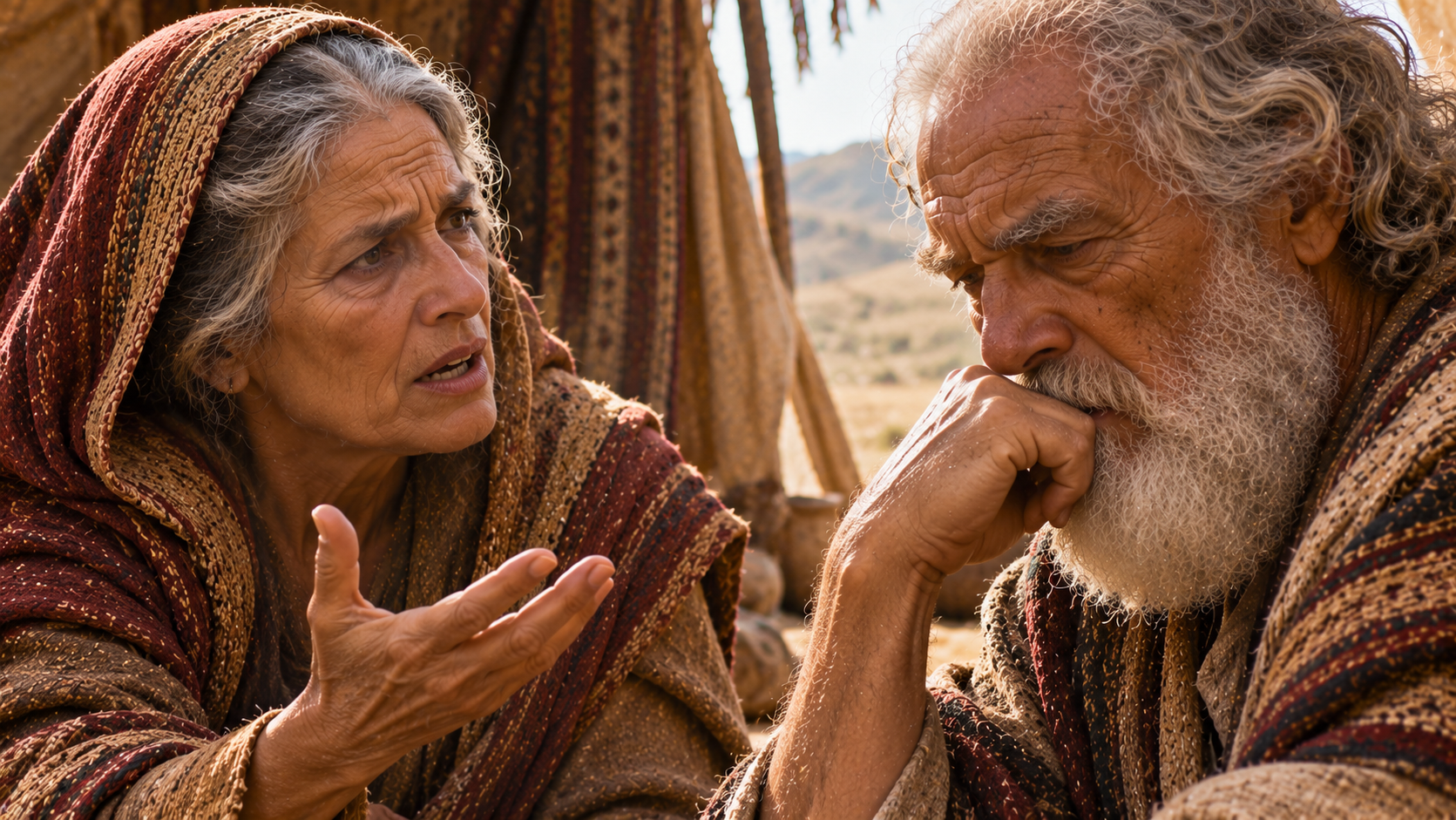
REBEKAH'S CLEVER
PRETEXT
Rebekah said to Isaac - It is interesting and surprising that this is the first time in all of Genesis 27 that husband and wife speak to each other. Isaac spoke privately to Esau (Ge 27:1-4), and Rebekah spoke privately to Jacob (Ge 27:6-17, 42-45). Could it be that Rebekah and Jacob's deception happened because a husband and wife did not talk honestly with each other?
Now, at last, Rebekah goes to Isaac, but even now she does not tell him everything. She says nothing of Esau’s plan to kill Jacob (Ge 27:41-42). Instead she gives a different reason for sending Jacob away, one that was genuine but secondary. It may have been wise tact, to spare the aged Isaac the knowledge that one son planned to murder the other. It was also another case of managing events by controlling what each person was told. In one stroke she arranged both Jacob’s escape and his marriage within the family.
I am tired (qut; LXX - prosochthizo - be very upset over something someone had done) of living because (term of explanation) of the daughters of Heth - NLT - "I'm sick and tired of these local Hittite women!" Tired (qut) is a strong verb meaning to loathe, feel disgust, or be sick of something. Thus the ESV renders it "I loathe my life." It is the word Israel used in the wilderness when they despised God’s provision (Nu 21:5) Solomon uses it in his warning: “My son, do not reject the discipline of the LORD or loathe His reproof” (Pr 3:11) This is not the first time she has spoken this way. When the twins struggled in her womb she cried, “If it is so, why then am I this way?” (Ge 25:22). The “daughters of Heth” are Esau’s Hittite wives, who had been “a grief” to both parents (Ge 26:34,35).
NET NOTE - Heb "loathe my life." The Hebrew verb translated "loathe" refers to strong disgust (see "abhorred" - Lev 20:23).
Notice her strategy: Rather than asking Isaac to send Jacob away because Esau intends to kill him, she gives Isaac a reason to send Jacob away to find a suitable wife.
if Jacob takes a wife from the daughters of Heth, like these, from the daughters of the land, what good will my life be to me?” - The Hebrew literally reads "If Jacob takes a wife from the daughters of Heth, like these, from the daughters of the land, why to me life?" Rebekah’s concern was real and right. Abraham had forbidden a Canaanite wife for Isaac (Ge 24:3), and the covenant line had to stay separate from the people of the land. Her appeal worked. Isaac immediately called Jacob, blessed him again, and gave him the charge she wanted: “Arise, go to Paddan-aram, to the house of Bethuel your mother’s father; and from there take to yourself a wife from the daughters of Laban your mother’s brother” (Ge 28:2).
TECHNICAL NOTE - Logically, this verse begins the next section. It is Rebekah’s appeal, and Isaac’s response follows directly in 28:1-5. The chapter divisions in our Bibles were added long after the text was written, by Stephen Langton, Archbishop of Canterbury, in the early thirteenth century. They are not part of the inspired text, and sometimes, as here, they divide a single scene. Genesis 27:46 should be read together with Genesis 28:1-5.
NET NOTE - Some translate the Hebrew term "Heth" as "Hittites" here (see also Ge 23:3), but this gives the impression that these people were the classical Hittites of Anatolia. However, there is no known connection between these sons of Heth, apparently a Canaanite group (see Gen 10:15), and the Hittites of Asia Minor. (ED: SOME THINK HETH IS RELATED TO HITTITE - see also Hittites and Hethites: A Proposed Solution to an Etymological Conundrum) See H. A. Hoffner, Jr., "Hittites," Peoples of the Old Testament World, 152–53.
🙏 THOUGHT - The whole tragedy of Genesis 27 might have been avoided if Isaac and Rebekah had talked honestly with each other and with the LORD about God’s word concerning their sons. Even at the end, Rebekah speaks to her husband only to steer him. Beloved, is there honest communication in your home, or do the people you love most get only part of the truth? “But speaking the truth in love, we are to grow up in all aspects into Him who is the head, even Christ” (Eph 4:15).
David Guzik points out that "In this tragic story, everyone lost. Each of the man characters—Isaac, Rebekah, Esau, and Jacob—schemed and maneuvered in human wisdom and energy, rejecting God’s word and wisdom. God still accomplished His purpose, yet each of the participants suffered because of they insisted on working against God’s word and wisdom."
Steven Cole (My Way or God's Way) Let me draw four concluding lessons from this drama:
(1) If we sow to the flesh, we’ll reap from the flesh. The law of sowing and reaping is as true for God’s people as it is for unbelievers. If you live for the pleasures of the flesh, you will reap from the flesh corruption (Gal. 6:7-8). If you live for the things of this world, you may get them, but you’ll be poor before God.
Some may protest: “But we’re under grace, not law!” But remember, Paul warned about sowing and reaping in the very letter where he strongly argues for the grace of God--Galatians. You can’t plant spinach and harvest sweet corn. While sin may taste sweet in your mouth, it will be bitter in your stomach and you’ll wish you had never tasted it! That’s true for believers under grace.
(2) You can’t thwart the ultimate purpose of God, so why not work with Him, not against Him? It is utter futility to fight God. It may seem as if you’re going to be able to get away with your plan. But “He who sits in the heavens laughs; the Lord scoffs at them” (Ps. 2:4). Man’s sin can never thwart God’s purpose. It may appear that things are not under God’s control and that the forces of evil are going to turn world history to their own ends. It’s only an illusion. Even the wrath of man will bring ultimate praise to God (Ps. 76:10). God, not man, determines history. You can either smash yourself to bits trying to fight against God or you can submit to His purpose. As the apostle Paul and millions of others can tell you, life is a lot more pleasant when you don’t kick against the goads.
(3) Godly ends do not justify wrong means. Was it God’s will to give the blessing to Jacob? Yes! Was it right for Rebekah and Jacob to gain the blessing through deception? No! Methods do matter! Wrong methods don’t become right just because they work, even when they help accomplish God’s purpose. We live in a pragmatic culture, and many Christians have bought into any method that works. Just because a marketing scheme brings people into the church does not make it right. God’s work must be done in His way.
(4) The way to find your life is to lose it for Christ’s sake. Hebrews 11:20 states: “By faith Isaac blessed Jacob and Esau, even regarding things to come.” How can that be, when it seems that he was acting in the flesh? The answer is in Genesis 27:33, where a trembling Isaac realizes that he has really blessed Jacob, not Esau, as he intended. He admits, “Yes, and he shall be blessed.” At that point Isaac realized that he and Esau had been fighting against God and they had lost. God pinned him to the mat, Isaac admitted defeat, and submitted to God’s sovereign way. So Isaac gives up his theme song, “I Did It My Way.” He lost his life, only to find real life in God.
That’s the key, by the way, to family harmony—when each member dies to his own selfish way and lives for God’s way. What is God’s word to wives? “Submit to your husband.” Many Christian wives hate that word! It grates on the flesh. But it is God’s Word to wives! Before you husbands start gloating, remember God’s word to you: “Husbands, love your wives, just as Christ also loved the church and gave Himself up for her.” The Bible never tells husbands to get their wives to submit. It tells us to seek the highest good of our wives by dying to our own selfish ways. God’s word to children is, “Obey your parents” and you will be blessed. To parents (especially fathers) He says, “Don’t provoke your children to anger, but bring them up in the training and instruction of the Lord.” (Eph. 5:22-6:4).
Many Christian counselors are telling hurting people, “Assert yourself! Stand up for your rights! Don’t be codependent! You’ve got a right to some happiness in life, so go for it!” But God’s Word is clear: If you seek your own way, you won’t get what you want and you’ll pay a high price in family conflict. If you’ll die to your way and seek God’s way, He will give you the desires of your heart. You’ve got to decide which will be your theme song: “I did it my way,” or, “I did it God’s way?”