Genesis 28:2
Genesis 28:3
Genesis 28:4
Genesis 28:5
Genesis 28:6
Genesis 28:7
Genesis 28:8
Genesis 28:9
Genesis 28:10
Genesis 28:11
Genesis 28:12
Genesis 28:13
Genesis 28:14
Genesis 28:15
Genesis 28:16
Genesis 28:17
Genesis 28:18
Genesis 28:19
Genesis 28:20
Genesis 28:21
Genesis 28:22
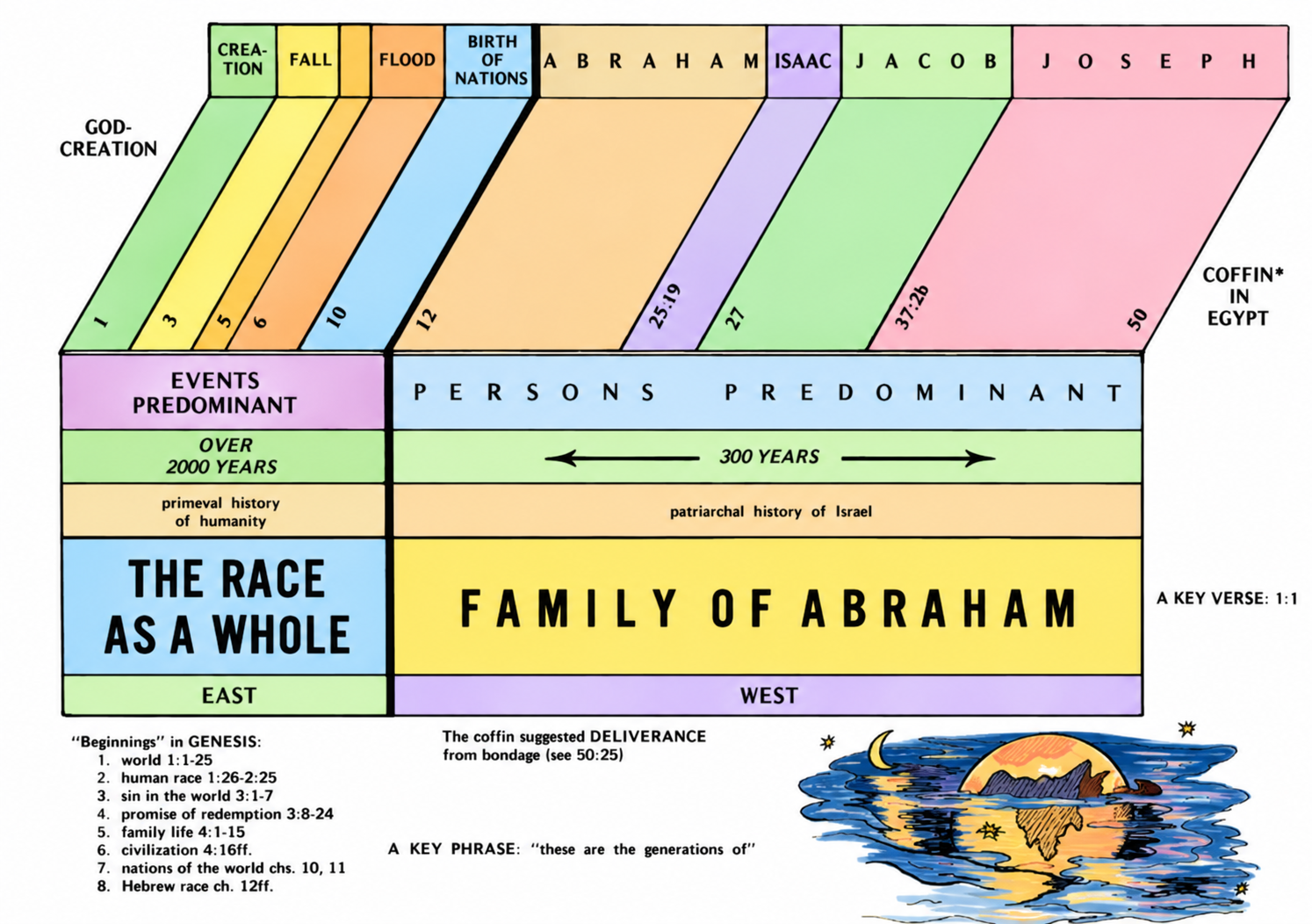
Click chart to enlarge
Chart from recommended resource Jensen's Survey of the OT - used by permission
| Summary Chart of The Book of Genesis |
||||||||
| Focus | Foundation Events (Four Events) (Events Predominant) |
Foundation People (Four People) (People Predominant) |
||||||
| Divisions | Creation (Ge 1-2) |
Fall (Ge 3-5) |
Flood (Ge 6-9) |
Nations (Ge 10-12) |
Abraham's Faith (Ge 12-24) |
Isaac's Family (Ge 25-26) |
Jacob's Conflicts (Ge 27-36) |
Joseph's Calamity (Ge 37-50) |
| Topics | Beginning of the Human Race (Race As A Whole) |
Beginning of the Hebrew Race (Family of Abraham) |
||||||
| Faithfulness of Mankind (Noah) |
Faithfulness of One Man's Family (Abraham) |
|||||||
| Historical | Biographical | |||||||
| Place | Eastward From Eden to Ur |
Westward From Canaan to Egypt |
||||||
| Time | ~2000+ Years (20% of Genesis) (~4004-2090BC) |
About 300 Years 193 Yr in Canaan, 93 Yr in Egypt (80% of Genesis) (2090-1804BC) |
||||||
| Primeval History of Humanity |
Patriarchal History of Israel |
|||||||
| Author | Moses | |||||||
Genesis 28:1 So Isaac called Jacob and blessed him and charged him, and said to him, “You shall not take a wife from the daughters of Canaan.
KJV And Isaac called Jacob, and blessed him, and charged him, and said unto him, Thou shalt not take a wife of the daughters of Canaan.
NET So Isaac called for Jacob and blessed him. Then he commanded him, "You must not marry a Canaanite woman!
NLT So Isaac called for Jacob, blessed him, and said, "You must not marry any of these Canaanite women.
ESV Then Isaac called Jacob and blessed him and directed him, "You must not take a wife from the Canaanite women.
NIV So Isaac called for Jacob and blessed him and commanded him: "Do not marry a Canaanite woman.
- blessed: Ge 28:3,4 Ge 27:4,27-33 Ge 48:15 Ge 49:28 De 33:1 Jos 22:7
- You shall not take: Ge 6:2, Ge 24:3,37 Ge 26:34,35 Ge 27:46 Ge 34:9,16 Ex 34:15,16 2Co 6:14-16
Related Passages:
Genesis 24:3 (ABRAHAM TO ISAAC) and I will make you swear by the LORD, the God of heaven and the God of earth, that you shall not take a wife for my son from the daughters of the Canaanites, among whom I live,
Deuteronomy 7:3-4 “Furthermore, you shall not intermarry with them; you shall not give your daughters to their sons, nor shall you take their daughters for your sons. 4“For they will turn your sons away from following Me to serve other gods; then the anger of the LORD will be kindled against you and He will quickly destroy you.
Genesis 27:34 When Esau was forty years old he married Judith the daughter of Beeri the Hittite, and Basemath the daughter of Elon the Hittite; 35 and they brought grief to Isaac and Rebekah.
Genesis 27:46 Rebekah said to Isaac, “I am tired of living because of the daughters of Heth; if Jacob takes a wife from the daughters of Heth, like these, from the daughters of the land, what good will my life be to me?”
Genesis27:27-29 So he came close and kissed him; and when he smelled the smell of his garments, he blessed him and said, “See, the smell of my son Is like the smell of a field which the LORD has blessed; 28 Now may God give you of the dew of heaven, And of the fatness of the earth, And an abundance of grain and new wine; 29 May peoples serve you, And nations bow down to you; Be master of your brothers, And may your mother’s sons bow down to you. Cursed be those who curse you, And blessed be those who bless you.”
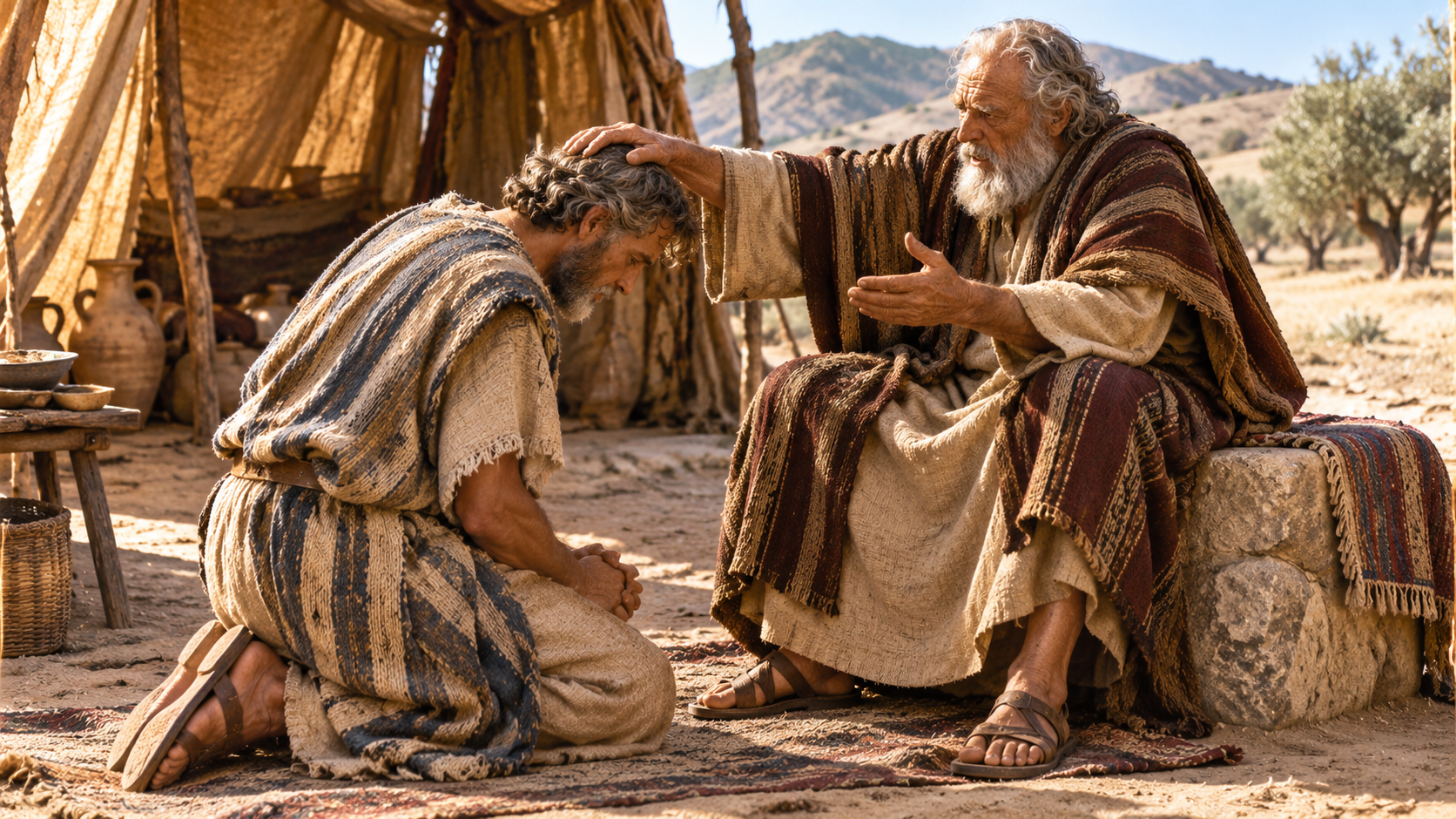
THE BLESSING
WILLINGLY CONFIRMED
So - The conjunction So connects Isaac's action with Rebekah's concern about Jacob marrying a Canaanite woman (Ge 27:46). Isaac now takes the initiative, summoning Jacob to give him instructions concerning his future marriage. There is a striking contrast with Genesis 27. Previously, Jacob approached Isaac disguised as Esau and obtained the blessing through deception. Now Isaac knowingly summons Jacob and willingly blesses him! The father who had been deceived now consciously acts on behalf of the son who received the blessing.
Isaac called Jacob - Isaac calls Jacob openly, knowing exactly who he is, for the secrecy and disguises are now past history. The father who trembled when he realized God had overruled him (Ge 27:33) now acquiesces to God's will and does not attempt to usurp God’s choice.
And blessed (barak; LXX - eulogeo) him What Jacob had previously obtained through deception, Isaac now knowingly confirms through a deliberate blessing. Isaac blesses Jacob freely without being tricked. This does not excuse Jacob's earlier dishonesty, but it demonstrates that Isaac has accepted Jacob as the recipient of the covenant blessing, consistent with God's declaration before the twins were born (Ge 25:23).
And charged (tsavah commanded) him, and said to him, “You shall not take a wife from the daughters of Canaan - Isaac issue a binding instruction. Jacob was now about 75 years old and still single. Why had Isaac been so lax in seeking a proper wife for his sons? The text does not explain. However one result of his negligence was Esau's bigamous marriage to two Hittite (Canaanite) women. Isaac wanted to avoid a second major misstep and readily received Rebekah's advice (Ge 27:46). Isaac's (and Rebekah's) concern was spiritual, not ethnic, for the danger of a Canaanite wife was that she likely would turn the covenant son away from Yahweh and to other gods. The New Testament carries the same principle forward for believers: “A wife is bound as long as her husband lives; but if her husband is dead, she is free to be married to whom she wishes, only in the Lord” (1Co 7:39; 2Co 6:14).
It is interesting to compare the commands to Jacob from Rebekan and Isaac. Both use the same verb tsavah but Rebekah used it when she pressed Jacob into the deception (Ge 27:8 while the purpose of Isaac’s command was to guard his son from intermarrying with the Canaanites (Dt 7:3,4). Isaac was exerting a father’s rightful authority in line with God’s will.
🙏 THOUGHT - Isaac failed badly in Genesis 27, but he did not end there. He blessed his son openly and charged him to keep the faith of his fathers in the choice of a wife. It is never too late for a parent to give a godly blessing and a godly charge. Beloved, especially fathers, have you spoken words of blessing over your children and grandchildren, and charged them to walk with the Lord? “Train up a child in the way he should go, even when he is old he will not depart from it” (Pr 22:6).
Jon Courson - The next eight chapters of the Book of Genesis all focus on God’s work in and on Jacob. We see the saving of Jacob here in chapter 28, the subduing of Jacob in chapters 29–32, the separating of Jacob in chapters 33–34, and the sanctifying of Jacob in chapter 35.(See Jon Courson's Application Commentary)
Genesis 28:2 “Arise, go to Paddan-aram, to the house of Bethuel your mother’s father; and from there take to yourself a wife from the daughters of Laban your mother’s brother.
KJV Arise, go to Padanaram, to the house of Bethuel thy mother's father; and take thee a wife from thence of the daughters of Laban thy mother's brother.
NET Leave immediately for Paddan Aram! Go to the house of Bethuel, your mother's father, and find yourself a wife there, among the daughters of Laban, your mother's brother.
NLT Instead, go at once to Paddan-aram, to the house of your grandfather Bethuel, and marry one of your uncle Laban's daughters.
ESV Arise, go to Paddan-aram to the house of Bethuel your mother's father, and take as your wife from there one of the daughters of Laban your mother's brother.
NIV Go at once to Paddan Aram, to the house of your mother's father Bethuel. Take a wife for yourself there, from among the daughters of Laban, your mother's brother.
- Arise (KJV): Ho 12:12
- Padanaram (KJV): Ge 28:5 22:20-23 24:10,15-24 25:20 29:1 31:18 32:10 35:9 46:15
- Laban (KJV): Ge 24:29,50
Related Passages:
Hosea 12:12 Now Jacob fled to the land of Aram, And Israel worked for a wife, And for a wife he kept sheep.
Genesis 25:20 and Isaac was forty years old when he took Rebekah, the daughter of Bethuel the Aramean of Paddan-aram, the sister of Laban the Aramean, to be his wife.
Genesis 27:43 “Now therefore, my son, obey my voice, and arise, flee to Haran, to my brother Laban!
Deuteronomy 26:5 “You shall answer and say before the LORD your God, ‘My father was a wandering Aramean, and he went down to Egypt and sojourned there, few in number; but there he became a great, mighty and populous nation.
Genesis 22:23 Bethuel became the father of Rebekah; these eight Milcah bore to Nahor, Abraham’s brother.
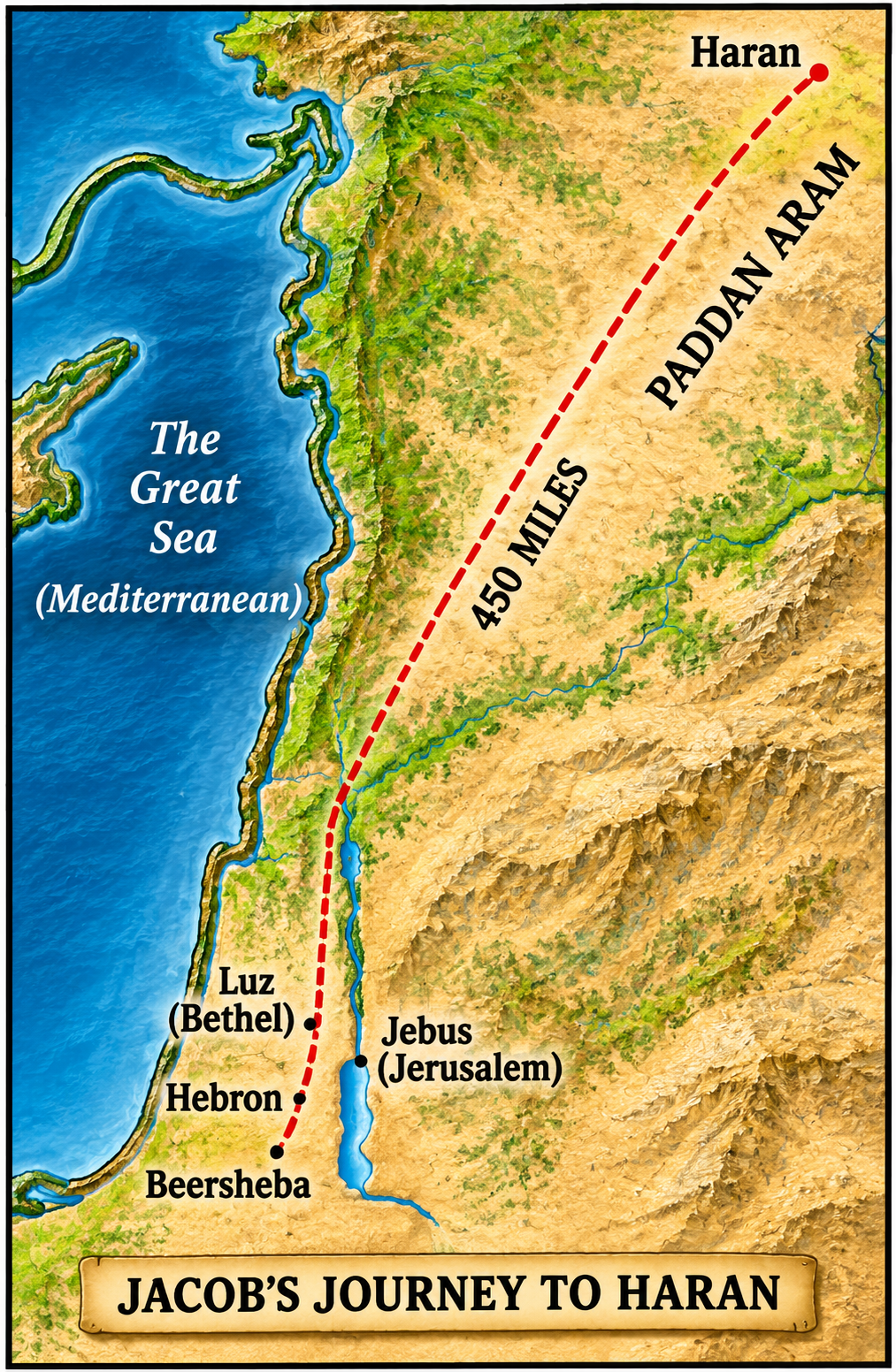
DON'T DELAY TO
FETCH A WIFE
Genesis 28:2 “Arise (qum), go (halak) to Paddan-aram - Isaac issues two commands, “arise” and “go, directing Jacob to leave Canaan and travel to northern Mesopotamia. Arise is the third time the word qum has been spoken to or by Jacob in this account (all used as commands). Jacob said it to his blind father in the deception: “Get up, please, sit and eat” (Ge 27:19). Rebekah said it to send him running: “arise, flee to Haran” (Ge 27:43). Now Isaac says it, and the flight becomes a "marriage mission." Jacob is no longer only escaping his brother’s anger. He is going with his father’s blessing to find a wife for the covenant line. God turned a fugitive’s escape into a father’s commission.
Paddan-aram, meaning “the plain of Aram,” was the region associated with Haran, where Rebekah's relatives lived (Ge 25:20; 27:43). Notice the contrast in the parents' instructions. Rebekah commanded Jacob to flee because of Esau's murderous intentions (Ge 27:43), while Isaac commanded him to go in search of a suitable wife. Both instructions pointed to the same destination, but for different reasons.
To the house of Bethuel your mother’s father and from there take to yourself a wife from the daughters of Laban your mother’s brother. - Bethuel was the son of Abraham’s brother Nahor (Ge 22:22, 23) and the father of Rebekah and Laban. Isaac directs Jacob to marry within the extended family of Terah, the family God had called out of Ur. That was the standard Abraham set for Isaac (Ge 24:4).
Bob Utley - "You shall not take a wife from the daughters of Canaan" This is exactly the statement made by Abraham to his servant for finding a wife for Isaac in Gen. 24:3-4. This must be related to the exclusive worship of YHWH. Although Bethuel's son, Laban, may not be a true YHWHist (i.e., Teraphim, cf. Gen. 31:19,34,35), apparently there was some theological understanding within that family.
Paddan-aram (Hebrew paddan ʾărām; KJV “Padan-aram”) is the name Genesis uses for the homeland of Abraham’s relatives in upper Mesopotamia, the region inhabited by the Arameans around the city of Haran, between the upper Tigris and Euphrates rivers. The name likely means “the field” or “plain of Aram.” The word paddan appears on Babylonian contract tablets from Abraham’s era as a land measure, and Assyrian texts equate it with iklu, “a field.” Hosea’s description of Jacob fleeing to “the field (śādeh) of Aram” (Hos 12:12) expresses the same idea. Assyrian texts also list padanu and ḫarrānu as synonyms meaning “road,” linking the name with Haran itself. The Septuagint translates it “Mesopotamia.”
Paddan-aram plays a central role in the patriarchal narratives. It was the home of Rebekah’s family, Bethuel and Laban (Gen 25:20). Isaac sent Jacob there to find a wife from his mother’s relatives rather than from the Canaanites (Gen 28:2, 5-7). Jacob spent twenty years there, and he returned to Canaan with his family and possessions (Gen 31:18; 33:18). God appeared to him again at Bethel after his return from Paddan-aram (Gen 35:9), and all of Jacob’s sons except Benjamin were born there (Gen 35:26; 46:15). In Genesis 48:7 the shortened form “Paddan” appears alone, though the Septuagint, Samaritan Pentateuch, and Peshitta include “Aram.”
Paddan-aram corresponds to “Haran” in other passages (Gen 27:43; 28:10; 29:4), and the ancient versions identify both with the district of Haran east of the upper Euphrates. The traditional identification with the region around Haran in upper Mesopotamia is the one most widely accepted.
Bethuel (Hebrew bᵊtûʾēl, H1328, usually explained as “dweller in God”) was the son of Nahor and Milcah, which made him Abraham’s nephew (Gen 22:20-23). He was the father of Rebekah and Laban, and so the grandfather of Jacob and Esau (Gen 24:15, 24, 29, 47; 28:2). He is twice called “Bethuel the Syrian” (KJV) or “the Aramean” (NASB), identifying him with the Aramean people of Paddan-aram (Gen 25:20; 28:5).
Bethuel appears as an active figure only in the account of Rebekah’s betrothal to Isaac, and even there he plays a secondary role. Laban takes the lead in welcoming Abraham’s servant and negotiating the marriage, with Bethuel mentioned alongside him only once (Gen 24:50). Laban’s prominence probably reflects the ancient custom by which a brother took special responsibility for his sister’s welfare, as seen with Dinah’s brothers (Gen 34:5, 13, 25) and with Absalom and Tamar (2 Sam 13:20, 22). Josephus suggests that Bethuel had already died by this time (Antiquities 1.16.2), though the mention of him in Genesis 24:50 makes that view uncertain. Years later, Isaac sent Jacob to “the house of Bethuel your mother’s father” to find a wife among Laban’s daughters (Gen 28:2, 5).
Note: A town named Bethuel (also called Bethul) belonged to the tribe of Simeon (1 Chr 4:30; cf. Josh 19:4), but it is unrelated to the person.
QUESTION - Who was Laban in the Bible? - GotQuestions.org
ANSWER - The Bible first mentions Laban in Genesis 24:29. Laban was the brother of Isaac’s wife, Rebekah. Abraham had sent his trusted servant back to his home country to find a wife for Isaac among his relatives (Genesis 24:2–4). When the servant found Rebekah, he made the purpose of his visit known, and she ran and told her father’s household the news. Her brother Laban came out to welcome the servant and invited him to stay with them.
Laban was involved in the decision to allow his sister to travel to a foreign land and marry a man she had never met (Genesis 24:50, 55). Laban may have been the eldest son in his family, as the Bible records specifically that he played the role of host to Abraham’s servant and had the right to voice an opinion on his sister’s future (Genesis 24:29, 50, 55).
We hear nothing more of Laban until many years later when Isaac and Rebekah send their son Jacob back to those same relatives to find a wife (Genesis 28:1–2). Jacob returned to his mother’s homeland and met Laban’s daughter Rachel, with whom he fell madly in love (Genesis 29:18). Laban promised to give Rachel to Jacob if he would work for him for seven years (Genesis 29:19–20).
However, Laban proved to be as duplicitous as Jacob himself. After Jacob had served the time agreed upon, Laban tricked Jacob and switched brides on the wedding night. When Jacob awoke the next morning, he found he had spent the night with Laban’s older daughter, Leah (Genesis 29:25). Infuriated, Jacob demanded an explanation. Laban replied, “It is not our custom here to give the younger daughter in marriage before the older one. Finish this daughter’s bridal week; then we will give you the younger one also, in return for another seven years of work” (Genesis 29:26–27).
Laban continued to connive throughout his and Jacob’s twenty-year relationship (Genesis 31:38). However, God blessed Jacob because Jacob was His choice to carry on the covenant He had made with his grandfather Abraham (Genesis 28:11–15). Genesis 31:1–3 indicates that Laban’s sons were jealous of Jacob because of how much God had prospered him. They said, “‘Jacob has taken everything our father owned and has gained all this wealth from what belonged to our father.’ And Jacob noticed that Laban’s attitude toward him was not what it had been. Then the Lord said to Jacob, ‘Go back to the land of your fathers and to your relatives, and I will be with you.’”
Fearful that Laban would take his wives, children, and everything he had, Jacob fled in the night, taking what he owned. However, unbeknownst to Jacob, Rachel had stolen her father’s household idols (Genesis 31:19, 34). When Laban learned of the departure of Jacob and his family, he pursued them. He caught up with them, and he rebuked Jacob for sneaking off. Then the idolater Laban demanded the return of his pagan images. But Jacob knew nothing of Rachel’s theft, and he scolded Laban for accusing him. Laban never found his idols.
The last mention of Laban in the Bible is after he had rebuked Jacob for disappearing without notice. After their exchange of angry words, Laban suggested that they make a covenant (Genesis 31:44). This overture appears to have been motivated by fear that Jacob might return to harm him (verse 52). Although there is no indication that Laban worshiped the Lord, he did hold a healthy fear of Him and invoked the name of Jacob’s God in forming the covenant between them (Genesis 31:49–50). Laban and his son-in-law shared a meal, and then Laban kissed his children and grandchildren and returned home.
After Laban said good-bye, Jacob and his family were free to continue their journey to the land God had given them. Whether he knew it or not, Laban played a large part in God’s plan for humanity, as his grandsons would grow up to head eight of the twelve tribes known as Israel (Genesis 49:28; Revelation 21:12).
Genesis 28:3 “May God Almighty bless you and make you fruitful and multiply you, that you may become a company of peoples.
KJV And God Almighty bless thee, and make thee fruitful, and multiply thee, that thou mayest be a multitude of people;
NET May the sovereign God bless you! May he make you fruitful and give you a multitude of descendants! Then you will become a large nation.
NLT May God Almighty bless you and give you many children. And may your descendants multiply and become many nations!
ESV God Almighty bless you and make you fruitful and multiply you, that you may become a company of peoples.
NIV May God Almighty bless you and make you fruitful and increase your numbers until you become a community of peoples.
- God (KJV): Ge 17:1-6 22:17,18 35:11 43:14 48:3 Ex 6:3 Ps 127:1 2Co 6:18 Rev 21:22
- and make (KJV): Ge 1:28 9:1 13:16 24:60 41:52 Ps 127:3-5 128:1-6
Related Passages:
Genesis 35:11 God also said to him, “I am God Almighty (EL Shaddai); Be fruitful and multiply; A nation and a company of nations shall come from you, And kings shall come forth from you.
Genesis 48:3 Then Jacob said to Joseph, “God Almighty (EL Shaddai) appeared to me at Luz in the land of Canaan and blessed me,
Exodus 6:3 and I appeared to Abraham, Isaac, and Jacob, as God Almighty (EL Shaddai), but by My name, LORD, I did not make Myself known to them.
Genesis 17:1 Now when Abram was ninety-nine years old, the LORD appeared to Abram and said to him, “I am God Almighty (EL Shaddai) ; Walk before Me, and be blameless.
Genesis 1:28 God blessed them; and God said to them, “Be fruitful and multiply, and fill the earth, and subdue it; and rule over the fish of the sea and over the birds of the sky and over every living thing that moves on the earth.”
Genesis 17:2; “I will establish My covenant between Me and you, And I will multiply you exceedingly.”
Genesis 17:6; 20 “I will make you exceedingly fruitful, and I will make nations of you, and kings will come forth from you. (17:20) “As for Ishmael, I have heard you; behold, I will bless him, and will make him fruitful and will multiply him exceedingly. He shall become the father of twelve princes, and I will make him a great nation.
BENEDICTION FOR EL SHADDAI
FOR FERTILITY AND PROSPERITY
May God Almighty bless (barak; LXX - eulogeo) you - May...bless is a blessing (benediction) in the form of a prayer-wish. God Almighty is EL Shaddai which emphasizes God's sovereign power and sufficiency to accomplish His promises. This is the name by which God revealed Himself to Abraham when He confirmed the covenant of descendants at a time when it seemed impossible (Ge 17:1).
Isaac is consciously passing on the Abrahamic covenant. God Himself later confirmed these words, in almost the same language, when He appeared to Jacob at Bethel on his return: “God also said to him, ‘I am God Almighty; be fruitful and multiply; a nation and a company of nations shall come from you, and kings shall come forth from you’” (Ge 35:11). Jacob never forgot it: “Then Jacob said to Joseph, ‘God Almighty appeared to me at Luz in the land of Canaan and blessed me’” (Ge 48:3).
And make you fruitful (parah) and multiply (rabah) you, that (term of purpose) you may become a company (qāhāl) of peoples - NET - "Then you will become a large nation." God’s creation blessing (Ge 1:28) now passes through the chosen line, from Abraham to Isaac to Jacob. The fulfillment came in Egypt, where the same two verbs describe Jacob’s descendants: “But the sons of Israel were fruitful and increased greatly, and multiplied, and became exceedingly mighty, so that the land was filled with them” (Ex 1:7). Jacob would become the father of the twelve tribes of Israel, and his descendants would grow into a great nation (Ge 35:22–26).
🙏 THOUGHT - Isaac sent Jacob away alone, with only a staff (Ge 32:10), and asked El Shaddai to make him a great assembly. The name fit the need, because only an all-sufficient God could build a congregation of peoples out of one fugitive. He is still the God who is enough when we have nothing: “And He has said to me, ‘My grace is sufficient for you, for power is perfected in weakness.’ Most gladly, therefore, I will rather boast about my weaknesses, so that the power of Christ may dwell in me” (2Co 12:9).
NET NOTE on EL Shaddai - The name אֵל שַׁדַּי (’el shadday, “El Shaddai”) has often been translated “God Almighty,” primarily because Jerome translated it omnipotens (“all powerful”) in the Latin Vulgate. There has been much debate over the meaning of the name. For discussion see W. F. Albright, “The Names Shaddai and Abram,” JBL 54 (1935): 173–210; R. Gordis, “The Biblical Root sdy-sd,” JTS 41 (1940): 34–43; and especially T. N. D. Mettinger, In Search of God, 69–72.
Shaddai/El Shaddai is the sovereign king of the world who grants, blesses, and judges. In the Book of Genesis he blesses the patriarchs with fertility and promises numerous descendants. Outside Genesis he both blesses/protects and takes away life/happiness. The patriarchs knew God primarily as El Shaddai (Exod 6:3).
While the origin and meaning of this name are uncertain (see discussion below) its significance is clear. The name is used in contexts where God appears as the source of fertility and life. In Gen 17:1–8 he appeared to Abram, introduced himself as El Shaddai, and announced his intention to make the patriarch fruitful. In the role of El Shaddai God repeated these words (now elevated to the status of a decree) to Jacob (35:11). Earlier Isaac had pronounced a blessing on Jacob in which he asked El Shaddai to make Jacob fruitful (28:3).
Jacob later prayed that his sons would be treated with mercy when they returned to Egypt with Benjamin (43:14). The fertility theme is not as apparent here, though one must remember that Jacob viewed Benjamin as the sole remaining son of the favored and once-barren Rachel (see 29:31; 30:22–24; 35:16–18). It is quite natural that he would appeal to El Shaddai to preserve Benjamin’s life, for it was El Shaddai’s miraculous power which made it possible for Rachel to give him sons in the first place.
In 48:3 Jacob, prior to blessing Joseph’s sons, told him how El Shaddai appeared to him at Bethel (see Gen 28) and promised to make him fruitful. When blessing Joseph on his deathbed Jacob referred to Shaddai (we should probably read “El Shaddai,” along with a few Hebrew MSS, the Samaritan Pentateuch, the LXX, and Syriac) as the one who provides abundant blessings, including “blessings of the breast and womb” (49:25). (The direct association of the name with “breasts” suggests the name might mean “the one of the breast” [i.e., the one who gives fertility], but the juxtaposition is probably better explained as wordplay. Note the wordplay involving the name and the root שָׁדַד, shadad, “destroy”] in Isa 13:6 and in Joel 1:15.)
Outside Genesis the name Shaddai (minus the element “El” [“God”]) is normally used when God is viewed as the sovereign king who blesses/protects or curses/brings judgment. The name appears in the introduction to two of Balaam’s oracles (Num 24:4, 16) of blessing upon Israel. Naomi employs the name when accusing the Lord of treating her bitterly by taking the lives of her husband and sons (Ruth 1:20–21). In Ps 68:14; Isa 13:6; and Joel 1:15 Shaddai judges his enemies through warfare, while Ps 91:1 depicts him as the protector of his people. (In Ezek 1:24 and 10:5 the sound of the cherubs’ wings is compared to Shaddai’s powerful voice. The reference may be to the mighty divine warrior’s battle cry which accompanies his angry judgment.)
Finally, the name occurs 31 times in the Book of Job. Job and his “friends” assume that Shaddai is the sovereign king of the world (11:7; 37:23a) who is the source of life (33:4b) and is responsible for maintaining justice (8:3; 34:10–12; 37:23b). He provides abundant blessings, including children (22:17–18; 29:4–6), but he can also discipline, punish, and destroy (5:17; 6:4; 21:20; 23:16). It is not surprising to see the name so often in this book, where the theme of God’s justice is primary and even called into question (24:1; 27:2).
The most likely proposal is that the name means “God, the one of the mountain” (an Akkadian cognate means “mountain,” to which the Hebrew שַׁד, shad, “breast”] is probably related). For a discussion of proposed derivations see T. N. D. Mettinger, In Search of God, 70–71. The name may originally have depicted God as the sovereign judge who, in Canaanite style, ruled from a sacred mountain. Isa 14:13 and Ezek 28:14, 16 associate such a mountain with God, while Ps 48:2 refers to Zion as “Zaphon,” the Canaanite Olympus from which the high god El ruled. (In Isa 14 the Canaanite god El may be in view. Note that Isaiah pictures pagan kings as taunting the king of Babylon, suggesting that pagan mythology may provide the background for the language and imagery.)
Play Michael Card's great song (he wrote it and sang it) El Shaddai.
El shaddai, el shaddai
El-elyon na adonia
Age to age You're still the same
By the power of the name
El shaddai, el shaddai
Erkamka na adonai
We will praise and lift You high
El shaddai
Genesis 28:4 “May He also give you the blessing of Abraham, to you and to your descendants with you, that you may possess the land of your sojournings, which God gave to Abraham.”
KJV And give thee the blessing of Abraham, to thee, and to thy seed with thee; that thou mayest inherit the land wherein thou art a stranger, which God gave unto Abraham.
NET May he give you and your descendants the blessing he gave to Abraham so that you may possess the land God gave to Abraham, the land where you have been living as a temporary resident."
NLT May God pass on to you and your descendants the blessings he promised to Abraham. May you own this land where you are now living as a foreigner, for God gave this land to Abraham."
ESV May he give the blessing of Abraham to you and to your offspring with you, that you may take possession of the land of your sojournings that God gave to Abraham!"
NIV May he give you and your descendants the blessing given to Abraham, so that you may take possession of the land where you now live as an alien, the land God gave to Abraham."
- the blessing (KJV): Ge 12:1-3,7 Ge 15:5-7 Ge 17:6-8 22:17,18 Ps 72:17 Ro 4:7,8 Ga 3:8,14 Eph 1:3
- sojournings, Ge 17:8
- which (KJV): Ge 12:7 13:14-17 15:18-21 Ps 39:12 105:6-12 Heb 11:9-13
Related Passages:
Genesis 12:1-3; 7 Now the LORD said to Abram, “Go forth from your country, And from your relatives And from your father’s house, To the land which I will show you; 2 And I will make you a great nation, And I will bless you, And make your name great; And so you shall be a blessing; 3 And I will bless those who bless you, And the one who curses you I will curse. And in you all the families of the earth will be blessed.” ....(12:7) The LORD appeared to Abram and said, “To your descendants I will give this land.” So he built an altar there to the LORD who had appeared to him.
Genesis 15:5-7 And He took him outside and said, “Now look toward the heavens, and count the stars, if you are able to count them.” And He said to him, “So shall your descendants be.” 6Then he believed in the LORD; and He reckoned it to him as righteousness. 7And He said to him, “I am the LORD who brought you out of Ur of the Chaldeans, to give you this land to possess it.”
Genesis 15:16-18 Then in the fourth generation they will return here, for the iniquity of the Amorite is not yet complete.” 17 It came about when the sun had set, that it was very dark, and behold, there appeared a smoking oven and a flaming torch which passed between these pieces. 18 On that day the LORD made a covenant with Abram, saying, “To your descendants I have given this land, From the river of Egypt as far as the great river, the river Euphrates:
Genesis 17:6-8 “I will make you exceedingly fruitful, and I will make nations of you, and kings will come forth from you. 7 “I will establish My covenant between Me and you and your descendants after you throughout their generations for an everlasting covenant, to be God to you and to your descendants after you. 8 “I will give to you and to your descendants after you, the land of your sojournings, all the land of Canaan, for an everlasting possession; and I will be their God.” .
Genesis 22:17 indeed I will greatly bless you, and I will greatly multiply your seed as the stars of the heavens and as the sand which is on the seashore; and your seed shall possess the gate of their enemies.
1 Chronicles 29:15 “For we are sojourners before You, and tenants, as all our fathers were; our days on the earth are like a shadow, and there is no hope.
Psalm 39:12 “Hear my prayer, O LORD, and give ear to my cry; Do not be silent at my tears; For I am a stranger with You, A sojourner like all my fathers.
Genesis 47:9 So Jacob said to Pharaoh, “The years of my sojourning are one hundred and thirty; few and unpleasant have been the years of my life, nor have they attained the years that my fathers lived during the days of their sojourning.”
Genesis 26:3 “Sojourn in this land and I will be with you and bless you, for to you and to your descendants I will give all these lands, and I will establish the oath which I swore to your father Abraham.
ISAAC PASSES THE
ABRAHAMIC COVENANT
May He also give you the blessing (berakah; LXX - eulogia - benediction, benefit bestowed by God) of Abraham - This is the heart of the blessing, and it is what Isaac had not named in Ge 27:27-29 where he spoke of dew, grain, and dominion. Now Isaac passes on by name the covenant promise God made to Abraham: “And I will make you a great nation, and I will bless you, and make your name great; and so you shall be a blessing” (Ge 12:2), together with the promise of blessing to all the families of the earth (Ge 12:3).
NET NOTE - The name "Abraham" is an objective genitive here; this refers to the blessing that God gave to Abraham.
to you and to your descendants (zera; LXX - sperma - see by metonymy as human descendants offspring) with you - The promise was never for one man alone. It ran through Jacob's line, and ultimately to the one Seed, Christ (Gal 3:16). It is worth noting that zera in this verse is singular which parallels Paul's statement in Gal 3:16 "He does not say, “And to seeds,” as referring to many, but rather to one, “And to your seed,” that is, Christ."
That you may possess (yarash; LXX - kleronomeo - receiving a possession or gift) the land of your sojournings (magor; LXX - paroikesis - living as aliens or foreigners) - Hebrew = "the land of your sojournings," that is, the land where Jacob had been living as a resident alien, as his future descendants would after him. “Possess” is yarash (H3423), to take possession of or inherit, a key word of the covenant and of Deuteronomy. God had used it when He first promised the land to Abraham: “And He said to him, ‘I am the LORD who brought you out of Ur of the Chaldeans, to give you this land to possess it’” (Ge 15:7). Jesus took up the same promise: “Blessed are the gentle, for they shall inherit the earth” (Mt 5:5; cf. Ps 37:11).
The land of your sojournings (magor) is related to gur, “to sojourn” (see the notes on Ge 26:3, 6). The phrase holds a paradox. Jacob is to possess the very land where he is only a sojourner. God used the same expression when He confirmed the covenant to Abraham: “I will give to you and to your descendants after you, the land of your sojournings, all the land of Canaan, for an everlasting possession; and I will be their God” (Ge 17:8). There is irony in the timing because Jacob receives this promise of the land at the very moment he is leaving it for Paddan-aram!
NET NOTE - Heb "the land of your sojournings," that is, the land where Jacob had been living as a resident alien, as his future descendants would after him.
Which God gave to Abraham - Gave is a completed-action verb, describing past tense. God has given it and that settles it. He will never take it away from the nation of Israel. Of course He would remove them from the land if they did not obey (taken into exile by Assyrians in 722 BC and Babylonians in 586 BC). They were removed from the land but the promise of land was never removed and will be fulfilled in the Messianic Kingdom. To be sure Abraham never owned more of Canaan than a burial cave he bought from the Hittites (Ge 23:14-20). Stephen pointed out the tension in his sermon declaring God "gave him no inheritance in it, not even a foot of ground, and yet, even when he had no child, He promised that He would give it to him as a possession, and to his descendants after him” (Acts 7:5). God’s promise was so certain that it could be spoken of as already given. (cf what He has give believers in Christ - Eph 1:3!) The patriarchs lived by that certainty: “All these died in faith, without receiving the promises, but having seen them and having welcomed them from a distance, and having confessed that they were strangers and exiles on the earth” (Heb 11:13).
🙏 THOUGHT - Jacob walked away from the land with a promise that it was his. Like Abraham, he would live by faith in what God had “given” but he did not yet possess. Believers live the same way. We are sojourners now, but we have an inheritance God has already secured: “Blessed be the God and Father of our Lord Jesus Christ, who according to His great mercy has caused us to be born again to a living hope through the resurrection of Jesus Christ from the dead, to obtain an inheritance which is imperishable and undefiled and will not fade away, reserved in heaven for you” (1Pe 1:3,4).
Possess (03423) yarash is a Hebrew verb meaning to take possession of, to possess, to inherit, to be an heir, and in its causative sense to dispossess, to drive out. It occurs over 230 times in the Old Testament and is one of the key words for Israel’s relationship to the Promised Land. Cognates appear in Aramaic, Ugaritic, Akkadian, and Old South Arabian. The Moabite Stone (ninth century BC) uses the same root when it says that Omri “took possession” of the land of Medeba. The verb has a double force that runs through all its uses: to possess something usually means that someone else is dispossessed of it, and the right of possession passed from one generation to the next as an inheritance. In the land of Canaan these two ideas meet, because Israel inherited by covenant what it had to take by conquest.
YARASH IN GENESIS - Gen. 15:3; Gen. 15:4; Gen. 15:7; Gen. 15:8; Gen. 21:10; Gen. 22:17; Gen. 24:60; Gen. 28:4; Gen. 45:11
The different stems. In the Qal stem, yārash means to take possession of or to inherit. It is used of land, cities (Josh 19:47; Judg 3:13), houses (Neh 9:25), and fields. Ahab’s seizure of Naboth’s vineyard shows the verb used of a wicked possession (1 Kings 21:15: “When Jezebel heard that Naboth had been stoned and was dead, Jezebel said to Ahab, ‘Arise, take possession of the vineyard of Naboth, the Jezreelite, which he refused to give you for money; for Naboth is not alive, but dead.’”), and God’s rebuke turns on the same word: “Have you murdered and also taken possession?” (1 Kings 21:19). In the Hiphil stem the verb means to dispossess, to drive out, and also to make poor, that is, to cause someone to lose his possessions (1 Sam 2:7: “The LORD makes poor and rich; He brings low, He also exalts.”). In the Niphal it means to be dispossessed, so to become poor (Prov 20:13: “Do not love sleep, or you will become poor; Open your eyes, and you will be satisfied with food.”; cf. Gen 45:11; Prov 30:9). The only Piel use pictures insects “possessing” Israel’s crops as a covenant curse (Deut 28:42: “The cricket shall possess all your trees and the produce of your ground.”).
Inheritance. In a legal sense, yārash describes the right of an heir. Childless Abram feared that his servant would inherit his estate, but God promised a son (Gen 15:3-4: “And Abram said, ‘Since You have given no offspring to me, one born in my house is my heir.’ Then behold, the word of the LORD came to him, saying, ‘This man will not be your heir; but one who will come forth from your own body, he shall be your heir.’”). Jeremiah later lamented Israel’s lack of heirs to its territory (Jer 49:1), and Ezra urged the people not to intermarry with idolaters so that they could leave the good land as an inheritance to their children (Ezra 9:12).
The land promise in Genesis. God introduced yārash in the context of the Abrahamic covenant (Gen 15:7-8: “And He said to him, ‘I am the LORD who brought you out of Ur of the Chaldeans, to give you this land to possess it.’ He said, ‘O Lord GOD, how may I know that I will possess it?’”). After the offering of Isaac, God added that Abraham’s seed would possess the gates of their enemies (Gen 22:17: “indeed I will greatly bless you, and I will greatly multiply your seed as the stars of the heavens and as the sand which is on the seashore; and your seed shall possess the gate of their enemies.”). Rebekah’s family used the same words when they sent her to Isaac (Gen 24:60: “They blessed Rebekah and said to her, ‘May you, our sister, Become thousands of ten thousands, And may your descendants possess The gate of those who hate them.’”). Isaac then passed this hope on to Jacob (Gen 28:4: “May He also give you the blessing of Abraham, to you and to your descendants with you, that you may possess the land of your sojournings, which God gave to Abraham.”). Note the contrast in that verse: Jacob was to possess (yārash) the land where his fathers had only sojourned (māgûr). The land was promised, but it would not be possessed until the iniquity of the Amorites was complete (Gen 15:16). God later confirmed the promise to Moses, using the related noun môrāshâ (H4181), “possession” (Ex 6:8: “I will bring you to the land which I swore to give to Abraham, Isaac, and Jacob, and I will give it to you for a possession; I am the LORD.”).
Possession and conquest in Deuteronomy. Deuteronomy has more uses of yārash than any other book, because it was written as Israel stood on the edge of Canaan after forty years in the wilderness. The call is repeated again and again (Deut 1:21: “See, the LORD your God has placed the land before you; go up, take possession, as the LORD, the God of your fathers, has spoken to you. Do not fear or be dismayed.”). The conquest demanded a balance of divine action and human response. (See "Paradoxical Principle of 100% Dependent and 100% Responsible") God would go ahead of them, but they had to step forward in faith (Deut 9:3: “Know therefore today that it is the LORD your God who is crossing over before you as a consuming fire. He will destroy them and He will subdue them before you, so that you may drive them out and destroy them quickly, just as the LORD has spoken to you.”). Faith meant placing their lives at risk on the battlefield, expecting God to defeat enemies greater and mightier than they were (Deut 7:1; 11:23; 31:3), even by such means as sending hornets ahead of them (Deut 7:20). A generation earlier, Caleb had shown that kind of faith (Num 13:30: “Then Caleb quieted the people before Moses and said, ‘We should by all means go up and take possession of it, for we will surely overcome it.’”). Possession also required righteous living (Deut 16:20: “Justice, and only justice, you shall pursue, that you may live and possess the land which the LORD your God is giving you.”).
The moral basis of the conquest. Israel’s possession of Canaan was not arbitrary. The land itself “spews out” a people whose morality defiles it (Lev 18:28: “so that the land will not spew you out, should you defile it, as it has spewed out the nation which has been before you.”). Israel served as God’s instrument of judgment on the Canaanites, just as Assyria later served as His rod to punish Israel (Isa 10:5-6). Israel received the land not because of its own merit (Deut 9:5: “It is not for your righteousness or for the uprightness of your heart that you are going to possess their land, but it is because of the wickedness of these nations that the LORD your God is driving them out before you, in order to confirm the oath which the LORD swore to your fathers, to Abraham, Isaac and Jacob.”), but solely because of God’s love and His oath to the patriarchs (Deut 4:37-38).
Incomplete possession. Joshua’s later years show that the land was given but not fully possessed (Josh 13:1: “Now Joshua was old and advanced in years when the LORD said to him, ‘You are old and advanced in years, and very much of the land remains to be possessed.’”). Judges records a sad refrain of tribes that failed to drive out the Canaanites (Jdg 1:27-33), often by choice rather than inability (Jdg 1:28: “It came about when Israel became strong, that they put the Canaanites to forced labor, but they did not drive them out completely.”). As a result, God announced He would no longer drive them out (Jdg 2:21: “I also will no longer drive out before them any of the nations which Joshua left when he died,”). Kings records the tragic outcome. Israel adopted the very practices of the nations God had dispossessed (1Ki 14:24; 2Ki 16:3; 21:2), and “walked in the customs of the nations whom the LORD had driven out before the sons of Israel” (2Ki 17:8).
Israel’s ownership of the land was eternal,
but its right to occupy the land depended on obedience.
Ownership versus occupation. Israel’s ownership of the land was eternal, but its right to occupy the land depended on obedience. David charged the nation accordingly (1 Chr 28:8: “So now, in the sight of all Israel, the assembly of the LORD, and in the hearing of our God, observe and seek after all the commandments of the LORD your God so that you may possess the good land and bequeath it to your sons after you forever.”). God gave Israel not only the land but also His law as a possession to govern life in it (Deut 33:4: “Moses charged us with a law, A possession for the assembly of Jacob.”). When the people broke the covenant, the curse of dispossession fell. God raised up the Babylonians “to seize dwelling places which are not theirs” (Hab 1:6), and Israel went into exile.
Future repossession. The prophets looked beyond exile to a day when Israel would possess the land again (Jer 30:3: “‘For behold, days are coming,’ declares the LORD, ‘when I will restore the fortunes of My people Israel and Judah.’ The LORD says, ‘I will also bring them back to the land that I gave to their forefathers and they shall possess it.’”). Isaiah connected this future possession with righteousness (Isa 60:21: “Then all your people will be righteous; They will possess the land forever, The branch of My planting, The work of My hands, That I may be glorified.”). Obadiah declared that “the house of Jacob will possess their possessions” (Obad 17), and Amos foresaw Israel possessing “the remnant of Edom And all the nations who are called by My name” (Amos 9:12). After the exile, Nehemiah’s prayer recalled God’s faithfulness in giving the land as promised (Neh 9:15, 22-25).
The New Testament. The Septuagint usually translates yārash with kleronomeo (κληρονομέω), “to inherit.” Psalm 37 uses yārash five times (Ps 37:9, 11, 22, 29, 34) to promise that the meek and righteous will inherit the land: “But the humble will inherit the land And will delight themselves in abundant prosperity” (Ps 37:11). Jesus quoted this verse in the Beatitudes (Mt 5:5: “Blessed are the gentle, for they shall inherit the earth.”). Believers in Christ are heirs of the promise made to Abraham (Gal 3:29: “And if you belong to Christ, then you are Abraham’s descendants, heirs according to promise.”), and they await an inheritance that cannot be lost (1 Pet 1:4: “to obtain an inheritance which is imperishable and undefiled and will not fade away, reserved in heaven for you,”). As with Israel, possessing God’s promises still requires faith and perseverance (Heb 6:12: “so that you will not be sluggish, but imitators of those who through faith and patience inherit the promises.”), and the final inheritance belongs to those who overcome (Rev 21:7: “He who overcomes will inherit these things, and I will be his God and he will be My son.”).
🙏 THOUGHT: Yārash teaches a pattern that is as true for us as it was for Israel. Covenant results in inheritance, but we must come to the inheritance to obtain it, and we must be willing to face every opponent along the way. Yet in reality it is God who defeats the enemies and gives the victory (Ps 44:3: “For by their own sword they did not possess the land, And their own arm did not save them, But Your right hand and Your arm and the light of Your presence, For You favored them.”). Like Israel in Joshua’s day, believers have been given every spiritual blessing in Christ (Eph 1:3), yet “very much of the land remains to be possessed.” We tolerate the "Canaanites" of sinful habits rather than driving them out, and they become thorns in our sides! WOE! May we, like Caleb, say by faith, “We should by all means go up and take possession of it, for we will surely overcome it.” Father, by Thy Spirit and Thy Word make this (to possess our possessions in Christ) be true for every person who reads this note. In the Name of the One Who purchased our possessions with His blood (Acts 20:28, Rev 5:9, 1Pe 1:18,19). AMEN.
Sojournings (04033) magor from gur = sojourn. Magor is a masculine noun meaning sojourning, a place of sojourning, a temporary dwelling. It comes from the verb gur (גּוּר), to sojourn, to dwell as a stranger, which also gives us the noun ger (01616), sojourner, resident alien. The root describes living among people who are not one’s blood relatives. A ger did not enjoy native civil rights and depended on the hospitality of his hosts, which played an important role in the ancient Near East. When Israelites lived among other peoples they were usually treated as protected residents, and foreigners who lived in Israel were largely regarded as proselytes. Māgor therefore carries the sense of a home that is not truly one’s own, a place where one lives without belonging. The noun occurs about eleven times in the Old Testament, most of them in Genesis. The Septuagint usually translates it with paroikēsis or related forms of paroikeo, “to dwell beside, live as a stranger.” The same word group gives the New Testament paroikos, “alien, sojourner.”
MAGOR - dwelling(1), pilgrimage(1), sojourning(2), sojournings(2), where he sojourned(1), where...had sojourned(1), where they sojourn(1), where they sojourned(1). Gen. 17:8; Gen. 28:4; Gen. 36:7; Gen. 37:1; Gen. 47:9; Job 18:19; Ps. 55:15; Ps. 119:54; Ezek. 20:38
The word most often describes the land of Canaan as the patriarchs’ “land of sojournings.” God promised that the very land in which Abraham lived as a stranger would become his family’s permanent possession (Gen 17:8: “I will give to you and to your descendants after you, the land of your sojournings, all the land of Canaan, for an everlasting possession; and I will be their God.”). Isaac passed this promise to Jacob as he sent him to Paddan-aram (Gen 28:4: “May He also give you the blessing of Abraham, to you and to your descendants with you, that you may possess the land of your sojournings, which God gave to Abraham.”). The phrase recurs in the accounts of Esau and Jacob (Gen 36:7: “For their property had become too great for them to live together, and the land where they sojourned could not sustain them because of their livestock.” and Gen 37:1: “Now Jacob lived in the land where his father had sojourned, in the land of Canaan.”). God reaffirmed it to Moses (Ex 6:4: “I also established My covenant with them, to give them the land of Canaan, the land in which they sojourned.”). Although Isaac and Jacob were born in Canaan, they only sojourned there, because the land had not yet been given to them. The iniquity of the Amorites was not yet full (Gen 15:16: “Then in the fourth generation they will return here, for the iniquity of the Amorite is not yet complete.”).
The patriarchs lived as protected residents in many places. Famine drove Abraham to Egypt (Gen 12:10: “Now there was a famine in the land; so Abram went down to Egypt to sojourn there, for the famine was severe in the land.”), Isaac to Gerar (Gen 26:3), and Jacob’s family to Egypt (Gen 47:4). Even in Canaan, the land of promise, Abraham confessed his status as an outsider (Gen 23:4: “I am a stranger and a sojourner among you; give me a burial site among you that I may bury my dead out of my sight.”). Jacob regarded his years with Laban as a sojourn, since he always expected to return to Canaan. Before Pharaoh he summed up his entire life as a sojourning, using māgûr twice (Gen 47:9: “So Jacob said to Pharaoh, ‘The years of my sojourning are one hundred and thirty; few and unpleasant have been the years of my life, nor have they attained the years that my fathers lived during the days of their sojourning.’”). The status of a sojourner could also be a source of scorn. When Lot confronted the men of Sodom, they sneered at him as an outsider with no voice in community affairs (Gen 19:9: “But they said, ‘Stand aside.’ Furthermore, they said, ‘This one came in as an alien, and already he is acting like a judge; now we will treat you worse than them.’”).
Israel’s experience as sojourners in Egypt became the basis for its treatment of strangers. They were outsiders at the beginning and virtual slaves at the end of their stay, so God commanded them to remember what it felt like (Ex 22:21: “You shall not wrong a stranger or oppress him, for you were strangers in the land of Egypt.”; Deut 10:19: “So show your love for the alien, for you were aliens in the land of Egypt.”). Even after the conquest, Israel remained a sojourner in a deeper sense, because the land belonged to the LORD (Lev 25:23: “The land, moreover, shall not be sold permanently, for the land is Mine; for you are but aliens and sojourners with Me.”). Their tenure in the land was secure only as long as they honored the covenant. In exile in Mesopotamia, Israel was again said to sojourn (Ezra 1:4), because they were cut off from their covenant home. God warned that He would purge rebels from among His people even from their places of sojourning (Ezek 20:38: “and I will purge from you the rebels and those who transgress against Me; I will bring them out of the land where they sojourn, but they will not enter the land of Israel. Thus you will know that I am the LORD.”).
The word is also used in connection with the wicked. The psalmist describes evil lodging in the dwellings of his enemies (Ps 55:15: “Let death come deceitfully upon them; Let them go down alive to Sheol, For evil is in their dwelling, in their midst.”). Bildad warns that the wicked man will leave no descendants in the place where he lived (Job 18:19: “He has no offspring or posterity among his people, Nor any survivor where he sojourned.”). Evil itself can never be a guest in God’s presence (Ps 5:4: “For You are not a God who takes pleasure in wickedness; No evil dwells with You.”, where “dwells” is gûr). Yet the godly gladly describe themselves as God’s sojourners. David prayed, “For we are sojourners before You, and tenants, as all our fathers were; our days on the earth are like a shadow, and there is no hope” (1 Chr 29:15), and the psalmist pleaded, “Hear my prayer, O LORD, and give ear to my cry; Do not be silent at my tears; For I am a stranger with You, A sojourner like all my fathers” (Ps 39:12). Isaiah even pictures the messianic age as one in which the wolf will be a peaceful guest of the lamb (Isa 11:6: “And the wolf will dwell with the lamb, And the leopard will lie down with the young goat, And the calf and the young lion and the fatling together; And a little boy will lead them.”).
The most beautiful use of māgûr is in Psalm 119:54: “Your statutes are my songs In the house of my pilgrimage.” The “house of my pilgrimage” is literally “the house of my sojournings.” The psalmist acknowledges that this world is only a temporary lodging, but God’s Word turns his pilgrimage into a journey of song.
The New Testament takes up this theme to describe the life of faith. Hebrews explains that the patriarchs lived as strangers because they were looking for a better homeland (Heb 11:9: “By faith he lived as an alien in the land of promise, as in a foreign land, dwelling in tents with Isaac and Jacob, fellow heirs of the same promise;” and Heb 11:13: “All these died in faith, without receiving the promises, but having seen them and having welcomed them from a distance, and having confessed that they were strangers and exiles on the earth.”). God honored their pilgrim faith (Heb 11:16: “But as it is, they desire a better country, that is, a heavenly one. Therefore God is not ashamed to be called their God; for He has prepared a city for them.”). Peter applies the same identity to all believers (1 Pet 2:11: “Beloved, I urge you as aliens and strangers to abstain from fleshly lusts which wage war against the soul.”).
A different noun with the same spelling, māgôr, means terror, fear. It is found in Jeremiah’s repeated phrase “terror on every side” (māgôr missābîb, Jer 6:25; 20:10) and in the new name Jeremiah gave to the priest Pashhur (Jer 20:3: “On the next day, when Pashhur released Jeremiah from the stocks, Jeremiah said to him, ‘Pashhur is not the name the LORD has called you, but rather Magor-missabib.’”). This word comes from a different root (gûr II, “to be afraid”) and should not be confused with māgûr, “sojourning.”
THOUGHT: Jacob described his entire 130 years as “the years of my sojourning” (Gen 47:9). He left his father’s house as a fugitive, lived as a stranger in Paddan-aram, and died as a guest in Egypt. Yet he carried with him the promise of “the land of your sojournings” (Gen 28:4). We too are pilgrims passing through a land that is not our home. The world may treat us as Sodom treated Lot, as outsiders without a voice. But like the psalmist, we can make God’s statutes our songs in the house of our pilgrimage (Ps 119:54), and like the patriarchs, we can look ahead to the city God has prepared for those who are not ashamed to call themselves strangers here (Heb 11:16).
Genesis 28:5 Then Isaac sent Jacob away, and he went to Paddan-aram to Laban, son of Bethuel the Aramean, the brother of Rebekah, the mother of Jacob and Esau.
KJV And Isaac sent away Jacob: and he went to Padanaram unto Laban, son of Bethuel the Syrian, the brother of Rebekah, Jacob's and Esau's mother.
NET So Isaac sent Jacob on his way, and he went to Paddan Aram, to Laban son of Bethuel the Aramean and brother of Rebekah, the mother of Jacob and Esau.
NLT So Isaac sent Jacob away, and he went to Paddan-aram to stay with his uncle Laban, his mother's brother, the son of Bethuel the Aramean.
ESV Thus Isaac sent Jacob away. And he went to Paddan-aram, to Laban, the son of Bethuel the Aramean, the brother of Rebekah, Jacob's and Esau's mother.
NIV Then Isaac sent Jacob on his way, and he went to Paddan Aram, to Laban son of Bethuel the Aramean, the brother of Rebekah, who was the mother of Jacob and Esau.
- Padanaram: Ge 28:2
JACOB DEPARTS ON A
LIFE CHANGING JOURNEY
Then Isaac sent (shalach) Jacob away - This is Isaac’s last active deed in the Genesis narrative. He does not appear again until his death (Ge 35:27-29). Earlier he had “sent away” Abimelech and his men “in peace” (Ge 26:31). Now he sends away his own son as the heir, carrying the blessing of Abraham with him (Ge 28:3,4). Jacob had obtained the blessing of inheritance, yet he must now leave the land he was promised! Rebekah had promised, “I will send and get you” (Ge 27:45) but as far as Scripture records, Rebekah never sent for him. She would not see him again for 20 years!
There is a striking contrast between the parents' motives. Rebekah wanted Jacob to leave to escape Esau's murderous intentions (Ge 27:42–45), while Isaac sent him away to find a suitable wife (Ge 28:1–2). Both purposes converge in Jacob's departure.
And he went to Paddan-aram - As best we can discern Jacob obeys at once, which makes sense if he knew his brother Esau was prepared to kill him when Isaac died. The journey to northern Mesopotamia would bring him into the very family from which his mother Rebekah had come (Ge 24:29–31).
to Laban, son of Bethuel the Aramean - The designation Aramean identifies the family's regional and cultural association with Aram. This geographical connection later appears in Israel's confession, “My father was a wandering Aramean” (Dt 26:5), commonly understood as referring to Jacob and his ancestral connections. The Aramean is repeated for Laban later in the story, at the point where God steps in to protect Jacob from him (Ge 31:24). Jacob was going to a hard master, but not beyond God’s watchful care.
The brother of Rebekah, the mother of Jacob and Esau - These are Moses' last words about Rebekah as a living person. Her nurse’s death is recorded later (Ge 35:8), and her burial is mentioned only in passing (Ge 49:31), but she herself does not appear again. Fittingly, she is remembered as “the mother of Jacob and Esau,” mother of both, though her favoritism along with Isaac's favoritism had divided the brothers. Notice that Jacob is named first, against the order of birth. After the blessing, Moses lists the brothers in the order God had decreed: “the older shall serve the younger” (Ge 25:23).
🙏 THOUGHT - Jacob set out alone on a road of about 450 miles, sent by his father with a blessing and watched over by a God he did not yet call his own (Ge 27:20). That very night God would meet him at Bethel. Beloved, whatever journey you are on, the God of Jacob goes ahead of you and behind you even as promised by the psalmist who declared “The LORD will guard your going out and your coming in from this time forth and forever” (Ps 121:8).
Treasury of Scripture Knowledge - Whoever observes Jacob's life, after he had surreptitiously obtained his father's blessing, will perceive that he enjoyed very little worldly felicity. His brother purposed to murder him, to avoid which he was forced to flee from his father's house; his uncle Laban deceived him, as he had deceived his father, and treated him with great rigour; after a servitude of 21 years, he was obliged to leave him in a clandestine manner, not without danger of being brought back, or murdered by his enraged brother; no sooner were these fears over, than he experienced the baseness of his son Reuben, in defiling his bed; he had next to bewail the treachery and cruelty of Simeon and Levi toward the Shechemites; then he had to feel the loss of his beloved wife; he was next imposed upon by his own sons, and had to lament the supposed untimely end of Joseph; and to complete all, he was forced by famine to go into Egypt, and there died, in a strange land. So just, wonderful, and instructive are all the ways of Providence!
Genesis 28:6 Now Esau saw that Isaac had blessed Jacob and sent him away to Paddan-aram to take to himself a wife from there, and that when he blessed him he charged him, saying, “You shall not take a wife from the daughters of Canaan,”
- Esau (KJV): Ge 27:33
- Thou (KJV): Ge 28:1
Now Esau saw that Isaac had blessed Jacob and sent him away to Paddan-aram to take to himself a wife from there, and that when he blessed him he charged him, saying, “You shall not take a wife from the daughters of Canaan
Genesis 28:7 and that Jacob had obeyed his father and his mother and had gone to Paddan-aram.
- Ge 27:43 Ex 20:12 Lev 19:3 Pr 1:8 30:17 Eph 6:1,3 Col 3:20
and that Jacob had obeyed his father and his mother and had gone to Paddan-aram
Genesis 28:8 So Esau saw that the daughters of Canaan displeased his father Isaac;
- the daughters (KJV): Ge 28:1 24:3 26:34,35
- pleased not (KJV): Heb. were evil in the eyes, 1Sa 8:6
So Esau saw that the daughters of Canaan displeased his father Isaac
Warren Wiersbe - Esau’s response to this news (THAT JACOB LEFT TO FIND A WIFE FROM HIS RELATIVES) was further evidence that he despised everything spiritual, for he went out and took another wife. Because Jacob was looking for a wife among his uncle Laban’s children, Esau chose a wife from the family of his uncle Ishmael. Perhaps he thought that this would qualify him to receive some kind of blessing from God, but it only added to the irritation in the home. (Bible Exposition Commentary)
Genesis 28:9 and Esau went to Ishmael, and married, besides the wives that he had, Mahalath the daughter of Ishmael, Abraham’s son, the sister of Nebaioth.
- unto Ishmael (KJV): Ge 25:13-17 36:3,13,18
- Mahalath (KJV): called also, Bashemath, Ge 36:3 the sister.
and Esau went to Ishmael, and married, besides the wives that he had, Mahalath the daughter of Ishmael, Abraham’s son, the sister of Nebaioth.
Morris - unto Ishmael. Esau, finally realizing his troubles were of his own doing and realizing that his father no longer supported his position, was belatedly trying to help matters by marrying an Ishmaelite woman. Even Ishmael, however, was outside the scope of God's promises regarding the Seed.
28:9 Mahalath. There is an apparent contradiction between the names of Esau's wives in Genesis 26:34 and 28:9. The probable resolution of this problem is discussed in the notes on Genesis 36.
to Ishmael. I.e., to Ishmael's family. Ishmael himself had died 14 years earlier. Notice that Esau did not put away his heathen wives when he married into Ishmael's family. See Ge 26:34.
Keith Krell - Esau rebelled against his parents’ wishes by marrying another pagan wife.38 Since he didn’t get his way, he wanted everyone to be miserable (cf. Ge 26:35). How do you respond when you don’t get your own way? Do you make others suffer by pouting or acting out? This is further evidence of scheming. Yet, the message of this story is clear: Faith is living without scheming.
In the end, all four players paid a huge price for their sin.
- Isaac: He lost all credibility as a spiritual leader in his family. His plans backfired. In his effort to give Esau everything, he was able to give him nothing. He never saw his son, Jacob, again. His relationship with his wife was severely damaged.
- Esau: He had led a sexually immoral and godless lifestyle (Heb 12:16-17). He forfeited his birthright and lost his blessing. He had to spend the rest of his life asking, “What if...?”
- Rebekah: Her relationship with her husband, Isaac, was severely damaged. She is forever remembered as a scheming deceiver. She never saw Jacob again—the only son she really loved.
- Jacob: He lived a life of isolation from his family for the next 20 years. He has humiliated his father. He never saw his father or mother alive again. He is homeless. He is fleeing for his life. He is estranged from his brother. He spent the next 20 years looking over his shoulder in fear of his brother.39 Furthermore, because Jacob left and Esau stayed home, Jacob forfeited all the material prosperity that would have been his through his inheritance from Isaac.40 Jacob refused to wait on God (Ps 37:15). Faith is living without scheming.
The bottom line is this: Everyone in the family sought the blessings of God without bending the knee to God. And everyone lost!41 Sin does not pay! Hebrews 11:25b tells us that its pleasure is “passing,” “fleeting” (NET, ESV), and only “for a season” (KJV). In the end, sin leads to death (Jas 1:13-15).
Fortunately, man’s sin can never frustrate the will of God, but it can fulfill it. Despite the sin and deceit of this family, the purpose of God, expressed to Rebekah in 25:23, was fulfilled exactly!42 God loves to work in spite of people. He can and will always accomplish His purposes, with our without our help. But we should exercise faith in the midst of our lives so we will experience God’s blessings instead of His discipline. Faith is living without scheming. I challenge you today to exercise faith by obeying God, no matter how we feel, what we think, or what might happen.43
Genesis 28:10 Then Jacob departed from Beersheba and went toward Haran.
- Ge 11:31 32:10 Ho 12:12 Ac 7:2 25:13
- Genesis 28:10-22 Jacob’s Ladder: Gate of Heaven
Then Jacob departed from Beersheba and went toward Haran
Genesis 28:11 He came to a certain place and spent the night there, because the sun had set; and he took one of the stones of the place and put it under his head, and lay down in that place.
- took (KJV): Ge 28:18 31:46 Mt 8:20 2Co 1:5
He came to a certain place and spent the night there, because the sun had set; and he took one of the stones of the place and put it under his head, and lay down in that place
Genesis 28:12 He had a dream, and behold, a ladder was set on the earth with its top reaching to heaven; and behold, the angels of God were ascending and descending on it.
- he dreamed (KJV): Ge 15:1,12 20:3,6,7 37:5-11 40:1-41:57 Nu 12:6 Job 4:12-21 Job 33:15,16 Da 2:1-49 4:1-37 7:1 Mt 1:20 2:12,13,19 Heb 1:1
- ladder (KJV): Ge 32:1,2 2Ch 16:9 Isa 41:10 Joh 1:51 2Ti 4:16,17 Heb 1:14
He had a dream, and behold, a ladder was set on the earth with its top reaching to heaven; and behold, the angels of God were ascending and descending on it
reached to heaven. This was a theophany, the first of about eight Jacob would experience. It appeared in the form of a remarkable dream. Jacob was assured of God's intense interest, and of his own key role in God's plan. The great ladder with ascending and descending angels, bridging the gulf between earth and heaven, symbolized Christ Himself (John 1:51; 3:13; Ephesians 4:8-10), as well as assuring Jacob of his own access to God through prayer and obedience.
Genesis 28:13 And behold, the LORD stood above it and said, “I am the LORD, the God of your father Abraham and the God of Isaac; the land on which you lie, I will give it to you and to your descendants.
- the Lord stood (KJV): Ge 35:1,6,7 48:3
- I am (KJV): Ge 15:1 17:6,7 26:24 31:42 32:9 46:3 Ex 3:6,15,16 Mt 22:32 Heb 11:16
- the land (KJV): Ge 28:4 12:7 13:15 35:12,15,17 Ps 105:11 Eze 37:24,25 Ac 7:5
And behold, the LORD stood above it and said, “I am the LORD, the God of your father Abraham and the God of Isaac; the land on which you lie, I will give it to you and to your descendants.
28:13-15 After identifying Himself as the God of . . . Abraham and Isaac, God confirmed to Jacob the Abrahamic covenant and added the promise of His presence with Jacob, wherever Jacob would go.
Genesis 28:14 “Your descendants will also be like the dust of the earth, and you will spread out to the west and to the east and to the north and to the south; and in you and in your descendants shall all the families of the earth be blessed.
- thy seed (KJV): Ge 13:16 32:12 35:11,12 Nu 23:10 Ac 3:25 Rev 7:4,9
- spread abroad (KJV): Heb. break forth
- to the west (KJV): Ge 13:14 De 12:20 Mt 8:11
- and in thee (KJV): Ge 12:3 18:18 22:18 26:4 Ps 72:17 Ac 3:25 Ga 3:8,16 Eph 1:3
Your descendants will also be like the dust of the earth, and you will spread out to the west and to the east and to the north and to the south; and in you and in your descendants shall all the families of the earth be blessed
Genesis 28:15 “Behold, I am with you and will keep you wherever you go, and will bring you back to this land; for I will not leave you until I have done what I have promised you.”
- I am (KJV): Ge 28:20,21 26:24 31:3 32:9 39:2,21 46:4 Ex 3:12 Jud 6:16 Ps 46:7,11 Isa 7:14 8:10 41:10 43:2 Jer 1:19 Mt 18:20 28:20 Ro 8:31,32 1Ti 4:8
- keep (KJV): Ge 48:16 Ps 121:5-8
- bring (KJV): Ge 35:6,7
- for I (KJV): De 31:6 Jos 1:5 1Ki 8:57 Joh 10:28,29 Heb 13:5,6 Jude 1:1
- until (KJV): Nu 23:19 Jos 23:14-16 Mt 24:35
Behold, I am with you and will keep you wherever you go, and will bring you back to this land; for I will not leave you until I have done what I have promised you
Genesis 28:16 Then Jacob awoke from his sleep and said, “Surely the LORD is in this place, and I did not know it.”
- and I (KJV): Ex 3:5 15:11 Jos 5:15 1Sa 3:4-7 Job 9:11 33:14 Ps 68:35 Isa 8:13
Then Jacob awoke from his sleep and said, “Surely the LORD is in this place, and I did not know it
Genesis 28:17 He was afraid and said, “How awesome is this place! This is none other than the house of God, and this is the gate of heaven.”
- he was (KJV): Ex 3:6 Judges 13:22 Mt 17:6 Lu 2:9 8:35 Rev 1:17
- the house (KJV): Ge 28:22 35:1-13 2Ch 5:14 Ec 5:1 1Ti 3:15 Heb 10:21 1Pe 4:17
He was afraid and said, “How awesome is this place! This is none other than the house of God, and this is the gate of heaven.”
Jacob felt as if he had entered the dwelling place of God. The divine presence was so overwhelming as to strike fear within him. He named the site "Bethel," meaning "house of God" (v. 19; 35:7).
Genesis 28:18 So Jacob rose early in the morning, and took the stone that he had put under his head and set it up as a pillar and poured oil on its top.
- rose up (KJV): Ge 22:3 Ps 119:60 Ec 9:10
- and took (KJV): The practice of setting up stones as a memorial by travellers still exists in Persia, and other parts of the East.
- set it (KJV): Ge 31:13,45 35:14,20 Jos 24:26,27 1Sa 7:12 2Sa 18:18 Isa 19:19
- poured (KJV): Lev 8:10-12 Nu 7:1
So Jacob rose early in the morning, and took the stone that he had put under his head and set it up as a pillar and poured oil on its top
Genesis 28:19 He called the name of that place Bethel; however, previously the name of the city had been Luz.
- the name (KJV): Ge 12:8 35:1 48:3 Judges 1:22-26 1Ki 12:29 Ho 4:15 12:4,5
He called the name of that place Bethel; however, previously the name of the city had been Luz
Genesis 28:20 Then Jacob made a vow, saying, “If God will be with me and will keep me on this journey that I take, and will give me food to eat and garments to wear,
- vowed (KJV): Ge 31:13 Lev 27:1-34 Nu 6:1-20 21:2,3 Jud 11:30,31 1Sa 1:11,28 1Sa 14:24 2Sa 15:8 Ne 9:1-10:39 Ps 22:25 56:12 61:5,8 66:13 Ps 76:11 116:14,18 119:106 132:2 Ec 5:1-7 Isa 19:21 Joh 1:16 Ac 18:18 23:12-15
- If God (KJV): Ge 28:15
- will give (KJV): 1Ti 6:8
Then Jacob made a vow, saying, “If God will be with me and will keep me on this journey that I take, and will give me food to eat and garments to wear
f God. The word "if" here should be read with the connotation of "since." Jacob was not bargaining with God, as some think, but gratefully accepting God's promised blessing outlined by Him (Genesis 28:13-15). Jacob was reciprocating by vowing that the Lord would always be his God and that he would serve Him.
20-22) The vow to erect a memorial and to give Yahweh a tenth of his substance was a sign of genuine devotion. The Lord honored Jacob's vow (see 31:13).
Genesis 28:21 and I return to my father’s house in safety, then the LORD will be my God.
- I come (KJV): Judges 11:31 2Sa 19:24,30
- then (KJV): Ex 15:2 De 26:17 2Sa 15:8 2Ki 5:17
and I return to my father’s house in safety, then the LORD will be my God
Genesis 28:22 “This stone, which I have set up as a pillar, will be God’s house, and of all that You give me I will surely give a tenth to You.”
- God's (KJV): Ge 28:17 12:8 21:33 33:20 35:1,15
- I will (KJV): Ge 14:20 Lev 27:30-33 De 14:22,23
This stone, which I have set up as a pillar, will be God’s house, and of all that You give me I will surely give a tenth to You.”